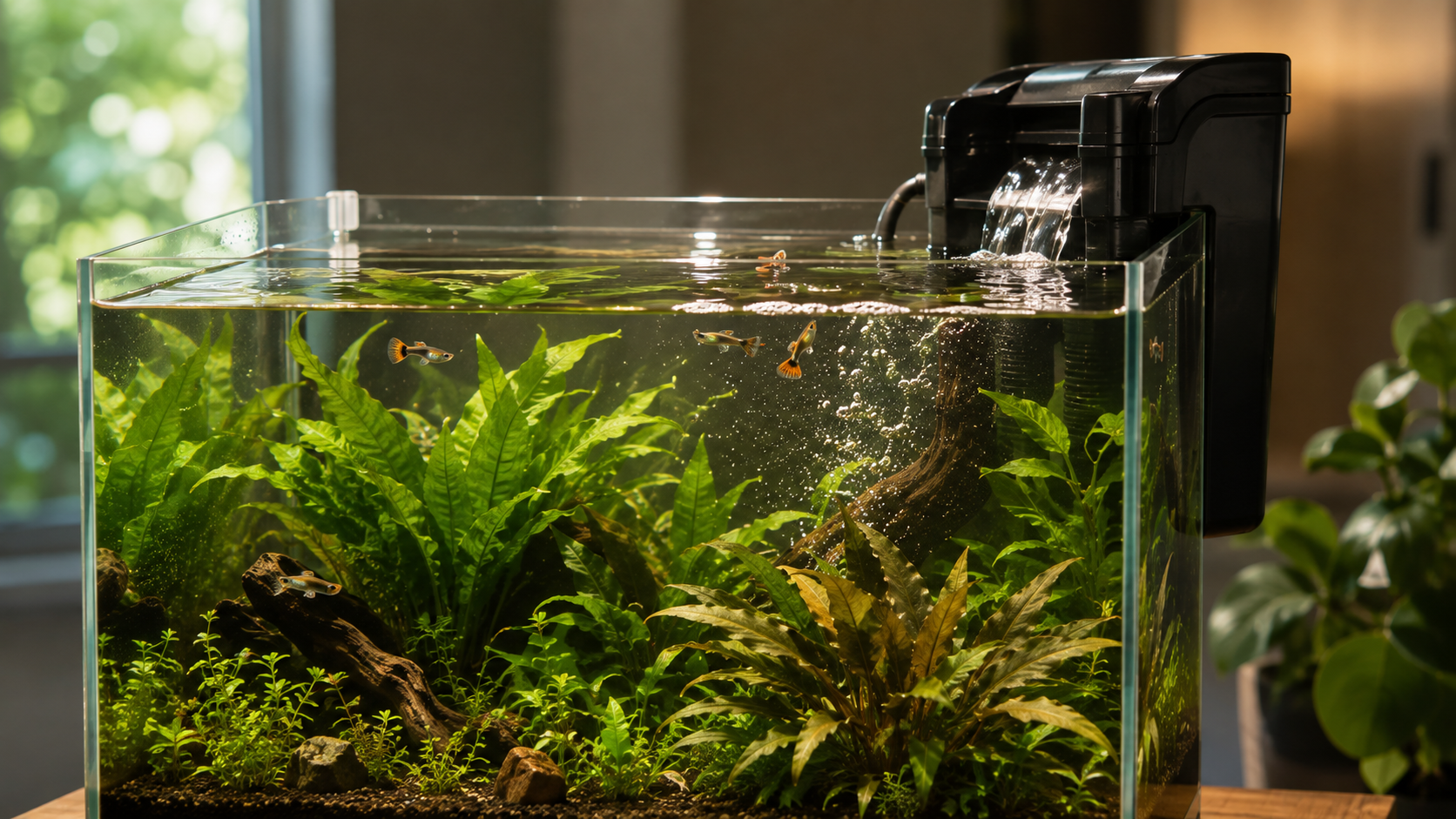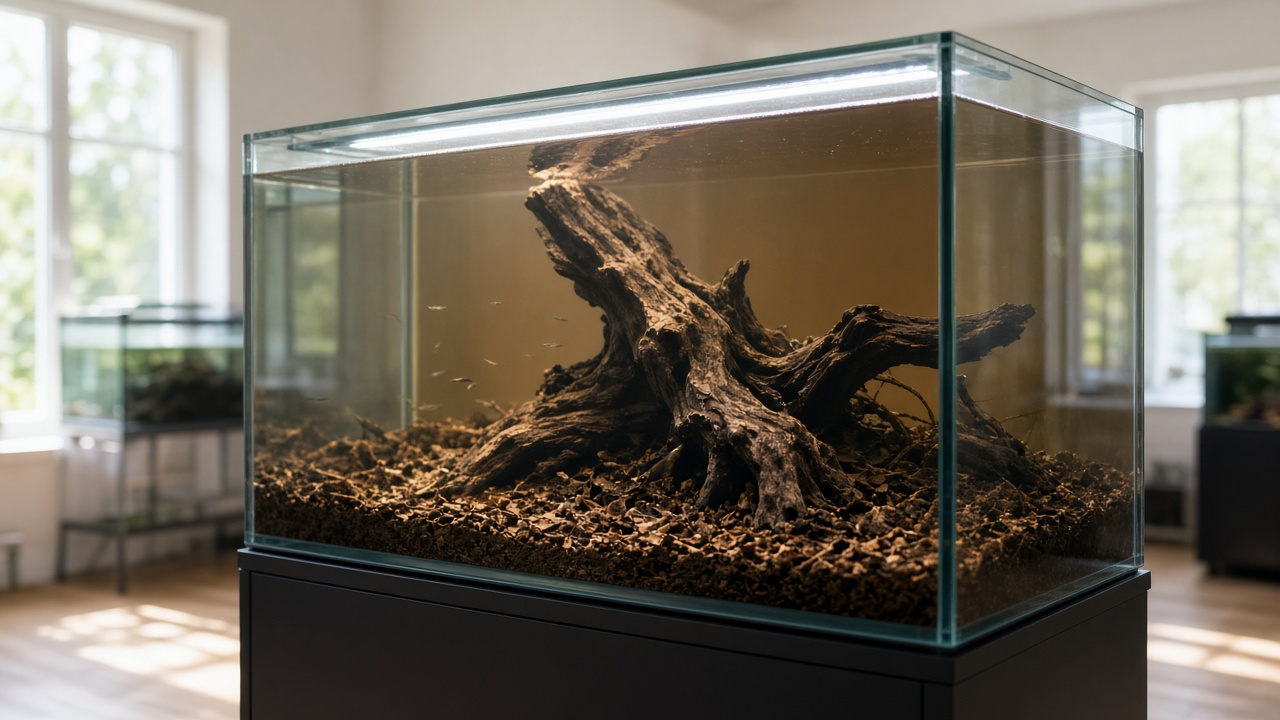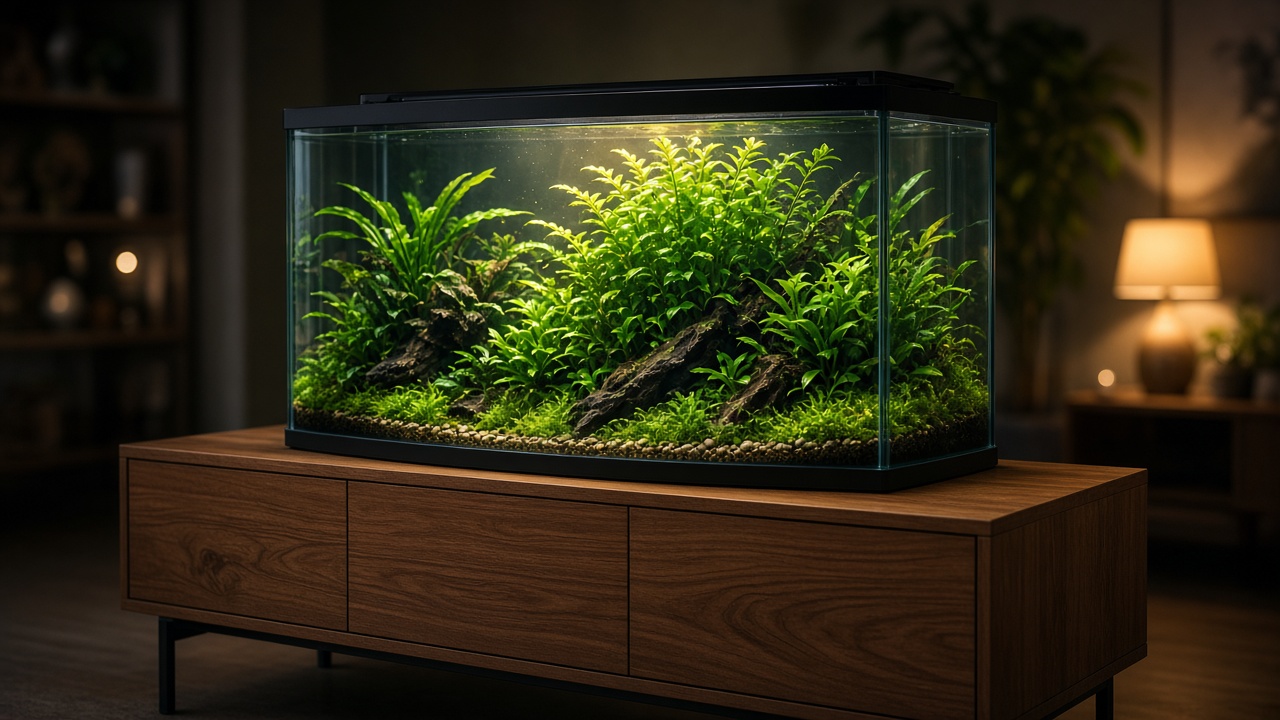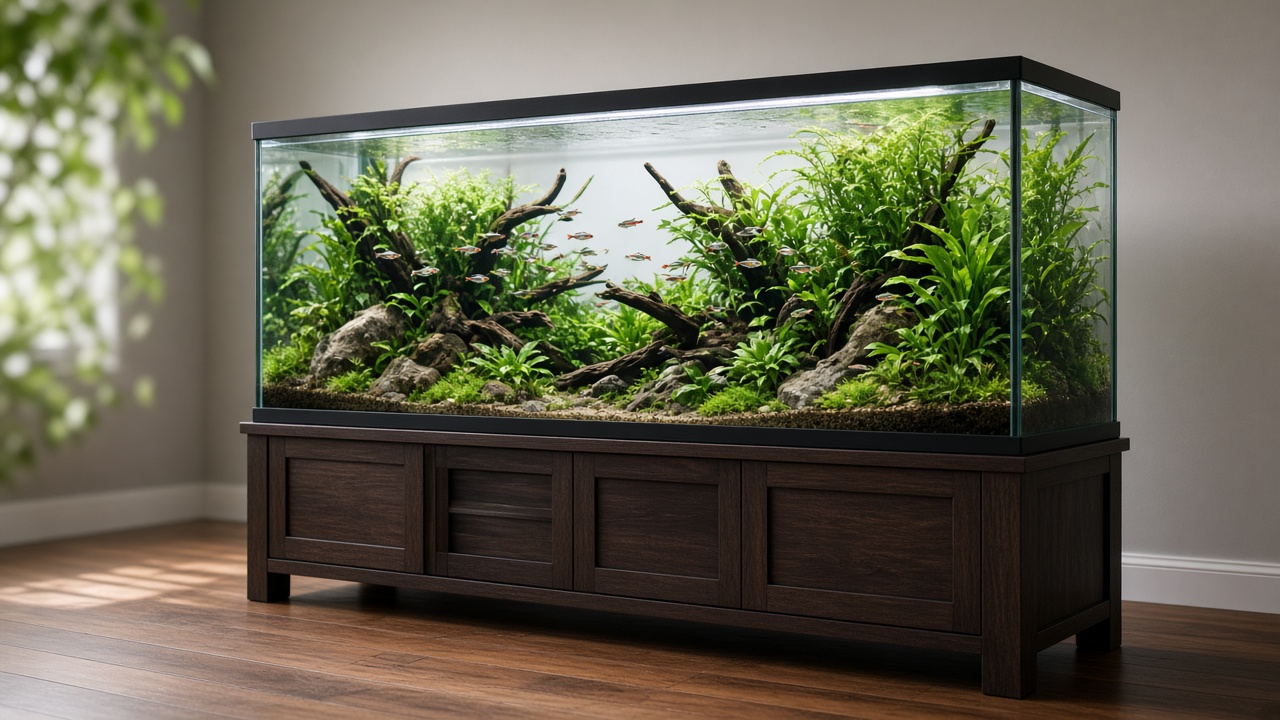
Quick answer: Plan for a roughly 48.5 × 18.5 × 25 inch glass rectangle. Expect about 1,050 pounds when filled per Aqueon’s published chart. Pair it with a stand built for that footprint.
Aqueon’s published 90-gallon glass tank measures 48½ × 18½ × 25⅛ inches and weighs 1,050 pounds filled.
This page is a footprint, weight, and stand planning guide. Our research team compared maker dimension sheets and current product listings. We did not place tanks on a scale. We did not load-test stands. We did not tape-measure tanks in a showroom.
Selection rule: We include only currently sold aquariums marketed as about 90 gallons when the maker or listing publishes exterior length, width, and height. We exclude DIY builds, discontinued SKUs, and models with no published footprint. We also skip “90” system names whose display volume is far below 90 gallons unless we label that gap clearly.
What “90 gallon dimensions” usually means
Most U.S. pet-store glass “90s” share one footprint family. Length sits near 48 inches. Width sits near 18 inches. Height sits near 24 to 25 inches.
Aqueon’s Critical Dimensions sheet lists the 90 as 48½ × 18½ × 25⅛ inches. That is the exterior measurement the maker publishes for planning.
Retail listings for Marineland’s 90 Gallon Aquarium quote actual exterior size as 48⅜ × 18⅜ × 24⅞ inches. The same listing gives nominal marketing size as 48 × 18 × 24 inches.
Those two numbers are close, not identical. Glass thickness and frame trim create the gap. Always check the model sheet before you order a canopy, lid, or cabinet.
Interior water length is shorter than exterior length. Thick side glass and silicone beads eat a little space on each end. That matters when you buy a background, a light bar, or a center brace cover.
Empty weight versus filled weight
Empty weight tells you how hard the move will be. Filled weight tells you what the floor and stand must carry.
Aqueon’s sheet lists the empty 90 at 135 pounds. The same sheet lists filled weight at 1,050 pounds. Aqueon notes that filled weights vary with substrate and décor.
Blue Fish Aquarium’s listing for the Marineland 90 Gallon Aquarium states approximate dry weight of 125 pounds. The same listing states approximate filled weight of 876 pounds.
Those filled figures are not interchangeable across brands. Different makers include different assumptions about water level, gravel, and rock.
Aqueon’s furniture page offers a planning tip of about 10 pounds per gallon. For a nominal 90-gallon setup, that rule of thumb points to roughly 900 pounds before heavy rockwork.
The U.S. Geological Survey’s Water Density page shows water near 70°F has a density of 0.99802 grams per cubic centimeter. That is about 62.300 pounds per cubic foot in the USGS table. Freshwater mass alone for 90 U.S. gallons is still several hundred pounds before glass, sand, and décor.
Saltwater setups weigh more than freshwater for the same volume. Dissolved salt raises density. Live rock and deep sand beds add still more load on the stand.
Footprint, floor space, and room clearances
The tank’s base is only the start. You also need walking space, service space, and door swing.
- Leave room behind the tank for hang-on filters, cables, and cords.
- Leave side clearance for a net and for gravel-cleaning hose work.
- Measure wall outlets before the stand arrives.
- Confirm the doorway and stair turn can pass a 48-inch crate.
A 48.5-inch tank needs more than 48.5 inches of wall. Stands often run a little longer and deeper than the glass. Match the stand SKU to your tank’s published length and depth before you buy.
Level the stand before you set the empty aquarium. A small high spot concentrates stress on glass seams.
Check the floor finish too. Vinyl, tile, and hardwood handle spills differently. Keep a towel path from the tank to the sink for water changes.
Stand rules that match maker guidance
Aqueon’s Critical Dimensions sheet says an appropriately sized, suitably designed aquarium stand is essential for safety and warranty. The furniture page repeats that maker-built stands are designed to support the aquarium’s weight.
Use a stand sold for the same length and depth group as the tank. Do not place a filled 90 on a dresser, desk, or DIY shelf that was never rated for that load.
- Match stand length and depth to the tank group.
- Keep the stand level front to back and side to side.
- Avoid soft carpet that lets one corner sink.
- Keep cabinet doors clear of plumbing and heaters.
If you run a sump, confirm cabinet interior height before you buy. Reef cabinets and pine stands are not the same interior volume.
Center braces on framed tanks need even support beneath the long edges. A stand top that sags in the middle can leave the brace carrying more stress than the maker planned.
Glass, acrylic, and “90” reef systems compared
Comparing published specs shows why one “90” can look nothing like another. Standard rectangles share a long footprint. Some reef systems use the “90” label for total system volume, not display gallons.
| Model | Material | Published exterior (L × W × H) | Empty / dry weight | Filled or system note |
|---|---|---|---|---|
| Aqueon Standard 90 | Glass | 48½ × 18½ × 25⅛ in | 135 lb | 1,050 lb filled |
| Marineland 90 Gallon | Glass | 48⅜ × 18⅜ × 24⅞ in | ~125 lb | ~876 lb filled |
| Clear-for-Life 90R | Acrylic | 48 × 18 × 24 in | Not listed on page | ⅜ in body panels |
| Waterbox MARINE X 90.3 | Ultra-clear glass system | 35.4 × 19.7 × 21.7 in display | Not listed on page | 59.3 gal display; 85 gal total; 12 mm glass |
The Clear-for-Life 90R listing matches the classic 48 × 18 × 24 inch rectangle in acrylic. Fish Tanks Direct’s product page for that model states ⅜-inch-thick body panels and an included acrylic lid.
Waterbox Aquariums’ MARINE X 90.3 page lists display volume at 59.3 gallons. Total system volume is listed at 85 gallons. Glass thickness is listed at 12 mm. The page also states ultra-clear glass with 91% light transmission. Height with cabinet is listed at 57.1 inches. That is a shorter, deeper display than a pet-store 48-inch 90, plus a cabinet and sump.
If your room only accepts a 36-inch wall run, a standard 48-inch glass 90 will not fit. A compact reef system may. If you need a full 90-gallon water column for large community fish, the standard rectangle is the closer match.
Acrylic scratches more easily than glass. Glass chips if corners take a hard hit during a move. Pick the material that matches how you clean and how you move furniture.
Height, lids, and viewing distance
Height changes how the tank looks in a room. A 25-inch-tall tank sits higher than a 21-inch 75-gallon on the same stand length.
Kids and seated viewers see mid-water better on shorter tanks. Tall tanks favor vertical swimming space and tall plants. Measure eye level from your main seating spot before you buy.
Lids and canopies add height above the glass. Clip-on lights add still more. Leave ceiling clearance for opening a hinged canopy without hitting a shelf.
Filters and lights once the footprint is set
Footprint drives equipment more than the gallon sticker alone. A 48-inch hood or bar light must cover the full length. A hang-on filter needs rear clearance. A canister needs hose reach to the stand cabinet.
For planted setups on smaller tanks, our lighting notes start on the best LED light for a planted 20-gallon aquarium. Scale length and PAR needs upward for a 48-inch 90.
Filtration guidance for mid-size tanks lives on our best filter for a 30-gallon aquarium and best filter for a 20-gallon aquarium pages. Use those as sizing logic, then step flow rate and media volume up for the larger water mass of a 90.
- Match light length to tank length, not to gallon marketing alone.
- Confirm hang-on lip clearance on framed tanks.
- Plan canister or sump space inside the stand before plumbing.
- Keep heater length shorter than tank length with room to spare.
Two heaters can split load on a large water mass. Place them where flow moves heat through the whole tank. Keep cords on drip loops below the outlet height.
Planning checklist before delivery day
Write the numbers on one card. Bring that card to the store or to the freight appointment.
- Confirm exterior L × W × H for the exact SKU.
- Confirm empty weight for moving help.
- Confirm published filled weight for floor planning.
- Confirm stand length, depth, and height.
- Confirm doorway, hallway, and stair clearance.
- Confirm outlet locations and drip-loop space.
Then dry-fit the empty stand. Level it. Only then set the empty aquarium and fill in stages while you watch for wobble.
Freight crates for acrylic and glass large tanks can be awkward in apartments. Measure elevator depth and hallway turns the same day you measure the wall.
FAQ
What are the most common 90 gallon aquarium dimensions?
Most standard U.S. glass 90s are about 48 inches long, 18 inches wide, and 24 to 25 inches tall. Aqueon’s sheet lists 48½ × 18½ × 25⅛ inches for its 90. Marineland’s listing sits close at 48⅜ × 18⅜ × 24⅞ inches.
How much does a filled 90 gallon tank weigh?
Aqueon lists 1,050 pounds filled for its 90. Marineland’s Blue Fish Aquarium listing states about 876 pounds filled. Substrate and rock push either figure higher. Aqueon’s roughly 10-pounds-per-gallon tip is a useful second check.
How much does an empty 90 gallon tank weigh?
Aqueon lists 135 pounds empty. The Marineland listing states about 125 pounds dry. Acrylic models are often lighter empty, but filled water mass still dominates the total.
Will a 48×18 stand fit a 90 gallon aquarium?
Confirm the stand’s product page for your exact tank brand and model. Aqueon’s guidance calls for a stand sized to the aquarium and able to bear a filled load.
Are all “90 gallon” tanks the same footprint?
No. Standard rectangles cluster near 48 × 18 × 24. Reef systems labeled “90” may have a shorter display and a sump. Waterbox’s MARINE X 90.3 lists a 35.4-inch display length, 59.3 display gallons, and 85 gallons total system volume.
Do I need extra floor space beyond the tank footprint?
Yes. Add clearance for filters, cords, doors, and maintenance access. Stands can also be slightly larger than the glass exterior. Plan a path for buckets during water changes.
Can I put a 90 gallon aquarium on furniture that is not an aquarium stand?
Maker guidance points to a suitably designed aquarium stand sized for the tank. Household furniture is a poor match for thousand-pound point loads and water risk. Use a stand built for the footprint group.