Quick answer: A canister or hang-on-back filter is the main cleaning tool on a 75-gallon home tank. Size it so published flow lands near 300 to 450 gallons per hour for a calm community. Messy fish need more flow, more media, or a second unit.
Fluval lists the 407's filter circulation at 245 GPH, equal to only 3.3 turnovers per hour in a 75-gallon tank.
What flow a 75 gallon aquarium filter actually needs
A 75-gallon aquarium filter should move the tank's water several times each hour. That turnover keeps waste heading into media instead of rotting on the sand.
Aqueon lists a standard 75-gallon glass tank at 48 1/2 by 18 1/2 by 21 1/8 inches. The same Aqueon chart puts the filled weight at 785 pounds. That long, heavy box needs a filter that can pull water from both ends, not just one corner.
Use these published-flow targets as a starting point:
- Light community or planted tank: about 300 to 375 GPH on the box
- Typical community tank: about 375 to 450 GPH on the box
- Goldfish, large cichlids, or heavy feeding: about 600 GPH or a second filter
Those targets use the printed gallons-per-hour number. Real flow after media and lift is lower.
Fluval states in its 07-series manual that circulation figures were measured with equal hose lengths. The same Fluval note says those tests omit the usual in-tank fittings.
A 75-gallon tank at four turnovers needs 300 GPH of true flow. Six turnovers need 450 GPH. Buy above the low number so a dirty sponge does not drop you under the floor.
Pump output is not the same as circulation
The big number on a carton is often pump output, not water through media. Fluval rates the 407 pump at 383 US GPH and lists filter circulation at 245 US GPH. That is a 36 percent drop on Fluval's own sheet.
Fluval rates the FX6 pump at 925 US GPH and lists circulation at 563 US GPH. Fluval also rates the FX6 for tanks up to 400 US gallons.
That circulation figure is 7.5 turnovers per hour on a 75-gallon tank. It is far more filter than a quiet tetra tank needs.
Fluval lists the 407 canister volume at 9.2 liters and the FX6 canister volume at 5.28 US gallons, or 20 liters. The FX6 holds more media. The 407 is sized for 50 to 100 US gallons, per Fluval.
Compare published numbers before you shop:
- Fluval 407: 383 GPH pump, 245 GPH circulation, 23 watts at 120 volts
- Fluval FX6: 925 GPH pump, 563 GPH circulation, 43 watts at 120 volts
- Seachem Tidal 75: 350 US GPH, 8 watts at 120 volts, 0.50 US gallons of media
- Oase rates the BioMaster 2 Thermo 600 at 350 GPH, or 1,250 liters per hour
Seachem rates the Tidal 75 for aquariums up to 75 US gallons. On paper that hang-on-back unit beats the Fluval 407 circulation number. It holds far less media, so flow and media volume are different jobs.
Canister, hang-on-back, or two smaller units
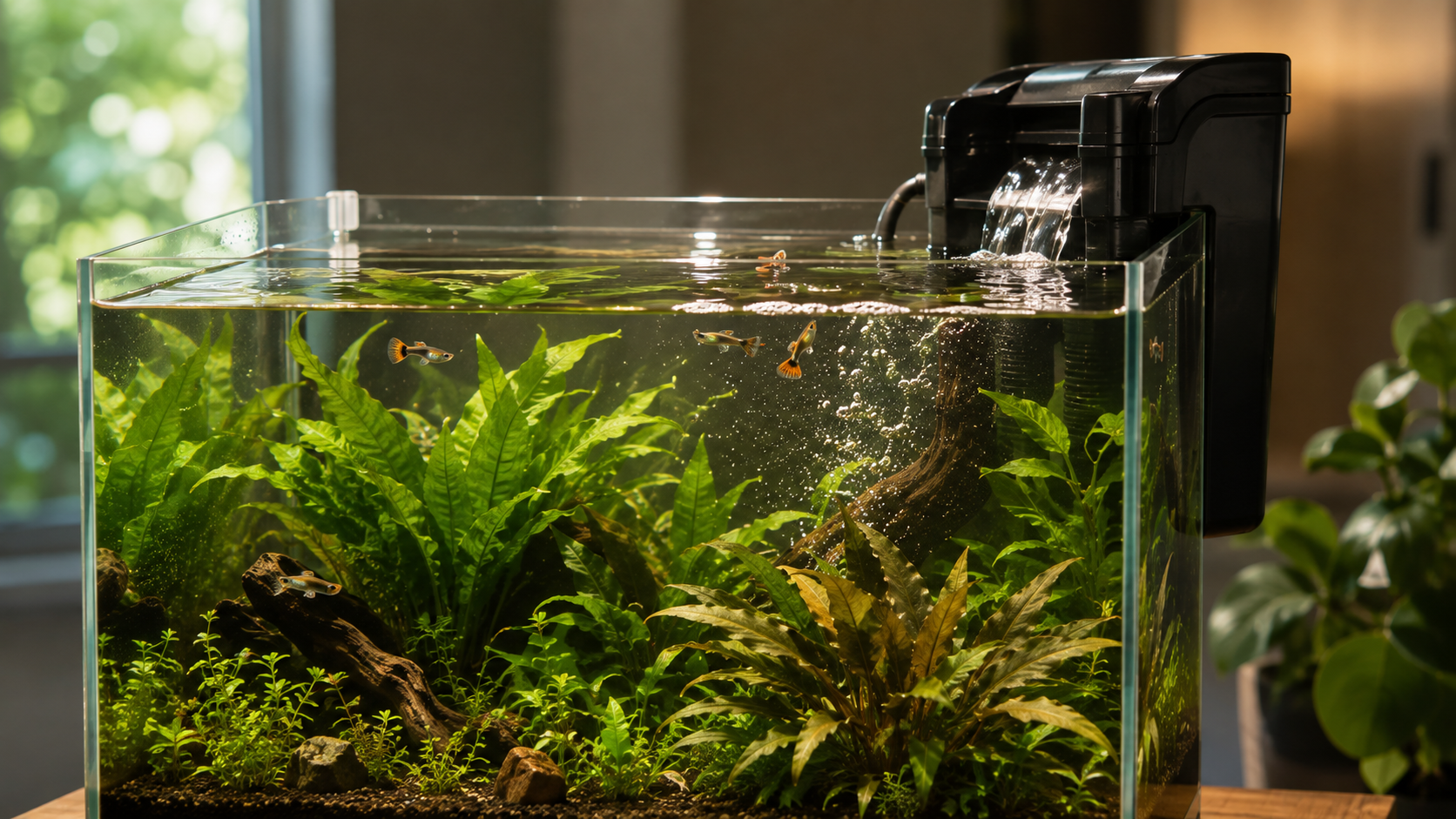
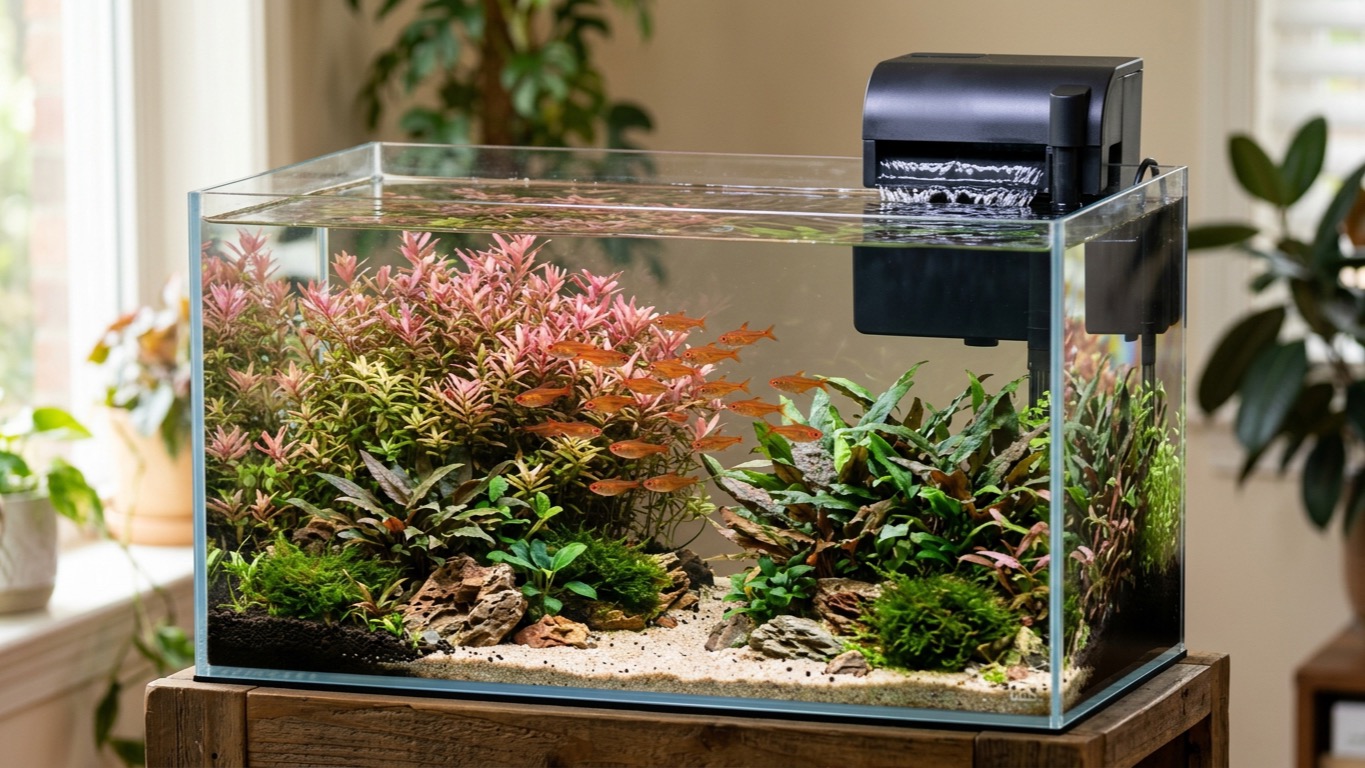
The right 75 gallon aquarium filter type depends on stand space, noise, and how dirty the fish are. A canister hides in the cabinet. A hang-on-back unit clips on the rim and is faster to rinse.
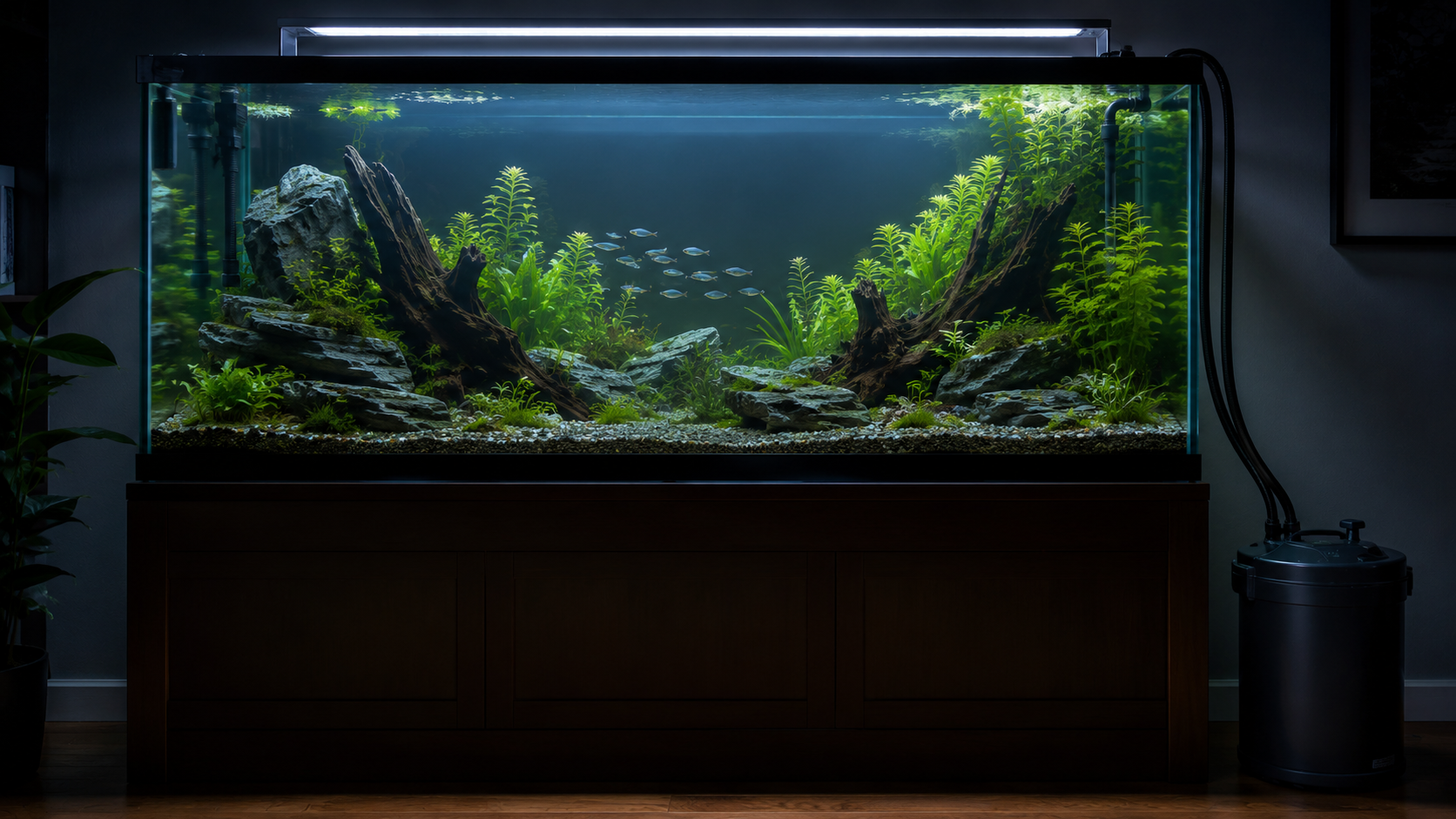
Canister filters suit most 75-gallon freshwater tanks. They hold thick foam, ceramic rings, and carbon in stacked baskets.
Fluval lists 4.2 liters of basket volume on the 407. That extra room is why canisters stay clear longer between cleanings.
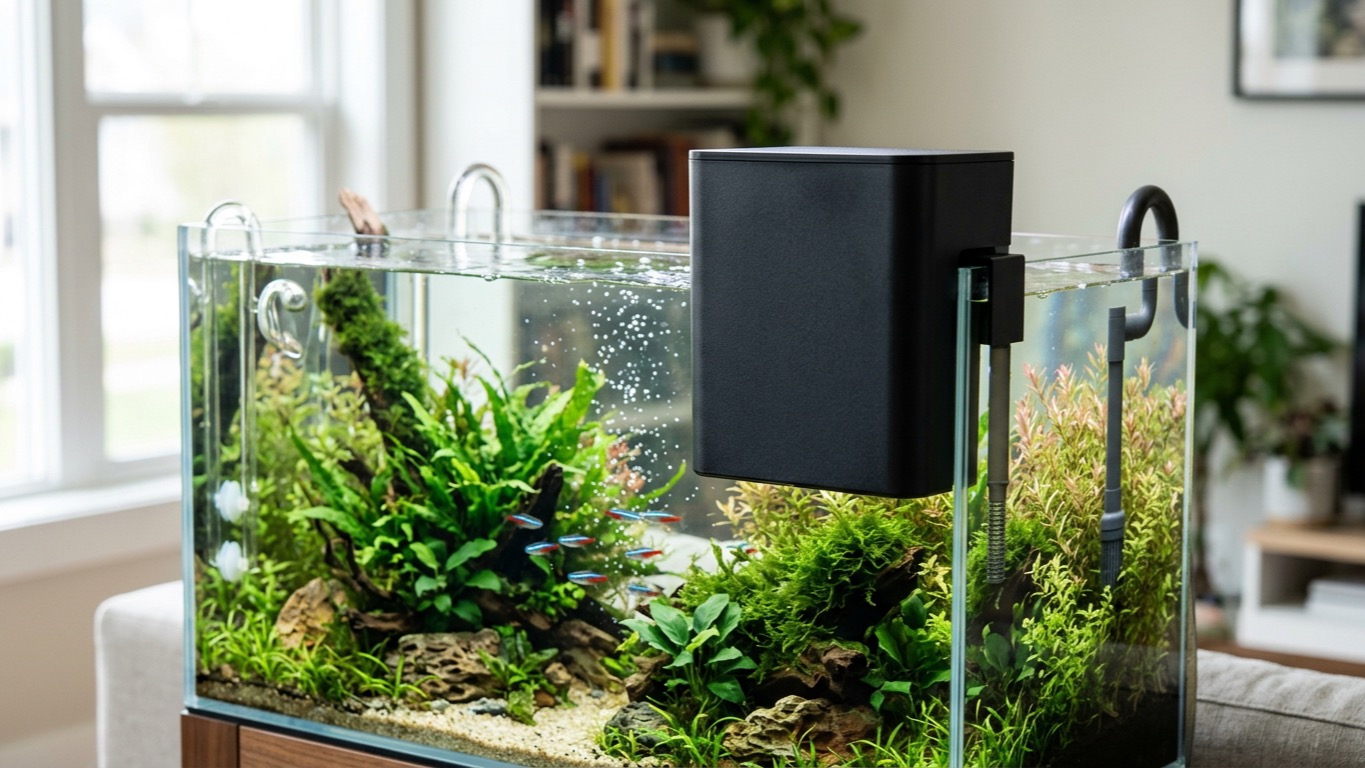
Hang-on-back filters suit keepers who want easy weekly service. Seachem lists the Tidal 75 filter volume at 0.50 US gallons, or 1.9 liters.
That is a small chamber next to a 9.2-liter Fluval 407 canister. Rinse the sponge more often if you pick a hang-on-back unit.
Two modest filters can beat one huge one. Place one intake at each end of the 48-inch tank so you still have flow if one impeller fails. Many keepers pair a canister with a sponge or a small hang-on-back unit.
Sump filters sit in a drilled stand and hold the most media. They need a hole in the tank and extra plumbing. Skip a sump unless you already plan a drilled glass tank.
Pick the type with this short list:
- Tight budget and easy cleaning: hang-on-back rated at 350 GPH or more
- Quiet cabinet install and more media: canister rated for 50 to 100 gallons
- Messy fish or turtles: large canister plus a sponge on the intake
- Planted tank with timid fish: strong filter, then a spray bar to soften the return
Match the filter to the fish, not just the glass
Fish waste, not the gallon sticker, sets the real load on a 75 gallon aquarium filter. A dozen small tetras make less ammonia than two adult oscars.
FishBase lists the freshwater angelfish Pterophyllum scalare at a maximum 10.5 centimeters total length. FishBase also lists a minimum aquarium length of 100 centimeters and keeping in groups of five or more. Aqueon's 48 1/2-inch 75-gallon tank is about 123 centimeters long, so it meets that FishBase length note.
FishBase lists the oscar Astronotus ocellatus at a maximum 45.7 centimeters total length and 1.6 kilograms. One adult oscar can outgrow a 75-gallon tank even if the filter is huge. Do not use a strong filter as a reason to keep a fish that will not fit.
The US Environmental Protection Agency sets a chronic ammonia limit of 1.9 milligrams per liter. EPA lists that value at pH 7.0 and 20 degrees Celsius. EPA sets the matching acute value at 17 milligrams per liter for a one-hour average.
Those EPA numbers are for outdoor waters, not a closed glass box. In a home tank, a hobby test kit should still read zero ammonia after the cycle.
Heavy waste setups need more than a bigger pump:
- Goldfish and big cichlids: aim near 600 GPH published flow and thick biological media
- Livebearers and tetras: 350 GPH can work if you rinse mechanical media on time
- Angelfish groups: moderate flow plus a spray bar so tall fins are not blasted
- Oscars or turtles: treat the 75 as temporary or under-stocked, and oversize media
A planted tank can use the same filter. Point the return along the glass. Strong jets uproot stems and blow CO2 off the water.
How to install and service the filter
A 75 gallon aquarium filter only works if water can enter, pass through media, and leave without air locks. Prime the canister fully. Seat hang-on-back units level on the rim.
Follow this setup order:
- Place the tank on a stand that can hold Aqueon's 785-pound filled rating plus rock and gear.
- Set a canister in the cabinet with short, even hoses. Fluval lists a 7-foot max head on the 407.
- Put coarse foam first, then biomedia, then a fine pad. Keep chemical media in a small, swappable bag.
- Aim the return so the whole 48-inch length ripples. Dead corners grow film.
- Cycle the tank before adding fish. The filter is a home for bacteria, not just a pump.
Service keeps the published flow from collapsing. Squeeze foam in old tank water so you do not wipe out bacteria. Never replace all media on the same day.
A simple monthly rhythm works for most community 75s:
- Weekly: rinse the coarse sponge if flow drops or the water looks dull
- Monthly: clean the impeller well and check hose kinks
- Every two to three months: rinse biomedia gently; replace carbon if you use it
- Any time ammonia or nitrite reads above zero: check flow, then reduce feeding
Seachem builds a maintenance flag into the Tidal 75. When the basket clogs, water bypasses and lifts a blue alert. That is a useful cue, while canister keepers must watch the output stream instead.
Common sizing mistakes on a 75-gallon tank
Most 75-gallon filter problems come from trusting the gallon range on the box. Fluval rates the 407 for up to 100 gallons, yet its listed circulation is only 245 GPH. That is 3.3 turnovers on a 75, not the six many community tanks want.
Buying only on pump output is the next trap. Fluval's FX6 pump number is 925 GPH, while Fluval's own circulation number is 563 GPH. Both are real Fluval figures, and they answer different questions.
Other frequent misses:
- One intake in a corner of a 48-inch tank, leaving the far end stale
- Fine filter floss stuffed so tight that flow nearly stops
- Washing biomedia under hot tap water and crashing the cycle
- Choosing an FX6-class canister for six small tetras, then fighting the current
- Skipping a prefilter sponge on goldfish or cichlid tanks
Oase rates the BioMaster 2 Thermo 600 at 350 GPH and for aquariums up to 160 gallons, or 600 liters. That gallon range is generous next to the flow number. Treat the GPH and the media volume as the real specs, and treat the "up to X gallons" line as a range, not a promise.
FAQ
What GPH does a 75 gallon aquarium filter need?
A community 75-gallon tank usually needs about 375 to 450 GPH on the carton, enough for four to six turnovers before media and head loss. Seachem rates the Tidal 75 at 350 GPH, or 4.7 turnovers if the pump holds that rate. Fluval's 407 circulation figure of 245 GPH is 3.3 turnovers, so many keepers add a powerhead or a second filter.
Is a hang-on-back filter enough for 75 gallons?
Yes for a light or moderate community if you clean it often. Seachem rates the Tidal 75 at 350 GPH and 8 watts, with only 0.50 gallons of media. Rinse foam weekly on messy tanks, or add a sponge filter, because that small basket cannot match a canister.
Can one canister handle goldfish in a 75-gallon tank?
One midsize canister is a thin margin for goldfish. Aim near 600 GPH of published flow, a large biomedia bed, and a sponge on the intake. Fluval's FX6 circulation of 563 GPH sits near that mark.
How often should I clean a 75 gallon aquarium filter?
Clean mechanical media when the output weakens, often every one to two weeks on a hang-on-back unit. Canisters with Fluval's 9.2-liter 407 volume can go longer if the prefilter is large. Leave biomedia in place unless it is collapsing or smells rotten.
Do I need two filters on a 75-gallon tank?
Two filters are smart when the tank is long, heavily stocked, or hard to reach for service. A 48-inch Aqueon 75 has room for an intake at each end. If one pump dies overnight, the other still moves water and keeps bacteria wet.