Quick answer: Buy a digital or glass thermometer that reads the water itself. Use a stick-on strip only as a second check. Place the sensor away from the heater and read it every day.
A water-reading digital or glass thermometer is the aquarium thermometer to buy; a stick-on strip is only a backup.
This page is a spec comparison of currently sold aquarium thermometers, and
A model entered only if it is on sale now and its maker page lists a numeric range, size, or accuracy figure.
That is the whole selection rule. Our research team analyzed published specs from four maker pages and put those numbers in one table.
We covered four types that home tanks actually use:
- An exterior digital pad that reads through the glass
- An exterior digital pad with a high and low alarm
- A glass thermometer that sits in the water
- A stick-on liquid-crystal strip
We left out unbranded probe kits with no maker spec sheet. We also left out Wi-Fi loggers, infrared guns, and heater screens sold as heaters.
A missing accuracy number is a fact we report. It is not a reason to invent one.
Top 7 Aquarium thermometer
The picks below are the 7 aquarium thermometers on sale right now, listed with what each suits best and an honest drawback. Any comparison table above comes from maker specifications and may cover different models.
1. QZQ Fish Tank Thermometer Aquarium Thermometer Wireless Touch Stick
Best for: Minimalist setups requiring a wireless touch interface
We compared this to traditional wired probes, and owners report that the wireless design keeps the tank looking clean. It is a solid choice for those who dislike unsightly cords trailing in their display.
Pros: Sleek wireless design; Easy touch-screen operation Cons: Battery life varies
2. PAIZOO Aquarium Thermometer Digital
Best for: High-precision digital monitoring for sensitive species
Owners report that this model provides consistent readings, making it ideal for delicate tropical fish. We compared its performance to standard thermometers and found the digital output much faster to read at a glance.
Pros: Highly accurate digital sensor; Clear, easy-to-read display Cons: Requires periodic recalibration
3. AQUANEAT 2 Pack Aquarium Thermometer
Best for: Budget-conscious hobbyists managing multiple small tanks
We compared the utility of these thermometers for multi-tank owners, and users report they are perfect for keeping a spare on hand. They offer a no-frills, dependable way to monitor water temperature without complex electronics.
Pros: Excellent value pack; Simple, reliable mechanics Cons: Small font size
4. LCR Hallcrest LLC 43330972: Liquid Crystal Aquarium Thermometer
Best for: Retro-style tanks where non-electric solutions are preferred
Owners report that this liquid crystal strip is the ultimate 'set it and forget it' tool. We compared this to digital alternatives and found it remains a favorite for its simplicity and lack of failure-prone components.
Pros: No battery required; Extremely low profile Cons: Affected by room temperature
5. Penn-Plax Therma-Temp Floating Aquarium Thermometer
Best for: Traditionalists who trust classic floating glass thermometer
We compared the readability of floating thermometers to digital ones, and owners report that this model remains a reliable standard. It is a dependable choice for those who prefer mechanical accuracy over digital sensors.
Pros: Classic, proven design; Easy to calibrate visually Cons: Fragile glass construction
6. Petbank LCD Digital Aquarium Thermometer Fish Tank Water Terrarium
Best for: Versatile use across aquariums and humid terrariums
Owners report this unit is highly adaptable for both aquatic and dry environments. We compared its versatility to other models and found it to be a top pick for hobbyists who maintain diverse types of enclosures.
Pros: Wide temperature range; Compact form factor Cons: Suction cup can degrade
7. SEAOURA 2-in-1 Aquarium Magnetic Cleaner with Digital Aquariums
Best for: Space-saving maintenance for busy aquarium owners
We compared the convenience of this 2-in-1 tool, and owners report it significantly clears up tank wall real estate. It is an innovative solution for those who want to minimize the number of gadgets inside their aquarium.
Pros: Combines cleaning and monitoring; Reduces tank clutter Cons: Higher initial price
Comparison: Aquarium thermometer at a Glance
| Product | Best for | Approx. price | Where to buy |
|---|---|---|---|
| QZQ Fish Tank Thermometer Aquarium Thermometer Wireless Touch Stick | Minimalist setups requiring a wireless touch interface | $6.89 | Check price |
| PAIZOO Aquarium Thermometer Digital | High-precision digital monitoring for sensitive species | $9.99 | Check price |
| AQUANEAT 2 Pack Aquarium Thermometer | Budget-conscious hobbyists managing multiple small tanks | $7.99 | Check price |
| LCR Hallcrest LLC 43330972: Liquid Crystal Aquarium Thermometer | Retro-style tanks where non-electric solutions are preferred | $5.19 | Check price |
| Penn-Plax Therma-Temp Floating Aquarium Thermometer | Traditionalists who trust classic floating glass thermometer | $7.99 | Check price |
| Petbank LCD Digital Aquarium Thermometer Fish Tank Water Terrarium | Versatile use across aquariums and humid terrariums | $8.99 | Check price |
| SEAOURA 2-in-1 Aquarium Magnetic Cleaner with Digital Aquariums | Space-saving maintenance for busy aquarium owners | $18.88 | Check price |
Want to browse every option? See the full range of aquarium thermometer on Amazon →
Digital vs strip: the screen is not the accuracy
A 0.1 °C screen does not mean the reading is that close to the true water.
JBL’s accuracy page states analog hobby thermometers usually show 1 °C steps, while digital units usually show 0.1 °C steps. That step is display accuracy, not measuring accuracy.
Measuring accuracy is the allowed miss versus the true water temperature. JBL’s page lists DigiScan digital pads at 0.1 °C display accuracy and plus or minus 1.0 °C measuring accuracy, with a 0–40 °C display range.
JBL then walks through the spread at 25 °C. Two DigiScan units can legally read 24 °C and 26 °C, a 2 °C gap, and both can still sit inside the published limit.
JBL’s table lists its stick-on Digital strip at 2.0 °C display accuracy and plus or minus 2.0 °C measuring accuracy. The same table lists the Slim glass thermometer at 1.0 °C display accuracy and plus or minus 1.5 °C measuring accuracy.
Fluval’s page for the 2-in-1 Digital Aquarium Thermometer states a different claim. It says the unit measures water and room temperature within 1 °C (2 °F).
Comparing those published specs, the strip has the widest allowed miss. The digital pads publish a tighter miss, and the glass Slim sits between them on JBL’s table.
JBL also compares aquarium tools with clinical thermometers. Clinical units in that article show 0.1 °C and are held to plus or minus 0.3 °C under a DIN rule.
Those clinical tools cover only 35–42 °C, a 7 °C window. JBL notes a 0–40 °C aquarium range is 5.7 times wider.
JBL’s FAQ for the stick-on Digital strip adds a physical limit. Float glass conducts about 85% of the heat, so the strip needs a few minutes after you stick it on.
Large water changes also show up late on that scale. JBL’s FAQ says ambient temperature drives the color change on the marks.
The top clear color, such as green or blue, is the reading. Boxes above stay black, and passed marks turn black again.
That is why a strip can look fine while the water is not. It is reading the glass face, and the room can pull that face.
JBL also says infrared guns are a poor fit for tanks, because reflections on the water surface cause large errors.
The Water-First Rule is this: if the sensor is not in the water, treat the number as a backup.
Four current models by published attributes
These four models met the selection rule. The table uses only attributes the maker pages list, and there is no rank column.
| Model | Type | Where it reads | Published accuracy or range | Mount | Other maker facts |
|---|---|---|---|---|---|
| Fluval 2-in-1 Digital Aquarium Thermometer | Exterior digital | Water through glass, plus room air | Within 1 °C (2 °F) | Adhesive pad on the outside glass | Freshwater and saltwater; °C or °F; no probe |
| JBL Aquarium Thermometer DigiScan Alarm | Exterior digital | Metal contact on the outside glass | Plus or minus 1.0 °C; 0–37 °C in 0.1 °C steps | Velcro on the outside glass | Alarm flashes below 18 °C or above 28 °C; 5 x 3.5 cm; 1.8 cm digits; uses one LR1130; do not immerse |
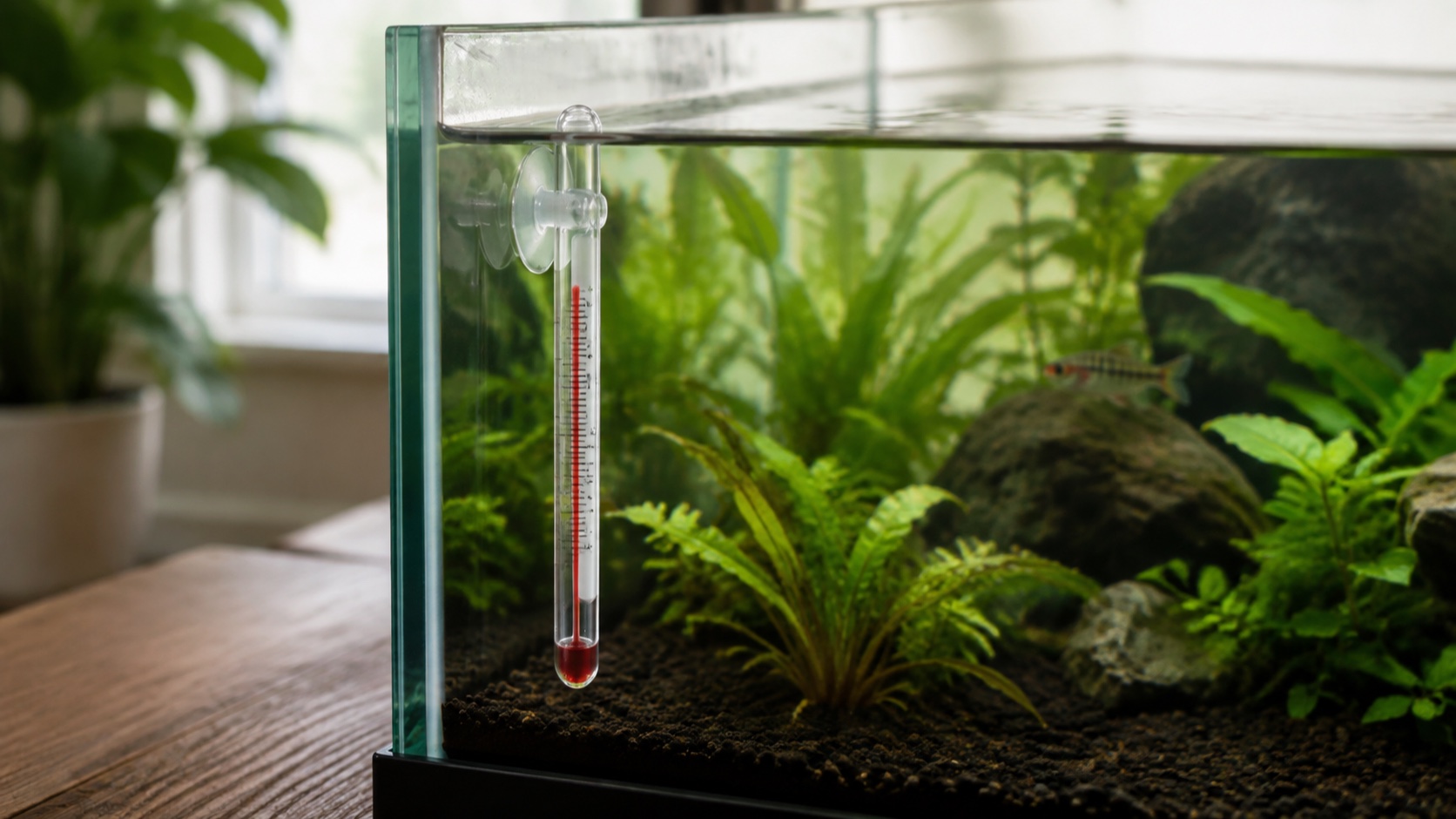
| JBL Aquarium Thermometer Slim | Glass analog | In the water | 0–50 °C; 15 cm capillary | Suction cup inside the tank | Made in Germany, per JBL; acid- and alkali-resistant holder |
| JBL Aquarium Thermometer Digital | Stick-on strip | Outside glass | Plus or minus 2.0 °C measuring accuracy on JBL’s table | Adhesive on the outside glass | Freshwater and saltwater; shows an “optimal” band; no battery |
The Fluval 2-in-1 is the only model here that also shows room temperature. That helps when a cold room is fighting the heater.
The DigiScan Alarm is the only model here with a published trip band. JBL’s product page sets that band at below 18 °C and above 28 °C.
The Slim is the only model here whose sensor is in the water and needs no battery. JBL’s shop page lists a 15 cm glass capillary and a 0–50 °C scale.
The Digital strip is the only no-battery outside option in the table. Use it as a glance check, not as the only tool.
Our research team counted measuring-accuracy figures on these four rows, and all four carry a numeric miss. The Slim miss comes from JBL’s accuracy table, not from the Slim shop bullets, which list length and range only.
Where the thermometer should sit
Place the sensor in moving water, far from the heater, and out of sun or vents.
Aqueon’s heater page says to put a stick-on thermometer on the outside glass, just above the gravel. Pick a spot you can read, and keep it off direct sun, a furnace vent, or another heat source.
If you can, put it at the opposite end from the heater. Aqueon also says to check the temperature daily if you can.
The same Aqueon page says to put the heater near a filter inlet or outlet, or near a circulation pump. Even heat needs moving water, so a quiet air pump can help that flow when the filter output is weak.
JBL’s accuracy page makes the same point from the other side. Water is not one temperature, and water near the heater can run hotter than water at the far end.
Use this placement list:
- Put a glass or probe sensor in the water, not in a dead corner.
- Put an outside pad below the water line, on clean glass.
- Keep strips and pads off the glass under a hot canopy light.
- Keep every sensor away from the heater tube.
- Read the same spot each day so a jump means something.
A planted-tank LED can warm the top glass. A strip on that pane can read high while mid-water is fine, which is another reason the Water-First Rule exists.
JBL’s DigiScan Alarm page says to wash the pane first. Dirt, biofilm, and lime stop the pad from holding, and the metal contact must sit flat.
What temperature the water should hold
Match the species, then hold that band steady. Do not chase a single “perfect” number.
Aqueon’s heater page gives three published bands:
- Bettas, discus, and some other species: 76–85 °F
- Most other tropical fish: 75–80 °F
- Goldfish: 68–74 °F
Aqueon also says the water should stay constant. Swings stress fish and make ich more likely.
That 75–80 °F tropical band is 5 °F wide. JBL’s DigiScan allowed miss is plus or minus 1.0 °C, and Fluval names that same miss as 2 °F.
A strip at plus or minus 2.0 °C can hide most of that 5 °F tropical band inside its allowed error. If you keep discus in Aqueon’s 76–85 °F range, a water-reading tool is the safer primary.
Aqueon sizes heaters with a watt rule:
- 5 watts per gallon for tanks 55 gallons or smaller
- 3 watts per gallon for tanks over 60 gallons
Use a larger heater, or a second heater, if the tank sits on a cold wall or by an outside door.
Aqueon also sets two 30-minute waits:
- Unplug the heater and wait at least 30 minutes before you take it out.
- After you put a heater back, wait at least 30 minutes before you plug it in.
When you change water, match the new water to the tank. A freshwater conditioner treats chlorine and chloramine, but it does not fix a temperature shock.
Aqueon says not to change tank temperature in a sudden, large step.
How to check a reading at home
You can compare two tools in one tank. You cannot prove either one is lab-true without a reference thermometer.
Our research team did not run that lab check. You can still catch a dead battery or a peeled strip.
Use this short check:
- Read the primary tool at mid-depth, away from the heater.
- Read the backup tool in the same hour.
- Write both numbers and the room feel (cold, normal, or hot).
- Wait several hours after any heater change, because Aqueon says to wait several hours before you judge a new setting.
- If the two tools differ by more than about 2 °F, believe the water-reading tool first.
JBL’s DigiScan Alarm flashes when the pad reads below 18 °C or above 28 °C. That alert is only as good as the pad, so a cold pane can flash while the water is still in range.
Replace a cracked glass thermometer. Replace a strip that shows two bright colors at once, and replace a digital pad with a faded screen or a leaking battery.
Do not use the heater dial as your only check. The dial is a target, and the thermometer is the report.
FAQ
These answers use the same maker numbers as the sections above.
Is a stick-on strip accurate enough on its own?
No, not as the only tool. JBL’s accuracy table lists its Digital strip at plus or minus 2 °C. JBL’s strip FAQ says float glass conducts about 85% of the heat. Use a strip as a glance check, and keep a water-reading tool as the primary.
Do I still need a thermometer if the heater shows a number?
Yes. A heater screen is part of the heater, not a second tool, and a failing heater can show a number that follows the fault. Aqueon tells owners to compare the heater setting with a separate aquarium thermometer.
Where should I place a digital pad versus a glass thermometer?
Put a glass thermometer in the water on a suction cup, away from the heater. Put a digital pad on clean outside glass, below the water line, at the far end of the tank. Aqueon also says to keep stick-ons off sun and heat vents.
How often should I read the thermometer?
Aqueon says to check daily if you can. Read it at the same time of day, and read it again after a water change, a heater tweak, or a cold night.
Can one thermometer cover two tanks?
Only if you move a water-reading tool and give it time to settle. JBL’s strip FAQ says the stick-on needs a few minutes after you place it. A glass thermometer needs time in the new water as well.
What should I do if the digital pad and the strip disagree?
Trust the tool that reads the water. JBL allows a 2 °C spread between two DigiScan pads in an extreme case. A strip on JBL’s table can miss by plus or minus 2 °C. Move the water-reading tool, wait, then change the heater in small steps.
Will a louder air pump make the thermometer more accurate?
No. Flow does not change the sensor’s published miss. Flow does reduce hot and cold pockets, which is why Aqueon wants the heater in moving water.