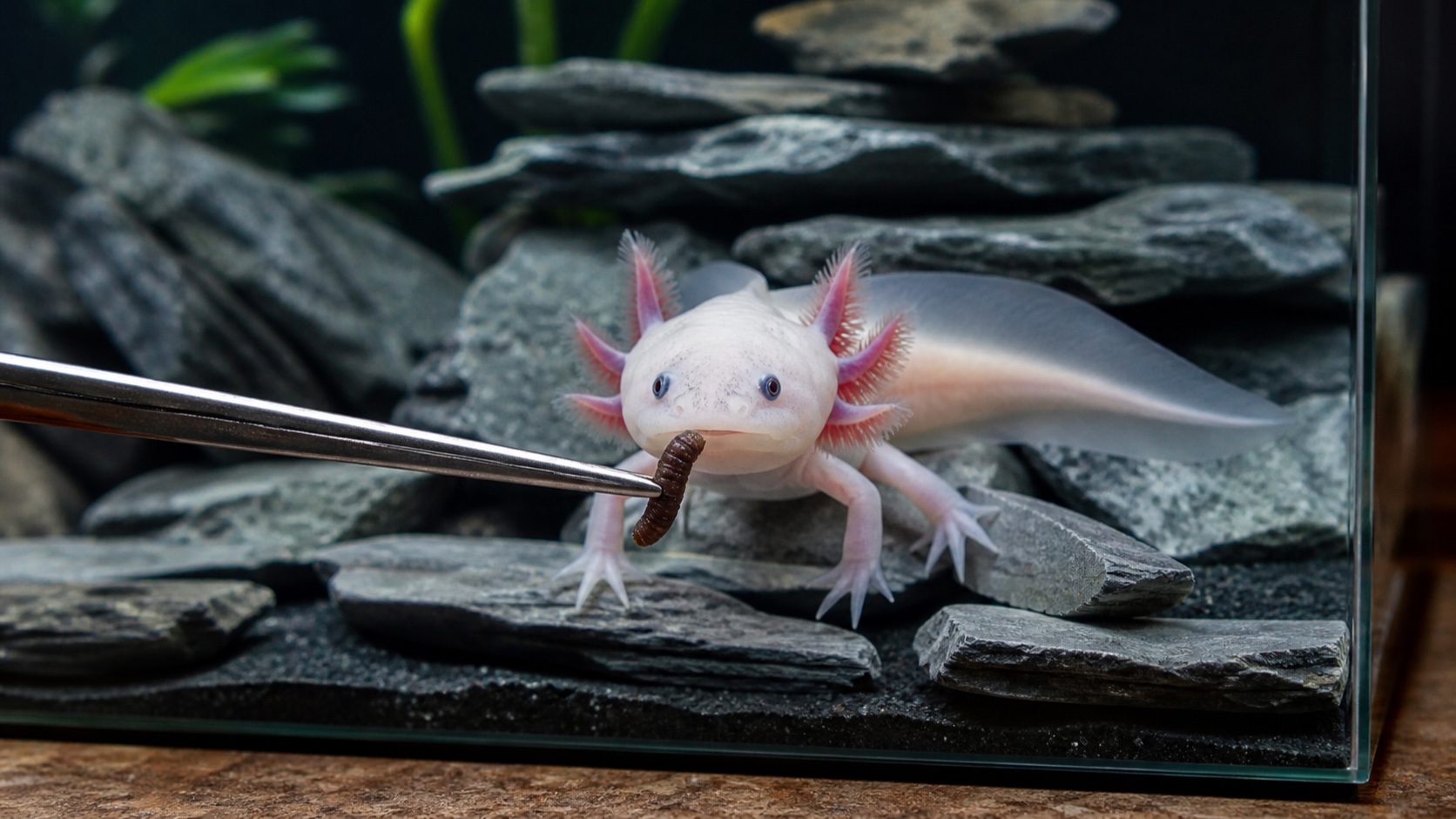
Quick answer: Farm-raised nightcrawlers are the earthworms to feed axolotls. Cut pieces so they fit the mouth. Feed juveniles daily and adults every 2–3 days.
VCA Animal Hospitals lists earthworm portions as axolotl food and feeds adults every 2 to 3 days.
This page is a research-desk comparison of published feeder-worm specs and husbandry notes.
Inclusion rule: a live-worm pack entered this article only if the maker page named the species or trade name. It also had to list a pack count or a length. We left out garden-dug worms, earthworm-meal pellets, and frozen bloodworms.
On 6 September 2026, our research team compared four live-worm listings that met that rule. We call that set the Waterpuppy Feeder Pack Scan.
Which earthworms belong on the menu
European or Canadian nightcrawlers sold as live farm-raised stock are the earthworms this page covers.
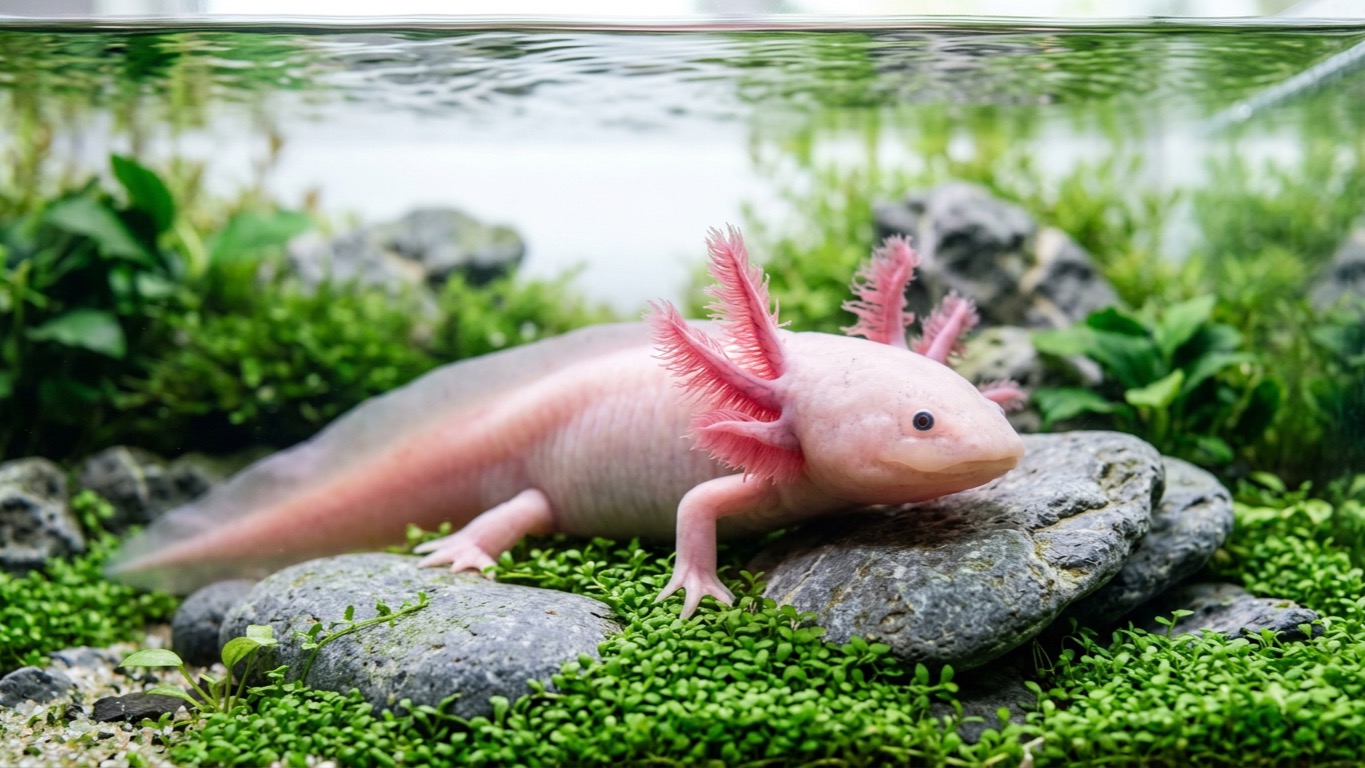
VCA Animal Hospitals names portions of earthworms, called night crawlers, among commonly available axolotl foods. The same VCA page says most adults reach about 23–25 cm (9–10 in).
Josh’s Frogs lists two nightcrawler species on its feeder pages.
- European nightcrawlers, Eisenia hortensis
- Canadian nightcrawlers, Lumbricus terrestris
The Josh’s Frogs page for European Nightcrawlers (25 count) states mature Europeans average 4–5 inches. It also states they average 1.5–2.25 inches at sale.
That same Josh’s Frogs page states mature Canadian nightcrawlers average 3.5–6 inches. A 6-inch worm is a large gulp for a 9–10 inch axolotl. Cut mature worms.
Meme’s Worms sells Pure European Nightcrawlers by weight. The maker page lists a 1/4 lb pack as about 87–100 worms.
Uncle Jim’s Worm Farm lists Super Red European Nightcrawlers as a 2,000-count bed-run pack. The maker page lists that pack at 1–4 inches.
Three of the four listings in the Waterpuppy Feeder Pack Scan published a length. Two of those listed a starting length of 1 inch or 1.5 inches. Only Meme’s Worms omitted a length and sold the pack by weight instead.
That split matters for portioning. A 1.5-inch European from Josh’s Frogs may already fit a juvenile, while a 6-inch Canadian needs a knife.
How much and how often to feed
Use the VCA time window, not a fixed worm count, because maker pages do not list a per-axolotl dose.
VCA Animal Hospitals says young axolotls should be offered food daily, while adults do well when fed every 2–3 days. The same VCA page gives one portion rule: only offer food the axolotl can finish in 2–5 minutes.
Use this schedule as the starting point:
- Juveniles still growing: offer worm pieces once a day
- Adults: offer worm pieces every 2–3 days
- Every feeding: stop when the 2–5 minute window ends
- Leftover pieces: remove them after that window
Our research team did not find a worm-count on the VCA page. Maker pages also omit a per-axolotl dose, so the time window is the rule we use.
VCA Animal Hospitals lists obesity as a common problem when axolotls are fed too much or too often. If the belly stays wide after rest days, skip the next feeding.
A betta feeding schedule is built for a small tropical fish. An axolotl is a large aquatic salamander, so do not copy that cadence.
VCA Animal Hospitals says captive axolotls may live up to 10–15 years, so a steady portion beats a heavy weekend feed.
How to prepare a worm before it hits the water
Keep bedding out of the tank, then cut the worm to a swallowable piece.
Josh’s Frogs packs the 25-count cups with an overcount, and both the European cup and the Canadian 25-count cup are 16 oz containers. Do not dump either cup into the aquarium, because bedding belongs in the cup, not on the tank floor.
Follow this prep list:
- Lift worms from the cup with clean fingers or tongs
- Leave the bedding in the cup
- Cut worms longer than the space between the eyes
- Offer one piece at a time
- Stop when the 2–5 minute window ends
VCA Animal Hospitals says axolotls gulp food and warns against small rocks or sand on the floor. A long uncut nightcrawler raises the same gulp risk.
The Josh’s Frogs European page lists a sale length of 1.5–2.25 inches. Many of those pieces still need a cut for a small juvenile.
VCA Animal Hospitals also lists frozen bloodworms and blackworms as common foods. Those items sit outside our live-earthworm rule, but they can fill the gap until a juvenile can take a cut nightcrawler.
Live worm packs we compared
The table below is an attribute comparison, not a ranking. On 6 September 2026, our research team compared published specs from four maker pages and did not rank the packs.
| Product | Species or trade name | Pack listed | Length listed | Storage listed |
|---|---|---|---|---|
| Josh’s Frogs European Nightcrawlers (25 count) | Eisenia hortensis | 25 plus overcount in a 16 oz cup | 1.5–2.25 in at sale; 4–5 in mature | Happiest at 60–70°F; tolerates 38–90°F; no fridge required |
| Josh’s Frogs Canadian Nightcrawlers (25 count) | Lumbricus terrestris | 25 plus overcount in a 16 oz cup | 3.5–6 in mature | Store in the fridge door for several weeks |
| Meme’s Worms Pure European Nightcrawlers | European nightcrawlers | 1/4 lb, about 87–100 worms | Not listed | Prefer 70–80°F; tolerate 45–90°F |
| Uncle Jim’s Super Red European Nightcrawlers (2,000 count) | Super Red European Nightcrawlers | 2,000 live, bed run | 1–4 in | Cool, moist bedding |
Josh’s Frogs states European nightcrawlers do not need a fridge and can keep 2–3 weeks without feeding at cooler temperatures. The same maker tells buyers to store Canadian nightcrawlers in the fridge door and feed them over a several week period.
Meme’s Worms states it may hold orders if temperatures exceed 90°F or fall below 30°F. The same page says Europeans prefer 70–80°F and tolerate 45–90°F.
Uncle Jim’s Worm Farm states it has raised and shipped worms since 1973. The 2,000-count page says about 99% of worm orders ship 2nd Day Express.
Josh’s Frogs restricts these worm packs from Hawaii. Most orders placed before 2 p.m. ET on business days ship the same day, per that maker.
Meme’s Worms also lists larger weights on the same page. A 1 lb order is about 350–500 worms. A 2 lb order is about 700–1,000 worms.
In the Waterpuppy Feeder Pack Scan, the two European listings that published a temperature band did not match. Josh’s Frogs lists 60–70°F as the happy range and 38–90°F as the tolerance band. Meme’s Worms lists 70–80°F as the preferred range and 45–90°F as the tolerance band.
Leftover worms and tank water
Uneaten worm pieces load the water and should come out after the feeding window.
A cut nightcrawler is dense protein, and if it sits on the floor the axolotl may gulp it with gravel. VCA Animal Hospitals warns that swallowed substrate can block the gut.
Leftover flesh also raises waste, which is a water-change problem, not a reason to leave food in the tank. See our guide on how often to change aquarium water.
VCA Animal Hospitals says water temperatures above 24°C (75°F) make axolotls sluggish, so warm water plus rotting worm is a poor mix.
The Merck Veterinary Manual states obesity is a disease in amphibians, and overfeeding is the main cause. Many amphibians keep eating if food stays in view, so remove the extra pieces.
Worms we left out on purpose
This page covers live nightcrawler packs with a named species or trade name, and it does not cover every worm a store can sell.
We left out garden-dug worms. VCA Animal Hospitals lists commonly available night crawlers, not yard soil worms, and
We left out red wiggler SKUs. Meme’s Worms says European nightcrawlers are larger than red wigglers.
We left out earthworm-meal pellets. A pellet can name earthworm on a label and still not be a live earthworm.
We left out frozen fish as a staple. The Merck Veterinary Manual ties thiamine deficiency in amphibians to frozen fish.
That page says the problem can be prevented by adding 250 mg of thiamine per 2.2 pounds (1 kilogram) of fish fed. Nightcrawlers do not carry that fish-thaw rule.
The Merck Veterinary Manual also states that, except for earthworms, most invertebrates contain little calcium. That is why this page stays on nightcrawlers instead of a cricket mix.
FAQ
Can axolotls eat earthworms from the garden?
This page does not cover garden-dug worms. VCA Animal Hospitals lists portions of earthworms, called night crawlers, as a commonly available food.
The four packs we compared are farm-raised listings, and
How many nightcrawlers should an adult eat at one feeding?
VCA Animal Hospitals does not publish a worm count. It says adults do well every 2–3 days and should finish the meal in 2–5 minutes.
Start with one cut piece, and add another only if that window is still open.
Do I need to cut the worm?
Yes, when the worm is longer than a comfortable gulp. Josh’s Frogs lists mature Canadians at 3.5–6 inches and mature Europeans at 4–5 inches.
VCA Animal Hospitals puts most adult axolotls at 9–10 inches and says they gulp food, so cut the worm.
Are red wigglers the same as nightcrawlers?
No. Meme’s Worms states European nightcrawlers are larger than red wigglers. Uncle Jim’s Worm Farm describes Super Reds as larger than ordinary red worms.
Our inclusion rule kept this page on nightcrawler packs, so
Can leftover worms stay in the tank?
No. VCA Animal Hospitals limits the feeding window to 2–5 minutes. Extra flesh fouls water and can be gulped with substrate, so lift leftover pieces after that window.
How should I store live nightcrawlers?
Match the maker page. Josh’s Frogs says Canadian nightcrawlers go in the fridge door.
The same maker says Europeans do not need a fridge and keep 2–3 weeks without feeding at cooler temperatures. Meme’s Worms lists a preferred range of 70–80°F.
Are earthworms enough as the only food?
VCA Animal Hospitals lists several common foods, not earthworms alone. That list includes frozen bloodworms, blackworms, earthworm portions, brine shrimp, small feeder fish, and salmon pellets.
Earthworms are the live staple this page covers. The rest sit outside our selection rule.