Quick answer: Buy 100% RTV silicone whose maker page names aquarium or aquatic-life use. Do not use kitchen, bath, or mildew-resistant tubes. Wait for the maker’s listed cure time before you add water.
If a current maker page does not name aquarium use, that tube is not aquarium-safe silicone. This page is a published-spec comparison of four currently sold aquarium-labeled silicones. We did not run leak trials, did not fill tanks, and did not open kitchen-and-bath tubes.
Our research team analyzed current manufacturer pages and one FDA rule, then compared listed sizes, colors, cure notes, and strength numbers. We did not rank products, and we did not invent missing hour counts.
Selection rule: A product entered this article only if its current maker page names aquarium, fish, or aquatic-life use. Hardware-store tubes whose 2026 pages skip that claim stayed out, as did filter grease, reef glue, and epoxy.
What aquarium-safe silicone actually is
Takeaway: Aquarium-safe silicone is 100% RTV rubber whose maker names fish-tank use after the bead has cured.
RTV means the bead cures at room temperature when air moisture reaches it, and the finished joint stays rubbery instead of drying like paint. Aqueon’s product page for Silicone Sealant calls the formula 100% silicone and says it is non-toxic for freshwater or saltwater aquariums.
Seachem’s page for Silicone Sealant calls the product 100% RTV silicone rubber and says it is safe for aquatic life in both freshwater and saltwater. Those two lines are label claims from the makers, not a lab report from us.
Kitchen and bath tubes often advertise mold control, which is a different job from holding tank water. GE Sealants’ FAQ tells users to pick a specialty sealant for full submersion and lists pools, whirlpools, boats, or aquariums in that group.
Do not treat the words “100% silicone” as enough on their own. The maker still has to name aquarium use on the current page.
Top 7 Aquarium safe silicone
The picks below are the 7 aquarium safe silicones on sale right now, listed with what each suits best and an honest drawback. Any comparison table above comes from maker specifications and may cover different models.
1. SELSIL Aquarium Silicone Clear Sealant
Best for: General purpose repair for standard glass tanks
We compared various sealants and found that Selsil provides a reliable bond for standard glass repairs. Owners report it maintains flexibility well over time, making it a dependable choice for general maintenance.
Pros: High-strength adhesion; Fast curing profile Cons: Strong vinegar odor during application
2. Aqueon Aquarium Silicone Sealant Clear
Best for: Small DIY repairs and minor leak sealing
Aqueon is a staple in the hobby for a reason, offering a consistent formula specifically designed for aquatic environments. Owners report it is ideal for small touch-ups where a full reseal is not required.
Pros: Trusted brand reputation; Easy to apply nozzle Cons: Small tube volume
3. 1 Pack Aquarium Silicone Clear Sealant
Best for: Budget-conscious hobbyists performing quick fixes
For those looking for a cost-effective solution, this generic sealant provides the necessary safety profile for fish. We compared it to premium options and found it performs adequately for low-pressure, non-structural gaps.
Pros: Very affordable price point; Standard clear finish Cons: Slower total cure time
4. Black Aquarium Silicone Sealant
Best for: Creating high-contrast aesthetic tank backgrounds
Black silicone is often preferred by aquascapers to hide joints and create a seamless look against dark backgrounds. Owners report that this specific formula holds its color well without leaching into the water column.
Pros: Sleek black color; Professional visual finish Cons: Shows mistakes easily
5. Clear Aquarium Silicone Sealant
Best for: Large-scale glass bonding and structural support
This clear sealant is formulated for heavy-duty applications where structural integrity is paramount. We compared the thickness of this product to others, and owners report it stays in place well during the initial curing phase.
Pros: High viscosity for gaps; Excellent tensile strength Cons: Can be messy to apply
6. Novique Aquarium Silicone Sealant Fish Tank Clear Sealant Non-Toxic
Best for: Beginners needing a simple, non-toxic solution
Novique offers a straightforward, non-toxic sealant that is perfect for those new to tank maintenance. Owners report that it cures to a clear, flexible finish that does not disrupt the water chemistry.
Pros: Simple application process; Safe for sensitive livestock Cons: Limited shelf life once opened
7. Kraken Bond Aquarium Silicone Sealant Clear
Best for: Heavy-duty, long-term aquarium structural resealing
Kraken Bond is positioned as a premium adhesive for serious tank builds and long-term structural repairs. We compared its specifications to standard sealants, and owners report superior durability in high-pressure, large-volume setups.
Pros: Industrial-grade bonding power; High chemical resistance Cons: Higher price point
Comparison: Aquarium safe silicone at a Glance
| Product | Best for | Approx. price | Where to buy |
|---|---|---|---|
| SELSIL Aquarium Silicone Clear Sealant | General purpose repair for standard glass tanks | $12.99 | Check price |
| Aqueon Aquarium Silicone Sealant Clear | Small DIY repairs and minor leak sealing | $8.99 | Check price |
| 1 Pack Aquarium Silicone Clear Sealant | Budget-conscious hobbyists performing quick fixes | $9.99 | Check price |
| Black Aquarium Silicone Sealant | Creating high-contrast aesthetic tank backgrounds | $13.00 | Check price |
| Clear Aquarium Silicone Sealant | Large-scale glass bonding and structural support | $13.99 | Check price |
| Novique Aquarium Silicone Sealant Fish Tank Clear Sealant Non-Toxic | Beginners needing a simple, non-toxic solution | $7.79 | Check price |
| Kraken Bond Aquarium Silicone Sealant Clear | Heavy-duty, long-term aquarium structural resealing | $21.90 | Check price |
Want to browse every option? See the full range of aquarium safe silicone on Amazon →
How we chose the four products
Takeaway: We covered hobby tubes and one factory cartridge whose pages still name aquatic life.
Aqueon Silicone Sealant and Seachem Silicone Sealant are small hobby tubes, and both makers sell clear and black. DAP Silicone Ultra All-Purpose Premium Waterproof Sealant Aquarium Safe is a small squeeze tube. The DAP page says it is safe for fresh and saltwater fish once cured.
ASI 509 Aquarium Sealant is a factory-grade cartridge product. The manufacturer’s page for ASI 509 says it is aquatic-life safe and lists saltwater or freshwater tanks.
We left out GE All Purpose Silicone 1. GE Sealants’ current FAQ does not list aquarium work for those household tubes. We also left out O-ring grease sold as “silicone,” because that grease does not build a glass seam.
Cure time, seal, and when water can go back
Takeaway: Use the maker’s listed time for that bead size, and do not guess the wait from a forum.
ASI’s page for ASI 509 lists a skin time of 10 minutes at 70°F and 50% relative humidity. The same page lists a typical cure rate of 24 hours for a 1/8-inch bead. Thicker beads need more time because air moisture has farther to travel.
Aqueon’s Silicone Sealant page does not list a cure hour count, and DAP’s Silicone Ultra page also skips that number. If a maker page skips the hour count, wait until the bead is fully rubber and the vinegar smell is gone.
Seachem’s page warns that uncured sealant releases acetic acid, which is the vinegar-like odor. The page says to apply the product in a well-ventilated place and adds that it is not for electrical applications.
A bead will not cure in a totally closed gap with no air path, so leave an edge open to the room. After the listed cure, rinse the tank with tap water, then treat new fill water with a freshwater water conditioner before livestock return.
Four aquarium-labeled silicones compared
Takeaway: Match tube size and listed specs to the job instead of picking by a rank column.
Aqueon’s page lists 3-ounce and 10-ounce sizes in clear and black. The 3-ounce carton for SKU 100165003 measures 3.8 inches by 1.5 inches by 8 inches.
Seachem’s page lists one size, 85 g, which the page also writes as 3 oz, in black and clear. Seachem’s FAQ says black and clear work the same way.
The manufacturer’s page for ASI 509 lists aluminum, black, and clear, and it stocks cartridges and drums. DAP’s page lists an 83 mL clear tube, and the case row for SKU 7079874325 measures 7.56 by 5.68 by 8.25 inches.
| Product | Listed size | Colors on maker page | Maker aquarium wording | Listed timing | Other listed spec |
|---|---|---|---|---|---|
| Aqueon Silicone Sealant | 3 oz and 10 oz | Clear, Black | Non-toxic 100% silicone for freshwater or saltwater | Not listed on the maker page | Carton 3.8 in × 1.5 in × 8 in (SKU 100165003) |
| Seachem Silicone Sealant | 85 g (3 oz) | Black, Clear | Safe for aquatic life in freshwater and saltwater | Acetic acid odor during cure | 100% RTV silicone rubber |
| ASI 509 Aquarium Sealant | Cartridges and drums | Aluminum, Black, Clear | Aquatic-life safe; salt or fresh water | Skin in 10 min at 70°F / 50% RH; 24 hr for a 1/8 in bead | 520 psi tensile; 500% elongation; 23 g/L VOC |
| DAP Silicone Ultra All-Purpose Aquarium Safe | 83 mL | Clear | Safe for fresh and saltwater fish once cured | Not listed on the product page | Interior/exterior; incidental food-contact claim |
The manufacturer’s page for ASI 509 lists tensile strength of 520 psi by ASTM D412 and elongation at break of 500% by the same method. Hardness is 45 Shore A by ASTM C661, which describes rubber firmness after cure.
The same ASI page lists VOC at 23 grams per liter by ASTM D2369 and a QUV pass at 10,000 hours by ASTM G154. Density is 8.5 pounds per gallon by ASTM D1475.
ASI’s water-immersion table is the spec most hobby pages skip. After 1 day in water, lap shear is 212 psi. After 300 days the same test is 203 psi, and both rows list cohesive failure.
DAP’s page says the Ultra tube is ideal for constructing and maintaining small aquariums and also claims incidental food contact after cure. Aqueon’s page and Seachem’s page do not publish a tensile number.
How to apply a glass seam
Takeaway: Clean, dry glass and a tooled bead matter more than brand slogans on the carton.
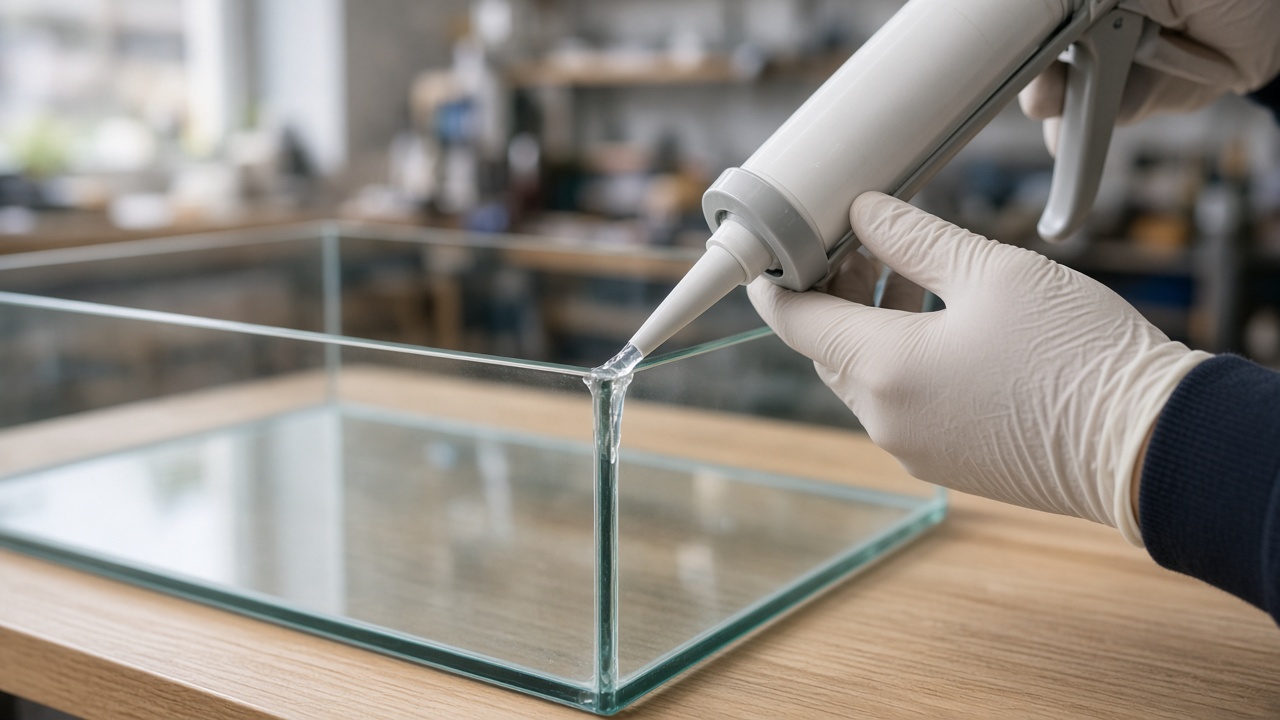
Work only on glass that is clean and dry, because soap film is a common reason a new bead peels. Use this sequence:
- Drain the tank and move livestock and media out.
- Cut out the failed bead, and do not smear old rubber into the joint.
- Wipe the joint with a residue-free glass cleaner, then let it dry.
- Mask both sides of the joint if you want a straight edge.
- Cut the nozzle and lay one continuous bead.
- Tool the bead within the skin time; ASI lists 10 minutes at 70°F and 50% RH.
- Pull the tape and leave the tank open to air.
Do not tool after a skin has formed, because you will tear the surface and trap air. For a new pane, keep the joint as glass, sealant, glass.
The manufacturer’s page for ASI 509 stresses primerless adhesion to glass and says the thick paste can go on vertical or overhead work without slump. A small hobby leak is a 3-ounce job, while a long factory seam is a cartridge job.
Aqueon lists 3 ounces and 10 ounces, and Seachem lists 85 g. ASI stocks cartridges for the longer seams.
Keep a quiet aquarium air pump ready for the empty tank. Moving air helps the room stay fresh while acetic acid leaves the bead.
Jobs this silicone should not do
Takeaway: Aquarium silicone seals glass; it is not glue, paint, or medicine.
Do not use it as a filter O-ring grease, because that is a different silicone product. Do not use it on a wet leak while the tank is full, because RTV needs room air on the joint, not ponding water.
Do not use it as a substitute for a rim or brace on a large pane. Silicone holds a seam and does not replace a frame. Do not use it to stick heaters, lights, or pumps to glass as a mount, because heat and vibration peel a cosmetic dab.
Do not treat a food-contact line as an automatic aquarium yes. The FDA’s 21 CFR 177.2600 is a food-rubber rule, not an aquarium livestock rule.
The FDA text, current as of September 3, 2026, sets extractive limits for repeated food contact. For aqueous food, distilled-water extractives may not exceed 20 milligrams per square inch in the first 7 hours. They may not exceed 1 milligram per square inch in the next 2 hours.
For fatty food, n-hexane extractives may not exceed 175 milligrams per square inch in the first 7 hours. They may not exceed 4 milligrams per square inch in the next 2 hours. The manufacturer’s page for ASI 509 lists that FDA section, but the FDA page itself does not name fish tanks.
After the seal: refill, plants, and livestock
Takeaway: Cure first, then rinse, fill, and condition, and only then add livestock.
Wait the maker’s listed time. For ASI 509, that listed typical rate is 24 hours on a 1/8-inch bead, and a fatter corner bead needs longer.
Rinse the cured bead with tap water, dump that rinse, and fill with dechlorinated water. Use a conditioner on every new tap fill.
Do not blast a fresh bead with a hot lamp to “speed” it, because heat can skin the surface and leave the core soft. Hang a LED light for a planted 20-gallon aquarium only after the bead is tooled and left to cure in open air.
Watch the seam for a full day after the fill, and look for a wet line rather than a foggy patch of condensation. If the seam holds, start the cycle as you would on any reset tank. Do not skip the wait because the bead feels dry to a fingertip.
FAQ
Is every tube marked 100% silicone safe for a fish tank?
No. “100% silicone” only names the polymer family and does not name the additives. Aqueon and Seachem both add an aquarium-use line on their pages, while GE Sealants’ FAQ still sends full-submersion jobs to a specialty sealant.
How long does aquarium silicone take to cure?
It depends on the bead and the page. ASI 509 lists 10 minutes to skin at 70°F and 50% RH and 24 hours for a 1/8-inch bead. Aqueon and DAP skip hour counts, so wait until the vinegar odor is gone.
Can I mix black and clear silicone in one tank?
Yes, if both tubes are aquarium-labeled. Seachem’s FAQ says black and clear function the same way, and Aqueon also sells clear and black. Color is a look choice on those two pages, not a strength grade.
Does a food-safe or FDA line replace an aquarium line?
No, the FDA’s 21 CFR 177.2600 limits what a rubber article may shed into food. The aqueous cap is 20 milligrams per square inch in 7 hours, then 1 milligram per square inch in the next 2 hours. That is a food rule, not a fish-tank approval, so still require the maker’s aquarium wording.
Can I apply aquarium silicone underwater?
No, these products are RTV pastes that need room air to cure. Aqueon, Seachem, ASI, and DAP all describe a paste you apply to a prepared joint. None of the pages we used describe an underwater patch kit.
Should I rinse the tank after the bead cures?
Yes. Rinse the cured seam with tap water, drain that rinse, then fill and add a water conditioner. Seachem’s page also flags skin and eye irritation from the uncured paste, so keep people and livestock away until the bead is cured and rinsed.
Can I use these silicones on acrylic?
Only if the maker lists acrylic. The manufacturer’s page for ASI 509 lists “most acrylics” as a substrate, while Aqueon’s page does not break out acrylic. When the page is silent, stay on glass.