Quick answer: Choose the largest acrylic reef sump that fits your stand and still has empty height for drain-back. Match the skimmer chamber to your skimmer. Pick a return pump by the maker’s listed flow and head.
An aquarium sump is a second tank under the display that must hold all water that drains when the return pump stops. This page compares published sump specs;
Selection rule: We covered a model only if the maker page listed exterior dimensions and either a water volume or a recommended tank-size range. We left out hang-on refugiums, DIY baffle kits, glass conversion kits, and canister filters.
Our research team compared those listed volumes to each maker’s top tank size. The ESHOPPS page for the RS-75 5th-gen lists 14 gallons of sump volume for tanks up to 75 gallons.
How a sump moves water
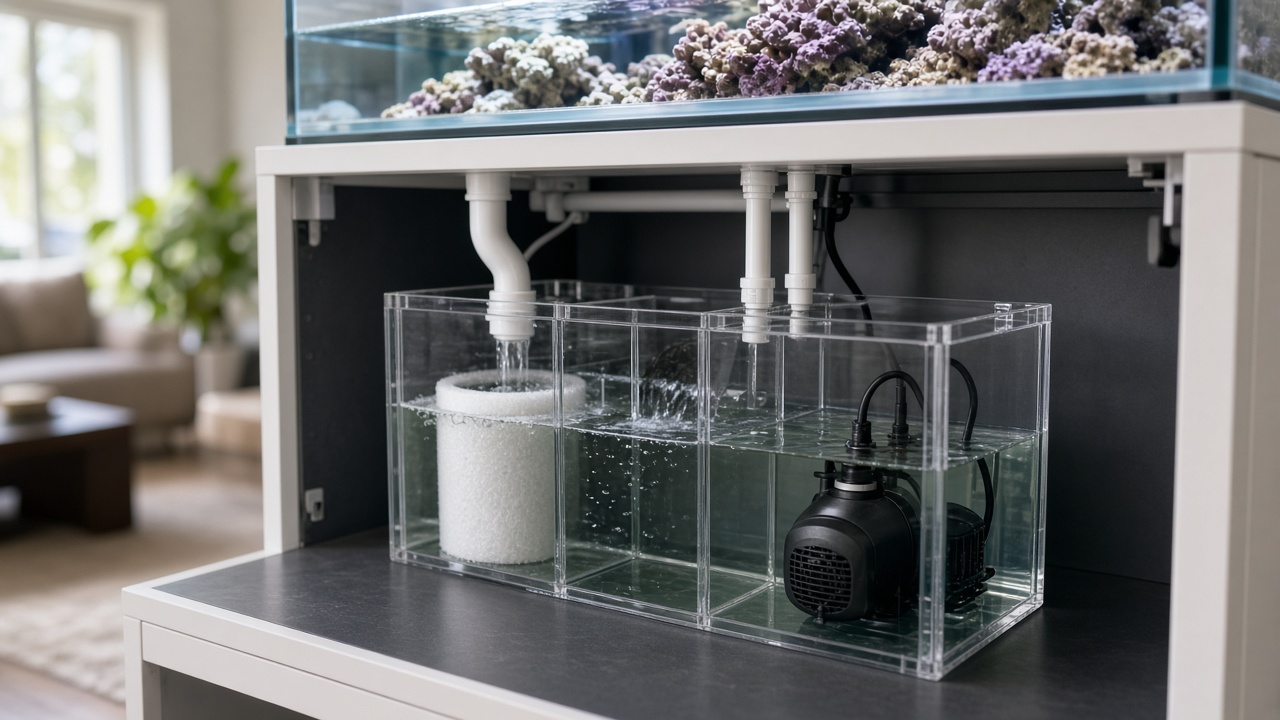
A sump is a second tank under the display that holds filters, the return pump, and spare water.
Water leaves the display through an overflow and drops into the first chamber. It then passes baffles, a sock or pad, a skimmer bay, and a return pump.
That extra volume slows swings in salt, heat, and waste, and it hides gear so the display stays open.
A sump does not replace water changes, and it does not replace a water conditioner on a freshwater fill.
Plan the stand around this path:
- Drain into a quiet first chamber
- Mechanical filter (sock, floss, or roller)
- Skimmer or reactor bay
- Optional refugium
- Bubble trap, then the return pump
Top 7 Aquarium sump
The picks below are the 7 aquarium sumps on sale right now, listed with what each suits best and an honest drawback. Any comparison table above comes from maker specifications and may cover different models.
1. LYL LEYOULAND Adjustable Sump Baffle Kit
Best for: Adjustable-level DIY reef sumps
We compared the maker page and the Amazon listing for this adjustable baffle kit. It ships with a sock holder, water-level plates, and a bubble-trap baffle; the tank and silicone are sold separately. Owners report a solid build when the tank’s inner width matches, and they warn that a wrong-width tank is the usual fail.
Pros: Adjustable water-level baffles; Includes sock-holder hardware Cons: Tank and silicone sold separately
2. Bubblefin Aquarium Sump Refugium DIY Kit for Protein Skimmer Sump
Best for: Budget first-sump baffle builders
We compared the published listing: this is a set of acrylic chamber dividers, not a finished sump. The tank and silicone aren’t in the box. Owners report a clean fit on matching standard tanks and messy leaks when they skip a dry-fit.
Pros: Low-cost acrylic dividers; Simple chamber-divider set Cons: No tank or silicone
3. VIVOSUN 800GPH Submersible Fountain Water Pump for Pond
Best for: Cheap freshwater sump returns
We compared the maker’s 800 GPH rating and the pond-and-fountain positioning. At this price it is a common budget return in a small sump, not a dedicated reef pump. Owners like the flow for the money and report mixed noise and lifespan.
Pros: Named 800 GPH flow; Low submersible-pump price Cons: Not a dedicated return pump
4. Aquarium Sump Refugium DIY Kit for Portein Skimmer Sump
Best for: 29-gallon spare-tank conversions
We compared this listing with the cheaper short-tank kits. Amazon sizes these dividers for a 29-gallon standard tank, which gives a skimmer more height. Owners still supply the tank and silicone, and they stress a dry-fit before any glue.
Pros: Sized for 29-gallon tanks; Taller skimmer chamber height Cons: Dividers only, no hardware
5. Protein Skimmer for 50-100 Gallon Saltwater Aquarium
Best for: Mid-size saltwater reef skimming
We compared the listing’s 50–100 gallon range with typical mid-size marine sumps. This is an in-sump protein skimmer for that tank class. Owners report that foam quality follows water height and cup tuning, not the gallon number on the box.
Pros: Sized for 50–100 gallons; In-sump dissolved-waste removal Cons: Needs careful water-level tuning
6. Reefing Art Ceramic Bio Filter Media Vast Surface Area for Aquarium
Best for: Fish-only biological media chambers
We compared the maker page with common sump-media use. The ceramic is sold for ammonia and nitrite work; the same page says it is not designed to lower nitrates on a reef. Owners treat the pieces as reusable biological media and rinse them in tank water, not tap.
Pros: Porous ceramic bio surface; Reusable, low box price Cons: Won’t reduce reef nitrates
7. Borlech 8-Layer Fast-Acting Aquarium Filter Pad
Best for: First-chamber mechanical polish
We compared the listing with other mechanical pads. This is an eight-layer sheet you cut to a sock, tray, or baffle slot. Owners say the pad polishes water once flow is through it, and that a neglected sheet chokes the return.
Pros: Eight-layer cut-to-size pad; Very low replacement cost Cons: Clogs without frequent rinsing
Comparison: Aquarium sump at a Glance
Want to browse every option? See the full range of aquarium sump on Amazon →
We used one rule: the maker page had to list a footprint and either a volume or a tank-size range.
Our research team read the current ESHOPPS, Trigger Systems, CoralVue, and SICCE pages named after this article. We compared those listed numbers side by side.
We kept five acrylic reef sumps that are sold now:
- ESHOPPS RS-75 5th-gen
- ESHOPPS RS-200 5th-gen
- Trigger Systems CRYS30S
- Trigger Systems CRYS36S
- IceCap 30 Reef Sump V2
We also kept the SICCE Syncra SILENT pump line, because that maker page lists flow, head, and watts.
We left out hang-on refugiums, glass-tank baffle kits, canister filters, and sponge filters.
How to size a sump for your tank
Size the sump to the stand first, then to drain-back, then to the maker’s listed tank range.
The hard limit is physical: the box must fit through the stand door and still leave room for hoses.
The safety limit is drain-back: when power dies, water in the overflow and return line falls into the sump. Empty height must hold that water.
The listed-range limit is the maker’s own tank band. We treated a model as sized for a display only when that display sits inside the published range.
Here is what those pages list:
- ESHOPPS RS-75 5th-gen: 14 gallons of volume and a 10–75 gallon tank range
- ESHOPPS RS-200 5th-gen: 25 gallons of volume and a 55–120 gallon tank range
- IceCap 30 Reef Sump V2 (CoralVue): 90–160 gallon tank range; no water volume listed
- Trigger Systems CRYS30S: 21.3 gallons; no tank range listed
- Trigger Systems CRYS36S: 30.6 gallons; no tank range listed
Using those ESHOPPS figures, 14 gallons is about 19 percent of a 75-gallon display. 25 gallons is about 21 percent of a 120-gallon display.
CoralVue lists a 30 by 16 by 16 inch footprint for the IceCap 30 Reef Sump V2. That outer box is about 33 gallons if filled to the rim.
Trigger Systems also lists a cube model, the CRYS18C, at 18 by 18 by 15 inches and 20 gallons for square stands.
Work through size in this order:
- Measure the stand opening, not just the floor pad.
- Subtract space for hoses, a salt mixer, and a spare jug.
- Pick a model whose listed length and width fit that hole.
- Confirm your display sits inside the maker’s listed tank range when one exists.
- Leave unused height so drain-back cannot reach the rim.
Do not buy by “percent of tank” alone, because none of the maker pages we read publish one percent rule.
Baffles, socks, and water height
Baffles set water height, kill bubbles, and split the skimmer bay from the return bay.
A baffle is a wall with a slot at the top or the bottom. Water must rise or drop to pass, and that change traps air before the pump.
Skimmers need a set water line, and a wrong line makes the skimmer gulp air or run dry.
Compare the height numbers the makers print:
- Trigger Systems: fixed 9.5 inch skimmer water level on the CRYS30S and CRYS36S
- CoralVue: adjustable 5–9 inch water depth on the IceCap 30 Reef Sump V2
- ESHOPPS: “adjustable water level” on both 5th-gen pages, with no inch range printed
Socks and pads catch debris before it hits the skimmer. The listed hardware is not the same on every box:
- Trigger Systems: one 4 inch sock on the CRYS30S; two 4 inch socks on the CRYS36S
- CoralVue: one 7 inch sock holder and a 200 micron prefilter sock
- ESHOPPS: one rectangular sock on the RS-75 5th-gen and the RS-200 5th-gen
A refugium is optional extra plant or pod space. The ESHOPPS RS-75 5th-gen page lists 5 gallons of refugium inside the 14-gallon sump, about 36 percent of that volume.
The RS-200 5th-gen page also lists 5 gallons of refugium inside a 25-gallon sump. A quiet air pump can add gas exchange in that chamber if you want it.
A planted display still needs its own light. If the display is a planted 20-gallon tank, use a display LED made for that size.
Current acrylic reef sumps by listed attributes
These five models met the selection rule, and the table uses only attributes printed on the maker pages.
| Model | Listed size (L × W × H) | Listed volume | Maker tank range | Skimmer chamber | Water height | Mechanical filter |
|---|---|---|---|---|---|---|
| ESHOPPS RS-75 5th-gen | 18 × 13 × 14 in | 14 gal | 10–75 gal | 7.5 × 7.5 in | Adjustable; inches not listed | 1 rectangular sock |
| ESHOPPS RS-200 5th-gen | 30 × 14 × 14 in | 25 gal | 55–120 gal | 7 × 13.5 in | Adjustable; inches not listed | 1 rectangular sock |
| Trigger Systems CRYS30S | 30 × 12 × 15 in | 21.3 gal | Not listed | 11 × 11.5 in | 9.5 in fixed | 1 × 4 in sock |
| Trigger Systems CRYS36S | 36 × 14 × 15 in | 30.6 gal | Not listed | 12 × 13.5 in | 9.5 in fixed | 2 × 4 in socks |
| IceCap 30 Reef Sump V2 | 30 × 16 × 16 in | Not listed | 90–160 gal | 13.4 × 15.4 in | 5–9 in adjustable | 1 × 7 in, 200 micron |
All five listed heights sit between 14 and 16 inches, which matches most stands built around a 16-inch-tall box.
Chamber width decides the skimmer, so measure the skimmer base before you buy. A wide skimmer will not fit the 7.5 inch ESHOPPS RS-75 bay.
Trigger Systems lists one 1 inch drain fitting on the CRYS30S and two on the CRYS36S. CoralVue lists three 1 inch intake drains on the IceCap 30 Reef Sump V2.
CoralVue prints a 1-year limited warranty on that IceCap page. The other size charts we used do not print a warranty term.
ESHOPPS lists three dosing-line holders on the RS-75 5th-gen and four on the RS-200 5th-gen.
The CRYS36S lists 30.6 gallons, and the CRYS30S lists 21.3 gallons. That is 9.3 extra gallons for 6 extra inches of length.
How to pick a return pump
Pick the return pump from listed flow, listed head, and the height of your stand.
The return pump sits in the last chamber and pushes water back to the display. Too much flow makes the overflow roar. Too little flow lets the overflow suck air.
SICCE’s Syncra SILENT page lists these U.S. 120-volt figures:
- Syncra 2.0: 568 GPH, 6.5 feet of head, 35 watts
- Syncra 3.0: 714 GPH, 9.9 feet of head, 48 watts
- Syncra 4.0: 951 GPH, 12.5 feet of head, 85 watts
Head is the vertical lift. A 5-foot rise needs a pump whose listed H-Max is above 5 feet. Real flow falls as head rises, so treat listed Q-Max as a ceiling.
None of the sump pages we read publish a single “times per hour” turnover number, so we do not invent one here.
Match the pump to the last chamber. Trigger Systems lists 6 by 11.5 inches on the CRYS30S and 8 by 13.5 inches on the CRYS36S.
CoralVue lists 6.5 by 15.4 inches on the IceCap 30 Reef Sump V2. ESHOPPS lists 7.5 by 5 inches on the RS-75 5th-gen and 5 by 13.5 inches on the RS-200 5th-gen.
A long, narrow bay can hide a pump, but a short bay cannot.
Use this pump checklist:
- Read the pump maker’s Q-Max and H-Max.
- Measure the vertical run from sump water to the return.
- Choose a model whose H-Max is higher than that run.
- Confirm the pump body fits the listed return chamber.
- Add a valve on the return so you can cut flow.
Checks before you fill the system
Do a dry fit, then a fresh-water leak check, before you add salt or livestock.
Place the empty sump in the stand and confirm the lid or brace still clears the shelf. ESHOPPS lists bracing on both 5th-gen pages, and CoralVue lists compartment lids on the IceCap 30 Reef Sump V2.
Then run this list:
- Level the sump so baffles flood in the printed order.
- Set water height to the skimmer’s printed line, inside the sump’s listed range.
- Plumb a true emergency drain if the overflow has a second port.
- Mark the running water line on the return chamber.
- Kill power once and watch how far the water rises.
- If the rise is tight, lower the running line or use a larger sump.
That power-off check is the Drain-Back Rule in practice. If water climbs near the rim, the sump is too small for that plumbing.
Keep spare water nearby, because evaporation drops the return line every day. An auto top-off jug belongs beside the sump unless the maker designed a reservoir.
The IceCap 30 Reef Sump V2 page says the older freshwater reservoir was removed on V2. Do not assume a new sump has a built-in ATO tank.
FAQ
What size sump do I need for a 75-gallon tank?
The ESHOPPS RS-75 5th-gen page lists a 10–75 gallon tank range and 14 gallons of sump volume. That is the only model in this set whose printed range includes 75 gallons at the top. Still measure the stand, because a deep overflow can dump more water than a high running line can spare.
Can a sump overflow when the power goes out?
Yes, if empty height is smaller than the water that falls from the overflow and return line. Kill power once during setup and watch the rise. If water nears the rim, lower the running line or use a larger listed volume.
Do I need a refugium chamber?
No, a refugium is extra plant or pod space, not a required filter. ESHOPPS lists 5 gallons of refugium on both 5th-gen models we covered, and you can leave that bay empty.
How much flow should the return pump move?
Use the pump maker’s listed GPH and head. Do not copy a single turnover rate from this page. SICCE lists 714 GPH, 9.9 feet of head, and 48 watts on the Syncra 3.0.
Should I use filter socks or a fleece roller?
Use what the sump is built to hold. Trigger Systems lists 4 inch socks, and CoralVue lists a 7 inch 200 micron sock. ESHOPPS lists one rectangular sock on both 5th-gen models.
Can I add a sump to a freshwater planted tank?
Yes, if the stand fits and the drain-back math still holds. Freshwater fills still need a dechlorinator; see our water conditioner guide. Keep the display light on the tank, such as a 20-gallon planted LED.
How do I keep the sump quiet?
Slow the drain so water does not free-fall onto a hard plate. Then cut return flow with a valve until the overflow is a soft sheet. A quiet air pump in a refugium is optional and should not rattle against acrylic.