Quick answer: Pick a canister whose listed circulation is at least 4 times your tank gallons. Mid-size units fit most 40–75 gallon tanks. Tanks over 100 gallons need a high-volume canister with more media space.
A canister filter is a sealed external unit that sits below the tank and pushes water through stacked media. This page is a spec comparison of seven current canisters.
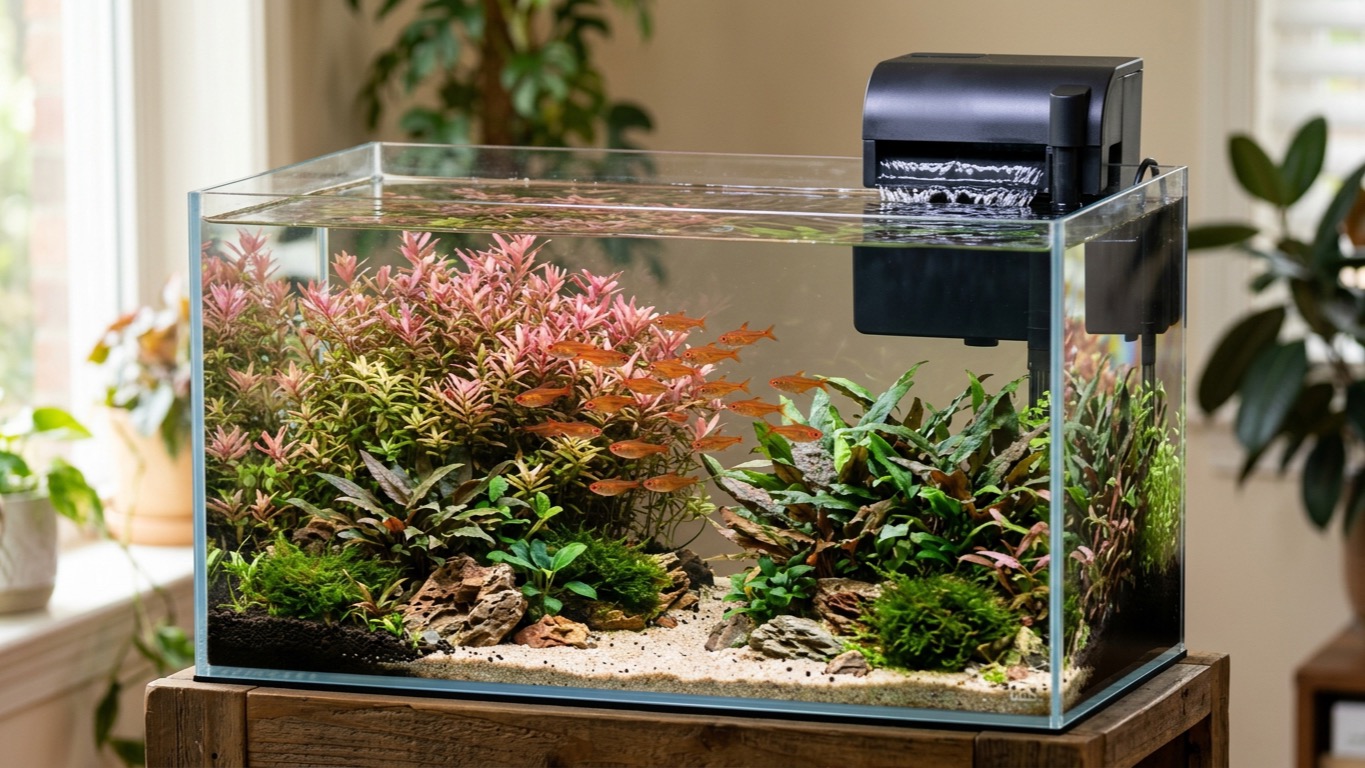
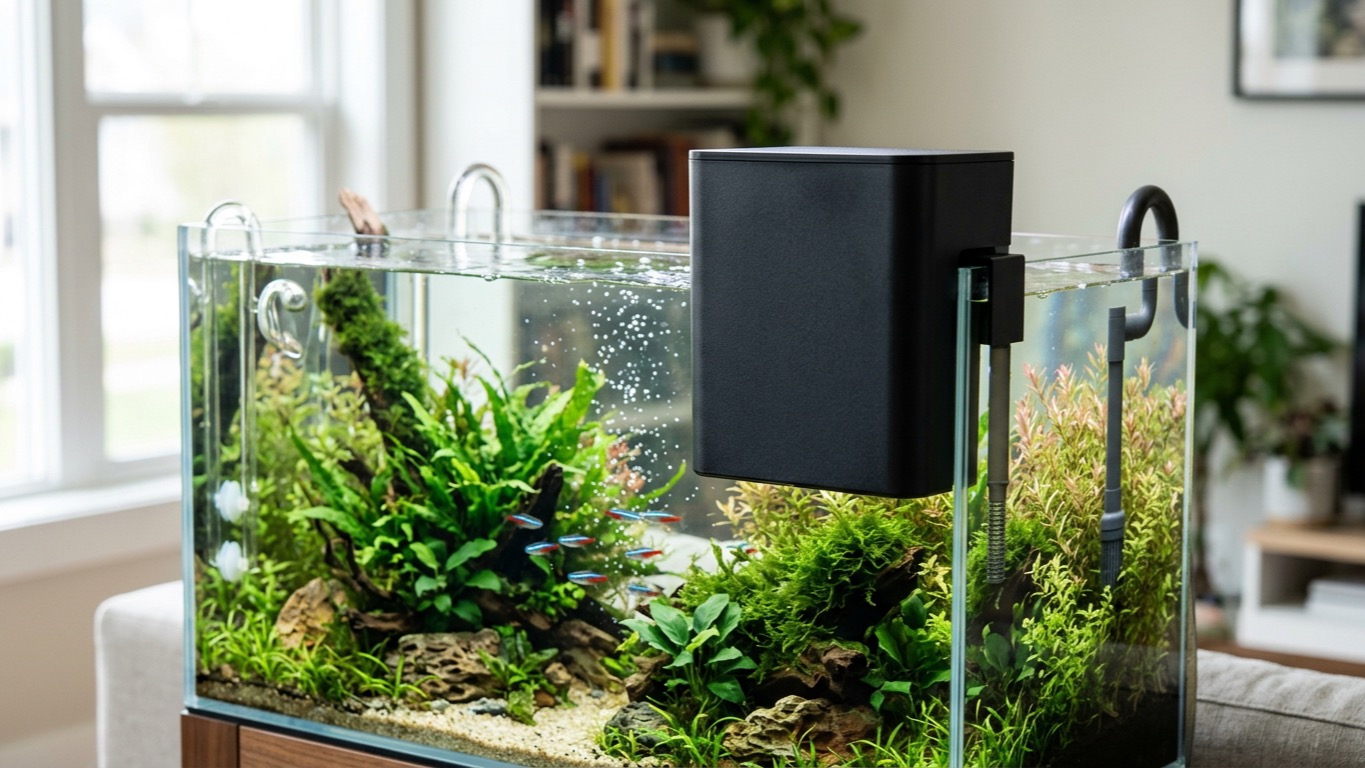
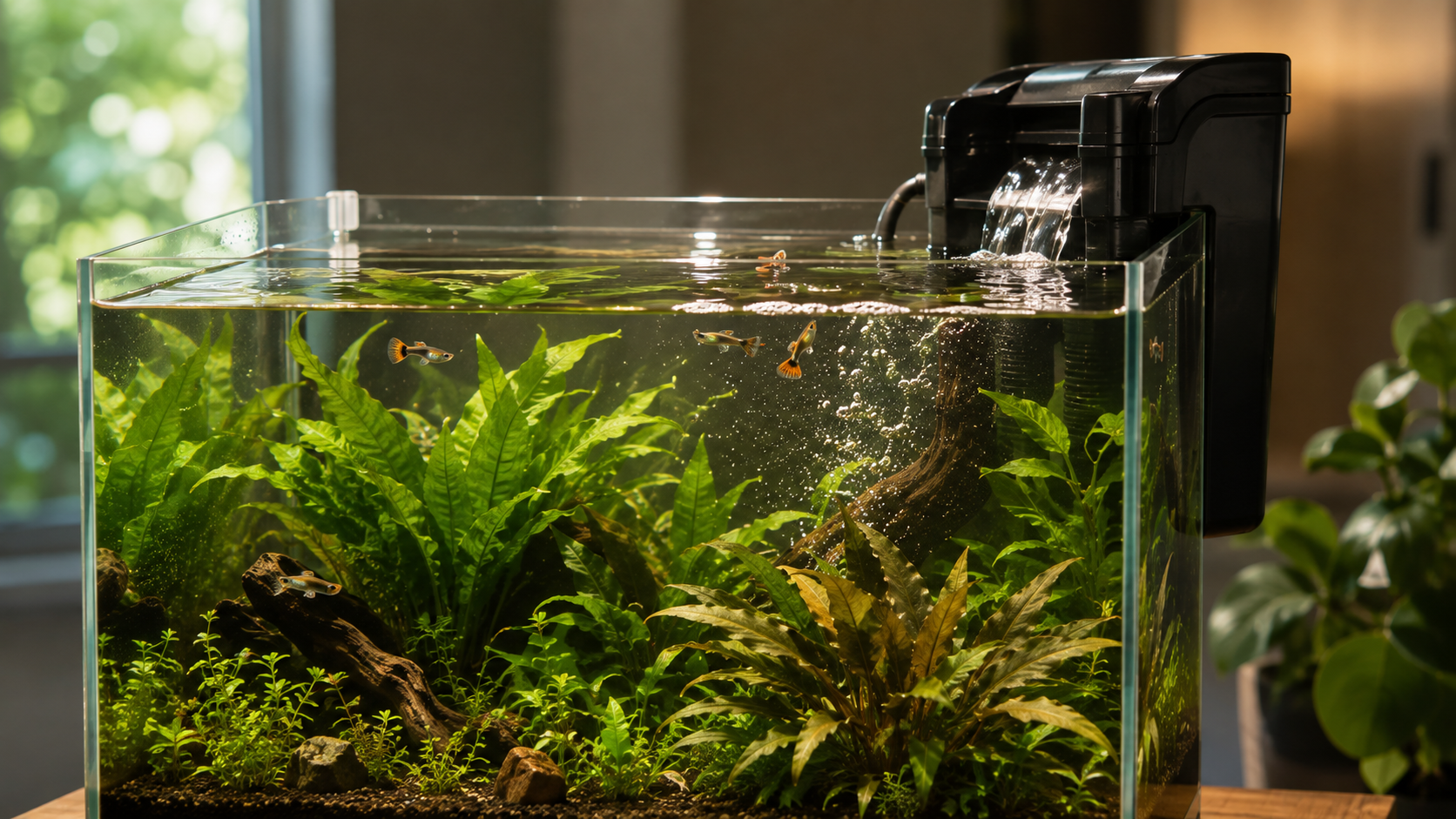
A hang-on-back sits on the rim, while a canister sits in the cabinet. That single placement change is why media volume rises.
What a canister filter does
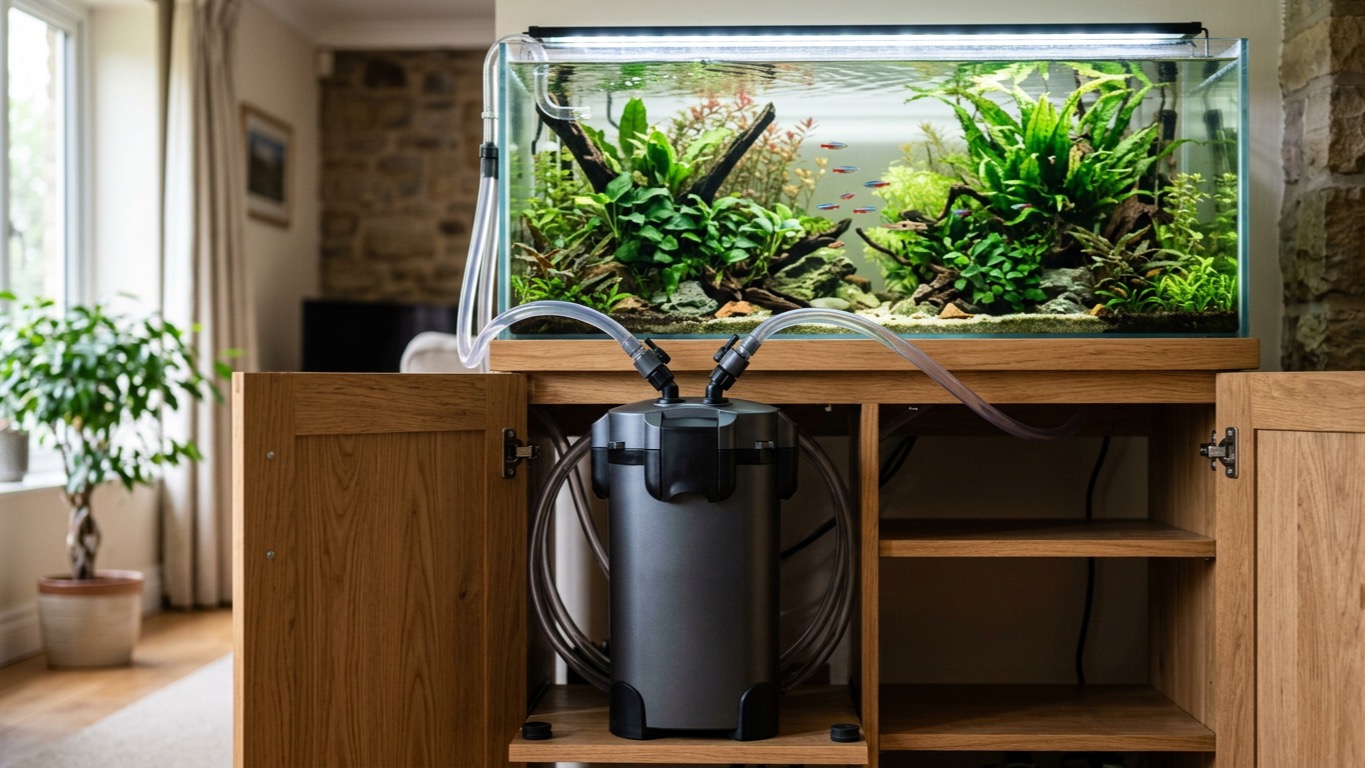
The takeaway: a canister sits under the stand and pushes tank water through a sealed media stack.
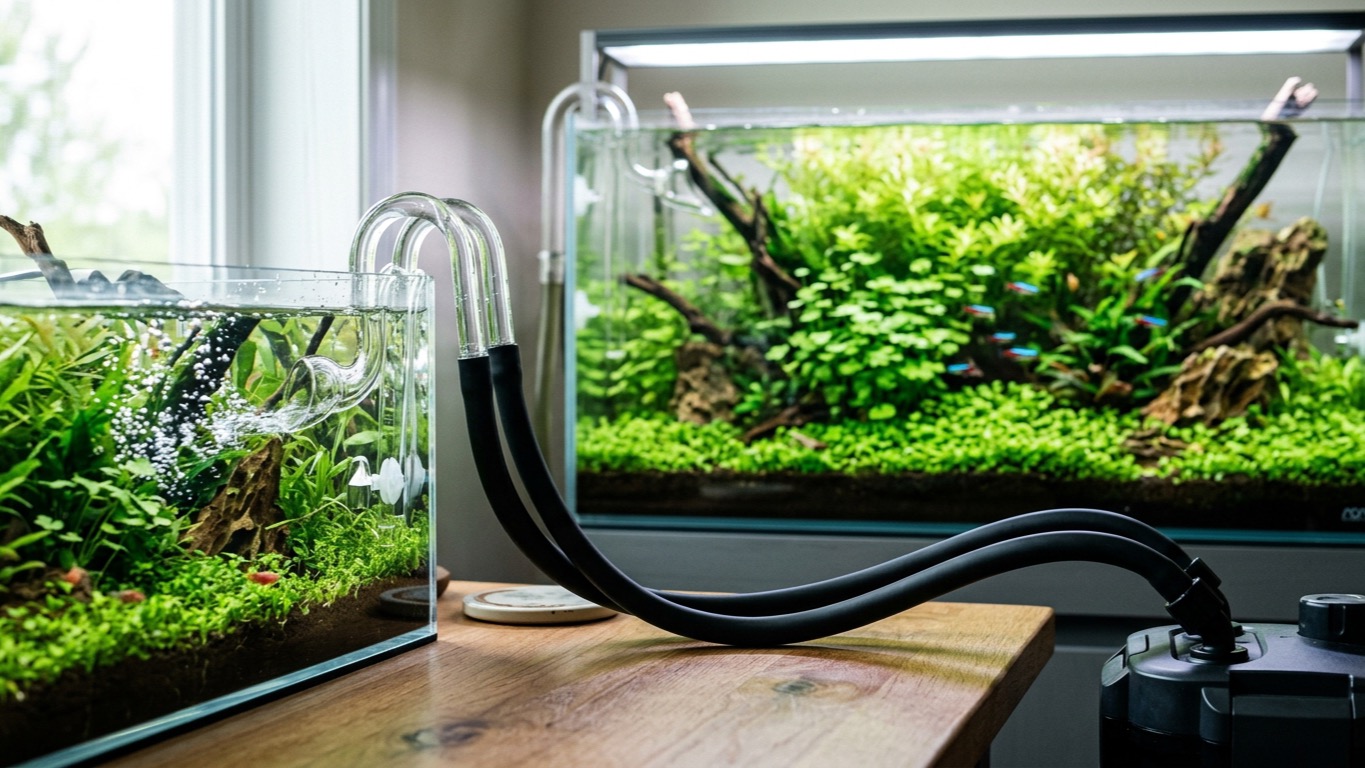
Tank water enters through one hose and then passes mechanical, biological, and optional chemical media. Cleaned water returns to the tank through a second hose.
That closed path is why canisters hold more media than a rim filter. It is also why you must prime the unit and shut the hose valves during service.
For a small tank, a hang-on-back can still be enough. We cover that path in our EF-S hang-on-back filter guide.
Top 7 Canister filter
The picks below are the 7 canister filters on sale right now, listed with what each suits best and an honest drawback. Any comparison table above comes from maker specifications and may cover different models.
1. PONDFORSE Canister Filter
Best for: Budget-conscious hobbyists maintaining small outdoor ponds
We compared this unit against premium brands and found it serves as a functional entry-level solution for smaller water features. Owners report that while it lacks advanced filtration stages, it performs adequately for basic debris removal in outdoor settings.
Pros: Affordable price point; Simple setup process Cons: Plastic build quality feels flimsy
2. Fluval 307 Perfomance Canister Filter for Aquariums up to 70 Gallons
Best for: Mid-sized community tanks requiring reliable, high-flow filt
Fluval's 307 is a staple in the hobby, and we compared its design to generic alternatives to highlight its superior impeller longevity. Owners report that the quick-prime handle and modular media trays make routine maintenance significantly less tedious.
Pros: Excellent flow rate consistency; Easy-to-access media baskets Cons: Replacement parts can be pricey
3. Fluval 207 Perfomance Canister Filter for Aquariums up to 45 Gallons
Best for: Nano or small planted aquarium setups
We compared the 207 to larger models and identified it as the ideal choice for hobbyists with limited cabinet space. Owners report that it provides robust biological filtration for smaller bioloads without overwhelming the tank with excessive flow.
Pros: Compact footprint; Quiet operation Cons: Smaller media capacity
4. VEVOR 224.5GPH Canister Filter
Best for: Beginners seeking an economical starter canister filter
We compared this VEVOR model to high-end canister filters and concluded it is best suited for those just starting out who need a basic mechanical filter. Owners report that it gets the job done for the price, though it lacks the refined seals of premium units.
Pros: Very low cost; Straightforward assembly Cons: Limited long-term durability
5. fishkeeper 390GPH Canister Filter
Best for: High-turnover filtration for medium-sized freshwater tanks
In our comparison of flow-to-price ratios, this unit stands out for its high GPH output relative to its cost. Owners report that the increased flow is beneficial for tanks with messy fish, though some note that the priming mechanism requires patience.
Pros: Strong water turnover rate; Generous media volume Cons: Can be difficult to prime
6. AMOSIJOY Ultra-Quiet Canister Filter for Large Fish Tanks and
Best for: Noise-sensitive environments like bedrooms or offices
We compared the noise levels of various entry-level canisters and noted this model's focus on silent performance. Owners report that it is nearly inaudible during operation, making it a top pick for tanks placed in quiet living spaces.
Pros: Extremely quiet motor; Sleek, modern aesthetic Cons: Flow rate may be overstated
7. VEVOR Aquarium Filter 317GPH
Best for: Balanced mechanical and biological filtration on a budget
We compared this 317GPH model to other mid-range filters and found it offers a solid middle ground for hobbyists who don't want to spend triple digits. Owners report that the filter is effective for general maintenance, provided the user handles the hoses with care.
Pros: Reliable flow performance; Easy to clean Cons: Tubing quality is average
Comparison: Canister filter at a Glance
| Product | Best for | Approx. price | Where to buy |
|---|---|---|---|
| PONDFORSE Canister Filter | Budget-conscious hobbyists maintaining small outdoor ponds | $75.99 | Check price |
| Fluval 307 Perfomance Canister Filter for Aquariums up to 70 Gallons | Mid-sized community tanks requiring reliable, high-flow filt | $217.99 | Check price |
| Fluval 207 Perfomance Canister Filter for Aquariums up to 45 Gallons | Nano or small planted aquarium setups | $166.22 | Check price |
| VEVOR 224.5GPH Canister Filter | Beginners seeking an economical starter canister filter | $59.90 | Check price |
| fishkeeper 390GPH Canister Filter | High-turnover filtration for medium-sized freshwater tanks | $85.99 | Check price |
| AMOSIJOY Ultra-Quiet Canister Filter for Large Fish Tanks and | Noise-sensitive environments like bedrooms or offices | $59.99 | Check price |
| VEVOR Aquarium Filter 317GPH | Balanced mechanical and biological filtration on a budget | $80.90 | Check price |
Want to browse every option? See the full range of canister filter on Amazon →
The takeaway: a model is in only if its current maker page lists a tank-size rating and a numeric flow figure.
That is the Listed-Flow Rule. Our research team applied it to Fluval, OASE, and EHEIM maker pages and did not add models from retailer copy.
We included these five currently sold units:
- Fluval 407
- Fluval FX4
- Fluval FX6
- OASE BioMaster Thermo 600
- EHEIM classic 600
OASE’s North America page for the BioMaster 2 Thermo 600 rates that U.S. listing for tanks up to 160 gallons (600 L).
We left out these groups on purpose:
- Hang-on-back and internal filters
- Pond canisters and drum filters
- Models whose maker page omitted a numeric flow figure
- Canisters sold only as UV bundles
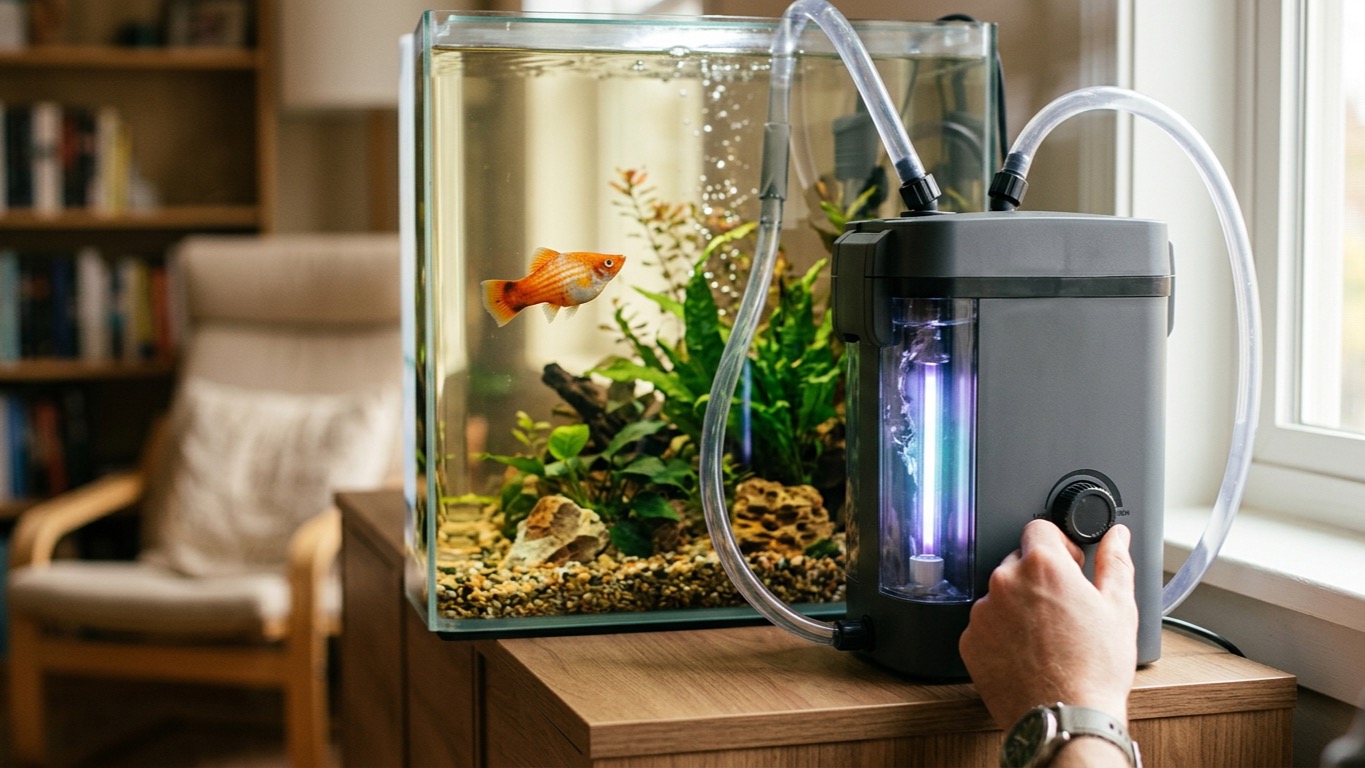
UV lamps change the buying question. We keep them on our canister filter with UV sterilizer guide.
Pump output is not circulation
The takeaway: use the maker’s circulation number for turnover, not the larger pump-output number.
Fluval’s page for the 407 lists two flow figures at 120 V / 60 Hz. Pump output is 383 US GPH (1450 LPH), and filter circulation is 245 US GPH (930 LPH).
Fluval’s FX4 page lists 700 US GPH pump output and 450 US GPH circulation. Fluval’s FX6 page lists 925 US GPH pump output and 563 US GPH circulation.
Our research team divided those pairs and named the result the WaterPuppy Circulation Ratio.
- Fluval 407: 245 ÷ 383 = 64%
- Fluval FX4: 450 ÷ 700 = 64%
- Fluval FX6: 563 ÷ 925 = 61%
On those three Fluval pages, listed circulation is 61–64% of listed pump output. If you size a tank on the bigger number, you overstate turnover.
OASE’s BioMaster Thermo 600 page lists one max flow of 1250 L/h. EHEIM’s classic 600 page lists about 1000 L per hour at 50 Hz. Neither page publishes a second circulation figure.
When a maker lists only one flow number, treat it as a ceiling. Do not treat that number as wet, media-filled flow.
A simple turnover check uses circulation, then tank gallons:
- Fluval 407 at 245 US GPH on a 100 gallon tank = 2.5 times per hour
- Fluval 407 at 245 US GPH on a 75 gallon tank = 3.3 times per hour
- Fluval FX6 at 563 US GPH on a 400 gallon tank = 1.4 times per hour
Those ratios use Fluval’s listed circulation and are not bench results. For a 75 gallon setup, see our 75-gallon canister filter guide.
OASE lists 1250 L/h on a unit rated to 600 L, which is 2.1 times max tank volume per hour. EHEIM lists 1000 L/h on a 600 L rating, which is 1.7 times per hour.
Media volume and stack order
The takeaway: pick media volume for bioload, then stack coarse debris first.
Fluval’s 407 page lists three volume figures:
- Basket volume: 4.2 L
- Total chamber volume: 6.0 L
- Canister volume: 9.2 L
It also lists a vertical pre-filter area of 1074 cm². The same page says the 407 ships with 70 g (2.46 oz) of carbon plus Bio-Foam and Quick-Clear.
Fluval’s FX6 page lists 5.9 L of biological media and 20 L of filtration volume. OASE’s BioMaster Thermo 600 page lists 6.8 L of filter volume, 0.60 L of pre-filter volume, and a 45 PPI sponge.
Our research team compared those published media figures. Fluval FX6 filtration volume (20 L) is 3.3 times the Fluval 407 chamber (6.0 L). OASE’s 0.60 L pre-filter is a separate chamber you can service first.
Stack media in this order unless the maker drawing says otherwise:
- Coarse foam or a pre-filter pad at the inlet
- Finer foam next
- Biological media in the middle
- Optional carbon or phosphate media last, in a bag you can pull
Rinse new foam in tank water before the first start. Do not wash biological media under hot tap water. Replace carbon on a short cycle, and clean the pre-filter first if flow falls.
Five current canisters, by the numbers
The takeaway: these five units differ by listed flow, media volume, and head, not by a rank score.
Our research team built this table from maker pages. Every cell is a listed attribute. Blank circulation means the maker did not publish a second flow figure.
| Model | Maker tank rating | Listed pump or max flow | Listed circulation | Media / filter volume | Listed power | Max head |
|---|---|---|---|---|---|---|
| Fluval 407 | 50–100 US gal (150–500 L) | 383 US GPH (1450 LPH) | 245 US GPH (930 LPH) | 4.2 L baskets; 6.0 L chamber | 23 W at 120 V / 60 Hz | 7 ft (2.25 m) |
| Fluval FX4 | up to 250 US gal (1000 L) | 700 US GPH (2650 LPH) | 450 US GPH (1700 LPH) | 3.9 L biological; 14 L filtration | 30 W at 120 V / 60 Hz | 6.9 ft (2.1 m) |
| Fluval FX6 | up to 400 US gal (1500 L) | 925 US GPH (3500 LPH) | 563 US GPH (2130 LPH) | 5.9 L biological; 20 L filtration | 43 W at 120 V / 60 Hz | 10.8 ft (3.3 m) |
| OASE BioMaster Thermo 600 | up to 600 L | 1250 L/h | not listed | 6.8 L filter; 0.60 L pre-filter | 22 W | 1.80 m |
| EHEIM classic 600 | about 180–600 L | 1000 L/h at 50 Hz | not listed | 6 L filter; 6.6 L container | 20 W at 50 Hz | 2.3 m |
Read the table left to right. Do not treat the first row as a winner.
Fluval’s 407 page lists cabinet size as 9.5 in × 7 in × 19.3 in. Fluval’s FX6 page states a 21 in tall design.
OASE lists 240 × 240 × 480 mm and 4 m of hose. EHEIM lists a 205 mm diameter and a 180 cm installation height.
OASE’s North America page for the BioMaster 2 Thermo 600 adds a heater range of 66–90°F with a ±2°F knob.
The FX6’s 43 W listing lines up with its extra circulation. That wattage is the listed cost of moving 563 US GPH, not a quality score.
Maintenance that protects listed flow
The takeaway: clean the pre-filter first, keep valves closed, and never dry-run the impeller.
A clogged pre-filter cuts flow before biological media fails. OASE’s 0.60 L pre-filter exists so you can pull debris without emptying 6.8 L of media.
Fluval’s 407 page describes EZ-Lift baskets with a center handle for lifting the stack. Fluval’s FX6 page says trapped air is auto-evacuated every 12 hours. That same page says you add water, plug in, and the pump takes over.
Use this service order:
- Shut both hose valves
- Unplug the filter
- Move the canister to a tub or sink
- Open the head clamps
- Rinse only the pre-filter or coarse foam in tank water
- Inspect the impeller and the O-ring
- Reseat the head, lock the clamps, reopen the valves, then plug in
Do not wash biological rings in chlorinated tap water. Do not skip the O-ring. A dry or twisted ring is the usual leak source.
Prime rules differ by brand. Fluval’s 07 Series uses a manual primer handle, while the FX Series uses the electronic start sequence above. EHEIM’s classic 600 sits below water level, with a 180 cm installation height on EHEIM’s page.
If the impeller ticks, unplug at once and check for gravel in the well. Hose kinks also fake a weak pump, so cut hoses short.
Matching tank size without overbuying
The takeaway: size on listed circulation and media volume, not on the box’s maximum gallon number.
Maker tank ratings assume light stocking and a clean unit. Fluval rates the 407 for 50–100 US gallons, and its listed circulation is 245 US GPH. That is 2.5 times a 100 gallon tank, not 4 times.
If you want about 4 times turnover on listed circulation, the 407’s 245 US GPH fits a tank near 60 gallons. A messy 75 gallon tank may still use a 407 if you add a second filter. You can also step to an FX4 at 450 US GPH.
Use this matching list as a starting point, not a rank:
- 20–45 gallon tanks: a hang-on-back, or the smallest canister that still lists flow
- 40–75 gallon tanks: Fluval 407 class, or OASE / EHEIM 600 L class if the cabinet fits
- 75–125 gallon tanks: Fluval 407 plus a second filter, or Fluval FX4
- 125–400 gallon tanks: Fluval FX4 at 450 US GPH circulation, or Fluval FX6 at 563 US GPH
Head height matters in a tall stand, so check the listed maximum in the table before you buy. If the canister sits far below the water line, listed flow falls.
Saltwater use is allowed on these five maker pages. Fluval, OASE, and EHEIM each list freshwater and saltwater or sea water on the pages we used.
A canister does not replace a protein skimmer on a reef. Cabinet fit is a hard stop.
The Fluval 407 is 19.3 in tall, and the Fluval FX6 is 21 in tall. Measure the stand opening, then add hose bend room.
FAQ
Do I need a canister filter for a 20 gallon tank?
Usually no. A hang-on-back or sponge filter can cover a 20 gallon tank. Use a canister on a small tank only if you want the filter hidden and you have stand space.
What flow rate should I use when I compare boxes?
Use listed circulation when the maker publishes it. Fluval’s 407 lists 245 US GPH circulation next to 383 US GPH pump output. If only one flow number exists, treat it as a ceiling.
How often should I clean a canister filter?
Clean the pre-filter when output slows, and leave biological media in place during that rinse. Do not set a calendar that dumps every basket each week.
Can I run two canisters on one tank?
Yes. Two mid-size units can beat one oversized unit on a messy tank, and you can service one while the other keeps bacteria online. Add the two circulation figures, not the two pump-output figures.
Does a canister filter work in saltwater?
Fluval, OASE, and EHEIM all list saltwater or sea water on the five pages we used. Rinse salt crust off valves and the impeller well. A canister still does not replace a skimmer on a reef system.
Why is my new canister quieter after the first day?
Air in the head is the usual cause of day-one noise. Fluval’s FX6 page says trapped air is auto-evacuated every 12 hours. On a manual-prime unit, tilt the canister and check the O-ring.
Should I buy a canister with a built-in UV lamp?
Only if green water is the problem you want to treat. UV does not add media volume. Start with flow and media, then read our UV canister filter guide.