Quick answer: Pick a full-width perforated panel that matches your tank’s listed gallon size. Lee’s AQ2 10-by-12-inch screen fits most 10-gallon tanks. Use a hang-on box only for fry or a short hold, not as a wall.
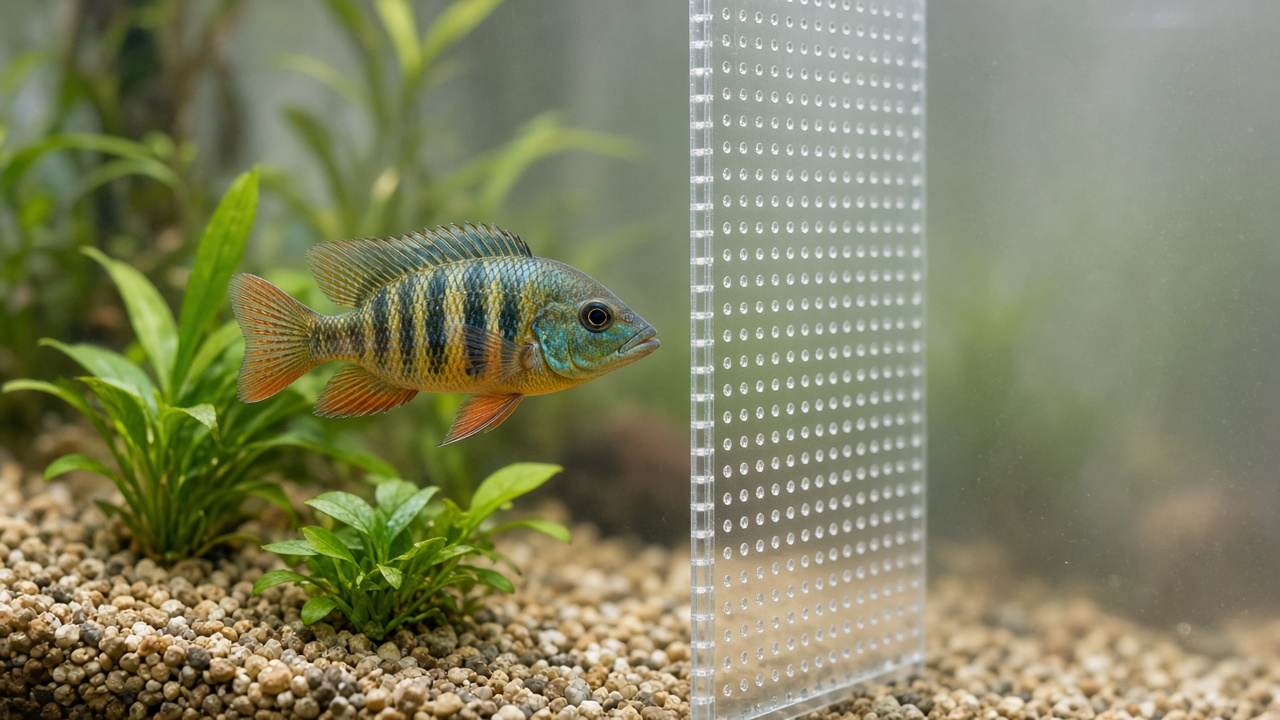
A tank-width perforated panel with holes 0.12 inches or smaller is the fish tank divider that blocks adult fish while sharing water.
This page is a fit, flow, and mesh buying guide. Our research team compared published maker specs. We did not run swim trials, cut acrylic, or time how cups hold on glass.
A divider splits one tank into two rooms that still share the same water, and it does not add a second filter or heater.
The Waterpuppy Fit-Flow-Mesh rule
We only cover products whose maker pages list a size, a water path, and a way to hold the panel.
That is the Waterpuppy Fit-Flow-Mesh rule, and a product had to clear all three checks to appear here.
- Fit: the maker lists a panel size in inches, or a tank-gallon match.
- Flow: the maker lists holes, vents, slit plates, or shared tank water.
- Mesh: we record a hole size only when the maker prints one.
We left out solid glass walls with no holes and no-name grids with no maker page. Hang-on boxes made the list only when they share the display tank’s water.
Our research team analyzed five current SKUs. Only one of those five maker pages prints a numeric hole diameter. That page is Hygger’s HC023 listing, which states 0.12 inches (3 mm).
Lee’s pages list tank-gallon fits and skip hole size, while Fluval lists a water volume and skips hole size.
Top 7 Fish tank divider
The picks below are the 7 fish tank dividers on sale right now, listed with what each suits best and an honest drawback. Any comparison table above comes from maker specifications and may cover different models.
1. 8pcs Fish Tank Divider with 10 pcs Suction Cups DIY Adjustable
Best for: Keepers building custom multi-zone tanks
This kit is eight cut-to-fit divider boards plus ten suction cups, sold as a DIY adjustable set at $14.99. Maker pages pitch snap-together grids for isolation, lids, and filter trays. Owners report the cups hold on clean glass, and they also say small fish still slip the holes.
Pros: Eight boards, ten cups; Low-cost DIY kit Cons: Must cut and snap together
2. TQDXZA Black Aquarium Divider Panel Fish Tank Separator Plastic Grid
Best for: Odd tanks that need cut grids
TQDXZA sells a black plastic grid meant as a tank separator, not a clear wall. Maker copy stresses cutting and linking panels so water still moves. Owners report the sheets trim easily, and one used a cut panel on a 40-gallon breeder.
Pros: Cut-to-fit plastic grid; Owners praise easy trimming Cons: Open grid, not fry-proof
3. Acrylic Fish Tank Divider
Best for: Budget clear isolation you can see through
This is a generic acrylic fish tank divider at $19.19, so it is a clear sheet, not a crate grid. We compared that listing class with other acrylic kits: the pitch is isolation you can still see through. Owners report you must measure the tank’s width, and cheap acrylic can cloud or scratch.
Pros: Clear acrylic isolation sheet; See-through at mid price Cons: Width must match your tank
4. ALEGI 12 Pcs Aquarium Fish Tank Divider Plastic Egg Crate
Best for: Hobbyists making lids and trays
ALEGI ships twelve plastic egg-crate panels, which is more raw grid than the eight-piece kits. Maker pages list lids, filter trays, and turtle platforms as extra jobs. Owners report the panels cut cleanly for lids, and leftover scraps get reused.
Pros: Twelve egg-crate panels; Spare stock for lids Cons: No mounts in the box
5. 4 Pcs Plastic Mesh Sheets Black Fish Tank Divider Crafts with Binding
Best for: Breeders blocking fry and shrimp
These four black mesh sheets come with binding bars, the same craft-mesh approach hobby guides use for fry screens. The $9.99 price sits in the bargain tier. Owners treat it as cut-and-frame plastic canvas, not a rigid wall.
Pros: Four sheets, binding bars; Fine mesh for fry Cons: Craft mesh, not tank-rigid
6. Adjustable Platic Grip Panel Aquarium Fish Tank Divider Filter Bottom
Best for: Under-gravel filter-bottom grate builds
The grip panel is the cheapest item here, and the name flags filter-bottom use as much as dividing. Maker pages describe snap-together plastic egg crate you can crop. Owners report the snaps can be stubborn once you start linking panels.
Pros: Lowest price on list; Made for filter bottoms Cons: Owners fight stubborn snaps
7. CLarellara Acrylic Fish Tank Divider 55Gallon
Best for: Standard 55-gallon acrylic tank splits
CLarellara sizes this acrylic divider for 55-gallon tanks, which is why it sits at $40.65. Maker pages describe a clear panel with suction-cup brackets and flow holes. Owners report the look is clean when the width matches, and some say they still had to trim a tight fit.
Pros: Sized for 55-gallon tanks; Clear acrylic, not grid Cons: Costly, one tank size
Comparison: Fish tank divider at a Glance
Want to browse every option? See the full range of fish tank divider on Amazon →
Fit comes from inside width, not the lid
Match the panel to the tank’s listed gallon size, or measure the inside width yourself.
Gallon labels on boxes are a shortcut. The real job is to span the glass from wall to wall with almost no side gap.
Lee’s page for the AQ2 Aquarium Divider System, 10" x 12" states that the kit fits most 10-gallon aquariums. The same maker’s page for the AQ2 Aquarium Divider 12" x 18" states that it fits most 29/55-gallon aquariums.
Compare those two listed panels:
- Lee’s 10-by-12-inch screen: 120 square inches of panel.
- Lee’s 12-by-18-inch screen: 216 square inches of panel.
- The larger screen is 80 percent more area than the 10-gallon size.
Hygger’s HC023 page lists two acrylic sizes. One is 9.4 by 11 inches (23.9 by 28 cm).
The other is 11.02 by 11.02 inches (28 by 28 cm). That page does not list a tank-gallon match.
Hygger’s HC029 page lists each grid at 11.6 by 5.78 inches (29.5 by 14.7 cm) in 8- or 12-piece kits.
Fluval’s Hang-On Breeding Box 10942 page lists 6.5 by 5 by 4.75 inches. The box holds 0.3 U.S. gallons (1.1 L) and hangs outside the tank.
Measure before you buy:
- Measure inside width at the gravel line, not the rim.
- Measure inside height from substrate to the water line.
- Pick the maker size that meets or exceeds that width.
A lid that lifts off does not change the width you need, but rim thickness can. Fluval’s page limits frameless glass to 0.25 to 0.4 inches (5 to 10 mm).
It also limits framed tanks to less than 1 3/4 inches (47 mm).
Flow is shared water, not a second filter
Both sides of a divider must share the same filter and the same heater.
A solid wall with no holes makes two dead zones. Waste piles up on the crowded side, and heat stays on the heater side.
Lee’s AQ2 pages say the screens keep heat circulating and leave filtration unobstructed. Each kit includes one divider screen, two side rails, two finishing strips, and two clips.
Hygger’s HC023 page lists circular holes 0.12 inches (3 mm) across, and those holes are the flow path.
Hygger’s HC029 page lists an open PP grid plus 48 brackets that stand 0.7 inches (1.8 cm) tall.
Fluval’s hang-on box shares the tank’s water on purpose, and the maker’s page says you need no extra heater or filter.
You do need an air pump at about 1 L per minute, plus 12 inches (30 cm) of airline tube and two slit plates.
Put the hardware on the right side of the wall:
- Place the filter and heater combo so outflow crosses the holes.
- Keep the heater in open water, not behind décor.
- Aim the filter return so both rooms get current.
- If one side is a fry room, keep the current gentle.
A divider does not add biofilter media, so if the tank is new, finish the cycle first.
See our guide on how long to cycle a fish tank. The MSD Veterinary Manual’s aquarium-fish page states that a tropical biofilter can take up to 8 weeks to become established.
Mesh size is a hole number, not a vibe
Use the printed hole size, then ask if your smallest fish can fit through it.
Hygger’s HC023 page is the only maker page in this set that prints a hole diameter of 0.12 inches (3 mm). That opening can stop most adult community fish. It will not stop newborn livebearer fry.
Lee’s AQ2 pages call the panel a screen and do not print a hole size. Fluval lists 3-bar and 5-bar slit plates with no gap in inches. Hygger’s HC029 page lists grid panels with no hole size.
Treat those gaps as unknown, and do not guess if fry must stay put.
A simple check:
- Adult tetras, gouramis, and most platies: 0.12-inch holes usually block them.
- Newborn guppy or molly fry: 0.12-inch holes can let them through.
- Shrimp and skinny loaches: many can walk a 0.12-inch hole.
If the maker prints no hole size, treat the panel as a visual block for large fish only.
Five current products, compared by listed attributes
These five SKUs are the ones whose maker pages met the Fit-Flow-Mesh rule.
The table has no rank column and no price column.
| Model | Type | Listed size | Flow path | Mount hardware | Stated tank fit |
|---|---|---|---|---|---|
| Lee’s AQ2 10" x 12" | Perforated screen | 10 in x 12 in | Screen vents (no hole size listed) | 2 side rails, 2 finishing strips, 2 clips | Most 10-gallon tanks |
| Lee’s AQ2 12" x 18" | Perforated screen | 12 in x 18 in | Screen vents (no hole size listed) | 2 side rails, 2 finishing strips, 2 clips | Most 29/55-gallon tanks |
| Hygger CO2 HC023 | Acrylic panel | 9.4 x 11 in or 11.02 x 11.02 in | 0.12 in (3 mm) holes | Install listed; no hardware count | No gallon size listed |
| Hygger CO2 HC029 | PP grid kit | 11.6 x 5.78 in per panel; 8 or 12 pcs | Open grid (no hole size listed) | 48 brackets, 0.7 in tall | No gallon size listed |
| Fluval Hang-On Breeding Box 10942 | Hang-on box | 6.5 x 5 x 4.75 in; 0.3 U.S. gal (1.1 L) | Shared tank water; 3-bar and 5-bar slit plates | Hangs on 0.25–0.4 in glass | Exterior box, not a wall |
Lee’s rows are the only gallon matches, and Hygger HC023 is the only printed 0.12-inch hole. Fluval 10942 is the only hang-on volume, at 0.3 gallons.
Eight HC029 panels at 11.6 by 5.78 inches add up to about 536 square inches of grid, not a finished wall.
A divider is not a quarantine tank
A mesh wall shares water, so it cannot stop parasites or cloudy new-tank water.
The MSD Veterinary Manual’s aquarium-fish page states that 30 days is the minimum quarantine time. It also says quarantined fish should have their own nets, buckets, and siphons.
The same page tells home keepers to use a 10-gallon tank, a sponge filter, a small air pump, and a heater. That is a second system, not a panel in the show tank.
Koi need still more care, and the MSD page states they should stay in quarantine at least 30 days at 24°C (75°F). A holey wall does not meet that rule.
Use a divider for these jobs:
- Two male bettas that must stay in one heated, filtered tank.
- A bully that needs a time-out from community fish.
- Fry that are already too big to pass the printed holes.
Skip the divider for these jobs:
- A new fish that just came home.
- Any fish with spots, clamped fins, or flashing.
- A tank that is still cycling.
New tanks stay risky even without a divider, and the MSD page says new tank syndrome usually shows up in the first 6 weeks. It also says a tropical biofilter can take up to 8 weeks to establish, so a wall does not shorten that clock.
Install, gaps, and daily checks
Press the panel to both walls and to the substrate, then watch for a gap the width of a fish head.
Lee’s AQ2 kits use rails, finishing strips, and clips. Fluval’s box hangs on the rim or glass. Hygger’s HC029 kit uses 48 brackets that stand 0.7 inches tall.
A common miss is the bottom corner. Gravel leaves a tunnel, and sand can slump and open a slot that a slim fish can use.
Install in this order:
- Move décor off the line where the wall will sit.
- Set rails or brackets plumb on both glass walls.
- Slide or join the panel so it meets the substrate.
- Bank gravel or sand against both faces of the bottom edge.
- Run the filter and confirm current on both sides.
- Watch the corners for a fish testing the gap.
After the first few water changes, check side gaps, a bowed sheet, clogged holes, and one side running warmer. If one room is much smaller, feed that side less.
A hang-on box needs its own check. Fluval’s page includes a 3-bar slit plate and a 5-bar slit plate. Use the 5-bar plate when the fish are tiny, and keep the air pump near 1 L per minute.
FAQ
Do fish tank dividers actually keep fish apart?
Yes, if the panel spans the inside width and the holes are smaller than the fish. A gap at the gravel line will undo the wall. Hygger’s HC023 page lists 0.12-inch holes, which stop most adult fish and will not stop every fry.
What size divider do I need for a 10-gallon tank?
Lee’s AQ2 page for the 10-by-12-inch screen says it fits most 10-gallon aquariums. Measure your inside width anyway. Brands differ, and a bow-front tank can miss that fit.
Will a divider block my filter and heater?
A perforated screen is meant to let water and heat pass. Lee’s AQ2 pages say the screen leaves filtration unobstructed and keeps heat circulating. Point the filter outflow at the holes.
Can I use a divider instead of a quarantine tank?
No, because shared water shares parasites. The MSD Veterinary Manual’s aquarium-fish page sets 30 days as the minimum quarantine time and calls for separate nets and siphons.
What mesh size keeps baby fish in?
Only use a printed number. Hygger’s HC023 page lists 0.12 inches (3 mm), and that size still lets many newborn livebearer fry through.
How do I stop fish from swimming under the divider?
Seat the panel on the glass bottom, then bank substrate up both faces. Watch the corners after you start the filter. A slim tetra only needs a small tunnel.
Is a hang-on breeding box the same as a tank divider?
No, because Fluval’s Hang-On Breeding Box 10942 holds 0.3 U.S. gallons and hangs outside the tank. A tank divider is a wall that splits the display.