Quick answer: Do a 50 percent water change with dechlorinated, temperature-matched water. Then dose a labeled ammonia detoxifier for the full tank volume. Stop feeding for 24 hours and keep the filter running.
A same-day 50 percent water change removes half the ammonia already dissolved in the tank.
This page is a research brief that compared maker labels; we did not run tank trials, collect fish exams, or invent dosages.
What this brief includes, and what it leaves out
A product is in this brief only if its current maker page names ammonia as a labeled use.
That selection rule is public and narrow, so we included a product when the maker page says it detoxifies ammonia or removes ammonia. We left out bottled bacteria, plain dechlorinators, and discontinued media.
We also left out ranked lists and price tiers, because those formats hide the dose numbers that decide what you pour.
Our research team compared five products that still have live maker pages. The set is Seachem Prime, Seachem Safe, API AMMO-LOCK, API AQUA ESSENTIAL, and Fritz Rescue ACCR.
What a reading above 0 ppm is telling you
Any hobby-kit ammonia reading above 0 ppm needs a water change the same day.
Fish release ammonia through gills, urine, and waste, and leftover food adds more. API’s AMMO-LOCK page states that even small amounts stress fish and that large amounts kill fish.
The US Environmental Protection Agency published freshwater ammonia criteria on August 22, 2013. At pH 7.0 and 20 °C, that notice lists an acute value of 17 mg TAN/L. The same notice lists a chronic value of 1.9 mg TAN/L.
Those EPA numbers are river and lake criteria, not a home-tank target. A home aquarium still aims for 0 ppm on a hobby kit, because the tank is a closed box.
Ammonia also gets more harmful as pH and heat rise, because warm water holds more of the harsher form. A spike in a warm tank needs faster dilution than a cool tank with the same reading.
Same-day steps that lower ammonia
A water change is the only step that takes dissolved ammonia out of the tank the same hour.
Detoxifiers hold ammonia in a less harmful form; they do not empty it from the water. API’s AMMO-LOCK page states this in plain words. Seachem’s Prime page says the same thing: Prime binds ammonia and does not remove it.
Do the work in this order so you dilute first and then dose.
- Test the tank water for ammonia before you change anything.
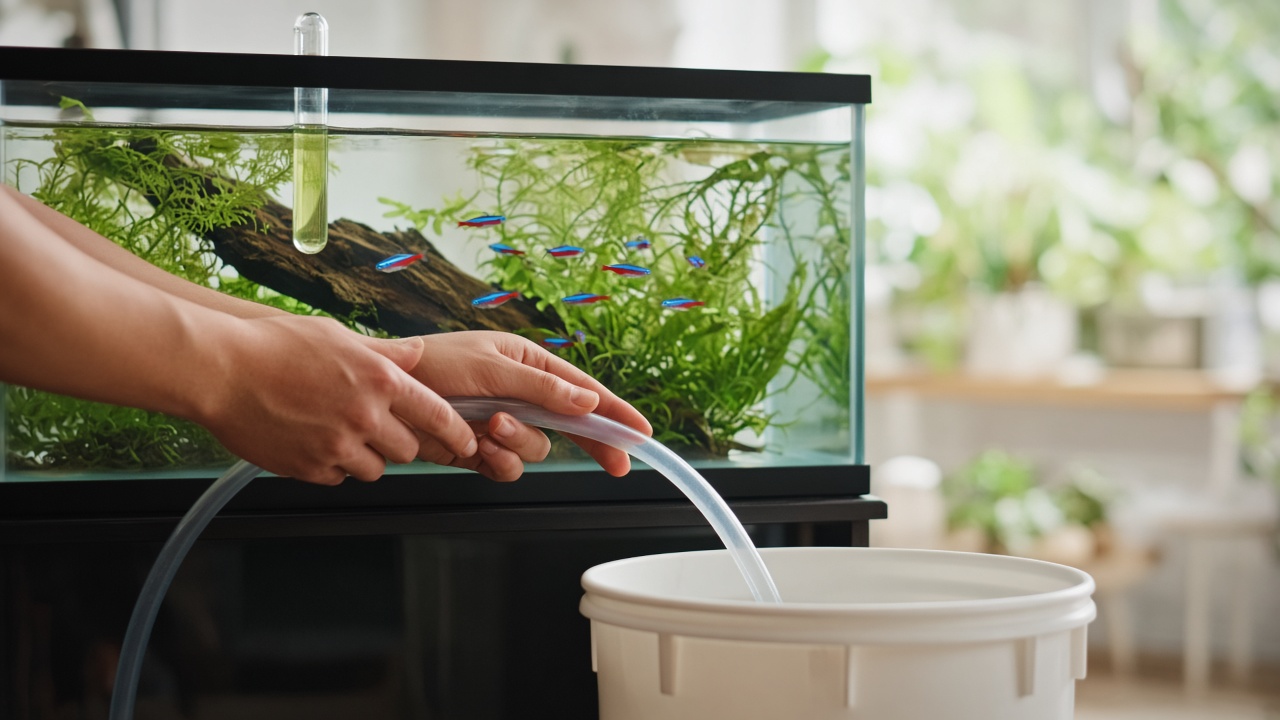
- Siphon 50 percent of the water and vacuum waste from the gravel as you go.
- Match the new water to the tank temperature within a few degrees.
- Treat the new water with a conditioner that handles chlorine and chloramine.
- Refill the tank, then dose an ammonia detoxifier for the full tank volume.
- Stop feeding for 24 hours and remove dead livestock and rotting plants.
- Keep the filter running and do not rinse media in tap water.
- Test again the next day and repeat a 25 to 50 percent change if the reading is still above 0 ppm.
A 50 percent change cuts the ammonia already in the water by about half, and that is dilution math, not a product claim.
A 25 percent change, which API’s AMMO-LOCK page still recommends after dosing, leaves three-quarters of the old water in place. Dose from the maker label and do not guess.
- Seachem’s Prime page lists 1 capful (5 mL) per 50 US gallons of new water.
- Seachem’s Prime FAQ says you may use up to 5 times that dose if ammonia is above 2 ppm.
- API’s AMMO-LOCK page lists 5 mL per 10 gallons (38 L).
- API’s AQUA ESSENTIAL page lists 5 mL per 10 gallons when the job is ammonia.
- Fritz’s Rescue ACCR page lists 1 cap (5 mL) per 10 US gallons.
If you only treat the bucket, leftover tank water still holds ammonia. Dose the full volume after the refill so the remaining water is covered too.
Detoxify versus remove: how the bottles differ
Liquid conditioners hold ammonia in a safer form, while water changes take it out.
Seachem’s Prime page says the binder holds ammonia, nitrite, and nitrate for up to 48 hours. After that window, leftover ammonia is released unless you re-dose. The same page says Prime can be dosed every 24 to 48 hours.
Fritz’s Rescue ACCR page states each standard dose neutralizes up to 1 ppm of ammonia. That page also says the dose may be raised or repeated up to 5 times within 24 hours.
API’s AMMO-LOCK page says to add the product every 2 days until ammonia is not detected. If ammonia is still present after 7 days, that page says to change water, service the filter, and reduce feeding.
Our research team compared those five labels side by side, and liquid ammonia doses fell into two families.
- 5 mL per 50 gallons: Seachem Prime’s standard dose, and API AQUA ESSENTIAL’s tap-water dose.
- 5 mL per 10 gallons: API AMMO-LOCK, Fritz Rescue ACCR, and API AQUA ESSENTIAL’s ammonia dose.
That is a five-fold volume gap on the same 5 mL measure. Seachem’s Prime page states Prime is up to 5 times more concentrated than competing products.
Seachem Safe is the dry form of the same binding idea. Seachem’s Safe page lists 1.25 g (1/4 tsp) per 75 US gallons for ammonia on sizes other than 50 g. The 50 g size uses 200 mg per 50 L (13 US gallons) for ammonia.
| Product | Form | Maker ammonia dose | Repeat note from maker | Water type |
|---|---|---|---|---|
| Seachem Prime | Liquid | 5 mL per 50 US gallons | Re-dose every 24–48 hours; up to 5× if ammonia is above 2 ppm | Fresh and salt |
| Seachem Safe | Dry powder | 1.25 g per 75 US gallons (sizes other than 50 g) | Up to 4× normal dose for nitrite or nitrate emergencies | Fresh and salt |
| API AMMO-LOCK | Liquid | 5 mL per 10 gallons (38 L) | Every 2 days; reassess at 7 days | Fresh and salt |
| API AQUA ESSENTIAL | Liquid | 5 mL per 10 gallons for ammonia | Separate tap-water dose of 5 mL per 50 gallons | Fresh, salt, planted |
| Fritz Rescue ACCR | Liquid | 5 mL per 10 US gallons (38 L) | Up to 5× within 24 hours; 1 ppm ammonia per standard dose | Fresh and salt |
Fritz’s Rescue ACCR page also lists bottle yield. The 4 oz (118 mL) size treats up to 240 US gallons at the standard dose.
Seachem’s Prime page lists bottle sizes of 50 mL, 100 mL, 250 mL, 500 mL, 1 L, 2 L, and 4 L. Seachem’s Safe page lists 50 g, 250 g, 1 kg, and 4 kg.
After the first change, stop the ammonia from coming back
The first water change lowers the load, and then filter bacteria finish the conversion.
Keep feeding light until the kit reads 0 ppm two days in a row, because extra food becomes extra ammonia the bacteria still cannot process.
Do not replace all filter media at once, and do not wash sponges under the tap. Chlorine in tap water kills the bacteria you still need.
If the tank is new, ammonia can return each day as waste builds, and that is a cycle, not a failed water change. Keep diluting and keep dosing on the maker’s schedule until the biofilter catches up.
For later upkeep, use our water-change schedule. A weekly change is maintenance, and it is not the same as a same-day 50 percent cut.
Watch for the source that started the spike before you only dose again.
- Overfeeding
- A dead fish behind a rock
- A clogged filter
- A new load of livestock
- Tap water that still carries chloramine
Chloramine is chlorine bound to ammonia, so a conditioner that only knocks out chlorine can leave ammonia behind. The five products in this brief all claim chloramine handling on their maker pages.
Warm tanks, bettas, and turtles
Heat and extra waste make the same ammonia reading more urgent in small tanks.
Seachem’s Prime page says to use a half dose if temperature is above 30 °C (86 °F) and chlorine or ammonia levels are low. That is a heat rule on the label, not a reason to skip a water change during a real spike.
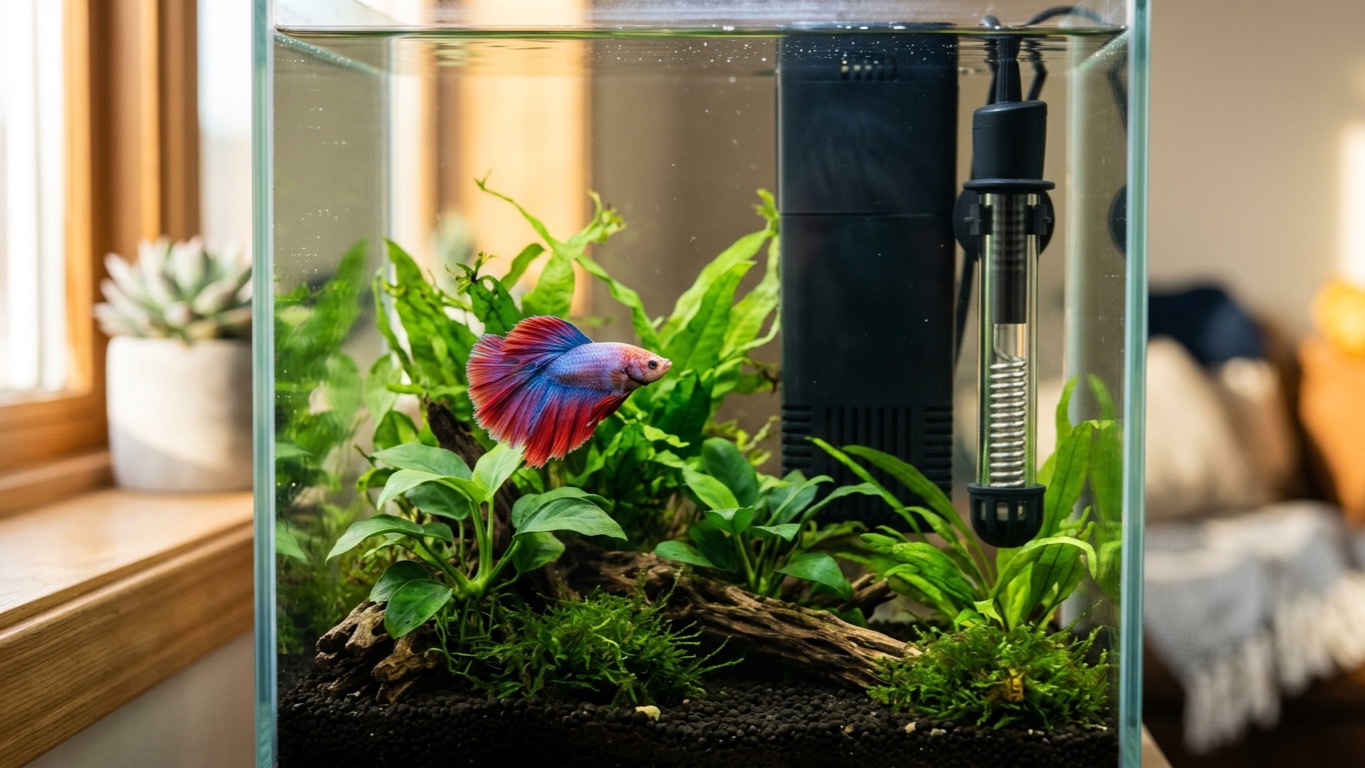
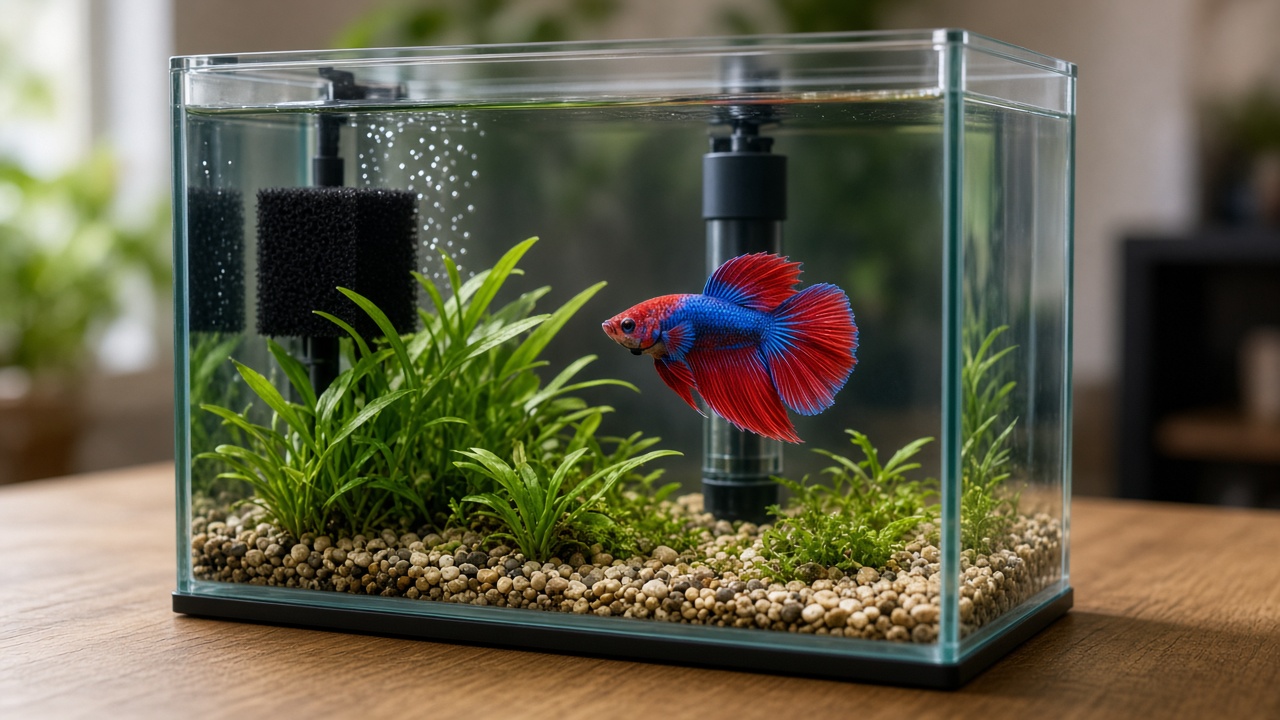
Bettas often live in small, warm bowls, so waste hits a high concentration fast. Keep heat in the range in our betta temperature guide. Do not skip the 50 percent change when the kit is not at 0 ppm.
Turtles eat a lot and foul water faster than most fish. A filter that is too small for the load will show ammonia first. Build the tank around waste, as our turtle setup guide covers.
Small tanks do not get a smaller emergency; they get a faster one. Measure the true water volume, not the tank’s advertised gallons.
What a detoxifier will not do
A conditioner bottle cannot replace a missing biofilter or a skipped water change during a spike.
Seachem’s Prime page is clear that Prime binds ammonia so bacteria can still use it. The bond lasts up to 48 hours and is not a permanent wipe.
API’s AMMO-LOCK page is also clear that the product converts ammonia to a non-toxic form. Test kits can still read ammonia after the dose.
Fritz’s Rescue ACCR page warns that Nessler-type kits will not read correctly after dosing. That page says to use a salicylate-type kit with a yellow-to-green chart.
A green test tube after a dose is not proof the product failed. It may be bound ammonia still sitting in the water. Keep changing water until the reading holds at 0 ppm without a fresh dose.
Do not stack five different conditioners in one night; pick one labeled ammonia product and follow that maker’s mL or gram figure.
FAQ
These answers use the same maker numbers as the rest of this brief.
Does a water change remove ammonia, or only hide it?
A water change removes ammonia that is already dissolved in the old water. A 50 percent change removes about half of that load. The new water must be dechlorinated, or you can add chlorine or chloramine back in.
How fast does Seachem Prime act on ammonia?
Seachem’s Prime page says Prime may be used during cycling to ease ammonia toxicity. The same page’s FAQ says the binder holds ammonia for up to 48 hours. It does not claim the tank reads 0 ppm after one capful.
How much API AMMO-LOCK do I add to a 20 gallon tank?
API’s AMMO-LOCK page lists 5 mL per 10 gallons. A 20 gallon tank takes 10 mL at that rate. That page also says to add it every 2 days until ammonia is not detected.
Can I use API AQUA ESSENTIAL instead of AMMO-LOCK?
API’s AQUA ESSENTIAL page lists two doses on the same bottle. Use 5 mL per 50 gallons for tap water. Use 5 mL per 10 gallons to address ammonia, nitrite, and nitrate.
How much ammonia does Fritz Rescue ACCR cover per dose?
Fritz’s Rescue ACCR page states each standard dose neutralizes up to 1 ppm of ammonia. The listed dose is 5 mL per 10 US gallons. The same page allows up to 5 times that dose within 24 hours.
Should I stop the filter during an ammonia spike?
Leave the filter running, because it holds the bacteria that convert ammonia. If the pad is clogged, rinse it in the old tank water you just siphoned, and do not rinse it in tap water.
Is 1.9 mg TAN/L a safe home-tank reading?
That reading is not a home-tank target. The EPA’s August 22, 2013 notice lists 1.9 mg TAN/L as a chronic criterion at pH 7.0 and 20 °C. That figure is for wild freshwater communities, so a home tank still treats any kit reading above 0 ppm as action.