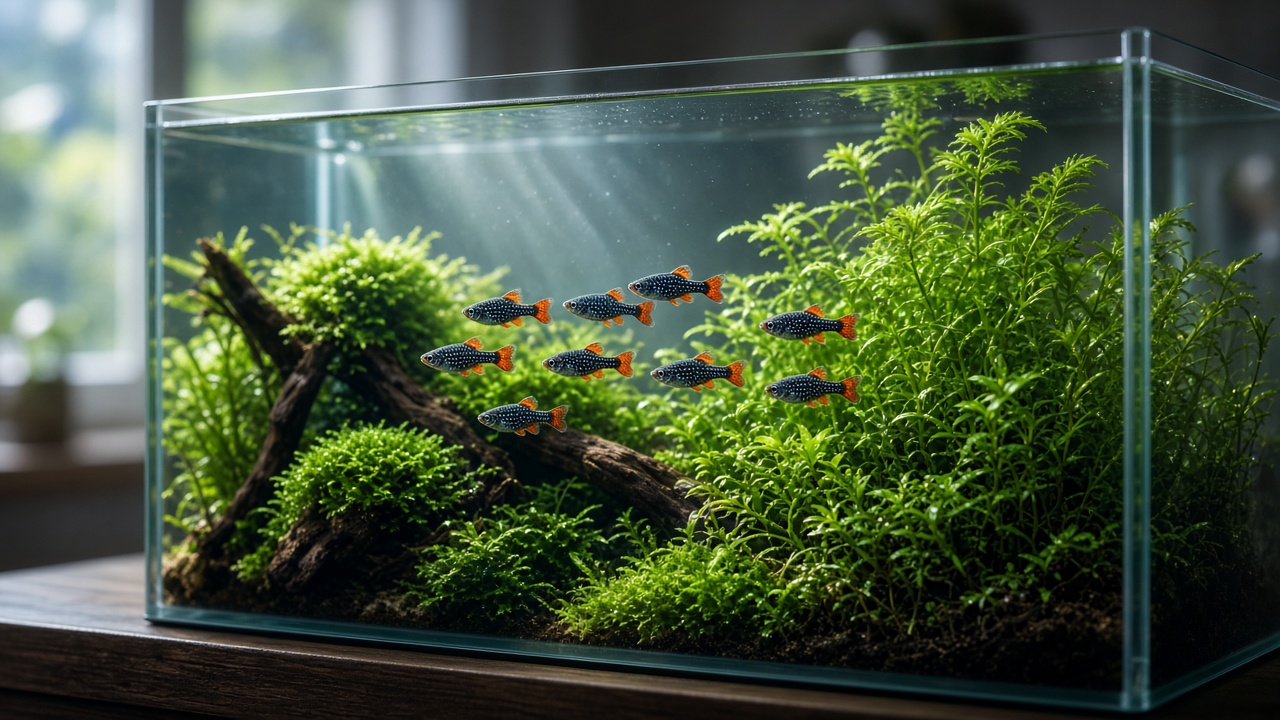
Quick answer: Keep a school of at least five harlequin rasboras in a tank at least 60 cm long. Use a 20-gallon long footprint, not a short 10-gallon box. Feed a small daily pellet and skip large, aggressive tank mates.
Harlequin rasboras reach 5.0 cm and need a school of five in a 60 cm tank. This page is a Waterpuppy desk brief that compares published species records and current food labels. We did not keep a school, log tank readings, or run a spawn.
How we chose what belongs on this page
The Waterpuppy 60-cm School Rule decides every setup on this page.
We include a plan only if it meets both FishBase marks: a group of five or more, and a tank at least 60 cm long. Our research team analyzed those published marks against Aqueon’s 2023 tank-length sheet.
We leave out shorter boxes, single fish, disease protocols, and breeding recipes. We also leave out foods and tanks whose maker pages we did not read.
That rule is why a 10-gallon cube fails here, because length is the gate, not a gallon sticker.
Tank length beats gallon labels
FishBase’s aquarium note is a length rule, not a gallon rule.
FishBase lists a minimum aquarium size of 60 cm, which is about 23.6 inches of swimming room. Comparing published specs, Aqueon’s 10 Leader tank is 20¼ inches long, or about 51.4 cm, so it misses that mark by about 8.6 cm.
Aqueon’s 2023 critical-dimensions sheet lists these current glass sizes:
- 10 Leader: 20¼ × 10½ × 12 9/16 inches; empty 11 lb; filled 111 lb
- 15: 24¼ × 12½ × 12¾ inches; empty 21 lb; filled 170 lb
- 20 High: 24¼ × 12½ × 16¾ inches; empty 25 lb; filled 225 lb
- 20 Long: 30¼ × 12½ × 12¾ inches; empty 25 lb; filled 225 lb
- 29: 30¼ × 12½ × 18¾ inches; empty 40 lb; filled 330 lb
Aqueon’s 15 and 20 High both run 24¼ inches long, or about 61.6 cm, so both just clear 60 cm. Aqueon’s 20 Long and 29 both run 30¼ inches, or about 76.8 cm, and those two give the school a real midwater lane.
Pick the 20 Long when the stand can hold 225 lb filled. Aqueon’s sheet warns that filled weight varies with substrate and décor, so use a stand built for that load.
A tall 20 High meets the length cut, but it still offers less horizontal run than the 20 Long. Harlequin rasboras use the middle and upper water, so length helps more than height.
Aqueon’s 5½ tank is 16 3/16 inches long, and the Mini Bow 5 is 14¾ inches long. Both footprints sit far under 60 cm and leave no room for a school of five.
School size from published records
FishBase’s keeping note starts at five fish, not a larger hobby count.
FishBase says to keep this species in groups of five or more individuals, and that is the published floor we use. Larger counts appear on many care pages, but those higher floors are not on the FishBase record we read.
FishBase also records wild fish in primary peat swamps in groups larger than 100. A home tank cannot copy that count, so a group of five is the smallest match to the published aquarium note.
Add fish only if the tank still meets the 60 cm rule. A 20 Long can hold a larger school than a just-legal 15, and the extra length is about 15 cm.
Buy a group of five or more of the same species, and skip mixed rasbora assortments. FishBase cites Tan 2020 for how this species differs from close kin such as Trigonostigma truncata.
Water values FishBase actually lists
Match the published band, and do not chase a wider hobby range.
FishBase lists these marks for Trigonostigma heteromorpha:
- Temperature: 22°C to 25°C (about 72°F to 77°F)
- pH range: 5.0 to 7.0
- Hardness (dH): 5 to 12
- Max length: 5.0 cm total length
- Habitat type: freshwater, benthopelagic, tropical
- Diet in the wild: worms, crustaceans, and insects
That temperature band is narrower than many care pages, so stay inside 22°C to 25°C if you follow the FishBase record. Do not treat a higher daily target as a listed value on that page.
The pH band ends at 7.0 on FishBase, and soft, slightly acidic water fits the peat-swamp note. Do not chase a higher pH as a FishBase value, because it is not on that summary.
Hardness of 5 to 12 dH is the published range, so very hard tap water sits outside it. If your tap is harder, a smaller water-change volume keeps swings down.
FishBase records the IUCN Red List status as Least Concern, assessed 26 January 2019. That is a wild-stock mark, not a tank-care mark, and it does not change the 60 cm rule.
FishBase also lists a trophic level of 3.3 based on food items. That number supports a small-animal diet, so do not treat a plant-only flake as a match.
Diet: small mouths and labeled staples
A 5.0 cm fish needs a tiny daily pellet, not a large cichlid stick.
FishBase says wild fish eat worms, crustaceans, and insects, which is a small-prey list. Our research team compared current maker labels for foods that fit that mouth size.
Hikari’s Tropical MICRO PELLETS page tells keepers to feed two to three times daily. Offer only what the fish finish in a few minutes, and treat that line as Hikari’s instruction, not a tank log of ours.
New Life Spectrum’s GROW page lists a 0.5 mm to 0.7 mm sinking pellet. That diameter fits a 5.0 cm fish better than a 3 mm or 6 mm pellet. NorthFin’s Krill Pro page also sells a 1 mm size.
Comparing published specs, crude protein on these four labels runs 42% to 45%, and crude fat runs 5% to 11%. None of those labels is a ranked winner; they are current bags with printed numbers.
| Product | Form listed by maker | Min. crude protein | Min. crude fat | Max. moisture | Other listed mark |
|---|---|---|---|---|---|
| Hikari Tropical Micro Pellets | Multi-colored granules for small-mouthed fish | 43% | 7% | 10% | Phosphorus min. 1.1%; feed 2–3 times daily |
| New Life Spectrum GROW | Sinking pellet, 0.5–0.7 mm | 45% | 10% | 10% | Vitamin A min. 10,000 IU/kg; 60 g jar |
| Omega One Color Slow-Sinking Mini Pellets | Slow-sinking mini pellets | 42% | 11% | 8.5% | Ash max. 8%; sizes 1.8 oz and 3.5 oz |
| NorthFin Krill Pro (1 mm) | Slow-sinking pellets | 42% | 5% | 9% | 85% whole Antarctic krill meal; ash max. 9% |
Hikari’s page also lists max. crude fiber 7%, max. ash 17%, and pack sizes of 22 g, 45 g, and 80 g. Use the granule as a daily staple if you want a semi-soft pellet for small community fish.
New Life Spectrum GROW lists max. crude fiber 7%, vitamin D min. 3,500 IU/kg, and vitamin E min. 400 IU/kg. The same page lists a 200 to 300 micron fry powder, so skip that powder for adult 5.0 cm fish.
Omega Sea’s Color Pellets page lists salmon and whole herring first, and it also lists max. crude fiber 2%. That is the lowest fiber cap on this table.
NorthFin’s Krill Pro page lists min. crude fat 5%, the lowest fat mark here. It also lists 1 mm, 2 mm, 3 mm, and 6 mm pellets. Stay on 1 mm for this species.
A simple daily plan looks like this:
- Pick one small staple from the table.
- Feed two or three small pinches, if you follow Hikari’s frequency line.
- Stop when the school leaves food.
- Rotate a second labeled staple a few days a week if you want variety.
Do not crush large sticks as a plan; buy a listed micro size instead. Leftover dust still fouls water.
Skip live-food collection notes here, because we did not culture worms or sort frozen packs. FishBase’s wild list already tells you the prey type.
Tank mates that fit the same water band
A tank mate must share the FishBase temperature and pH band.
We cover only peaceful, similar-size freshwater fish that can live at 22°C to 25°C and pH 5.0 to 7.0. We do not cover African rift-lake cichlids, large predators, or marine fish, which sit outside that band or size class.
Safe-looking mates on paper still need the 60 cm tank. A pair of extra fish does not erase the length rule, so if the school already fills a just-legal 15, add plants, not more mouths.
Skip fin-nipping barbs and large gouramis in this brief. We have no published compatibility table for those pairings on the pages we read, so the selection rule is the water band and size class.
Bottom fish can share the floor if they accept the same soft, warm water. Keep the midwater lane open, because harlequin rasboras use that lane.
Do not add a single centerpiece cichlid to a 20 Long, because that fish will own the tank. The school then fails the group rule in practice, even if the count is still five.
Shrimp and snails are not on the FishBase summary we read. We do not add them to this page, and that is a gap, not a hidden yes.
A simple planted setup that matches the record
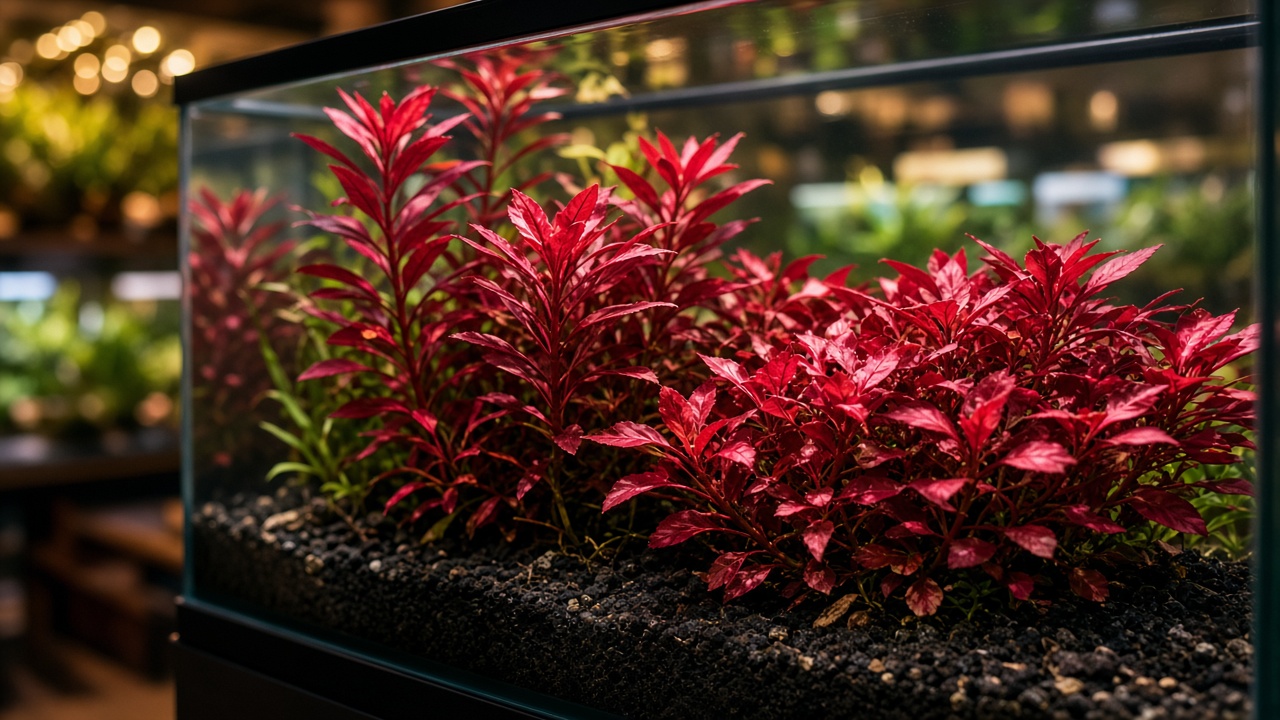
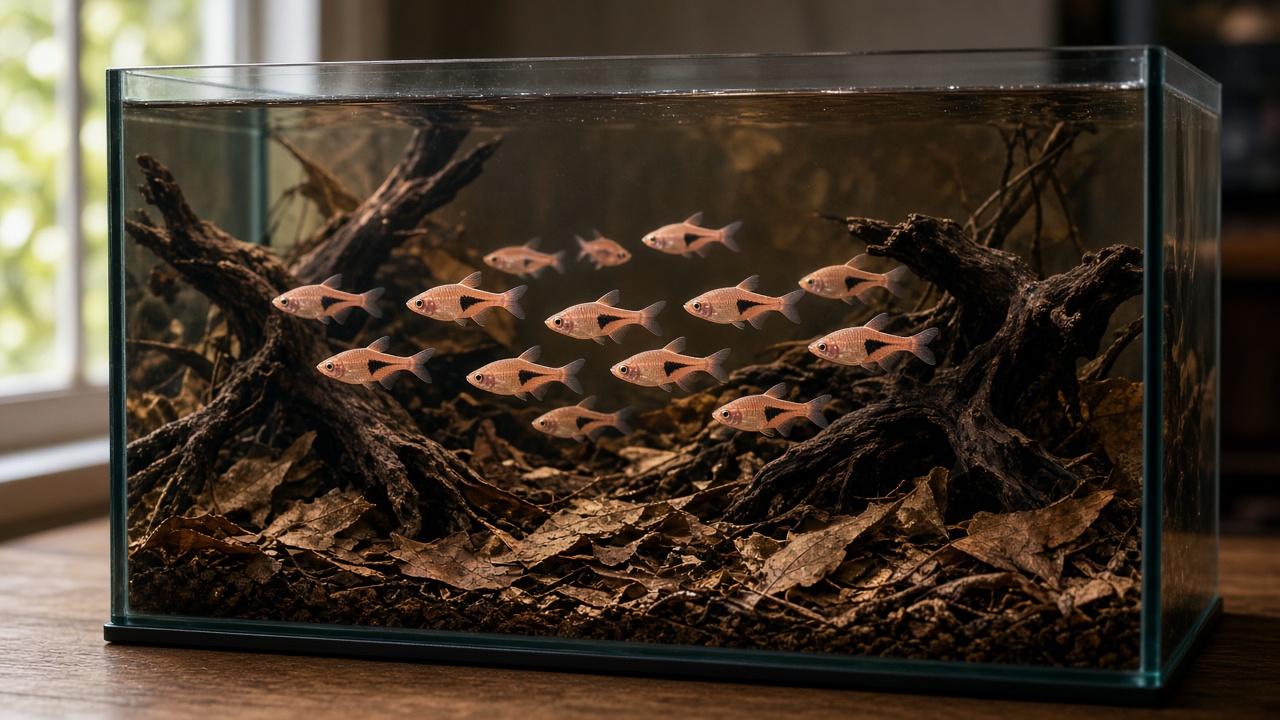
Copy the forest-stream note, not a bare glass box.
FishBase says the species inhabits forest streams and peat swamps, and it also says eggs are spawned on the underside of broad leaves. You do not need to breed them for that fact to matter, because broad leaves still give shade and cover.
Use a gentle filter return, since a hard spray pushes a 5.0 cm school into one corner. Point the flow along the long wall of a 20 Long.
Plant the back and sides, and leave the front two-thirds open. The school needs a straight run of at least 60 cm.
Dim the light if the fish stay pale and hide, because peat-stained water in the wild is not a bright sandbed.
Change water on a fixed day, and match temperature to the 22°C to 25°C band before it goes in. Large cold dumps are how small fish crash.
Aqueon’s filled-weight line is the stand check, and a 20 Long at 225 lb is not a dresser load. Put the tank on a listed aquarium stand.
FAQ
Can harlequin rasboras live in a 10-gallon tank?
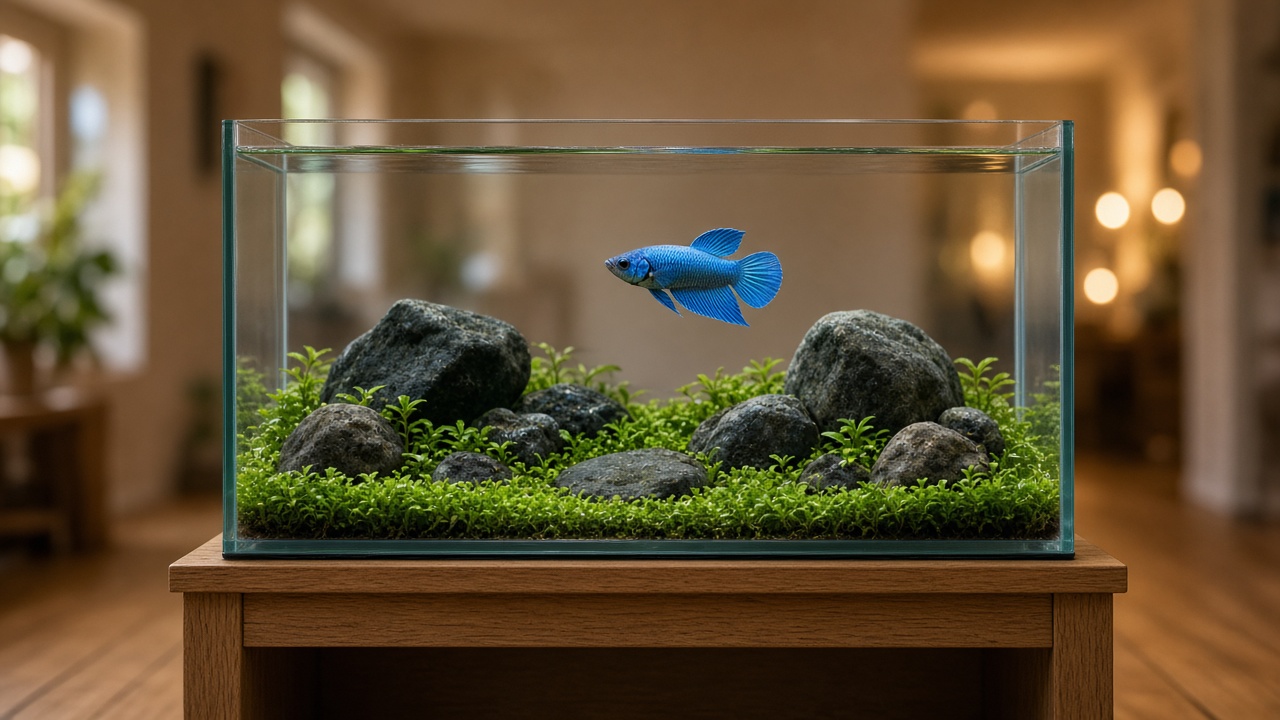
Aqueon’s 10 Leader is 20¼ inches long, about 51.4 cm. FishBase’s minimum aquarium size is 60 cm. That 10-gallon box fails the Waterpuppy 60-cm School Rule, so we do not cover it as a home for a school.
How many harlequin rasboras should I keep?
FishBase says groups of five or more, and that is the floor on this page. Wild peat-swamp groups can exceed 100 fish, but a home tank cannot copy that count.
How big do harlequin rasboras get?
FishBase lists a maximum length of 5.0 cm total length. Plan food size and tank mates around that number, and do not buy a pellet made for much larger fish.
What temperature do harlequin rasboras need?
FishBase lists 22°C to 25°C, which is about 72°F to 77°F. Stay in that band if you follow the record we used.
What should I feed harlequin rasboras?
FishBase lists worms, crustaceans, and insects, so pick a small labeled staple in the 42% to 45% protein band. Hikari Tropical Micro Pellets, New Life Spectrum GROW, Omega One Color Slow-Sinking Mini Pellets, and 1 mm NorthFin Krill Pro all sit in that band. Feed small amounts the school can finish quickly.
What fish can live with harlequin rasboras?
We only list mates that share 22°C to 25°C and pH 5.0 to 7.0. They should also stay near the 5.0 cm size class. We skip large predators and rift-lake cichlids, and the 60 cm tank still comes first.
Do I need a long tank or a tall tank?
FishBase’s 60 cm mark is a length mark. Aqueon’s 20 Long is 30¼ inches, about 76.8 cm, while Aqueon’s 20 High is only 24¼ inches long. The Long is the better match for a school.