Quick answer: Leave the clutch above water if you want babies, or peel it off and trash it if you do not. Move it only into humid air, never underwater. University of Florida IFAS states inundated apple-snail eggs will not hatch.
A mystery snail clutch hatches only in humid air, not underwater, and usually finishes in 15 to 24 days at 23°C. This page is a Waterpuppy research desk guide to three home-tank choices. We did not run hatch trials, count live clutches, or treat any tank as a clinic.
Our research team analyzed published species profiles and current maker pages.
What a mystery snail clutch actually is
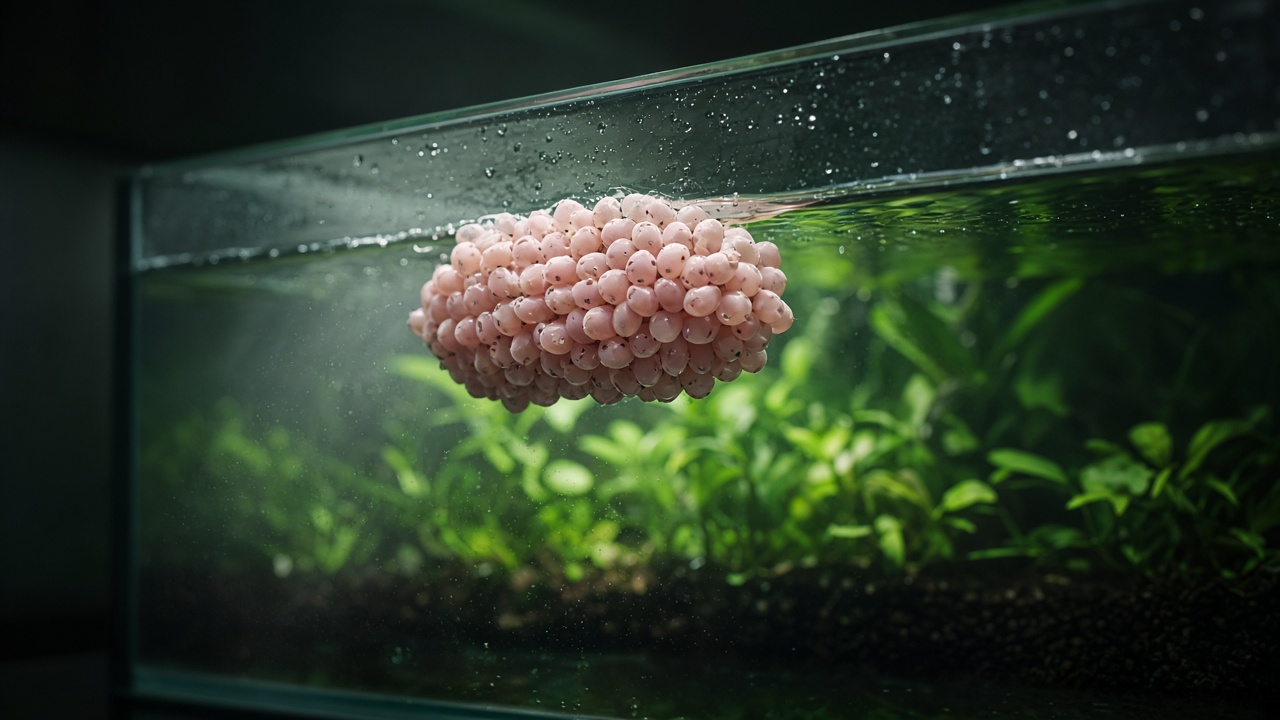
Those chalky pink clusters are air eggs, not underwater spawn.
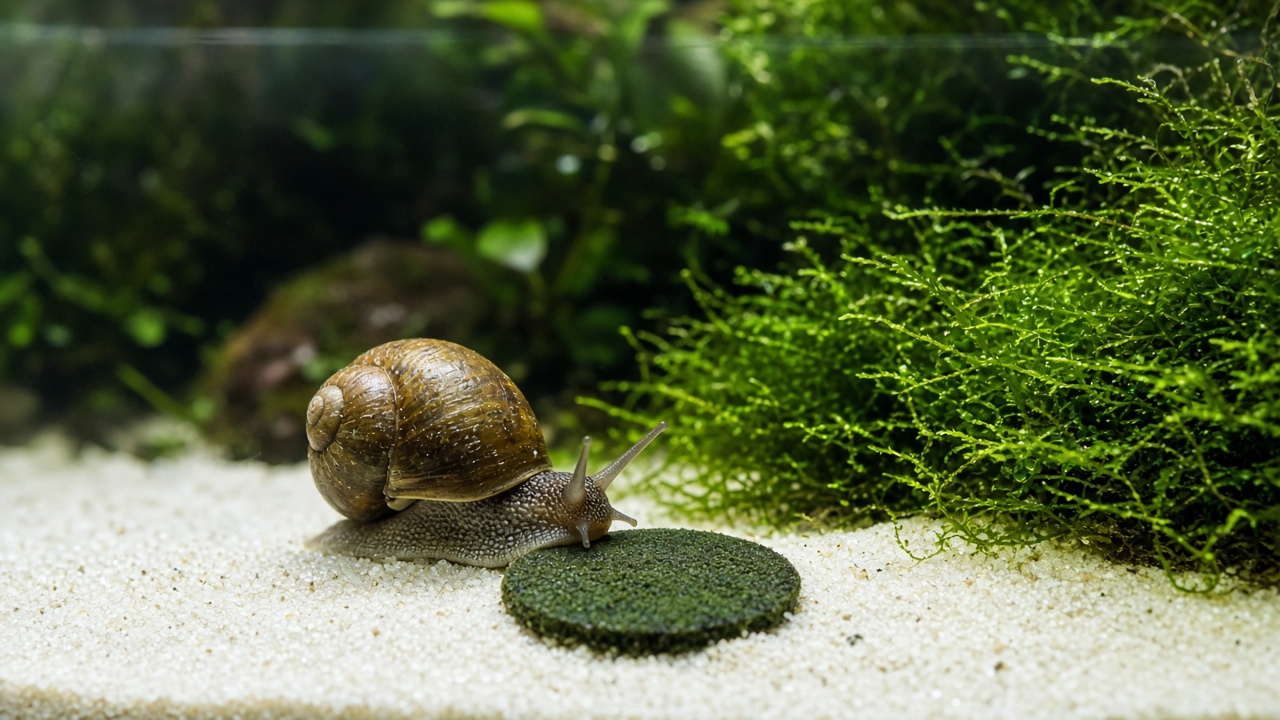
A mystery snail in the US trade is the spike-topped applesnail. The US Geological Survey Nonindigenous Aquatic Species page lists it as Pomacea diffusa.
Older papers used Pomacea bridgesii. The USGS page notes that name was later split by genetic work.
The female leaves the water to lay. She glues eggs to glass, a lid, tubing, or hard décor.
The USGS species profile gives a clutch of 200 to 600 eggs. Each egg is listed at 3 mm in diameter.
Egg color on that page is tan to salmon. Adult height on the same page reaches 60 mm.
University of Florida IFAS lists P. diffusa at 40 to 60 mm high. That is about 1½ to 2⅓ inches.
This is not the island applesnail. It is not the native Florida applesnail with large white eggs.
Do not scrape white wild clutches outdoors. IFAS says those belong to the native Florida applesnail.
Our selection rule for this guide
We only cover home-aquarium P. diffusa clutches that already sit above the waterline.
We cover a clutch only when all three are true:
- The eggs sit on a home freshwater tank, not a pond or ditch.
- The keeper can name a hatch, move, or remove goal.
- Each named product has a current maker page we could read.
We leave out these cases on purpose:
- Wild apple-snail control and rice-field pests
- Saltwater snails and nerite eggs
- Any ranked gear list
- Any dose we could not read on a maker page
- Freeze-time recipes with no primary page we could attribute
That last skip is a concrete non-event. We did not invent a freezer protocol.
The Waterpuppy Three-Door Rule
Pick one door on day one. Do not mix the three jobs.
We call the choice the Waterpuppy Three-Door Rule. The doors are Hatch, Move, and Remove.
- Hatch: leave the clutch in humid air above the tank water.
- Move: peel it after it firms, then park it in a second humid air gap.
- Remove: peel it and put it in household trash. Do not dump it outside.
University of Florida IFAS is blunt on outdoor release. Never release applesnails from aquaria into the wild.
IFAS also states that inundated eggs will not hatch. A dunk is a removal method, not a hatch method.
Pick Hatch only if you can house the babies. A USGS clutch of 200 to 600 eggs is a crowd.
Pick Move if the clutch sits on a filter rim or a dry lid gap. Dry air kills eggs. So does a soak.
Pick Remove if the tank is already stocked. Or if you cannot rehome hundreds of 2.4 mm snails.
Lusófona University’s record of Coelho, Calado, and Dinis (2012) lists hatchlings at 2.4 mm shell length.
How to hatch a clutch in place
Keep the eggs in moist air near 23°C, and keep the lid on.
Hatch in place if the clutch already sits in a humid air gap.
Lusófona University’s record of that 2012 AACL Bioflux paper gives a clear clock. Development at 23±1°C lasted 15 to 24 days after laying.
The same record says hatching in one cluster can last up to 20 hours.
Mean hatch success in that record is 94.56±0.62%. That figure is from culture conditions, not a living-room tank.
Use this in-place list:
- Leave the clutch stuck where it is.
- Keep a lid on so tank air stays damp.
- Keep the water near 23°C, about 73°F.
- Do not spray the clutch until it drips.
- Do not slide it under the waterline.
University of Florida IFAS notes Pomacea in Florida are not known to take water below 10°C, or 50°F. That is a cold floor for the animals, not an egg recipe.
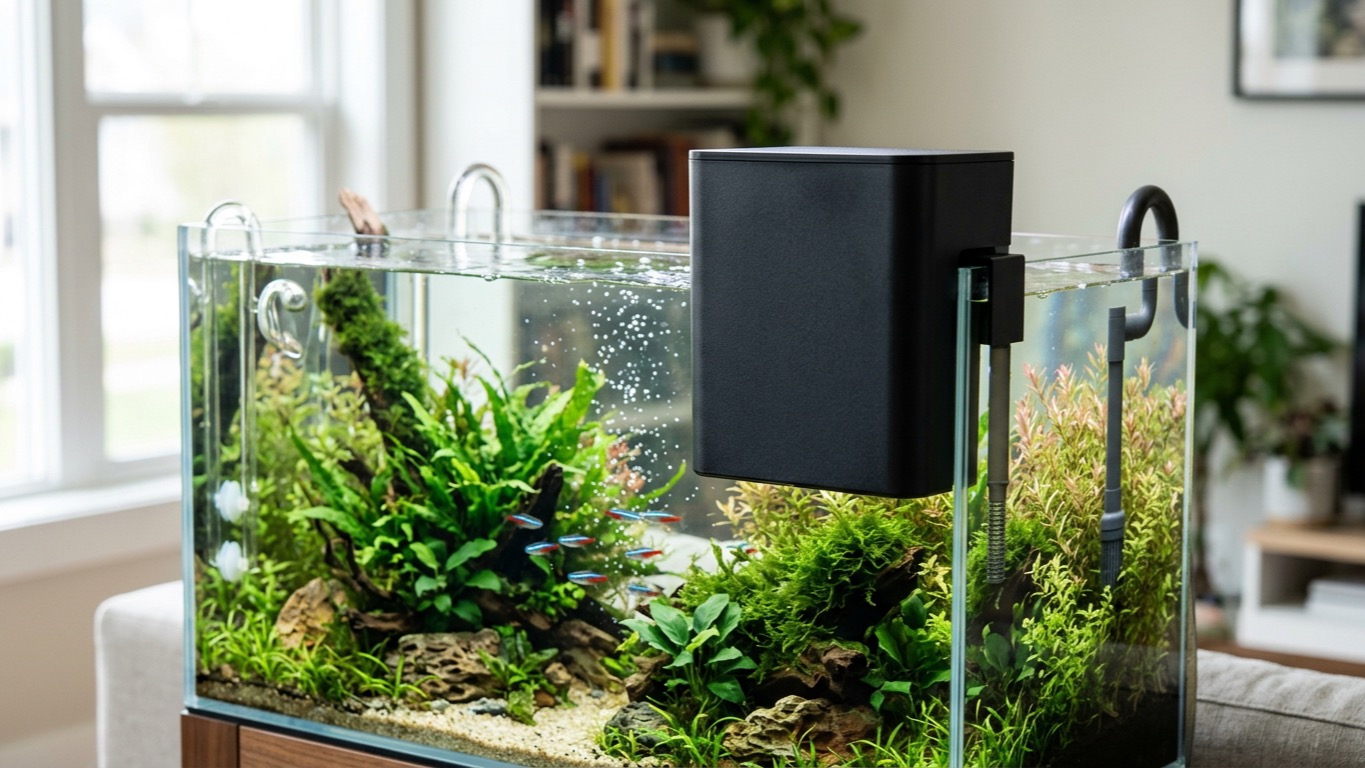
A stable heater helps you hold the 23°C window. Fluval’s M-series page lists the M100 at 100 W for up to 30 US gallons.
The same Fluval table lists the M150 at 150 W for up to 45 US gallons. The M150 housing is 13 by 1 by 1 inches.
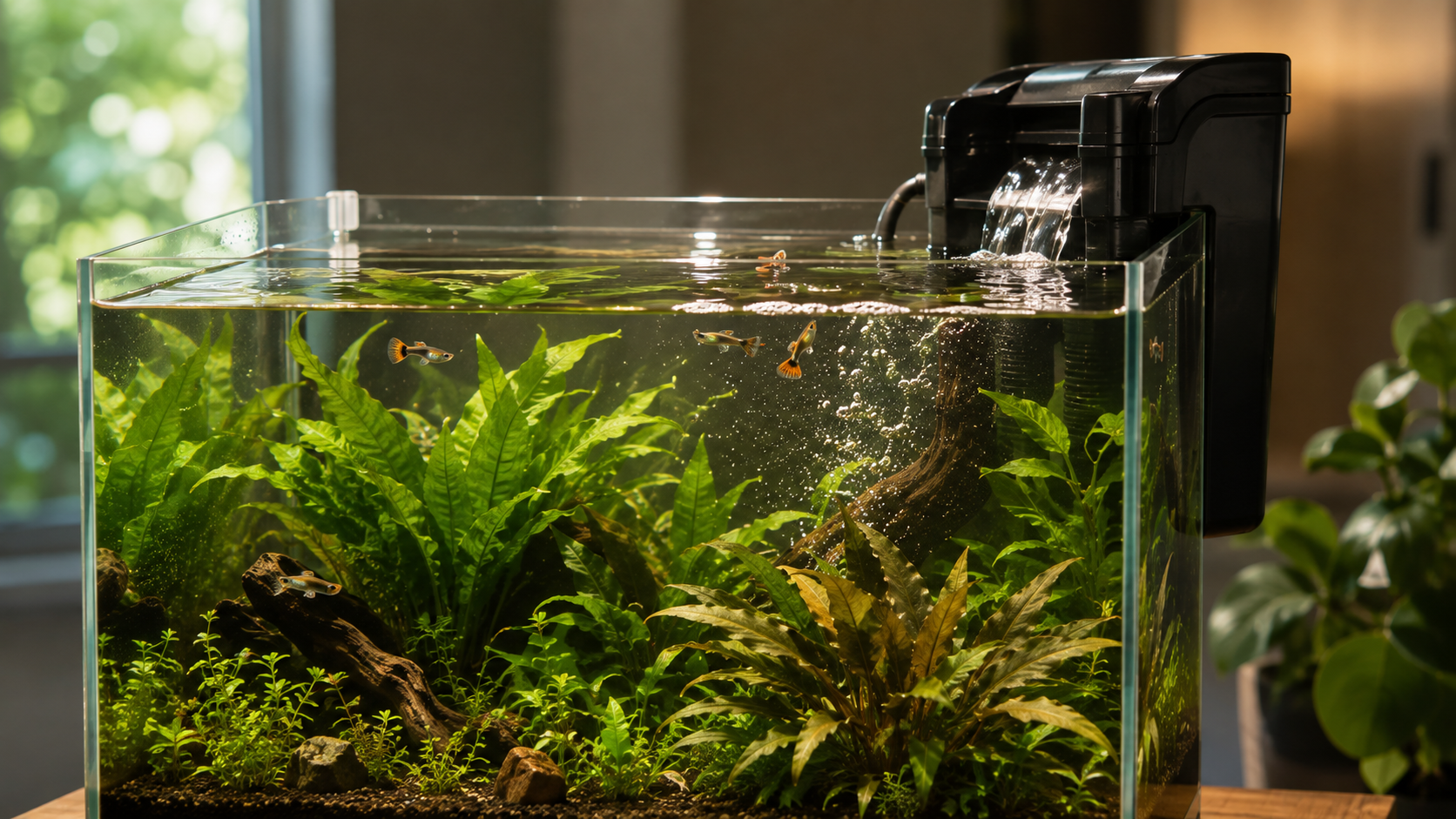
A quiet air stone can lift surface mist under a tight lid. See our quiet aquarium air pump guide for pump sizing, not for a clutch dunk.
Watch color, not the calendar alone. Tan to salmon eggs that stay chalk-white for weeks are often infertile.
When babies drop, they fall into the water. The USGS page states the young snails fall in after hatch.
That is why the clutch must hang over water. A dry tray under the clutch strands them.
How to move a clutch without drowning it
Move only a firm clutch, and keep it in air the whole time.
Move a clutch when the first spot is too dry, too bright, or in the filter splash.
Wait until the surface firms.
Use this move list:
- Wash your hands. Skip soap residue on the eggs.
- Slide a plastic card under the clutch, not a metal blade.
- Keep the mass in one piece if you can.
- Set it on a floating raft, a clip, or a jar lid above water.
- Close a lid or bag so air stays damp.
- Never set the eggs in the water.
The air gap is the whole point. University of Florida IFAS says inundated eggs will not hatch.
A second small tank works if it has a lid and warm water below. The eggs still sit in air.
Do not park the clutch on a heater tube. Direct heat can cook the mass.
A planted-tank light helps you see color change. It is not a hatch heater.
If you already run plants, our LED guide for a 20-gallon planted tank covers fixture length, not egg lamps.
After the move, leave the clutch alone. Peel once. Do not flip it daily.
Lusófona University’s record says maturity in culture came at 192±1.5 days. Plan tank space before you move a clutch just to see.
How to remove a clutch you do not want
Peel the mass, keep it out of outdoor water, and trash it.
Remove is the right door when you cannot house 200 to 600 snails.
University of Florida IFAS says you can scrape egg masses and let them fall in water. Inundated eggs will not hatch.
In a home tank that is a messy option. Babies you do not want should not enter the display.
Use this remove list instead:
- Wait until the clutch is firm enough to lift.
- Peel it with a plastic card.
- Bag the mass.
- Put the bag in household trash.
- Wipe the glass so slime does not re-stick.
Do not toss the clutch in a creek, pond, or storm drain. IFAS says never release aquarium applesnails into the wild.
IFAS also cites a hard shipping date. Effective 5 April 2006, USDA-APHIS requires permits for interstate shipment of marine and freshwater snails.
IFAS states permits are not being issued for Pomacea except P. diffusa. Shipping other apple snails without a permit violates US federal law.
If you remove, do it before day 15 in a warm room. Lusófona University’s record starts hatching at day 15 at 23°C.
Water tools that match a hatch
After babies drop, test the water and treat new water by the maker’s dose.
A hatch adds many small bodies at once. Waste rises even when each snail is tiny.
Our research team compared published specs on four current products. We did not rank them and we did not invent prices.
| Product | Job around a clutch | Maker-listed size or dose | Maker-listed numeric spec |
|---|---|---|---|
| Seachem Prime | Treat new water after babies drop | 5 mL per 50 US gallons of new water | Binds ammonia, nitrite, and nitrate up to 48 hours |
| API Freshwater Master Test Kit | Check pH, ammonia, nitrite, and nitrate | Four test tubes and a laminated color card | Maker page lists six parameters; test weekly |
| Fluval M100 Submersible Heater | Hold heat near the 23°C hatch window | 100 W for tanks up to 30 US gallons | Housing 11 x 1 x 1 in |
| Fluval M150 Submersible Heater | Same job in a mid-size tank | 150 W for tanks up to 45 US gallons | Housing 13 x 1 x 1 in |
Seachem’s Prime page sets the dose at 1 capful, which is 5 mL, per 200 L or 50 US gallons of new water.
The same page says Prime can be dosed every 24 to 48 hours. It binds those nitrogen compounds for up to 48 hours.
If ammonia or nitrite is above 2 ppm, Seachem’s page allows up to 5 times the normal dose. If water is above 30°C, or 86°F, and chlorine is low, it calls for a half dose.
A hatch tank should not sit at 86°F. That half-dose note is for hot water, not for speeding eggs.
For a full conditioner walk-through, see our freshwater water conditioner guide. Use the maker dose on the bottle you own.
API’s Freshwater Master Test Kit page says to test weekly. It ships with four test tubes, a tray, and a computer-calibrated color card.
That page lists six parameters. They include pH, high range pH, ammonia, nitrite, and nitrate.
API’s page states a pH of 7.0 is neutral. Use that card. Do not guess from water color.
Match wattage to tank volume on that Fluval table. Do not size up to force a faster hatch.
After babies drop, do small water changes. Dose Prime on the new water, not by guess.
We are a research desk. We compared published specs. We did not write a clinic protocol.
FAQ
How long do mystery snail eggs take to hatch?
Lusófona University’s record of Coelho, Calado, and Dinis (2012) lists 15 to 24 days at 23±1°C. One cluster can take up to 20 hours to finish. A clutch that never darkens by week four is often infertile.
Can mystery snail eggs hatch underwater?
No. University of Florida IFAS states inundated apple-snail eggs will not hatch. The USGS page also describes eggs laid above the water on plants or hard surfaces.
How many babies are in one clutch?
The USGS P. diffusa profile lists 200 to 600 eggs per clutch. Each egg is 3 mm across. Culture work in the Lusófona record reported a mean hatch success of 94.56%.
When should I move the clutch?
Move it only after the surface firms, and only if the first spot is dry or in splash. Keep the mass in air the whole time. A second humid lid gap is the goal.
What temperature should I hold for a hatch?
The Lusófona record used 23±1°C, about 73°F. Fluval’s M100 is listed at 100 W for up to 30 US gallons. The M150 is 150 W for up to 45 US gallons.
Are mystery snails legal to ship in the United States?
University of Florida IFAS says that as of 5 April 2006, USDA-APHIS requires permits for interstate snail shipments. IFAS also says permits are not being issued for Pomacea except P. diffusa. Do not dump any of them outdoors.
What should I do after the babies drop?
Test weekly with a kit such as the API Freshwater Master Test Kit. Treat new water with Seachem Prime at 5 mL per 50 US gallons. Culture animals in the Lusófona record reached maturity at about 192 days.