Quick answer: Keep one redtail shark in a long tank of 50 US gallons or more. Pair it with midwater schoolers. Skip a second shark and skip a rainbow shark.
FishBase lists a 13.0 cm maximum length and says this species should be kept solitary. This page is a published-spec research brief.
We use one selection rule for every scenario and product in this brief. We include only one redtail shark per tank, and only filters whose maker page lists 50 US gallons or more.
We also include only sinking foods that list a guaranteed analysis on the maker page. We exclude second sharks, nano tanks, floating flake-only diets, and rainbow sharks as tank mates.
What a redtail shark is
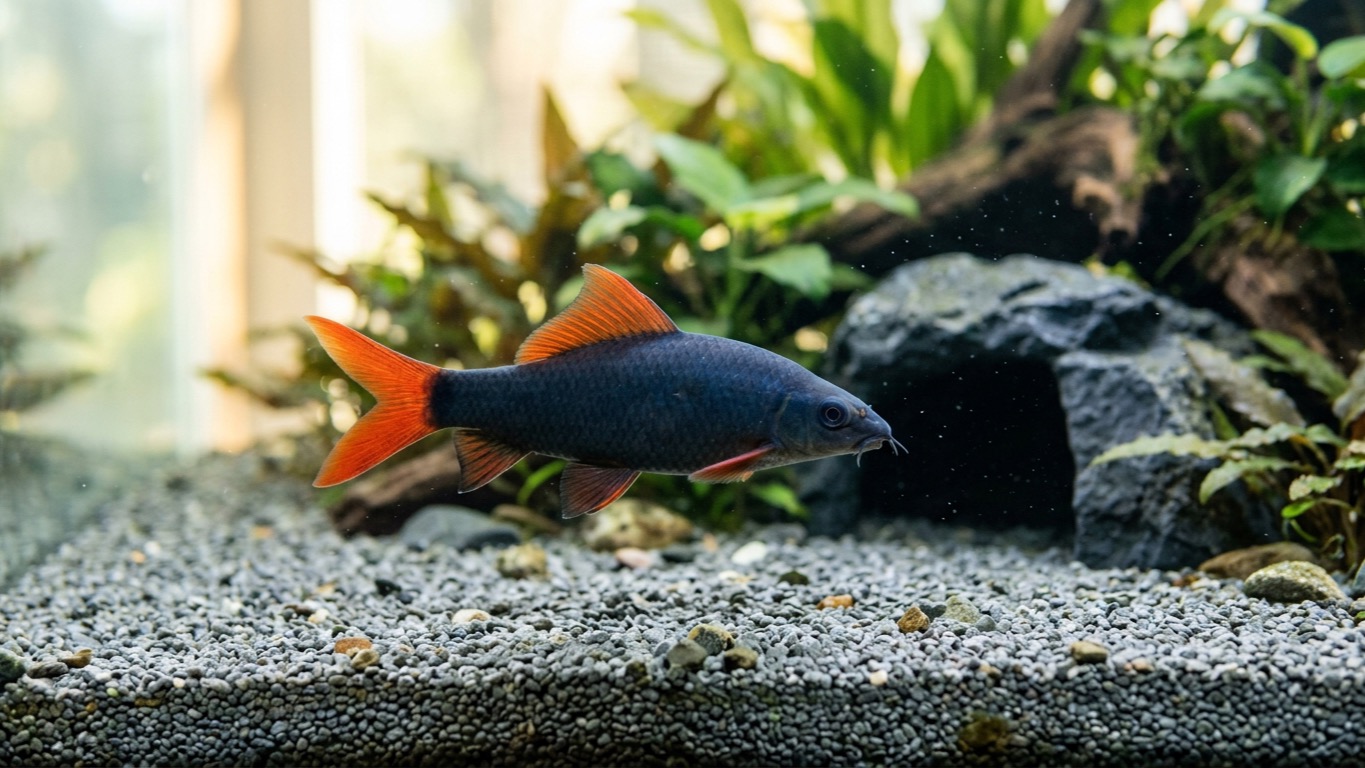
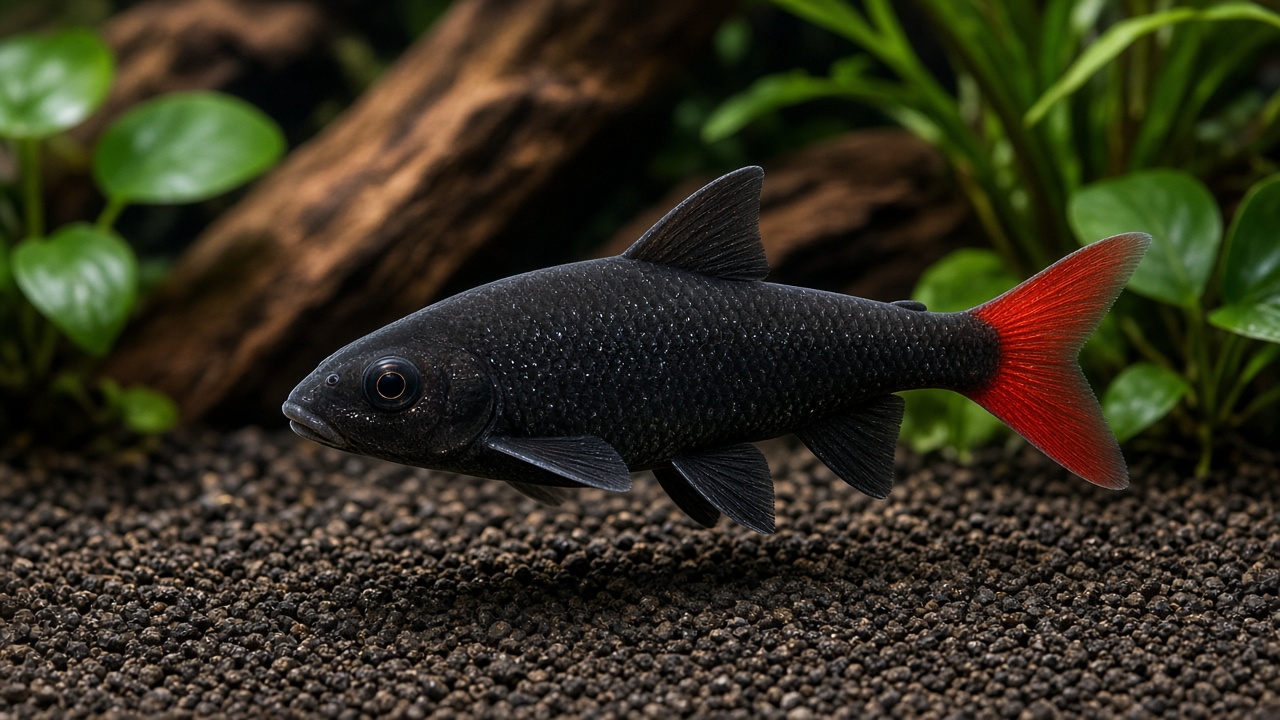
A redtail shark is a freshwater minnow with a shark-like outline, not a true shark.
FishBase lists the species as Epalzeorhynchos bicolor, with the common name redtail sharkminnow. It sits in Cyprinidae, the minnow or carp family.
FishBase places the species in Thailand’s Chao Phraya basin and also reports it from the Mekong basin. The fish is listed as elongated and demersal, so it uses the lower water more than the surface.
FishBase lists a maximum length of 13.0 cm TL, which is about 5.1 inches. Many store fish are sold much smaller than that adult size.
FishBase describes the diet as omnivorous and says the fish eats plant matter and small benthic animals. The same page lists a trophic level of 3.0, with a standard error of 0.34.
That trophic score sits at a mid-level consumer, not a large predator. FishBase also lists a fishing vulnerability of 20 of 100, which is a low score on that model.
FishBase lists the IUCN Red List status as Critically Endangered, assessed on 23 February 2011. That status is about wild fish, not a ban on farmed fish in the trade.
FishBase states that tens of thousands of specimens are exported each year from Thailand, and that all of those fish are now captive bred. The same record lists CITES as Not Evaluated.
Tank size and footprint
Our desk only covers tanks and filters listed for 50 US gallons or more.
FishBase lists aquarium keeping as solitary, and it says adults are territorial and may bully other fish. A short tank leaves no room to break that patrol.
FishBase also lists a 12.0 cm minimum aquarium size, and we reject that figure as a stocking rule. The same page lists a 13.0 cm adult and territorial behavior.
A 50 US gallon long tank is the smallest volume that meets our gear rule. Fluval’s page for the 407 Canister Filter lists a capacity of 50–100 US gallons. That listed floor is why 50 gallons is the cutoff here.
A longer footprint matters more than extra height. The shark needs a lane along the glass and one cave it can claim.
Give the tank hardscape that breaks sightlines. Use one main cave, then wood or rock so other fish can leave the claimed end.
Add the shark last, because a fish that arrives first often treats the whole floor as its yard.
Temperament and how many to keep
FishBase lists this species as solitary, and adults may bully other fish.
Keep one redtail shark, because two fish of the same shape will contest the same floor. Chasing is common as the fish grows and claims a cave.
The black body and red tail make the fish look bold, but the behavior is territorial, not hunting for large prey. Do not read the name as a license to stock a predator tank.
FishBase lists the species as harmless to humans and of no interest as a food fishery. Hobby tanks fail when people add a second “shark” for company, because company is the stressor here.
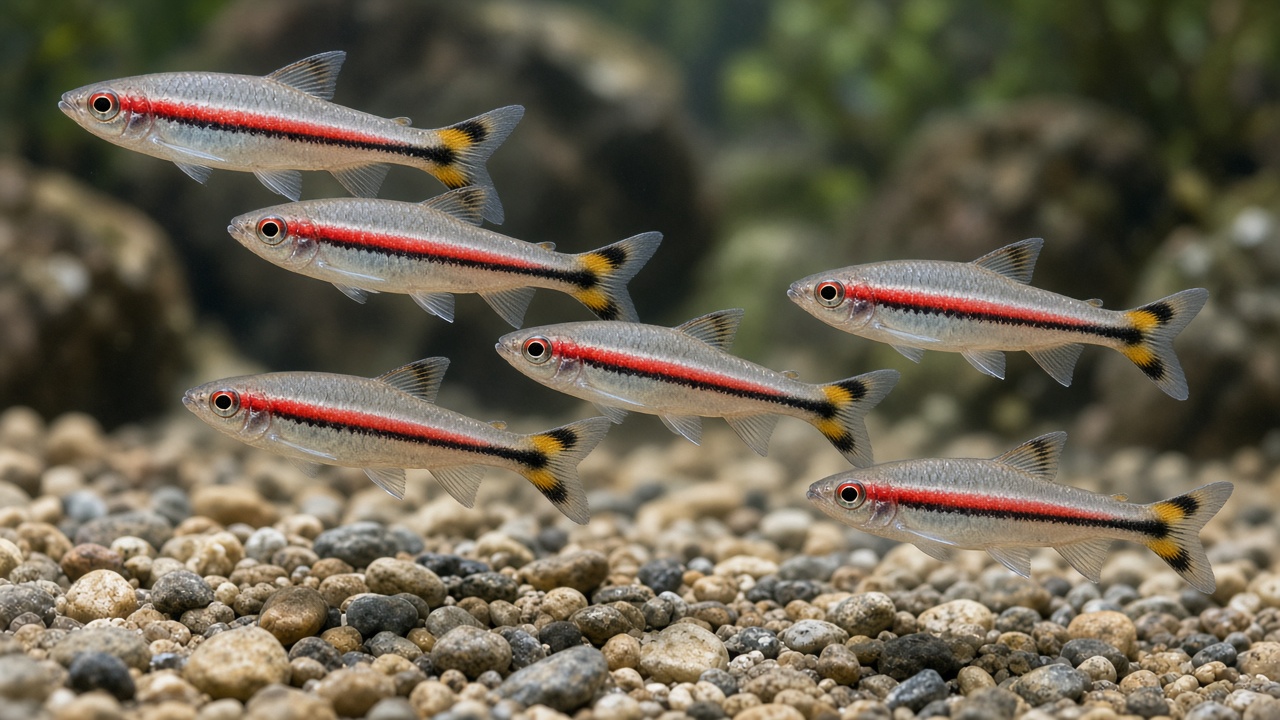
If you want a similar look, that is a different species. See our rainbow shark care brief, and still keep those two species apart.
Water values from published records
Match FishBase’s 22–26°C and pH 6.5–7.5, then check the tank with a weekly kit.
FishBase lists these published ranges:
- Temperature: 22°C to 26°C (about 72°F to 79°F)
- pH: 6.5 to 7.5
- Hardness: up to 15 dH
- Climate zone: tropical
- Habitat type: freshwater, demersal
Stay inside that band, and do not chase a single “perfect” number.
Aqueon’s Pro Adjustable Heater page lists a setting range of 68 to 88°F. The electronic thermostat is listed as accurate to ±1°, and that band covers FishBase’s 22–26°C window.
The same Aqueon page lists five wattages: 50, 100, 150, 200, and 300. The 50-watt size is listed for aquariums up to 20 gallons, so that size fails our 50-gallon gear rule.
API’s Freshwater Master Test Kit page tells you to test weekly. The kit measures pH, high range pH, ammonia, nitrite, and nitrate.
API’s page states that a pH of 7.0 is neutral, and that value sits inside FishBase’s 6.5–7.5 pH range. The kit includes four test tubes, a holding tray, and a laminated color card.
Follow the booklet for each test, then correct only what the card flags.
Tank mates we include and exclude
We include midwater schoolers and exclude other sharks and most bottom dwellers.
Include fish that stay off the floor. Fast schoolers in the middle and top of the tank leave the cave alone.
Exclude other redtail sharks, rainbow sharks, loaches, corydoras, and large plecos that sit in the same caves. Exclude shrimp, because a territorial bottom fish will treat small invertebrates as food.
Exclude slow, long-finned fish that cannot leave the patrol path. A guppy or a betta has no exit.
If you already keep a rainbow shark, do not add a redtail shark to that tank. The body-shape overlap is the problem.
Stock the school first and let those fish settle. Add the redtail shark last.
Gear compared from maker pages
Compare listed capacity, wattage, and analysis, and skip any rank column.
Our research team lined up six currently sold products against the 50-gallon gear rule. We kept one heater size that fails the volume rule so the cutoff is visible.
| Product | Role | Maker-listed capacity or analysis | Other published spec | Meets 50-gallon gear rule |
|---|---|---|---|---|
| Fluval 407 Canister Filter | Canister filter | 50–100 US gal | Pump output 383 US GPH (120 V / 60 Hz) | Yes |
| Aqueon Pro Adjustable Heater 50 W | Heater | Up to 20 gal | 68–88°F; ±1° | No |
| Aqueon Pro Adjustable Heater 200 W | Heater | 200 W size on the maker page | 68–88°F; ±1° | Use only on tanks that already meet the 50-gallon rule |
| Hikari Tropical Algae Wafers | Sinking disc food | min. 33.0% crude protein | Packs from 0.70 oz (20 g) to 2.2 lb (1 kg) | Yes, as a sinking diet |
| Hikari Tropical Sinking Wafers | Sinking disc food | min. 36.0% crude protein | Packs from 0.88 oz (25 g) to 2.2 lb (1 kg) | Yes, as a sinking diet |
| API Freshwater Master Test Kit | Liquid test kit | pH, high range pH, ammonia, nitrite, nitrate | Four test tubes; test weekly | Yes, as weekly monitoring |
Our research team compared those published specs. The Fluval 407’s listed pump output is 383 US GPH. That is 7.7 turnovers per hour on a 50-gallon tank, and 3.8 turnovers on a 100-gallon tank.
Hikari Sales USA lists 33.0% minimum crude protein on Algae Wafers and 36.0% on Sinking Wafers. The protein gap is 3.0 percentage points.
Algae Wafers also list a 4.0% minimum crude fat, while Sinking Wafers list a 9.0% minimum crude fat. Use the algae disc as the plant-heavy staple, and use the higher-fat disc as a smaller share.
The Aqueon 50-watt Pro heater is a real product and the wrong size for this fish. Pick a higher wattage from the same page after you confirm tank volume.
Diet and feeding
Feed sinking wafers that list protein on the maker page, then remove leftovers.
FishBase lists an omnivore diet of plants and small bottom animals. A sinking disc matches that feeding spot.
Hikari’s Algae Wafers page lists five sizes:
- 0.70 oz (20 g)
- 1.41 oz (40 g)
- 2.89 oz (82 g)
- 8.8 oz (250 g)
- 2.2 lb (1 kg)
Hikari’s Sinking Wafers page lists four sizes:
- 0.88 oz (25 g)
- 1.76 oz (50 g)
- 3.88 oz (110 g)
- 2.2 lb (1 kg)
Offer one disc at a time and watch the shark eat. Take out food that sits after the feeding window.
Do not rely on leftover algae on the glass, because that film is not a full diet. Skip floating flakes as the only food, since the fish feeds on the bottom.
FAQ
How big do redtail sharks get?
FishBase lists a maximum length of 13.0 cm TL, which is about 5.1 inches. Store juveniles are shorter, so plan the tank for the published adult length, not the bag size.
Can I keep two redtail sharks together?
No. FishBase lists aquarium keeping as solitary, and it says adults are territorial and may bully other fish. Our rule is one shark per tank.
Can a redtail shark live with a rainbow shark?
No. A rainbow shark is a different species with a similar outline, and both fish want the same floor. Keep the two species in separate tanks.
What water temperature do they need?
FishBase lists 22°C to 26°C, which is about 72°F to 79°F. Aqueon’s Pro heater page lists a 68–88°F setting range with ±1° accuracy, and that range covers the FishBase band.
Are wild redtail sharks still common?
FishBase lists the IUCN Red List status as Critically Endangered, assessed on 23 February 2011. The same FishBase page says tens of thousands of captive-bred fish are exported from Thailand each year.
What should I feed a redtail shark?
Use a sinking disc. Hikari’s Algae Wafers list a minimum of 33.0% crude protein, and Hikari’s Sinking Wafers list a minimum of 36.0% crude protein. Rotate plant-heavy wafers with a smaller share of the higher-fat disc.
How often should I test the water?
API’s Freshwater Master Test Kit page says to test weekly. Check pH, ammonia, nitrite, and nitrate, and keep pH inside FishBase’s 6.5–7.5 range.