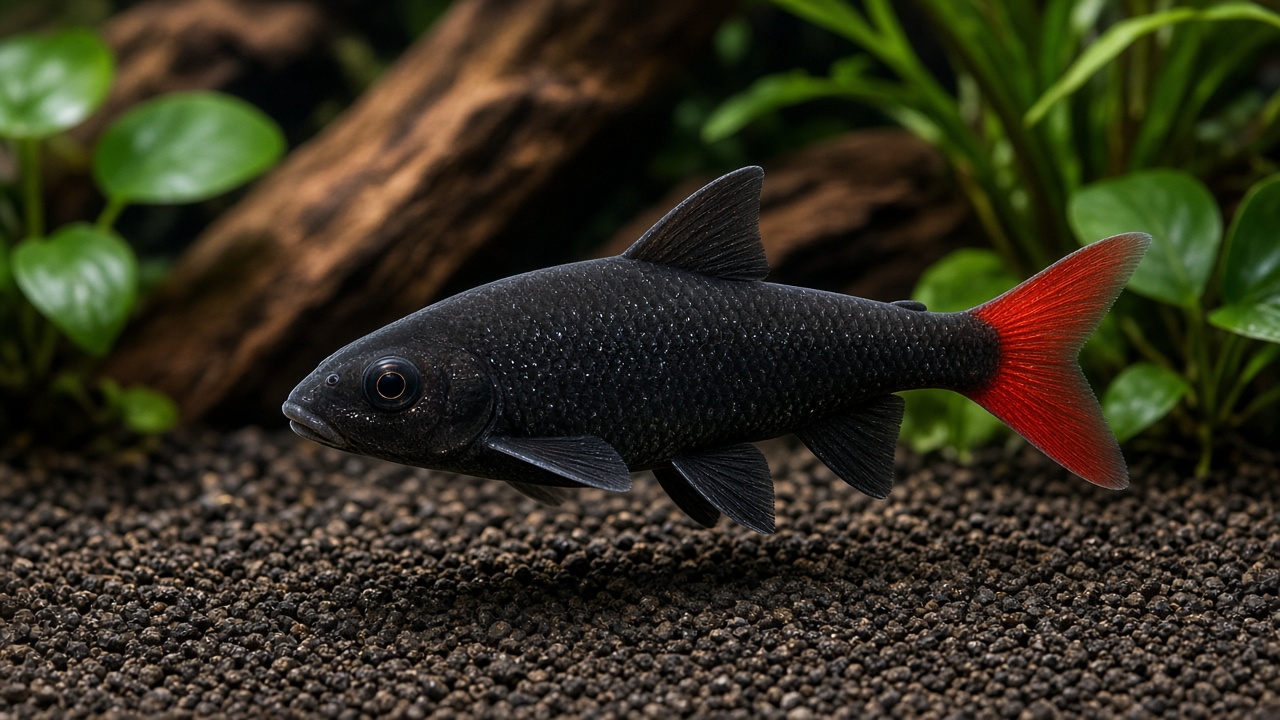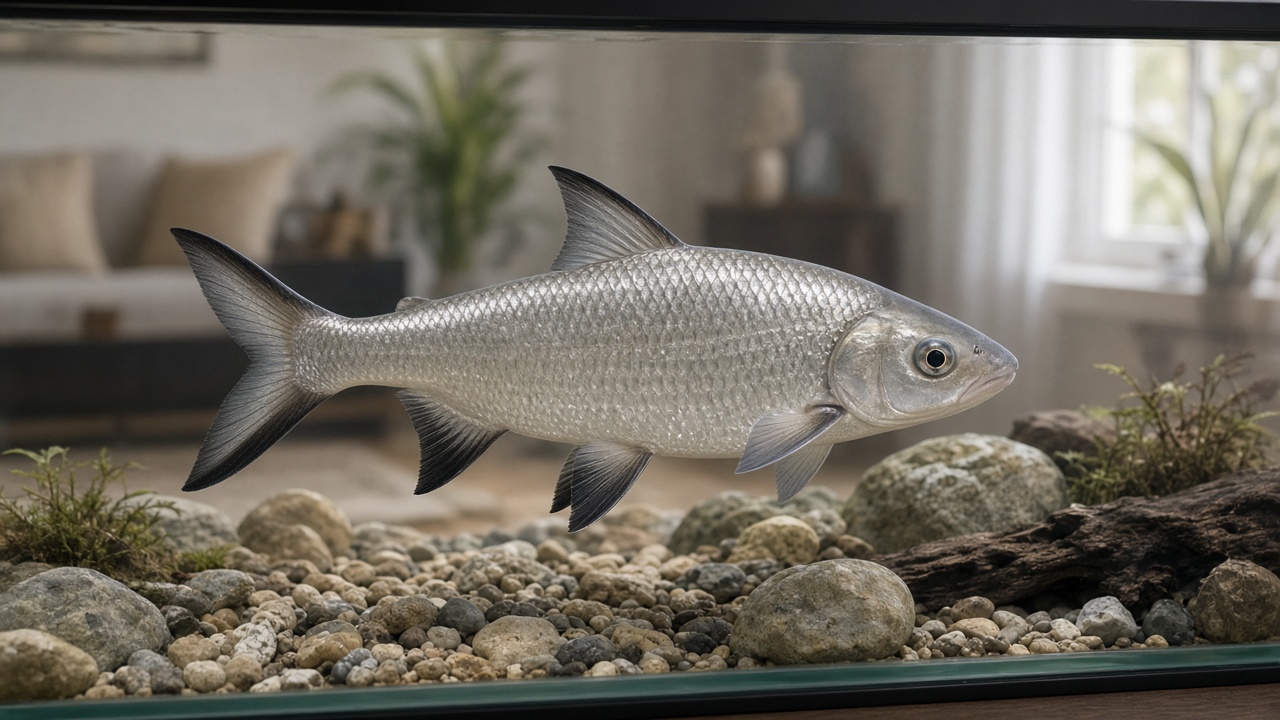
Quick answer: Plan for a 13.8-inch adult body, not the tiny fish on the store tag. FishBase lists 35.0 cm standard length. A school needs a tank longer than 150 cm, which means a 6-foot body, not a 4-foot 75-gallon.
A bala shark’s published adult size is 35.0 cm standard length, which is 13.8 inches without the tail. This page is a desk review of published size and tank-length figures.
Our research team compared FishBase records with Aqueon’s published tank chart. We put a tank in this article only if that chart lists a length of 48 inches or more. That cut keeps the 4-foot versus 6-foot gap visible, and we left out bowls, nano cubes, ponds, and every other “shark” species.
Adult size in the published record
FishBase, not hobby blogs, is the size source we used for this species.
FishBase lists Balantiocheilos melanopterus with a maximum of 35.0 cm standard length. Standard length is the body from the snout to the last backbone, and it does not include the tail fin.
Convert that figure to inches and you get 13.8 inches of body. That is the number that answers “bala shark size” with no extra story around it.
The common name is a look, not a family. This fish is a minnow relative, not a true shark, and stores also sell it as a silver shark or tricolor sharkminnow.
FishBase also marks the species as Vulnerable in its IUCN Red List field, and that field is dated 07 February 2019. The listing does not change the adult length.
Why some pages say 16 inches
The extra inches on some care pages usually come from counting the tail.
Standard length stops before the tail fin, while total length adds that fin. A 35.0 cm body plus a few inches of tail can look closer to 16 inches in a photo.
Our research team did not find a FishBase maximum above 35.0 cm standard length, so
If a store tag says 3 or 4 inches, that fish is still a juvenile. Aqueon’s FAQ states that fish do not stay small just because the tank is small.
Poor water in a small tank can stunt growth, and that outcome is harm, not a size plan.
Growth rate: what the records leave out
FishBase does not publish a month-by-month growth chart for this species.
The only honest growth line is that the published adult size is 35.0 cm standard length.
FishBase does publish a resilience note that estimates a minimum population doubling time of 1.4 to 4.4 years. That is a wild-stock model, not a home-tank growth calendar.
Buy the tank for the 35.0 cm adult on day one, not for a later upgrade.
FishBase gives this species a food-level score of 3.0, plus or minus 0.38. That matches an eater of small animals more than plants, so food quality can change how fast a fish fills out.
Diet still does not change the published maximum, so plan space around 13.8 inches of body.
The 150-cm Length Rule
Tank length, not gallon labels, is the rule we used for every setup in this guide.
FishBase’s aquarium-keeping line for this species is a group of 5 or more. The same line sets a minimum aquarium size greater than 150 cm, which is 59.1 inches of tank length.
We call that the 150-cm Length Rule. A tank qualifies for a school only if the maker’s published length is at least 150 cm. Gallon count is a second check, not the first.
Aqueon’s Standard Glass Rectangle chart makes the gap obvious:
- The Aqueon 75 Gallon Standard is 48.5 inches long, or 123.2 cm.
- That length is 26.8 cm short of the FishBase 150 cm floor.
- The Aqueon 90 Gallon Standard is also 48.5 inches long.
- Extra height on the 90 does not add a swim lane.
- The Aqueon 125 Gallon Standard is 72.5 inches long, or 184.2 cm.
- That length clears the 150 cm floor by 34.2 cm.
A 75-gallon tank can pass a gallon test and still fail length, so skip that plan for this species.
A betta tank can be a few gallons, but a bala shark cannot. The two fish share a pet-store aisle, and they do not share a footprint.
Published tank dimensions compared
These five Aqueon Standard Glass Rectangle sizes are the models we compared.
Aqueon’s chart lists length, width, height, empty weight, and filled weight.
| Model | Length (in) | Width (in) | Height (in) | Empty weight (lb) | Filled weight (lb) |
|---|---|---|---|---|---|
| Aqueon 75 Gallon Standard | 48.5 | 18.5 | 21.1 | 98 | 785 |
| Aqueon 90 Gallon Standard | 48.5 | 18.5 | 25.1 | 135 | 1,050 |
| Aqueon 125 Gallon Standard | 72.5 | 18.5 | 23.1 | 177 | 1,400 |
| Aqueon 150 Gallon Standard | 72.5 | 18.5 | 29.5 | 281 | 1,800 |
| Aqueon 210 Gallon Standard | 72.5 | 24.5 | 29.6 | 343 | 2,450 |
The 125 and the 150 share the same 72.5-inch length. The 150 is taller, not longer, so the extra gallons do not give this fish a longer cruise.
The 210 keeps that 72.5-inch length and adds width. Aqueon lists it at 24.5 inches wide, which helps turning room and still does not add swim length.
Aqueon’s FAQ says a filled aquarium weighs about 10 pounds per gallon, and the FAQ example is a 20-gallon tank at about 200 pounds.
The 125-gallon row on the chart lists 1,400 pounds filled, and that is a floor-load problem before it is a fish problem.
Aqueon’s FAQ also says most household furniture holds 5 gallons or less, so a 125-gallon body needs a stand built for that load.
Aqueon’s product page lists a 90-day warranty on these glass tanks, and large sizes use a one-piece center brace.
School size, water numbers, and the inch-per-gallon trap
Five adult bodies is the FishBase group size, not a suggestion.
FishBase says keep this species in groups of 5 or more. One fish is not a school, and two or three still leave a midwater minnow exposed.
Water numbers from the same FishBase page are narrow and plain:
- Temperature: 22–28°C, about 72–82°F
- pH: 6.0–8.0
- Hardness: 5–12 dH
- Habitat note: midwater in large and medium rivers and lakes
Aqueon’s FAQ offers a stocking slogan of one inch of adult fish per net gallon. Five adults at 13.8 inches equal 69 inches of fish, so that slogan would point to about 69 gallons.
Our desk math shows why that slogan fails here. Sixty-nine gallons can sit in a 4-foot box, but FishBase asked for more than 150 cm of length and five fish.
Length and group size beat the inch-per-gallon line. A short, deep tank can meet gallons and still fail the 150-cm Length Rule.
Aqueon’s FAQ also says a decorated 10-gallon tank holds about 8 gallons of water. Rock and gravel steal volume in a 125-gallon tank too, so plan filtration on real water, not the label.
Aqueon calls a 10% water change each week ideal, and it says to avoid changing more than 50% at once. Those are maker care notes, not a size substitute.
Filters, lids, and tank mates at this size
A 13.8-inch swimmer needs flow and a lid, not a hang-on filter sized for a 20-gallon.
Aqueon’s FAQ says to pick a filter rated one size larger than the tank. For a 125-gallon body, that points past a 125-gallon rating.
Fluval’s FX6 page lists these published specs:
- Rated aquarium capacity: 400 U.S. gallons (1,500 L)
- Pump output: 925 U.S. gallons per hour
- Filter circulation: 563 U.S. gallons per hour
- Filtration volume: 5.28 U.S. gallons
- Wattage at 120 V: 43 W
Those numbers are maker ratings, not a trial we ran. A school of five large minnows produces a lot of waste, so a canister in that class matches the volume.
This fish jumps when spooked, so a tight lid is part of the size plan. Open-top 6-foot tanks fail that simple check.
Tank mates must match the 13.8-inch adult, not the 3-inch juvenile, because tiny tetras become food later.
A rainbow shark is a different species with a different, smaller adult size. An electric blue acara is another large fish that needs real floor space, and neither one changes the 35.0 cm bala number.
FishBase lists the diet as phytoplankton plus small crustaceans, rotifers, and insect larvae for an eater with a bias toward small prey.
Feed what they finish in a short time, because Aqueon’s FAQ says most aquarium fish should eat their food in 2 minutes or less.
FAQ
How big do bala sharks get?
FishBase lists a maximum of 35.0 cm standard length, which is 13.8 inches of body without the tail. Some photos look longer because they include the tail fin. Plan the tank for the 13.8-inch body.
Can a bala shark live in a 75-gallon tank?
An adult school does not fit a 75-gallon tank. Aqueon lists the 75 Gallon Standard at 48.5 inches long, which is 123.2 cm and under FishBase’s 150 cm minimum. Volume on the label does not fix the short swim lane.
How fast do bala sharks grow?
FishBase does not publish a monthly growth rate for this species, and Use the 35.0 cm adult figure on the day you buy the fish. A small tank will not keep the fish small in a safe way.
How many bala sharks should I keep together?
FishBase’s aquarium-keeping line says groups of 5 or more, and that is the number we used. One fish does not meet that line, and a school also needs the 150 cm tank length, not a short 75-gallon box.
Is a 125-gallon tank long enough?
Aqueon lists the 125 Gallon Standard at 72.5 inches, or 184.2 cm, and that length clears the FishBase 150 cm floor. The 150-gallon Aqueon is the same length and only taller. Length is the pass or fail, not the extra gallons.
Are bala sharks true sharks?
They are not true sharks. They are minnow relatives in the carp family, and the shark name comes from the body shape and the tall back fin. True sharks are a different class of fish, but size care still follows the 35.0 cm FishBase figure.
What temperature do they need?
FishBase lists 22–28°C, which is about 72–82°F, and the fish should stay inside that band. Aqueon’s FAQ says most tropical fish prefer 76–80°F, which sits inside the FishBase range.