Quick answer: Keep roseline sharks only as a school of 6 or more in a long tank of 55 gallons or larger. Feed a small sinking or slow-sinking pellet twice a day. Do not treat them like a single “shark” centerpiece.
A roseline shark is a 15 cm hill-stream barb that needs a school of 6 in a tank 55 gallons or larger.
This research brief compared FishBase records and maker labels, and we did not keep a school, run assays, or write breeding steps.
The 55-and-6 rule
This article covers a setup only if it holds 6 or more captive-bred roseline sharks in 55 gallons or more.
That cut is ours, not a number copied from a shop blog. FishBase calls the species gregarious but does not name a school size.
We set the floor at 6 so the group can split and reform. We set the volume floor at 55 gallons so a long tank can hold that group.
We leave these cases out:
- One or two fish sold as a “shark” centerpiece
- Wild-caught buying lists
- Hormone breeding steps
- Sick-fish treatment plans
- Nano tanks under 55 gallons
If your plan fails that rule, stop here, because this page will not stretch the numbers to fit a short kit tank.
What a roseline shark is
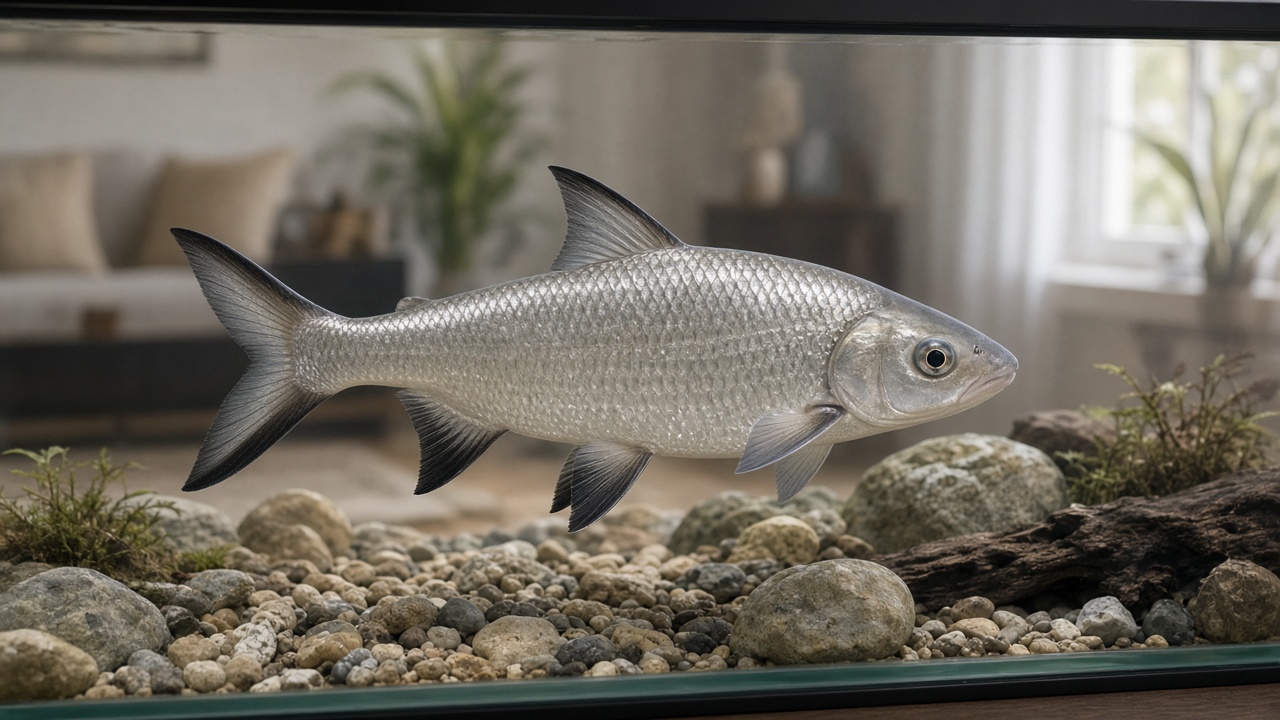
A roseline shark is a barb, not a shark, and FishBase lists the species as Dawkinsia denisonii.
Shops still print older names on bags, so you may see Sahyadria denisonii or Puntius denisonii. The trade names are roseline shark, Denison barb, and red-line torpedo barb.
FishBase records a maximum length of 15.0 cm total length, which is about 6 inches from snout to tail tip. The same page counts 2 dorsal spines and 9 dorsal soft rays. It also counts 1 anal spine and 5 anal soft rays.
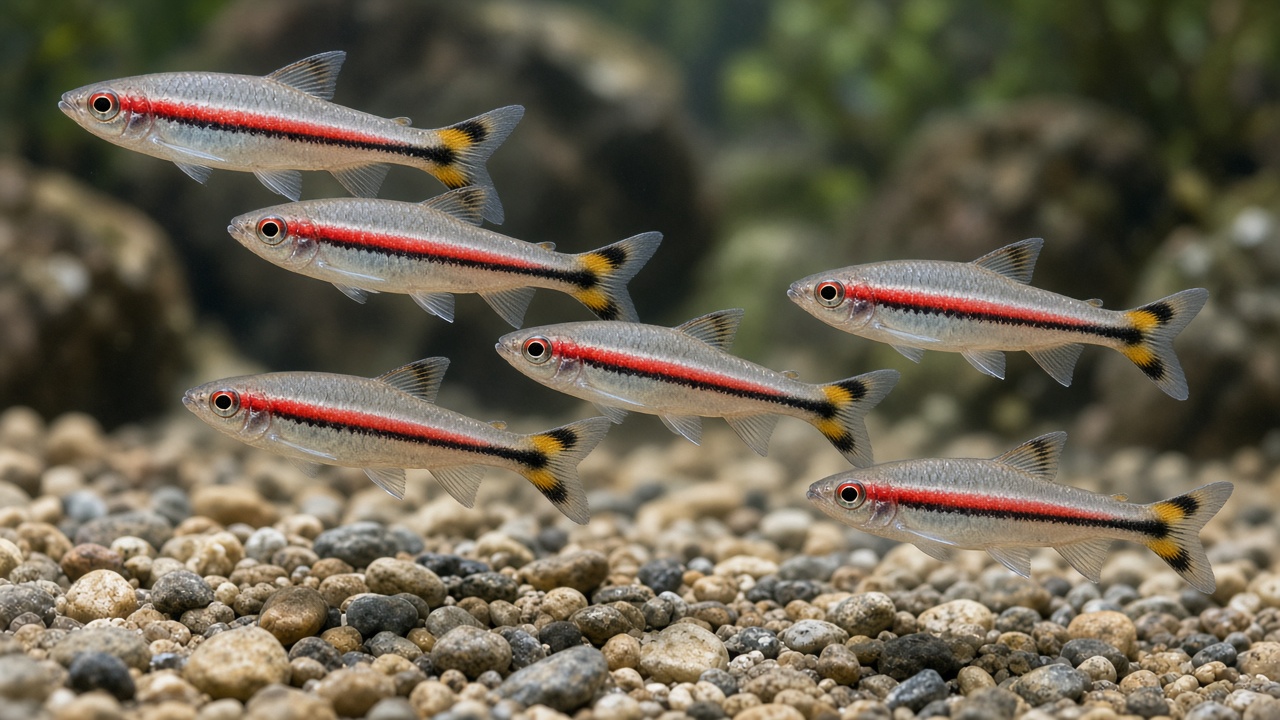
The body is a fast, slim hill-stream shape with a scarlet stripe from the snout toward the tail. A black band sits under that stripe, and the tail often shows a dark oblique mark.
FishBase places the fish in India, where it lives in fast hill streams. The record also calls the fish gregarious, which is why a lone fish is the wrong plan.
FishBase lists a trophic level of 2.6 and also lists the species as herbivorous, while shop foods for this fish are still omnivore pellets. Our table later compares those labels because that is what stores sell.
FishBase estimates generation time at 1.4 years, and that number is a model rather than a home-tank clock. It still tells you this is a short-generation stream barb, not a long-lived pond fish.
Tank size and swim room
A roseline shark needs a long swim lane more than it needs a tall tank.
Adults near 15.0 cm turn in a pack, and six adults need open midwater. A cube or a short 40-gallon box fails that need. Our 55-and-6 rule starts at 55 gallons, and a longer 75-gallon box is the better fit for 8 to 10 fish.
Use this layout checklist:
- A rectangular tank, not a tall column
- Open midwater from end to end
- Hardscape along the back and sides, not in the swim lane
- Smooth rock and wood with no sharp edges
- A tight lid on every open side
- A stand rated for a filled glass box
Do not stack decor in the center, because these fish cruise the long axis. They will pace the glass if that swim lane is blocked.
A 55-gallon long tank is the smallest box we will discuss, so add water volume when you add fish, not after color fades.
Schooling, tank mates, and the rainbow-shark mix-up
A roseline shark is a schooler, and a single fish is a stressed fish.
Keep 6 as the floor under our rule, and eight to 10 is the calmer group in a 75-gallon tank. The school should be the main midwater fish, not a side note.
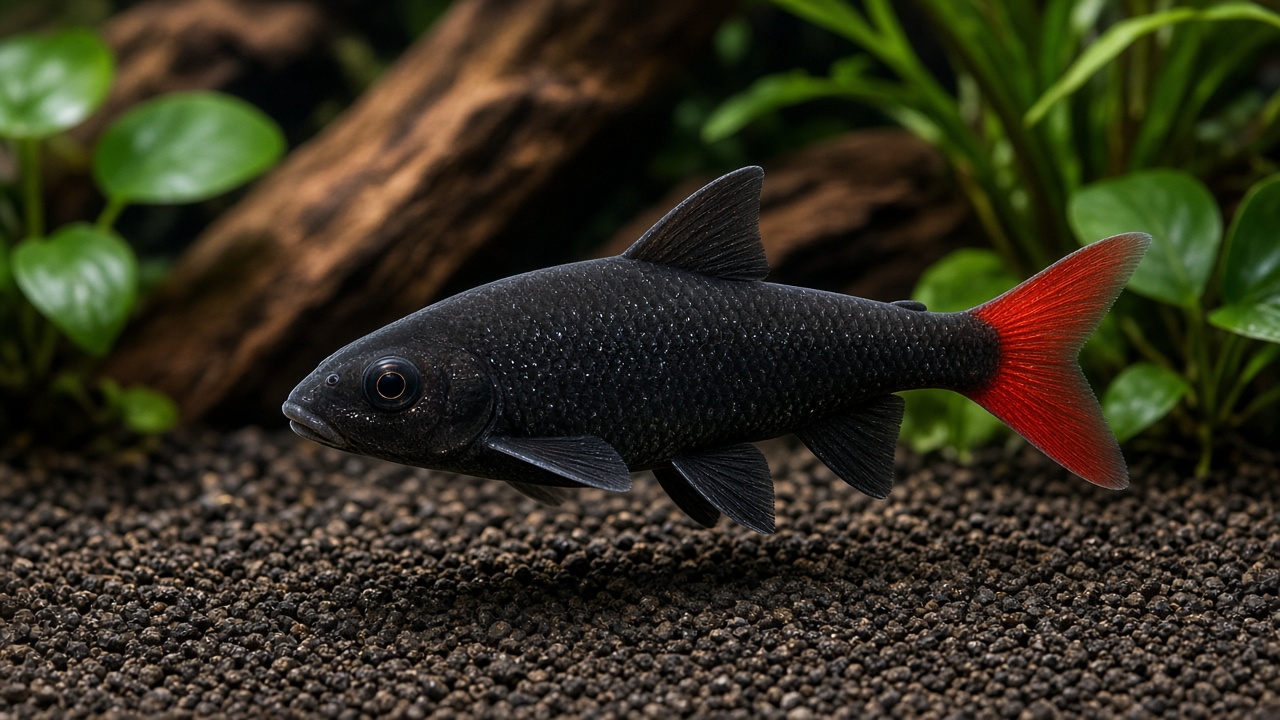
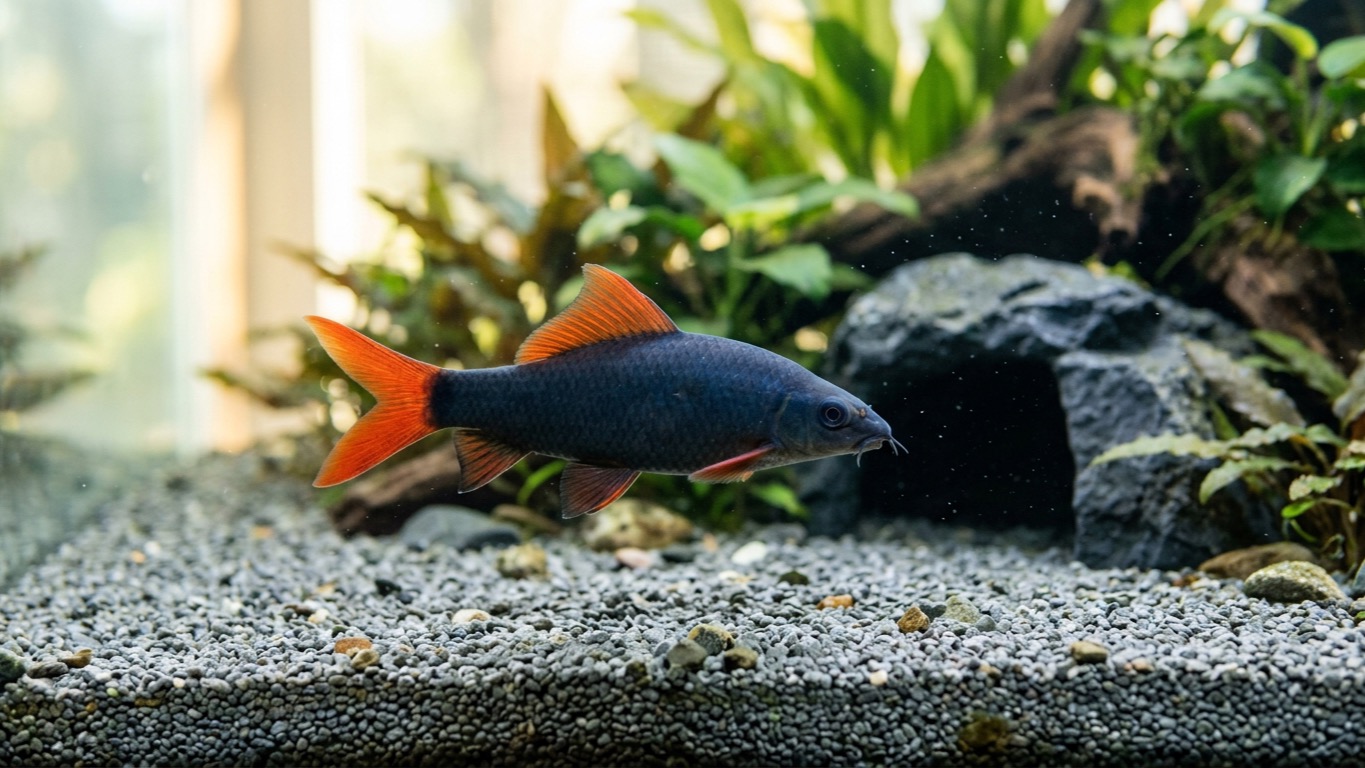
Do not mix this fish with a rainbow shark. A rainbow shark is a territorial bottom cyprinid kept as one. A roseline shark is a packing midwater barb, and those two plans fight each other for space and flow.
Safer tank mates stay out of the school’s lane:
- Other fast midwater barbs of similar size
- Large danios
- Rainbowfish that match the cool, moving water
- One quiet algae eater that stays on wood or glass
Skip these pairings:
- Other “shark” loaches or rainbow sharks
- Slow, long-finned gouramis
- Tiny tetras that fit in a mouth
- Shrimp colonies you want to keep
Add the school first and let it claim the lane, then add tank mates that will not crowd the same band of water.
Water, flow, and oxygen
Match a cool, moving hill stream, not a still tropical box.
FishBase lists these ranges:
- Temperature: 15°C to 25°C (59°F to 77°F)
- pH: 6.8 to 7.8
- Hardness: 5 to 25 dH
Hold the warm end under 77°F, because hot still water is the common failure. Use a heater only if the room drops below the FishBase floor. Aim the filter outlets along the long wall, and add a powerhead if the surface does not ripple.
Do this each week:
- Test ammonia and nitrite, and both should read none in a cycled tank.
- Change about one quarter of the water, which is our desk rule.
- Rinse filter media in old tank water, not tap water.
- Check that the lid still seats after you move decor.
High waste comes from a large, hungry school, and overfeeding shows up as cloudy water before it shows up as sick fish.
Diet and staple foods
Feed a small pellet that reaches midwater, then rotate a green item.
FishBase lists the species as herbivorous, with a trophic level of 2.6. That points to plants, algae, and small stream fare rather than a meat-only mix. Our research team compared published guaranteed analyses on four sinking or slow-sinking foods plus one floating color pellet.
Maker labels in that set list crude protein from 39% to 43%. Crude fat on those same pages runs from 7% to 12.5%. That spread is why we put the foods in one table, and we did not rank them.
| Product | Form and listed pack | Crude protein (min) | Crude fat (min) | Maker note on form |
|---|---|---|---|---|
| Hikari Tropical Micro Pellets | Granule; 22 g, 45 g, or 80 g | 43% | 7% | Daily diet for barbs and other small-mouthed fish |
| Fluval Bug Bites Tropical Granules (M-L) | 1.4–2.0 mm granules; 45 g | 40% | 12.5% | Slow-sinking granule |
| New Life Spectrum Thera+A Small | 0.5–0.75 mm pellets; 60 g jar | 39% | 9% | Negative buoyancy; most pellets sink |
| Omega One Color Pellets Slow Sinking | Mini pellets; 1.8 oz or 3.5 oz | 42% | 11% | Slow-sinking color pellet |
| Omega One Super Color Pellets Small Floating | Small pellets; 3.5 oz or 6.5 oz | 42% | 10% | Floating color pellet |
Hikari’s page for Tropical Micro Pellets lists minimum phosphorus at 1.1%. Fluval’s page for Bug Bites Tropical Granules lists phosphorus at 0.80% and calcium at 1.50%.
New Life Spectrum’s Thera+A page lists vitamin A at 10,000 IU/kg, and Fluval’s granule page lists vitamin A at 2,500 IU/kg. Those are label facts, not feeding scores.
Hikari’s page names tetras, barbs, and other small-mouthed tropical fish as the target. That matches a roseline shark’s mouth better than a large cichlid wafer.
Fluval’s granule page lists black soldier fly larvae as the first ingredient. It also says the formula can hold up to 40% of that larvae meal.
New Life Spectrum’s Thera+A page lists krill first and a small pellet of 0.5 mm to 0.75 mm. Fluval’s M-L granule is larger, at 1.4 mm to 2.0 mm. Use the smaller pellet for young fish, and use the larger granule once mouths grow.
Use this feeding plan:
- Offer Hikari Tropical Micro Pellets or Fluval Bug Bites Tropical Granules as the weekday staple.
- Hikari’s page says to feed 2 to 3 times daily, only what fish finish in a few minutes.
- Fluval’s page says to feed 2 or 3 times daily, only what fish finish in 2 minutes.
- Drop New Life Spectrum Thera+A Small or Omega One Color Pellets Slow Sinking on some days so food reaches the lower half of the school.
- Keep Omega One Super Color Pellets Small Floating as a top-water extra, not the only food.
- Add blanched zucchini or spinach 2 days a week to match the plant-leaning FishBase record.
- Fluval’s page says to use an opened tub within 6 months.
Skip a flake-only diet if the school ignores the surface, though a floating pellet can still help the top fish. The rest of the school needs a sinking or slow-sinking grain.
Do not chase color with extra feedings, because uneaten pellets raise waste. The red stripe fades first from heat, crowding, and nitrate, not from a missing can.
Wild status and what to buy
Buy captive-bred fish, and treat wild stock as off the table.
FishBase reports the IUCN Red List status as Endangered, and the assessment date on that record is 6 July 2010. FishBase also marks CITES as not evaluated, while listing the fish as endemic to India and used in the aquarium trade.
We did not survey exporters, and we did not count farm lots. The desk rule is still plain: if a seller cannot say the fish are captive-bred, walk away.
Ask the shop these questions:
- Are these fish captive-bred?
- How long have they been in the store tank?
- Are they eating a pellet, not only frozen food?
- How many can I take so I leave with 6 or more?
Bring a school home in one trip if you can, because adding two later often leaves the new fish outside the pack.
FAQ
How big does a roseline shark get?
FishBase lists a maximum length of 15.0 cm total length, which is about 6 inches. Plan the tank for that adult size, not for the small fish in the bag.
How many roseline sharks should I keep?
Our 55-and-6 rule starts at 6 fish. FishBase calls the species gregarious, so a pair is the wrong read of that record. Eight to 10 fish is the better school once the tank is larger than 55 gallons.
What tank size do roseline sharks need?
This page does not cover tanks under 55 gallons, and a long 55-gallon box is the floor for 6 adults. Move to 75 gallons or more for 8 to 10 fish, because length matters more than height.
What should I feed a roseline shark?
Use a small barb pellet as the staple. Hikari Tropical Micro Pellets list 43% minimum crude protein, while Fluval Bug Bites Tropical Granules list 40% and a 2-minute feed window. Add a green food twice a week, because FishBase lists the species as herbivorous, with a trophic level of 2.6.
Can I keep one roseline shark with a rainbow shark?
No, because a roseline shark needs a school. A rainbow shark is kept as one bottom fish. Those two plans do not share a 55-gallon tank well.
Are roseline sharks endangered?
FishBase reports the IUCN Red List status as Endangered, assessed on 6 July 2010. That is a wild-stock listing, which is why this page covers captive-bred fish only.
What water temperature do they need?
FishBase lists 15°C to 25°C, which is 59°F to 77°F. Stay in the cool half of that band if your room runs warm. Do not treat this fish like a hot still-water tank.