Quick answer: Keep adult freshwater angelfish in a tall tank of 55 gallons or more. Hold warm, stable water and feed short omnivore meals. Do not add fish small enough to swallow.
Aqueon sets 55 gallons as the floor for a full-grown freshwater angelfish. This page is a WaterPuppy desk brief that compares Aqueon’s angelfish care guide with current maker labels. We did not stock a display tank, hatch a spawn, or run feeding trials.
Selection rule: We cover captive-raised Pterophyllum scalare sold as freshwater angelfish for home tanks. We include only foods and conditioners whose maker pages we read in full. We leave out marine angelfish, altum and leopoldi husbandry, and wild-caught programs.
Our research team analyzed those sheets and called the set the WaterPuppy Angelfish Spec Spread, a label comparison rather than a tank log.
What a freshwater angelfish is
Most shop fish sold under this name are one South American cichlid, not a saltwater angel.
Aqueon’s angelfish care guide places them in the family Cichlidae and says most fish for sale are captive-raised Pterophyllum scalare. Pterophyllum altum shows up only now and then on that sheet, and Aqueon calls Pterophyllum leopoldi the smallest, most aggressive species, and almost never seen.
Wild fish on Aqueon’s page are silver with vertical stripes, while veiltails are farm strains with longer fins. Aqueon maps the wild range to much of the Amazon River system and says they use quiet, slow water under plants and fallen trees.
This brief stays with the shop species scalare and does not write a husbandry plan for altum or leopoldi.
Tank size and hardscape
Size the tank to the adult fish, and pick height over a short, wide box of the same gallons.
Aqueon’s housing line is plain and easy to check: a full-grown angelfish needs 55 gallons or larger, and tall tanks fit the body better. Aqueon does not print a juvenile gallon number on that care sheet, so do not invent a 20-gallon starter rule from other blogs.
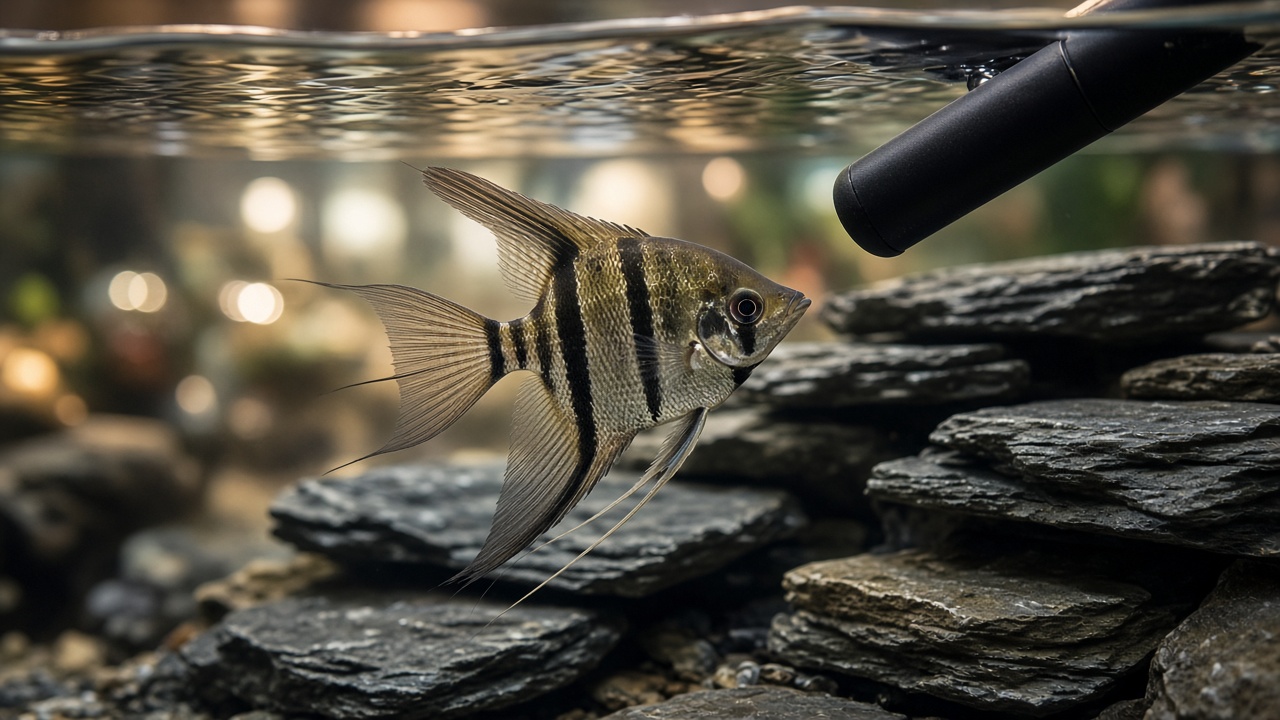
Aqueon also wants gentle flow through the tank, because strong current is a poor match for long, trailing fins.
Build the hardscape from that same Aqueon page:
- Large broadleaf plants
- Driftwood set vertically, like downed branches
- A few floating plants for shade
- Fine to medium gravel with a smooth surface
Aqueon says they forage along the bottom for food, so sharp gravel is a poor match for that habit. For plant picks that fit a tall, calm tank, see our freshwater aquarium plants guide.
Aqueon’s sheet does not give a jump height, so we do not invent one. A tight cover is still the safe default on a tall tank.
Water numbers Aqueon prints
Hold Aqueon’s published ranges, then change water on a set clock instead of waiting for cloudy glass.
Aqueon says captive-raised fish accept a wide range of tap water, and it still prints targets you can check with a kit:
- Temperature: 78°F to 84°F
- pH: 6.8 to 7.8
- Hardness: 3° to 8° dKH (54 to 145 ppm)
- Water change: 10% each week, or 25% every other week
Aqueon’s angelfish sheet does not print ammonia or nitrate limits, and we do not invent those missing numbers.
Treat new tap water before it hits the tank. Seachem’s Prime page sets the dose in milliliters, not guessed drops:
- 1 capful (5 mL) treats 50 U.S. gallons of new water
- Each cap thread is about 1 mL
- A double dose is listed for high chloramine
- Up to 5 times the normal dose is listed for a nitrite emergency
- Use a half dose if water is above 86°F and chlorine or ammonia is low
- Repeat doses are listed every 24 to 48 hours
Seachem also lists bottle sizes from 50 mL to 4 L, and the page says to add Prime to new water first when you can. A 55-gallon tank on Aqueon’s 10% weekly plan needs 5.5 gallons of new water. Seachem’s 5 mL per 50 gallons equals 0.1 mL per gallon, so that change uses about 0.55 mL.
For how conditioners differ, see our freshwater water conditioner guide. Check the tank on a schedule, not when the glass looks clear.
A liquid freshwater kit is the tool for that job. Our freshwater test kit guide covers the kits keepers actually buy.
Diet labels we compared
Rotate food forms so the fish is not locked to one floating flake for every meal.
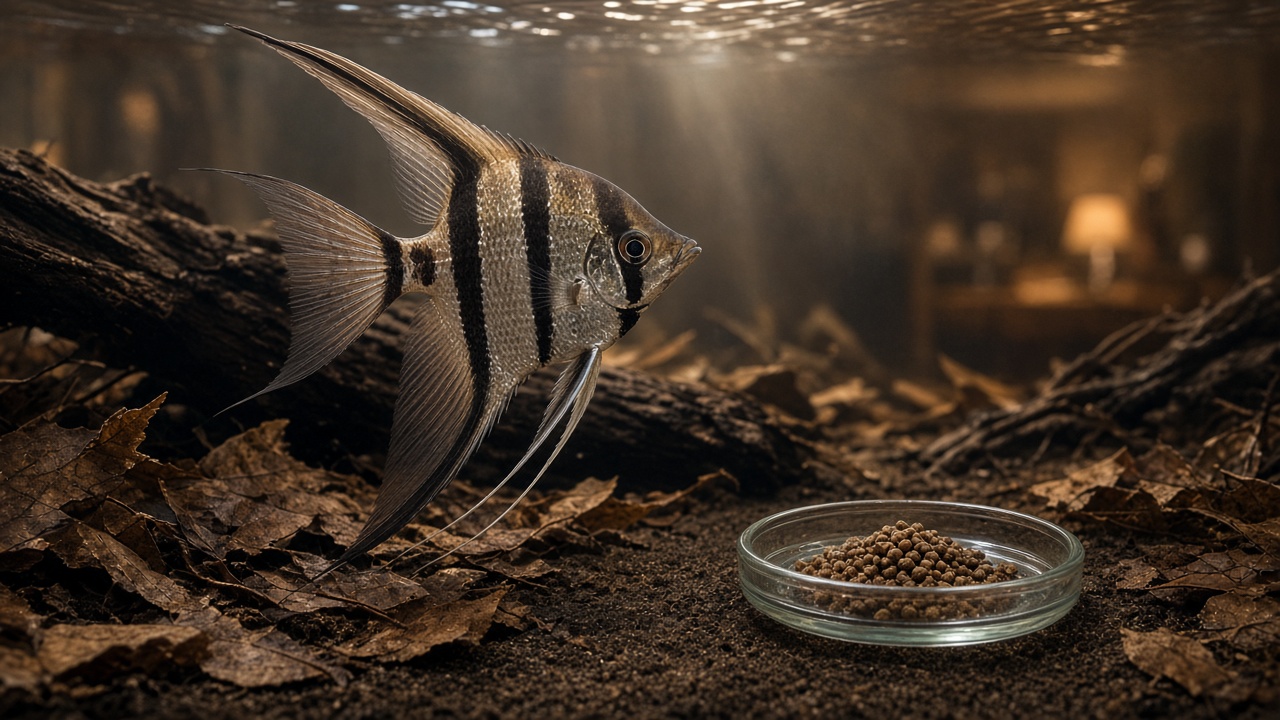
Aqueon calls angelfish omnivores that take worms and small crustaceans off the bottom. In the tank they will still feed at the surface or in mid-water.
Aqueon’s feeding clock is short and easy to copy:
- Feed only what they finish in 2 to 3 minutes
- Feed once or twice a day
- Rotate the diet each day
- Use frozen or live foods as treats, or to help induce spawning
Aqueon’s care guide names flakes, granules, and shrimp pellets as daily options. We opened the maker pages for those three products, plus one cichlid pellet.
Comparing published specs, the WaterPuppy Angelfish Spec Spread keeps these label facts:
| Product | Form | Maker-listed use | Listed size or pack |
|---|---|---|---|
| Aqueon Tropical Flakes | Floating flake | Maker names angelfish | 0.45 oz to 7.12 oz; carton 2.95 × 2.95 × 6.13 in |
| Aqueon Tropical Granules | Sinking granule | Maker names angelfish; listed for larger fish | 3.25 oz and 6.5 oz; carton 2.5 × 2.4 × 3.3 in |
| Aqueon Shrimp Pellet Bottom Feeder Foods | Sinking pellet | Maker names South American cichlids | About 9 mm; packs 3.25 oz, 4.8 oz, and 6.5 oz |
| Hikari Sinking Cichlid Gold | Sinking pellet | Maker names all cichlid types | Mini 3.0–3.4 mm; Medium 5.0–5.5 mm; 3.5 oz (100 g) |
| Seachem Prime | Liquid conditioner | Maker lists fresh and saltwater | 5 mL per 50 U.S. gal; bottles 50 mL to 4 L |
Aqueon’s flake and granule pages do not print protein or fat. We leave those cells blank on purpose instead of borrowing a number from a store listing.
Hikari’s Sinking Cichlid Gold page does print a guaranteed analysis. Crude protein is 40.0% minimum, and crude fat is 7.0% minimum. Fiber on that same Hikari label is 4.0% maximum, and moisture is 10.0% maximum.
That 40.0% protein figure is why the pellet sits in the table, and it is a printed label, not a feeding trial.
Hikari lists Mini item 04620 at 3.5 oz (100 g), and Medium item 04720 uses the same pack weight. Pick Mini pellets for young fish with small mouths, then move to Medium as the mouth grows.
Aqueon Tropical Flakes lists SKU 100551703 and UPC 015905003056, while Tropical Granules lists SKU 100106190 and UPC 015905061902.
Aqueon Shrimp Pellets list SKU 100552011, UPC 015905003315, and a carton of 2.4 × 2.4 × 4.6 in. The pellet is about 9 mm, which is a large bite for adults that already forage on the bottom.
Do not pour extra food to speed color, because leftovers become waste, and waste is a water problem rather than a growth plan.
Tank mates Aqueon lists
Pick neighbors too big to swallow, then watch pairs when they start to spawn.
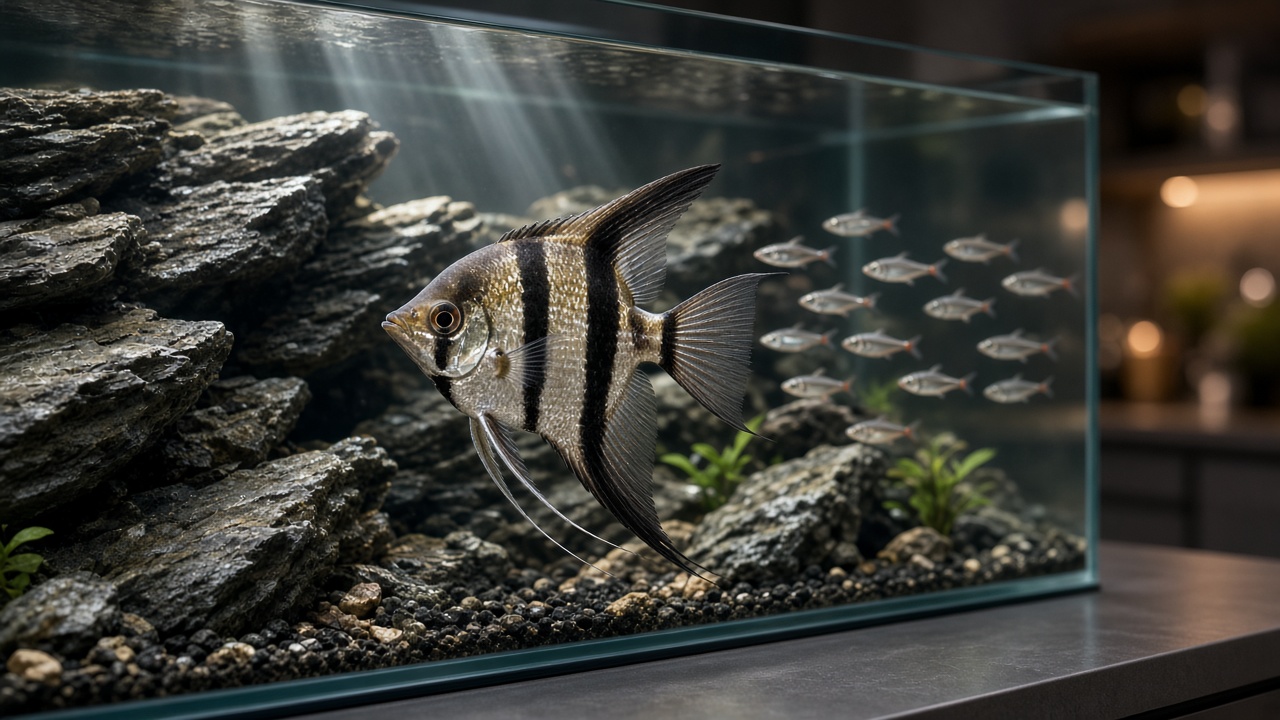
Aqueon calls angelfish generally peaceful community fish, and it still flags two habits you can see in a home tank. They can fight each other when they pair and spawn, and they will also eat any fish that fits in the mouth.
Aqueon says that second habit is ordinary feeding, not a special mean streak. A neon-size tetra is a snack if it fits.
Suitable mates on that Aqueon sheet are:
- Larger tetras and rasboras
- Gouramis
- Peaceful barbs
- Rainbowfish
- Corydoras and other medium-sized catfish
Aqueon also allows discus in larger tanks if temperature stays above 82°F. That 82°F floor is a mate rule, not a new everyday range for every tank.
Skip livestock Aqueon did not name on the care guide. We do not add shrimp, livebearers, or fin-nippers from other blogs.
Breeding: spawn site and egg theft
Aqueon rates breeding as intermediate, and most home pairs eat the eggs.
Adults pair off and spawn readily, per Aqueon’s care guide. They clean a flat vertical surface and chase other fish away from that spot.
Spawning itself is a two-step pass on that sheet:
- The female lays rows of eggs on the cleaned surface.
- The male follows and fertilizes those rows.
Aqueon says most captive angelfish have lost the rearing instinct. They usually eat their own eggs or fry.
Home breeding, on that sheet, is a salvage job rather than parent-rearing:
- Give the pair a vertical slate or similar plate.
- Let them lay on it.
- Move the plate to a hatchery tank.
- Raise the young away from the parents.
Aqueon does not print hatch hours, egg counts, or fry foods, so we do not invent those figures. Frozen or live foods are the only diet note that belongs here, and Aqueon lists them as treats that can help induce spawning.
A breeding pair will defend the site hard. Move tank mates before the chase turns into torn fins.
FAQ
Are freshwater angelfish the same fish as marine angelfish?
No. Freshwater angelfish are South American cichlids, and Aqueon names Pterophyllum scalare as the usual shop species. Marine angelfish are a different family sold for reef tanks, and the two care plans do not swap.
Can I keep a single freshwater angelfish?
Aqueon’s sheet does not ban a single fish, but it warns that groups fight when pairs form. A single adult still needs the same 55-gallon adult tank, and you should add a second fish only if you can split them later.
Why do people say neon tetras fail with angelfish?
Aqueon says angelfish eat anything that fits in the mouth. Small tetras match that size, so they fail as long-term neighbors. Use the larger tetras Aqueon lists.
Does Aqueon want a species-only tank?
No. The care guide is written for large community tanks, and it names gouramis, rainbowfish, and corydoras as fits. The limit is mouth size and spawn defense, not a ban on neighbors.
How can I tell they have spawned?
Look for a cleaned vertical plate, slate, or broad leaf. Aqueon says the pair lays eggs in rows, then guards the site. If eggs vanish overnight, the parents likely ate them.
Should I buy Pterophyllum altum instead of Pterophyllum scalare?
Aqueon says altum is only occasionally available, and this page does not write an altum plan. Buy scalare unless a seller documents the other species and you have a separate brief.
How often should I change water if I also test weekly?
Aqueon lists 10% each week or 25% every other week, so pick one clock and keep it. Testing tells you if that clock is failing, and it does not replace the change.
A freshwater angelfish is a tall cichlid, not a small community tetra. Hold Aqueon’s 55-gallon floor, print the water numbers, and rotate short meals.
Leave hatch recipes to people who move slates, and do not fill the gaps with a guess.