Quick answer: Buy a titanium in-line compressor chiller by the maker’s listed BTU or watt figure, not by horsepower. Match the printed flow window, and size up if summer room air stays above your target.
A 1/10 HP stamp is not one cooling rate: Hydrofarm lists 190 watts, and JBJ lists 75 watts. This page is a published-spec desk for home aquarium chillers, and we did not run tanks, record decibels, open compressors, or time any pull-down.
The Two-Number Rule: what got in
A model is in this article only if its maker page lists a titanium exchanger and a numeric min-max flow rate.
That Two-Number Rule is how this desk chose the six units below, after our research team analyzed current maker pages and ignored reseller blurbs.
We covered in-line compressor chillers that are sold for home tanks, and we compared only attributes each maker printed on its own page.
We left these items out on purpose:
- Thermoelectric probe coolers with no compressor
- Drop-in coils that skip in-line plumbing
- Fan-only surface coolers
- 230-volt commercial units
- Any model whose maker page omits a flow window
Horsepower alone did not get a unit into this page, and a gallon chart with no flow window did not either.
Top 7 Aquarium chiller
The picks below are the 7 aquarium chillers on sale right now, listed with what each suits best and an honest drawback. Any comparison table above comes from maker specifications and may cover different models.
1. AQUASMITH Aquarium Chiller Fan
Best for: Budget-friendly evaporative cooling for small nano tanks
We compared this to mechanical units and found it ideal for hobbyists needing a minor temperature drop without a high investment. Owners report it effectively lowers temps by a few degrees, provided the room humidity is kept in check.
Pros: Extremely affordable; Simple clamp-on installation Cons: High water evaporation rate
2. BAOSHISHAN 1/10 HP Aquarium Chiller 42 Gal Fish Tank Water Chiller
Best for: Reliable temperature regulation for 40-gallon setups
When reviewing mid-sized tank solutions, we noted this model offers a balanced approach to heat exchange. Owners report it is a dependable workhorse for maintaining stability in reef environments where temperature swings are a concern.
Pros: Compact footprint; Consistent cooling performance Cons: Requires external pump
3. VEVOR Aquarium Chiller
Best for: Heavy-duty cooling for larger residential reef tanks
We compared this unit to others in its price tier and found it offers significant BTU output for larger volumes. Owners report that while it takes up more space, the cooling efficiency is superior for demanding coral-heavy systems.
Pros: High cooling capacity; Sturdy build quality Cons: Heavy and bulky
4. SDLOOL Aquarium Chiller 42gal
Best for: Entry-level mechanical cooling for standard aquariums
In our assessment of accessible chillers, this model stands out for its straightforward setup process. Owners report it is a quiet, unobtrusive addition to a living room setup, making it a popular choice for beginners.
Pros: User-friendly digital interface; Quiet operation Cons: Limited flow rate compatibility
5. Fitnet 79 Gal Aquarium Chiller
Best for: Larger capacity cooling for up to 79 gallons
We compared this unit against smaller models and found it provides the necessary headroom for larger aquarium setups. Owners report it maintains a steady temperature even during warmer months, justifying the higher energy draw.
Pros: Handles larger water volumes; Efficient heat dissipation Cons: Higher power consumption
6. AISPA Aquarium Chiller 1/10 HP
Best for: Mid-range performance for specialized saltwater environments
When looking at 1/10 HP options, owners report this model provides a solid balance of power and precision. Owners report that the unit is highly effective at keeping sensitive invertebrates stable, provided the intake is kept clean.
Pros: Corrosion-resistant components; Precise temperature control Cons: Requires regular maintenance
7. PAIZOO Aquarium Chiller Fan
Best for: Micro-cooling solutions for desktop or betta bowls
We compared this to larger mechanical chillers and found it is best suited for very small volumes where space is limited. Owners report it is excellent for preventing heat spikes in small bowls, though it won't handle major temperature drops.
Pros: Ultra-low power usage; Very compact design Cons: Weak cooling range
Comparison: Aquarium chiller at a Glance
| Product | Best for | Approx. price | Where to buy |
|---|---|---|---|
| AQUASMITH Aquarium Chiller Fan | Budget-friendly evaporative cooling for small nano tanks | $45.99 | Check price |
| BAOSHISHAN 1/10 HP Aquarium Chiller 42 Gal Fish Tank Water Chiller | Reliable temperature regulation for 40-gallon setups | $279.99 | Check price |
| VEVOR Aquarium Chiller | Heavy-duty cooling for larger residential reef tanks | $359.91 | Check price |
| SDLOOL Aquarium Chiller 42gal | Entry-level mechanical cooling for standard aquariums | $219.99 | Check price |
| Fitnet 79 Gal Aquarium Chiller | Larger capacity cooling for up to 79 gallons | $279.99 | Check price |
| AISPA Aquarium Chiller 1/10 HP | Mid-range performance for specialized saltwater environments | $238.88 | Check price |
| PAIZOO Aquarium Chiller Fan | Micro-cooling solutions for desktop or betta bowls | $25.99 | Check price |
Want to browse every option? See the full range of aquarium chiller on Amazon →
Size by listed BTU and watts, not horsepower
Horsepower on a chiller case is a marketing label, not a standard cooling rate.
NIST’s Guide to the SI lists electric horsepower as 746 watts, so one-tenth of that is 74.6 watts. JBJ’s page for the Arctica DBA-075 prints “1/10 Hp / 75 w” as compressor output. Hydrofarm’s page for the Active Aqua AACH10HP prints a rated wattage of 190 watts on that same 1/10 HP stamp.
Those two numbers are not the same kind of rating, because JBJ is labeling compressor output while Hydrofarm is labeling unit wattage. TECO’s US TK-500 page prints power consumption of 225 watts on a 1/6 HP stamp.
Here is the horsepower mismatch in one list:
- JBJ Arctica DBA-075: 1/10 HP, 75 w compressor output
- Active Aqua AACH10HP: 1/10 HP, 190 W rated wattage
- TECO TK-500: 1/6 HP, 225 W power consumption
- JBJ Arctica DBE-200: 1/4 HP, 180 w compressor output
A 1/6 HP TECO lists more watts than a 1/4 HP JBJ, so if horsepower were a real rank that pair could not exist.
Hydrofarm’s AACH10HP page also prints 1,020 BTU per hour, which is a cooling rate you can check against the heat your gear adds.
NIST lists 1 International Table BTU per hour as 0.2930711 watt. The inverse is about 3.41 BTU per hour for each watt of heat in the water.
Use this sequence, and do not skip a step.
- Add the watt ratings of lights, return pumps, and powerheads that run in summer.
- Multiply that watt total by 3.41 to get heat in BTU per hour.
- If the maker lists BTU per hour, pick a unit at or above that load.
- If the maker lists only watts and a gallon range, use that range and the next size in a hot room.
- Keep the pump inside the maker’s printed GPH window.
TECO’s US TK-500 page gives a worked example you can copy. In an 86°F room, it lists a 40-gallon case at 1.89 watts per gallon. That pull-down is 9°F, from 86°F to 77°F, with a COP of 2.0.
That TECO example is a heat-load check, so a brighter 40-gallon tank needs more than 1.89 watts per gallon.
Six current models by published attributes
These six units are sold now, and the table uses only numbers their maker pages print.
No rank column appears here, and no price band either, so compare the printed labels side by side.
| Model | Maker HP label | Listed volume or BTU | Listed power | Flow window | Refrigerant |
|---|---|---|---|---|---|
| Active Aqua AACH10HP | 1/10 HP | 1,020 BTU/h; 10-40 gal | 190 W | 132-396 GPH | R134a |
| JBJ Arctica DBA-075 | 1/10 HP | 75 w compressor output | 75 w | 240-960 GPH | R-134a |
| TECO TK-500 | 1/6 HP | up to 120 gal | 225 W | 106-211 GPH | R290 |
| JBJ Arctica DBE-200 | 1/4 HP | 180 w compressor output | 180 w | 480-1,920 GPH | R-134a |
| TECO TK-1000 | 1/4 HP | 60-200 gal | 315 W | 132-211 GPH | R290 |
| JBJ Arctica DBM-250 | 1/3 HP | 250 w compressor output | 250 w | 480-2,420 GPH | R-134a |
Hydrofarm prints a titanium evaporator on the AACH10HP and a 10 psi maximum. TECO’s US TK-500 page prints a titanium exchanger and an 8.7 psi maximum. JBJ’s aquarium-series page prints a titanium heat exchanger on every model in the table.
TECO’s Italian catalog page lists the TK 500 at 130 US gallons. That rating is at 86°F room air and 77°F water. TECO’s US TK-500 page lists “up to 120 gallons” for the same family.
TECO’s US TK-500 page also prints a GWP score of 3 out of 150 for R290. It claims R290 cuts energy use 30% to 50% versus older refrigerants. That is TECO’s claim, not a lab result from this desk.
Pick by the row that matches your volume and flow, not by the HP column.
- Nano and small tanks: Active Aqua AACH10HP or JBJ Arctica DBA-075
- Mid tanks that need a wider flow window: JBJ Arctica DBE-200
- Mid tanks that need a tight flow window: TECO TK-500
- Larger home tanks: TECO TK-1000 or JBJ Arctica DBM-250
Match the printed flow window
A chiller cools only if water moves through it inside the printed gallon-per-hour window.
Too little flow can trip a freeze-protect circuit, and too much flow can cut contact time in the exchanger.
Maker windows from the pages we read:
- Active Aqua AACH10HP: 132-396 GPH
- TECO TK-500: 106-211 GPH on the US page; 132-211 GPH on the Italian page
- TECO TK-1000: 132-211 GPH
- JBJ Arctica DBA-075: 240-960 GPH
- JBJ Arctica DBE-200: 480-1,920 GPH
- JBJ Arctica DBM-250: 480-2,420 GPH
A TECO TK-500 will not take a 600 GPH return as-is. A JBJ DBA-075 expects at least 240 GPH, so those pumps are not interchangeable.
Plumbing notes the makers print:
- Hydrofarm includes 1/2 inch and 3/4 inch fittings on the AACH10HP
- TECO lists 3/4 inch SAE thread and a 5/8 inch barb
- JBJ lists 3/4 inch, 5/8 inch, and 1/2 inch adapters
Use vinyl or PVC rated for the pump, and do not feed house plumbing into these units. Hydrofarm’s AACH10HP page says the unit is not rated for central or house plumbing.
Put a strainer or filter sock ahead of the inlet, because debris in a titanium coil is a clog, not a later cleaning job.
Noise, stands, and exhaust air
Maker pages we read do not print a decibel rating, so placement and exhaust matter more than a noise rank.
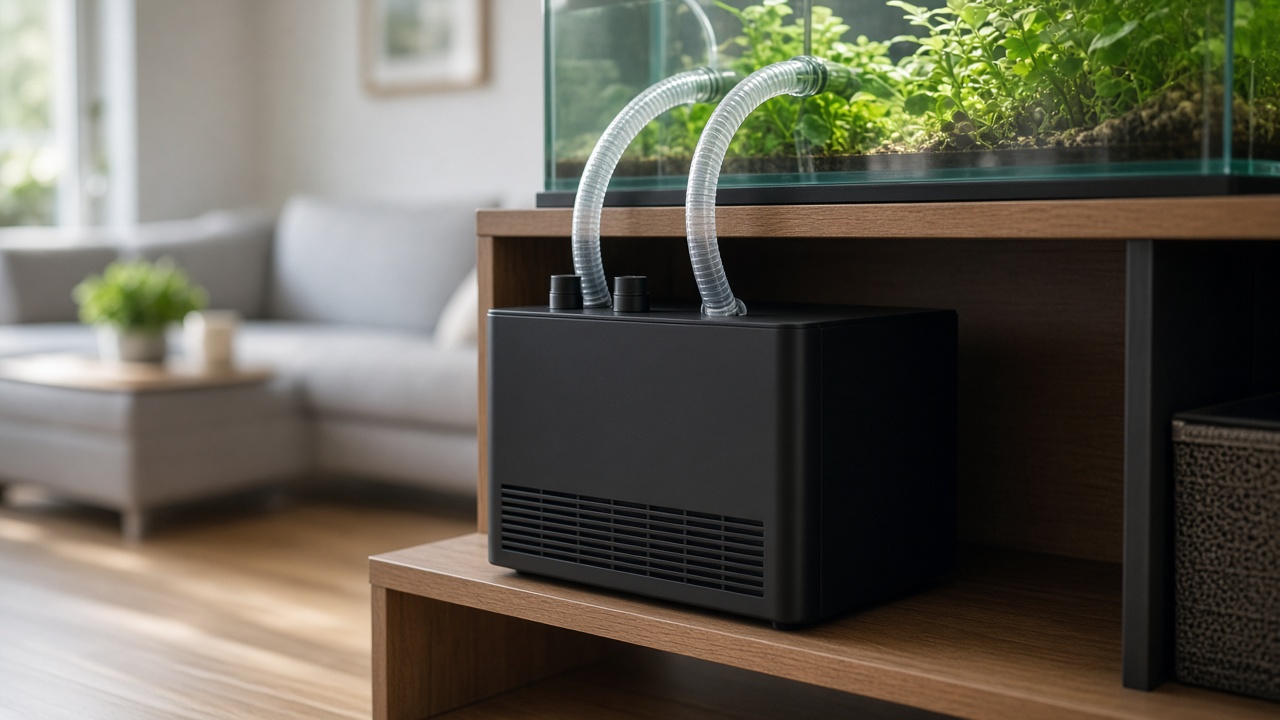
A compressor chiller is a small refrigerator, and its fan dumps heat into the room. A sealed stand cooks the unit and shortens run life.
Follow this placement list:
- Leave open air at the intake and the exhaust grille.
- Do not point exhaust back at the tank or the intake.
- If the unit sits in a stand, cut a vent and add a small exhaust fan.
- Keep the cabinet dry. Condensate belongs in a tray, not on wood.
- Set the unit on a firm, level pad so the compressor does not rock.
Warm water holds less oxygen than cool water. While the chiller catches a spike, a quiet air pump keeps the surface moving. That extra air is aeration, not a substitute for cooling.
Do not hunt for a silent compressor on these spec sheets, because none of these maker pages claim a dB number we can quote.
Heat sources: lights, pumps, and room air
Lights, pumps, and hot rooms add watts of heat that a gallon-only size chart misses.
A return pump dumps nearly all of its watts into the water, and powerheads do the same. Old halide lights dumped far more heat than modern LEDs. A 20-gallon planted tank on LEDs may stay in range with room air and a cracked lid.
You may skip a chiller when all of these points are true:
- Summer room air stays near your target
- Lights are low-heat LEDs
- The stand is open and the lid can vent
- A fan across the surface holds the peak
You likely need a compressor when any of these points are true:
- The room runs hotter than the target for weeks
- The tank sits in a closed canopy
- You keep cold-water species
- Fans drop the level too fast through evaporation
A water change can shave a short heat spike, but treat new tap water with a freshwater conditioner first. A change is not a sizing plan for the whole summer.
Hydrofarm’s AACH10HP page notes that starting ambient temperature changes how long the first cool-down takes. Treat that note as a startup warning, not a summer duty cycle.
FAQ
These answers use the same published maker numbers as the table above.
Do I need an aquarium chiller?
Need is about heat load, not tank brand, so if summer room air stays above your target a fan often fails. If lights and pumps add more heat than the water can shed, you need a compressor.
A 20-gallon LED tank in a cool room often does not need one.
How many BTU do I need?
Add equipment watts, then multiply by 3.41. NIST lists 1 BTU per hour as 0.2930711 watt, so that 3.41 factor is the inverse.
Compare the result to a listed BTU figure such as Hydrofarm’s 1,020 BTU per hour on the AACH10HP. If the maker lists gallons and COP instead, use that table and size up in a hot room.
Can I put the chiller inside the stand?
Yes, if air can enter and leave the cabinet, because a sealed stand traps the hot exhaust and makes the unit run longer.
TECO’s US pages describe a rotatable exhaust on the TANK line. Point that exhaust out of the cabinet and leave the intake unblocked.
Freshwater or saltwater — does the exchanger matter?
Yes, because salt water will eat the wrong metal, and every model in the table lists titanium.
Hydrofarm’s AACH10HP page says the evaporator is for fresh and salt water. JBJ and TECO print titanium as well, so do not use a copper or steel coil on a marine tank.
Why is my chiller running all the time?
The unit is undersized, starved for air, or starved for flow. Check the printed GPH window first, then check that exhaust is not looping back into the intake.
If both checks are fine, the listed BTU or gallon range is below your summer load, so move up one maker size.
Will a cooling fan replace a chiller?
A fan cools by evaporation and can hold a small tank a few degrees down. It also raises salinity and the amount of top-off water you must add.
It will not hold a reef or a cold-water tank in an 86°F room. TECO’s TK-500 example is a 9°F pull-down in that room, and a clip-on fan is not that job.
What pump do I need?
Use the maker’s min and max GPH, not the tank’s return rating. Hydrofarm lists 132-396 GPH for the AACH10HP, and TECO lists 106-211 GPH for the US TK-500.
JBJ lists 240-960 GPH for the DBA-075, and a valve or a dedicated loop is how you hit those windows.