Quick answer: Buy a cyanoacrylate gel sold for aquariums to mount plants and moss. Seachem Flourish Glue and Aquarium Co-Op Super Glue Gel are the two plant gels with listed hold times. Use an epoxy stick only when you need to lock heavy rock.
A cyanoacrylate gel with a listed 20- to 30-second hold is the aquarium glue for plants, moss, and light hardscape.
This page is a spec comparison of six sold adhesives;
Our research team compared the six maker pages listed after this article. Every gel that names a hold time uses 20 seconds or 30 seconds.
What this article includes, and what it leaves out
A product is in this article only if its maker page names aquarium use and lists a numeric hold, work, or cure time.
We call that filter the Waterpuppy Glue Gate, and it is our selection rule rather than a lab grade.
A product had to meet both checks:
- The maker page names freshwater use, saltwater use, or both.
- The same page lists a hold time, working time, or cure time in seconds, minutes, or hours.
These items did not make the cut:
- Household super glues that never name aquarium use
- Tank-building silicones sold as glass sealants
- Cotton thread, fishing line, and plant weights
- Coral-only liquids with no listed time on the maker page
This is a research-desk comparison of published specs, not a livestock clinic or a chemistry lab.
Top 7 Aquarium glue
The picks below are the 7 aquarium glues on sale right now, listed with what each suits best and an honest drawback. Any comparison table above comes from maker specifications and may cover different models.
1. WoldoClean Aquarium Super Glue Gel 50g Fish Safe
Best for: Bulk moss and hardscape days
WoldoClean’s 50g gel is the large tube on this list. The maker sells it as fish-safe super glue for plants, moss, and hardscape. Owners say one bottle covers a full scape, and they also warn a sloppy cap can skin the leftover glue.
Pros: Large 50-gram gel tube; Mid-price bulk size Cons: Open bottle dries out
2. Seachem Flourish Glue
Best for: Anubias and Java fern
Seachem Flourish Glue is the planted-tank staple on shop shelves. The maker’s page calls it a cyanoacrylate gel for moss, bunch plants, and wood, packed in small aluminum tubes. Owners like the control on rhizome plants; they also say those tubes empty fast on a wide hardscape.
Pros: Plant-line brand gel; Small aluminum tubes Cons: Tiny tubes empty fast
3. Aquarium Glue Clear for Plants Corals aquascaping Instant Aquarium
Best for: First cheap aquascape kit
This clear instant glue is the generic listing at $7.99. The name pitches plants, corals, and aquascaping, not a branded chemistry story. Owners treat it as a first tube and report the usual haze when too much gel meets wet rock.
Pros: Low $7.99 price; Clear instant plant glue Cons: No-name listing, thin support
4. Hygger CO2 Aquarium Glue
Best for: Budget planted-kit add-on
Hygger’s CO2-branded glue is the cheapest option here. Maker copy frames it as a clear gel for plants, moss, and wood. Owners buy it with Hygger gear and say it holds small moss patches; the tubes are not a bulk refill.
Pros: Lowest price on list; Clear plant-and-moss gel Cons: Small tubes, little leftover
5. Seachem Reef Glue
Best for: Coral frag plug mounting
Seachem Reef Glue is the coral-side gel, not the planted Flourish tube. The maker positions a thicker gel for mounting frags to rock and plugs, including underwater work. Reef keepers report it stays on plugs; planted-tank shoppers pay more than they would for a plant-labeled glue.
Pros: Reef-focused thick gel; Larger 20-gram tube Cons: Costs more than plant glue
6. 1DFAUL Aquarium Glue Fish Safety
Best for: Labeled fish-safe gel buyers
1DFAUL’s listing leads with fish safety and sits at the top of this gel-price stack. The name is the pitch: aquarium glue marketed as safe for livestock, not a heritage brand. Owners who write about it like that labeling; several note the bead can bloom white if it meets water too soon.
Pros: Fish-safety labeled gel; Sold as livestock-safe glue Cons: Highest gel price here
7. Loctite Silicone Sealant
Best for: Nano tank seam repairs
Loctite silicone sealant is not plant glue. Henkel’s sheet lists it as aquarium-safe silicone for glass repair and caps use at 30 gallons and 18 inches of water height. Owners use it on nano seams; it will not pin moss the way a cyanoacrylate gel does.
Pros: Flexible silicone tank sealant; Known hardware-store brand Cons: Wrong tool for plants
Comparison: Aquarium glue at a Glance
| Product | Best for | Approx. price | Where to buy |
|---|---|---|---|
| WoldoClean Aquarium Super Glue Gel 50g Fish Safe | $10.99 | Check price | |
| Seachem Flourish Glue | $9.45 | Check price | |
| Aquarium Glue Clear for Plants Corals aquascaping Instant Aquarium | $7.99 | Check price | |
| Hygger CO2 Aquarium Glue | $6.99 | Check price | |
| Seachem Reef Glue | $11.13 | Check price | |
| 1DFAUL Aquarium Glue Fish Safety | $14.89 | Check price | |
| Loctite Silicone Sealant | $27.85 | Check price |
Want to browse every option? See the full range of aquarium glue on Amazon →
Gel glue versus epoxy putty
Gel glue holds plants in seconds, while epoxy putty holds rock on a much longer clock.
Two chemistries show up on current maker pages, and they are not interchangeable.
Cyanoacrylate gel is the plant and moss adhesive. Seachem’s Flourish Glue page calls the product a cyanoacrylate adhesive that bonds within seconds. Aquarium Co-Op’s Super Glue Gel page lists ethyl-2-cyanoacrylate and polymethyl methacrylate.
Epoxy putty is the hardscape adhesive. Two Little Fishies’ AquaStik White Stone page describes an epoxy that cures underwater. Fluval’s Epoxy Stick page describes a kneadable stick for rock, coral, and certain plants.
Our research team lined up the listed clocks:
- Seachem Flourish Glue: press 20 seconds
- Seachem Reef Glue: press 20 seconds
- Aquarium Co-Op Super Glue Gel: press 30 seconds
- hygger HC005 Aquarium Glue: press 30 seconds; full cure in 5 minutes
- Two Little Fishies AquaStik White Stone: about 5 minutes of work; hardens in about 20 minutes
- Fluval Epoxy Stick: 24 hours in water; 48 hours out of water
That split is the practical rule. Use gel when you are holding a plant, and use epoxy when you are stacking rock.
Published specs for six current adhesives
The six maker pages split into 20-second gels, 30-second gels, and hour-scale epoxies.
Comparing published specs, the gel tubes are small and the epoxy sticks are not.
Listed pack mass from those pages:
- Seachem Flourish Glue: two 4 g tubes
- Aquarium Co-Op Super Glue Gel: two 5 g tubes (0.17 oz each)
- Seachem Reef Glue: one 20 g (0.7 oz) tube
- Two Little Fishies AquaStik White Stone: 114 g (4 oz)
- Fluval Epoxy Stick: 4 oz / 115 g
- hygger HC005 Aquarium Glue: a 2-piece or 3-piece pack with no gram weight on that page
Two original counts from that list:
- Seachem Reef Glue’s 20 g tube is five times one 4 g Flourish Glue tube.
- The 114 g AquaStik stick and the 115 g Fluval stick are each about 14 times the 8 g Flourish two-pack.
Aquarium Co-Op’s product page lists Super Glue Gel at $5.99 for the two-tube pack. Two Little Fishies lists AquaStik White Stone 114 g at $14.46 on its own store page.
| Product | Chemistry | Listed pack size | Listed set or cure time | Underwater use on the maker page | Glass note |
|---|---|---|---|---|---|
| Seachem Flourish Glue | Cyanoacrylate gel | 2 × 4 g | Press 20 seconds | Yes | Do not use on glass |
| Seachem Reef Glue | Cyanoacrylate gel | 20 g (0.7 oz) | Press 20 seconds | Yes | Do not use on glass |
| Aquarium Co-Op Super Glue Gel | Ethyl-2-cyanoacrylate + PMMA | 2 × 5 g | Press 30 seconds | Dries white underwater | Not stated |
| hygger HC005 Aquarium Glue | Gel adhesive | 2-piece or 3-piece pack | 30 seconds to set; 5 minutes to full cure | Yes, dry or underwater | Not stated |
| Two Little Fishies AquaStik White Stone | Epoxy putty | 114 g (4 oz) | About 5 minutes work; hardens in about 20 minutes | Cures underwater | Not stated |
| Fluval Epoxy Stick | Epoxy stick | 4 oz / 115 g | 24 hours in water; 48 hours out of water | Made for freshwater and saltwater | Not stated |
Seachem’s Reef Glue page says the new formula is 17x thicker, which is a thickness claim and not a strength rank.
Seachem’s Flourish Glue page says the aluminum tube is meant to last longer than plastic bottles. Reef Glue’s page repeats the same aluminum-tube claim.
Aquarium Co-Op’s page tells you to use one drop per square inch on one surface only. That is the only dose number in this set.
Which glue matches plants, moss, or heavy rock
Match gel to moss and rhizome plants, and match epoxy to stacked rock.
Plants and moss
Seachem’s Flourish Glue page names moss, bunch plants, rocks, driftwood, and even gravel. It tells you to apply glue to moss or plant roots and press for 20 seconds.
Aquarium Co-Op’s Super Glue Gel page names Java fern, Anubias, Bolbitis, mosses, and Bucephalandra. It tells you to glue roots when you can, not the rhizome.
hygger’s HC005 page names moss, coral, stones, wood, and live plants. It tells you to press for 30 seconds and wait 5 minutes for a full cure.
Seachem Reef Glue is the thicker 20 g gel. Its page aims the product at coral frags and plugs, and it also allows freshwater or saltwater aquascaping.
For a first planted tank, the 4 g or 5 g gels are the simpler buy. You get a short press time and a small tube you can empty before it skins over.
Mounted plants still need light after the glue sets. Use a fixture sized for the tank, such as the options in our LED light guide for a 20-gallon planted aquarium.
Hardscape
Two Little Fishies’ AquaStik White Stone page says the cured color is off-white and is meant to blend with dry limestone and ceramic rock.
That page gives you about 5 minutes of working time after a full mix, and it says the putty hardens in about 20 minutes.
Fluval’s Epoxy Stick page names rock, coral, and certain aquatic plants. Full cure is 24 hours in water and 48 hours out of water.
Do not use gel when gravity is the real problem. A 20-second press will not replace a stacked-rock plan.
What glue does not replace
Glue does not replace a water change after a messy session. Treat new tap water with a freshwater aquarium water conditioner before it goes back in.
Glue also does not replace gentle flow while plants settle. If you add an air stone during that week, pick a quiet aquarium air pump so the tank stays calm.
How to apply cyanoacrylate gel
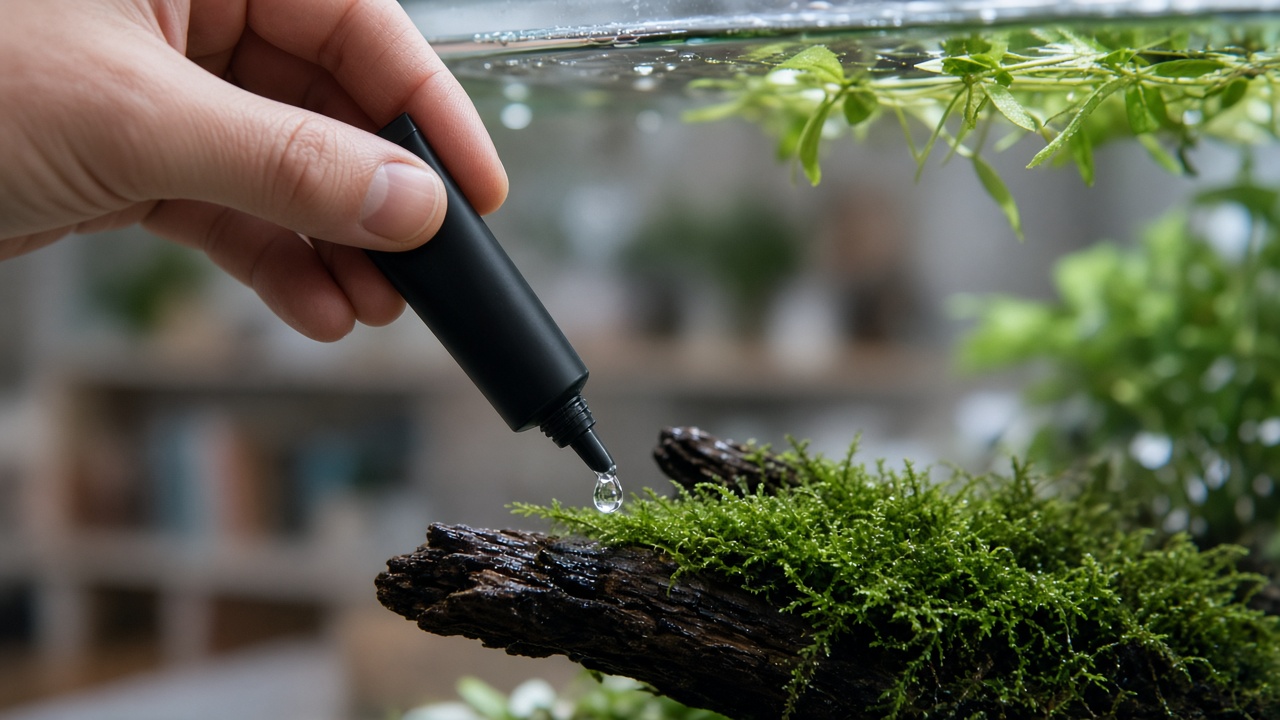
A rice-grain bead and a timed press beat a large smear.
Work from the maker directions, not from habit.
Seachem Flourish Glue and Seachem Reef Glue both say to dispense a small amount first. Then apply a small amount and press for 20 seconds. Wipe the tip before the cap goes back on.
Aquarium Co-Op Super Glue Gel adds more detail:
- Work in a ventilated area and keep the tube away from your face.
- Screw on the nozzle to puncture the seal. Do not squeeze while you do this.
- Use one drop per square inch on one surface only.
- Press for 30 seconds, or until the joint sets.
- Glue roots when you can. Too much glue on a rhizome can harm the plant.
- Use the outer cap to press the plant. The glue does not stick to that cap.
- Clean the tip and recap the tube.
hygger’s HC005 page gives a shorter list:
- Use a small amount so you leave less white residue.
- Press firmly for 30 seconds.
- Wipe the nozzle and tighten the lid.
- Put glue on contact points, not on large surrounding areas.
- Wait for a full cure before you add livestock. That page lists 5 minutes.
Seachem’s Flourish Glue page and Reef Glue page both warn that cyanoacrylate bonds skin and eyes in seconds. If glue reaches an eye, those pages say to rinse with water for 5 to 10 minutes.
Seachem’s Flourish Glue page also says not to use the product on glass, and Reef Glue’s page repeats that glass ban.
Aquarium Co-Op’s page says the gel dries white underwater. Cover the bead with a pinch of sand if the white spot bothers you.
How to apply epoxy putty
Knead epoxy until the color is even, then press the joint before the working window ends.
Two Little Fishies’ AquaStik White Stone page gives you about 5 minutes after a full mix. It says the putty hardens in about 20 minutes.
Use that window like this:
- Cut only the length you can place in 5 minutes.
- Knead until the color is even.
- Press the putty into the joint, not into plant tissue.
- Hold the rock until it stays put.
- Leave the structure alone through the 20-minute harden time.
Fluval’s Epoxy Stick page says the stick is easy to knead by hand. Plan the longer clock:
- 24 hours for a full cure in water
- 48 hours for a full cure out of water
That is a build-day product, not a 20-second plant tool.
Fluval’s page also says the stick will not hold an object that gravity would already pull down. Brace heavy rock first, then use epoxy to lock the joint.
Keep epoxy off rhizomes and moss cushions. Those jobs belong to the gels with 20- or 30-second presses.
None of these six pages list a bond-strength number in pounds, and our research team did not invent one.
FAQ
Is aquarium glue safe for shrimp once it has set?
Aquarium Co-Op’s Super Glue Gel page says the gel is completely safe for fish, plants, snails, shrimp, and other aquarium animals. Fluval’s Epoxy Stick page says the stick is non-toxic and safe for aquatic plants, fish, and reptiles. Use the product the maker named for your job, and keep animals off unset gel.
Can I use a hardware-store super glue gel?
This article leaves those tubes out. The Waterpuppy Glue Gate requires a maker page that names aquarium use and lists a time. A hardware tube can be the same monomer and still fail that rule.
Why does the glue turn white in the tank?
Aquarium Co-Op’s page says Super Glue Gel dries white when used underwater. hygger’s HC005 page says excess glue may leave white residue. Use a smaller bead, or cover the spot with sand.
Can I glue plants to the aquarium glass?
No for the two Seachem gels in this article. Seachem’s Flourish Glue page and Reef Glue page both say not to use those products to adhere items to glass surfaces. Use wood, rock, or gravel instead.
How much gel should I use on an Anubias?
Aquarium Co-Op’s page says one drop per square inch on one surface. Glue the roots if you can, and press for 30 seconds. Do not coat the rhizome.
When should I buy epoxy instead of gel?
Buy epoxy when the job is stacked rock or a coral plug that needs a kneaded mass. Two Little Fishies lists about 5 minutes of work and a 20-minute harden on AquaStik White Stone. Fluval lists a 24-hour in-water cure on the 115 g stick.
Do I need a water change after I glue plants?
A small, clean gel job does not require a change on its own. If you shed crumbs or stir debris, change part of the water and treat the new water with a conditioner. Then leave the plants under the light they already need.