Quick answer: Cycle a new tank until ammonia and nitrite read 0 ppm and nitrate is present. Use a liquid test kit each week, because bottled bacteria can seed the filter but do not replace testing.
Aquarium bacteria convert ammonia to nitrite, then nitrate; the tank is cycled only at 0 ppm ammonia and nitrite. This page is a research-desk comparison of maker-listed cycling products and EPA tap-water limits. We did not run tank trials, keep livestock, or culture filter bacteria.
The 0-0-plus rule: what the cycle actually does
The nitrogen cycle is a two-step bacterial conversion from ammonia to nitrite to nitrate.
Fish waste, leftover food, and rotting plants release ammonia into the water. Bacteria oxidize that ammonia to nitrite, and a second group oxidizes nitrite to nitrate.
Nitrate stays in the water until you dilute it or plants take it up.
We use this pass check, the 0-0-plus rule:
- Ammonia reads 0 ppm.
- Nitrite reads 0 ppm.
- Nitrate is present, so the second step is working.
That rule can be shown wrong if ammonia or nitrite stays above 0 ppm.
API Fishcare’s page for the API Freshwater Master Test Kit lists ammonia, nitrite, and nitrate among six measured levels. The same page also lists pH and high range pH, and it tells you to test weekly.
Seachem’s Stability page describes the same waste chain in maker language. Its bacteria blend is listed for waste organics, ammonia, nitrite, and nitrate.
How our research team chose what to cover
A product is in this article only if the maker’s own page lists a first-day dose or a weekly test rule.
That rule let in five currently sold items:
- API Freshwater Master Test Kit, for weekly ammonia, nitrite, nitrate, and pH
- API Quick Start, a live nitrifying-bacteria dose
- Seachem Stability, a 7-day spore-form bacteria schedule
- Seachem Prime, a conditioner that binds ammonia, nitrite, and nitrate
- Tetra SafeStart Plus, a whole-bottle live-bacteria start for tanks up to 100 gallons
The same rule left out saltwater-only kits, medications, and ranked “best bacteria” lists. It also left out any bottle we could not read on the maker’s HTML page, kitchen ammonia recipes, and livestock medical advice.
Our research team analyzed published specs and lined up first-day label doses for a 10-gallon tank as label math, not tank results.
Ammonia, nitrite, and nitrate in plain numbers
Hobby kits report aquarium waste, while the EPA reports nitrate and nitrite in public tap water. Do not treat those two jobs as the same number.
The U.S. EPA’s National Primary Drinking Water Regulations set a nitrate MCL of 10 mg/L, measured as nitrogen. The same EPA table sets a nitrite MCL of 1 mg/L, also measured as nitrogen.
The EPA notes that milligrams per liter equal parts per million. Those EPA caps apply to public drinking water and are not aquarium stocking targets.
They still matter on water-change day, because tap water can already hold nitrate under that EPA cap. A water change may not drop tank nitrate as far as you expect.
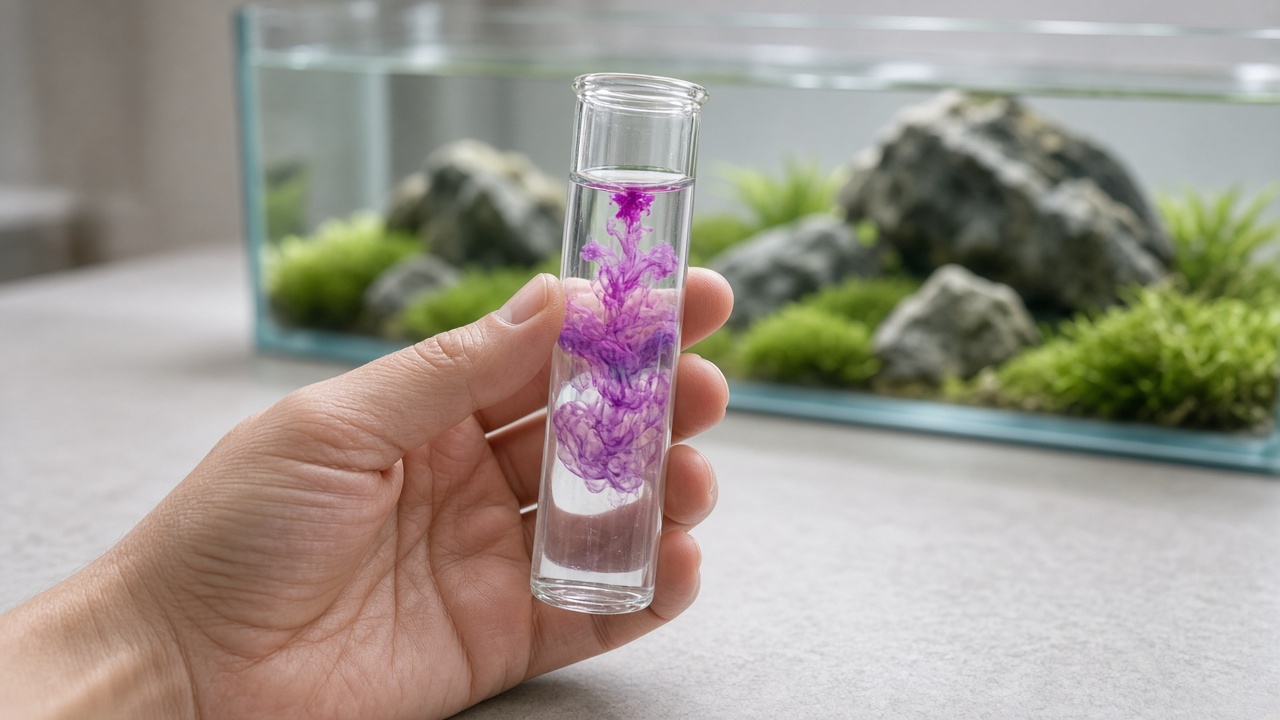
API Fishcare’s Freshwater Master Test Kit page says water problems are invisible. It names ammonia, pH, high range pH, nitrite, and nitrate as the six levels the kit measures.
The kit ships with four test tubes and a laminated color card. API’s page also states that a pH of 7.0 is neutral, above 7.0 is alkaline, and below 7.0 is acidic.
Test pH with the cycle, because the same kit treats pH as a weekly job. If you later need a higher reading, use our guide to raising aquarium pH.
Five cycling products, compared by label
Label dose and water type decide the product, not a rank column.
Our research team compared first-day published doses on a 10-gallon tank:
- Seachem Stability: 5 mL on day 1
- API Quick Start: 10 mL
- Seachem Prime: 1 mL, from the 5 mL per 50-gallon label
- Tetra SafeStart Plus: the entire bottle, for aquariums up to 100 gallons
The four treatments are different jobs, and the test kit is required because you cannot close the cycle without a number.
| Product | Maker-stated job | First listed dose | Water type on the label | Extra label constraint |
|---|---|---|---|---|
| API Freshwater Master Test Kit | Measures ammonia, pH, high range pH, nitrite, and nitrate | Test weekly | Freshwater | Ships with 4 test tubes and a laminated color card |
| API Quick Start | Live nitrifying bacteria; starts the cycle | 10 mL (2 tsp) per 10 gallons (38 L) | Freshwater and saltwater | Double the dose in saltwater; store cool and dry |
| Seachem Stability | Establishes the bio-filter; 7-day schedule | 5 mL per 10 U.S. gallons on day 1 | Freshwater and marine | Then 5 mL per 20 U.S. gallons daily for 7 days; turn off UV and ozone; 6-year shelf life |
| Seachem Prime | Removes chlorine and chloramine; binds ammonia, nitrite, and nitrate | 5 mL per 50 U.S. gallons (200 L) | Fresh and saltwater | Will not change pH; emergency nitrite dose up to 5×; binds up to 48 hours |
| Tetra SafeStart Plus | Live bacteria for a new freshwater start | Entire bottle for tanks up to 100 gallons | Freshwater | Sizes 1.69, 3.38, and 8.45 fl oz; do not freeze or heat; maintenance 5 mL per 10 gallons |
API Fishcare’s Quick Start page says the product contains live, nitrifying bacteria. Shake the bottle well, then add 2 tsp (10 mL) per 10 gallons (38 L), and double that dose in saltwater.
The same API page says you may add fish right after the dose. That maker claim does not cancel the need to test ammonia and nitrite.
Seachem’s Stability page sets a two-step schedule for a new aquarium. Use 1 capful (5 mL) for each 40 L (10 US gallons) on the first day. Then use 1 capful for each 80 L (20 US gallons) daily for 7 days.
Turn off UV and ozone while you dose Stability, because Seachem’s page says UV and ozone kill the bacteria. The same page lists a 6-year shelf life from the date of manufacture.
Seachem’s Stability FAQ says most tanks are cycled within 4 to 6 weeks. That is Seachem’s published range, not a promise for your room.
Seachem’s Prime page is a conditioner, not a bacteria bottle. Use 1 capful (5 mL) for each 200 L (50 US gallons) of new water, and treat each cap thread as about 1 mL.
Prime binds ammonia, nitrite, and nitrate, and it does not remove them from the system. Seachem’s FAQ says the bind lasts up to 48 hours, and you may dose Prime every 24 to 48 hours.
If ammonia or nitrite is above 2 ppm, Seachem’s Prime FAQ allows up to 5 times the normal dose. Prime will not change pH, per the same maker page.
Tetra’s SafeStart Plus page lists live Nitrosomonas, Nitrosospira, and Nitrospira. Shake the bottle well, then add the entire bottle to aquariums up to 100 gallons.
The same Tetra page lists three sizes: 1.69 fl oz, 3.38 fl oz, and 8.45 fl oz. For later maintenance, add 1 teaspoon (5 mL) per 10 gallons after fish, water changes, or media swaps.
Do not freeze Tetra SafeStart Plus, and do not expose the bottle to heat.
Filters, plants, and pH during a cycle
Bacteria live on wet surfaces, so the filter is the main growth surface.
A hang-on-back cartridge or sponge is where the colony sits. Rinse media in old tank water, not tap water, because chlorine in tap water can wipe the film you just grew.
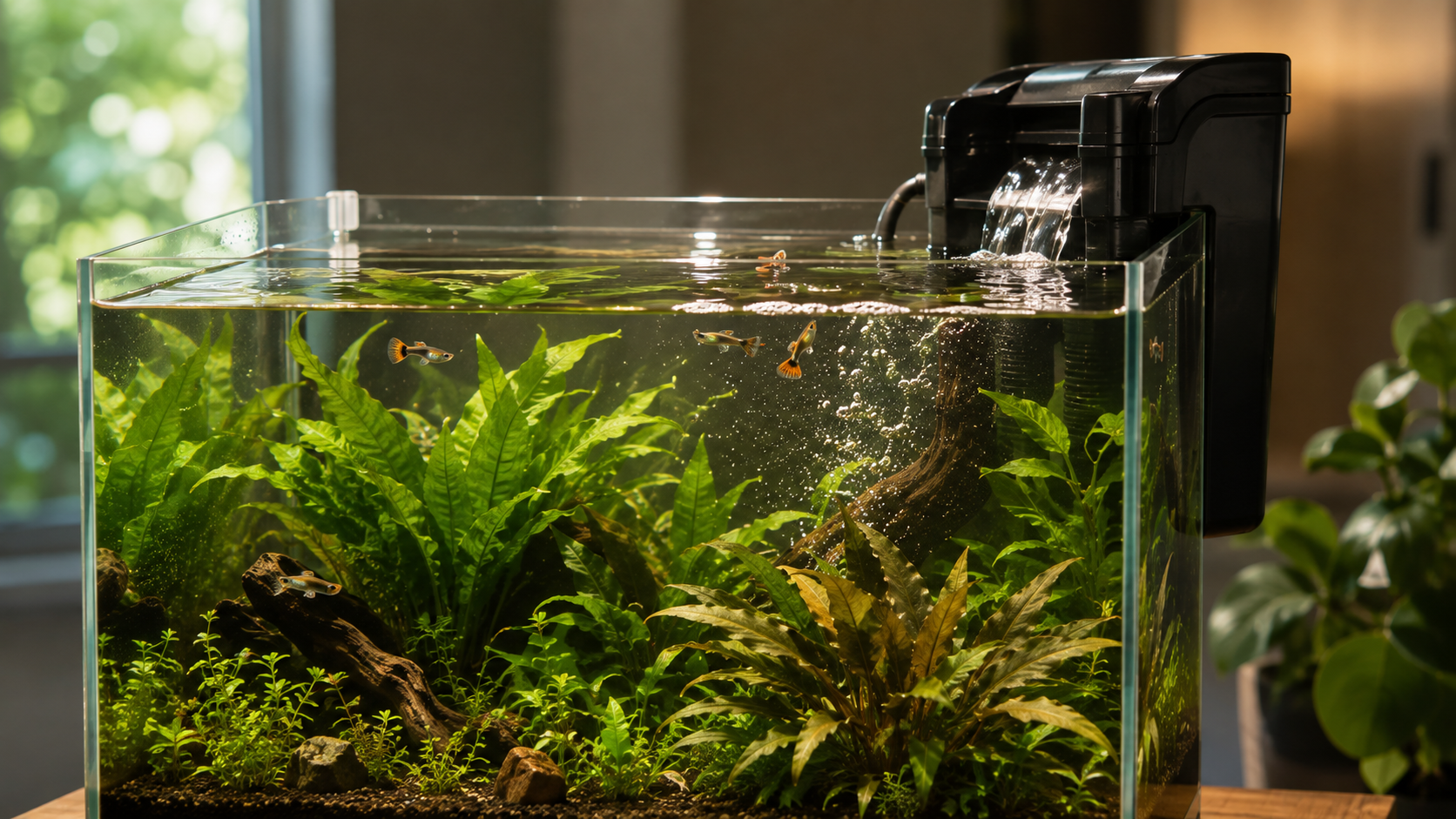
Keep the filter running through the whole cycle, and see our Top Fin EF-S filter guide for that hang-on-back layout.
Plants do not replace the bacterial steps, but they do take up nitrogen after it appears.
A planted tank can hold nitrate down once the second step is working. Easy stem and rhizome plants are the usual start, and our beginner planted-tank plant list is the matching plant page.
pH is part of the same weekly kit, not a side project. API’s Master Test Kit page treats pH 7.0 as neutral, and Seachem’s Prime page says Prime will not impact pH.
If pH is low for the fish you keep, fix it as its own job. Do not chase pH and the cycle with the same bottle on the same day.
A weekly test routine that matches the labels
Test first, dose second, and write the three nitrogen numbers down.
API Fishcare’s Master Test Kit page says to follow the booklet for each test and to test weekly. During a new cycle you may test more often than that weekly floor, but the maker floor is still weekly.
Use this order:
- Test ammonia, nitrite, and nitrate on the same day.
- Test pH with the same kit, because API lists it as one of the six levels.
- If you add new tap water, dose Seachem Prime at 5 mL per 50 US gallons.
- If you are on a Stability course, keep the 7-day schedule and leave UV off.
- If you used Tetra SafeStart Plus at start-up, do not freeze leftover product.
- Do not call the tank cycled until ammonia and nitrite both read 0 ppm and nitrate is present.
For a 10-gallon start, the published first-day treatment doses sit in one list:
- Seachem Stability: 5 mL, then 2.5 mL daily for 7 days
- API Quick Start: 10 mL, or 20 mL if the tank is saltwater
- Seachem Prime: 1 mL on new water
- Tetra SafeStart Plus: the whole bottle if the tank is 100 gallons or smaller
Stability’s day-2-through-7 dose is 5 mL per 20 gallons. On a 10-gallon tank that is 2.5 mL a day.
API has sold aquarium products for almost 60 years, per the Master Test Kit and Quick Start pages. Company age does not tell you the tank is cycled; the test card does.
FAQ
How long does the aquarium nitrogen cycle take?
Seachem’s Stability page says most tanks are cycled within 4 to 6 weeks. That is a maker range, not a fixed number of days. Keep testing until ammonia and nitrite stay at 0 ppm and nitrate is present.
Can I add fish the same day I add bottled bacteria?
API Fishcare’s Quick Start page says yes, you may add fish right after the dose. Tetra’s SafeStart Plus page says the tank is ready for fish after the whole-bottle start. Still test ammonia and nitrite, because a label start is not a finished cycle.
Does Seachem Prime stop the nitrogen cycle?
Seachem’s Prime FAQ says Prime binds ammonia, nitrite, and nitrate and leaves them available to bacteria. The bind lasts up to 48 hours and does not remove those compounds from the tank.
Why do I still see nitrate after ammonia is gone?
Nitrate is the end of the two-step chain, and API’s Master Test Kit page includes it as one of the six weekly levels. You lower nitrate with water changes and plant uptake, not by waiting for a third bacterial step in an open filter.
How often should I test during a cycle?
API Fishcare’s Master Test Kit page says to test weekly, and that is the maker’s stated floor. During the first month, test on a fixed weekday so you can see the ammonia-then-nitrite-then-nitrate pattern.
Do plants replace the bacterial cycle?
Plants use nitrogen after bacteria convert it, and they can use some ammonia directly. They do not replace the 0-0-plus rule, so keep the filter wet and keep testing.
What if ammonia comes back after the tank was cycled?
The colony is too small for the new load, or the media was cleaned in tap water.
Seachem Stability lists a later dose of 5 mL per 20 US gallons after new fish, medication, or a water change. Tetra lists 5 mL per 10 gallons for the same events, and you should test again the next day.