Quick answer: Raise pH with a labeled carbonate buffer, then retest before any second dose. Keep any 24-hour change at or under 0.2 pH when fish are present. Skip a raise if the tank is already stable.
Raise aquarium pH with a labeled carbonate buffer, and keep any 24-hour change at or under 0.2 pH.
This page is a research-desk guide to published freshwater pH labels, not a tank trial, livestock dose log, or reef-chemistry manual.
pH is a water number, not a brand contest. The U.S. Geological Survey’s pH and Water page puts the scale at 0 to 14, with 7 as neutral.
That same USGS page says each full unit is a 10-fold change. A jump from 6.0 to 7.0 is not a small nudge. Our research team compared published specs, not tank results.
Decide whether the tank needs a pH raise
A raise is a job only when pH is low for the fish you keep, and the reading is not already stable.
API Fishcare’s product page for API pH UP calls pH 7.0 ideal for a mixed tropical community. That same page lists goldfish and livebearers at 7.5, and many Amazonian fish, including angelfish and neon tetras, at 6.5 to 6.8.
It also lists mollies and swordtails at 7.2 to 7.5, so match the fish you own to those published bands.
The EPA’s secondary drinking water list sets pH at 6.5-8.5. That band is an aesthetic tap-water guide, not a fish-care rule. API Fishcare’s community target of 7.0 sits inside that EPA band.
The Merck Veterinary Manual’s aquatic-systems table lists freshwater pH at 6.5-9.0. A tank at the API community target does not fail that Merck range.
Use this yes-or-no check before you buy a bottle:
- The pH test is repeated, not a one-time strip.
- The reading sits below the species target on a maker page you can name.
- Carbonate hardness (KH) is also low, or pH keeps sliding down.
- Fish are present, so any change must stay slow.
Do not raise pH just to hit a textbook number. A stable tank at API Fishcare’s community target of 7.0 is often enough.
What this article covers and what it leaves out
We used one selection rule: a method is in only if a maker page or a named water-quality table publishes the number.
That rule let in three product families and three public tables:
- Seachem Alkaline Buffer, from Seachem’s own product page
- API pH UP, from API Fishcare’s own product page
- CaribSea Florida Crushed Coral, from CaribSea’s marine substrates page
- The EPA secondary pH band of 6.5-8.5
- USGS pH scale facts, including the 10-fold unit rule
- Merck Veterinary Manual freshwater ranges for pH, alkalinity, and ammonia
The same rule kept kitchen-sink recipes, ranked “best pH raiser” lists, and marine reef two-part dosing. It also left out livestock medical treatment and any claim that we ran a tank trial. If a dose is not on a page in our source set, it is not in this guide.
Measure pH and KH before you add a buffer
Test first, because a buffer cannot fix a number you have not measured twice.
The USGS pH and Water page says pH 5 water is ten times more acidic than pH 6 water. Home kits are coarser than a lab meter, and they are still the right first tool.
API Fishcare’s pH UP page tells you to determine pH with an API pH test kit before you dose. Test, dose, then test again.
Also test KH, because pH is the reading and KH is the brake. The Merck Veterinary Manual’s aquatic-systems table lists freshwater total alkalinity above 100 mg/L as CaCO3.
That same table lists freshwater total hardness above 20 mg/L as CaCO3. Merck’s pH chapter calls alkalinity below 50 mg/L low, and says that level will not stop major pH swings.
Seachem’s Alkaline Buffer page states that 2 meq/L equals 5.6 dKH. It tells you to divide a dKH kit reading by 2.8 to get meq/L. Write both numbers down before you add powder.
Do this in order:
- Test pH in the tank, not only in the tap bucket.
- Test KH in the same water sample.
- Test total ammonia nitrogen (TAN) before any raise.
- Compare pH to the species band on a named maker page.
- If KH is already high and pH is only a little low, wait and retest tomorrow.
The Merck Veterinary Manual links old tank syndrome to alkalinity near 0 mg/L and pH usually below 6. That pattern is a crash, not a trim.
Use a labeled buffer and the 0.2-day raise rule
Follow the label dose, then stop if a 24-hour change would exceed 0.2 pH.
API Fishcare’s product page for API pH UP states this caution in plain words. Some fish may be sensitive to pH adjustments greater than 0.2 in a 24-hour period. Changes of that size should be done with extreme care.
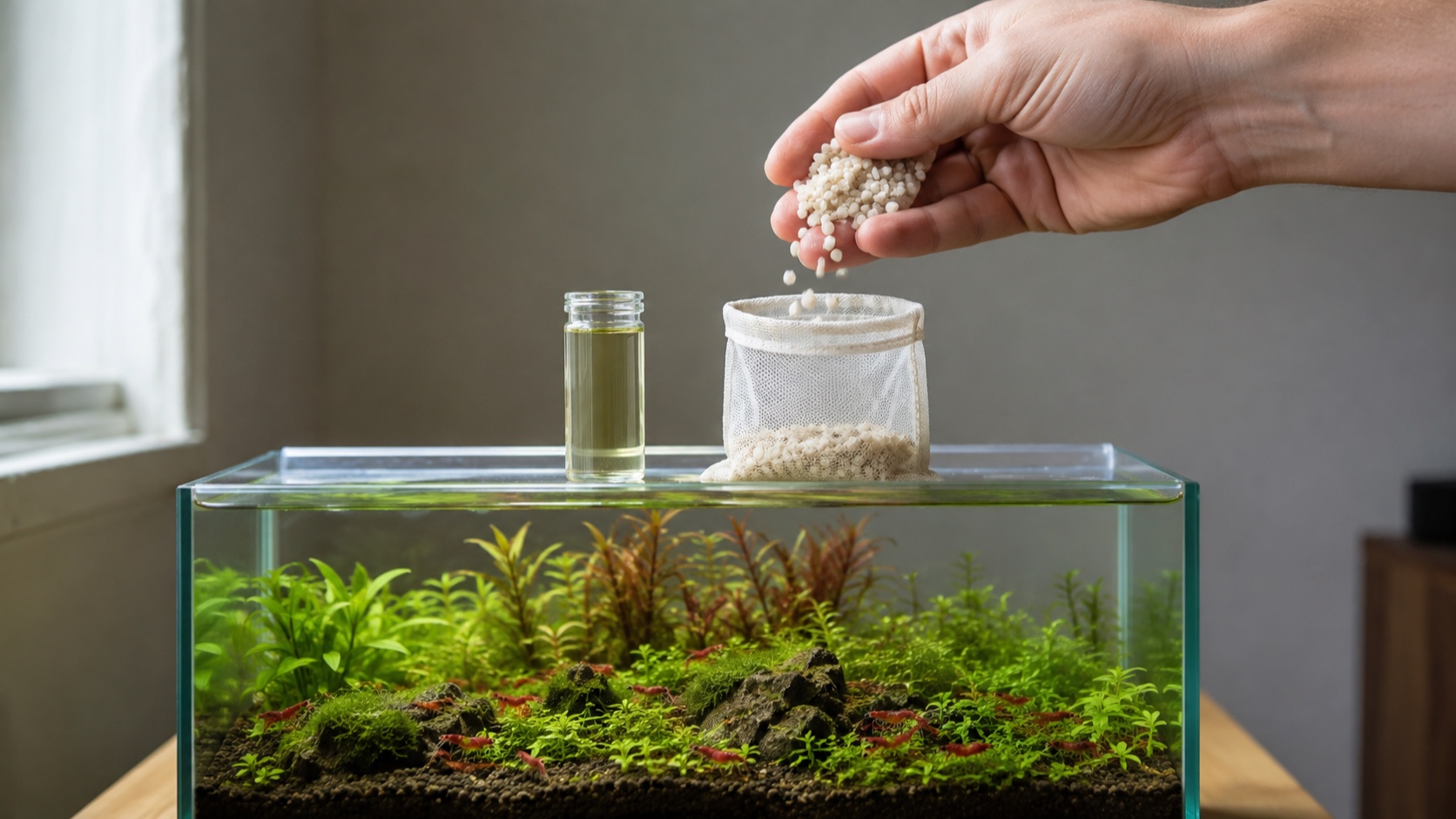
Here are the published doses our research team compared:
| Product | Published dose | Stated pH band or target |
|---|---|---|
| Seachem Alkaline Buffer | 1 teaspoon (6 g) per 80 L (20 US gallons), daily until the target | Buffers 7.2-8.5 |
| API pH UP | 1/2 teaspoon (2.5 ml) per 25 U.S. gallons (95 L) | Community target 7.0 on the same page |
Seachem’s Alkaline Buffer page says that one dose raises alkalinity by about 1 meq/L (2.8 dKH). API Fishcare’s page also lists a calculator rate of 1 ml per 10 gallons. Those are not the same units, so do not mix the two labels in one day.
Comparing published specs, Seachem’s 70 g jar holds about 11 of the 6 g standard doses.
If you use Seachem Alkaline Buffer, follow this label path:
- Dose 6 g per 20 US gallons.
- Wait and retest pH and KH.
- Repeat the next day only if you are still below the target.
- Stay inside the 7.2-8.5 buffer band Seachem publishes.
If you use API pH UP, follow this label path:
- Dose 2.5 ml per 25 U.S. gallons.
- Take another pH reading before any second dose.
- Do not plan a change greater than 0.2 pH in 24 hours.
Seachem also publishes a ratio chart for Acid Buffer plus Alkaline Buffer in RO water:
- 1 to 1.3 for pH 6.5
- 1 to 2.0 for pH 7.0
- 1 to 2.5 for pH 7.5
- 1 to 4.0 for pH 8.0
That chart is for a paired plan, not a same-day acid dose.
Add the dose to strong flow. A hang-on-back or canister filter keeps the mix even. Our Top Fin EF-S filter guide walks through that kind of small-tank flow.
Hold the new pH with carbonate rock or crushed coral
Rock and crushed coral hold KH so a bottle raise does not fade overnight.
CaribSea’s marine substrates page lists Florida Crushed Coral at 2.5-5.5 mm and an average density of 72 pounds per cubic foot. Bag sizes on that page are 10 lb, 15 lb, and 40 lb.
CaribSea’s CORALINE line is described there as pH support where elevated pH is wanted. That page also points those coarser mixes toward brackish or cichlid aquariums. These are slow methods, not a timed 0.2 pH dose.
Use carbonate media when:
- You keep fish that want alkaline water, such as African cichlids.
- KH keeps falling after water changes.
- You want a hold, not a one-day spike.
Do not bury a planted tank in crushed coral if the plants and fish want soft, acid water, because that fight never ends.
A mesh media bag in a filter is easier to remove than a full substrate swap. Our filter recommendations from Reddit collect hobby notes on media that raise pH.
Treat them as hobby talk, and use CaribSea’s published grain sizes when you buy rock. The Merck Veterinary Manual puts lethal pH limits for many species near 4 and 10. A crushed-coral bed should not be a race toward 10.
Check ammonia, plants, and filters after pH goes up
Raising pH changes more than the pH kit, because ammonia gets harsher as pH rises.
The Merck Veterinary Manual states that rising pH increases ammonia toxicity. Its nitrogen chapter says the toxic un-ionized share of TAN (NH3) rises as pH and temperature rise. pH has more influence than temperature.
Merck’s table target for toxic un-ionized ammonia is 0 mg/L. The notes say values below 0.05 mg/L are not considered harmful in most cases. Freshwater fish can often tolerate TAN below 1 mg/L unless pH exceeds 8.5.
That is why you test TAN before you raise pH, because a hidden ammonia load becomes worse at a higher pH.
Merck’s hazard table flags ammonia toxicity when un-ionized ammonia is above 1 mg/L and pH is above 8. Old tank syndrome on that table pairs pH below 6 with very high TAN. Merck’s text says TAN may exceed 20 mg/L in that crash.
If TAN is above 5 mg/L and pH is below 7, Merck warns that a sudden pH rise can shift ammonium to NH3. The U.S. Geological Survey says normal rainfall is about pH 5.6, so uncovered top-offs can pull pH down.
Seachem’s Alkaline Buffer page says the product contains no phosphate and is designed for planted aquariums. Pick plants that can live in the pH you are holding. Our beginner planted-tank plant list is the matching plant page.
After any raise, do this checklist:
- Retest pH at 1 hour and at 24 hours.
- Retest KH with the same kit brand you used first.
- Retest TAN before the next dose.
- Stop dosing if any 24-hour pH change would exceed 0.2.
FAQ
How fast can I raise aquarium pH?
API Fishcare’s pH UP page says some fish may be sensitive to a change greater than 0.2 pH in 24 hours. Use that as the ceiling when livestock are in the tank. Seachem’s page allows a daily 6 g per 20 US gallon dose, and daily is not all at once.
Can I raise pH with crushed coral alone?
Yes, if you want a slow hold, not a timed jump. CaribSea’s marine substrates page lists Florida Crushed Coral at 2.5-5.5 mm and 72 pounds per cubic foot. That page frames CORALINE mixes as pH support.
What if my tap water is already above 8.0?
Then a raise is usually the wrong job. The EPA secondary drinking water list already tops out at 8.5, and Merck’s freshwater table goes to 9.0. API Fishcare’s community target is 7.0, so if tap sits near that EPA top and your fish match a higher band, leave it.
Does raising pH make ammonia more dangerous?
Yes. The Merck Veterinary Manual says rising pH increases ammonia toxicity. Its notes put a common TAN comfort line at 1 mg/L, and a sharper worry if pH exceeds 8.5. Un-ionized ammonia below 0.05 mg/L is the “not considered harmful” line on that table.
Why does pH drop again after I dose?
KH was too low to hold the new number. Merck’s table wants freshwater alkalinity above 100 mg/L as CaCO3, and Seachem says one Alkaline Buffer dose adds about 2.8 dKH. If acids from food, CO2, or wood keep eating that KH, pH falls again.
Is baking soda the same as a labeled aquarium buffer?
No. Seachem’s Alkaline Buffer page says that product is a sodium bicarbonate based buffer with a published 6 g per 20 US gallon dose. Merck mentions baking soda as one way to raise alkalinity in small systems, with no aquarium dose on that page. Our selection rule leaves kitchen scoops out.