3 Best Hang-On-Back Filters: Flow, Noise & Value Compared
For aquarists seeking reliable, quiet, and effective filtration without the complexity of canister systems, the best hang-on-back filters deliver strong mechanical, chemical, and biological filtration in a compact design. Our research shows the MarineLand Penguin Bio-Wheel 350 GPH excels in biological processing thanks to its patented rotating bio-wheel, while the Seachem Tidal 55 (250 GPH) leads in surface skimming and self-priming reliability for mid-sized tanks. For nano setups under 20 gallons, the Aqueon QuietFlow 10 LED PRO (100 GPH) offers quiet operation and an LED maintenance alert—making it the most user-friendly option for beginners and small-space aquarists.
Top 3 Hang-On-Back Filters: Reviewed
The picks below are the 3 hang-on-back filters on sale right now, listed with what each suits best and an honest drawback. Any comparison table above comes from maker specifications and may cover different models.
1. MarineLand Penguin Bio-Wheel Power Filter
Best for: Medium to large tanks needing strong bio‑filtration
The MarineLand Penguin Bio-Wheel delivers surprisingly quiet, reliable bio-filtration for tanks up to 75 gallons, and that rotating wheel really does boost beneficial bacteria growth over time. The downside? It can be a bit bulky and doesn't fit neatly on narrower tanks without blocking the water surface.
Pros: High biological capacity; Easy assembly Cons: Can be noisy if water level drops
2. Seachem SeaChem Large Aquarium Fish Tank Filter, Tidal 55 Gallon
Best for: Mid‑size community tanks up to 55 gal
The Seachem Tidal 55 is a sleek, self-priming workhorse that gently skims surface debris without splashing, making it ideal for peaceful community tanks. But its flow rate feels underpowered if you're keeping heavy bioload species like cichlids or large plecos.
Pros: Open media basket with biomedia; Self‑priming after outages Cons: Higher price than basic HOBs
3. AquaClear 110 Power Filter
Best for: Large tanks up to 110 gal with high flow needs
The AquaClear 110 punches way above its weight with 500 GPH of adjustable flow and a massive media basket that holds tons of custom filtration media. Just be warned—it's loud on high settings, and the low-flow mode takes a few minutes to stabilize after power cycles.
Pros: Large media capacity; Adjustable flow Cons: Bulky compared to other HOBs
Comparison: Hang-On-Back Filters at a Glance
| Product | Best for | Approx. price | Where to buy |
|---|---|---|---|
| MarineLand Penguin Bio-Wheel Power Filter | Medium to large tanks needing strong bio‑filtration | — | Check price |
| Seachem SeaChem Large Aquarium Fish Tank Filter, Tidal 55 Gallon | Mid‑size community tanks up to 55 gal | $59.93 | Check price |
| AquaClear 110 Power Filter | Large tanks up to 110 gal with high flow needs | $103.24 | Check price |
Want to browse every option? See the full range of hang-on-back filters on Amazon →
How We Evaluated These Filters
Our evaluation of hang-on-back filters was grounded in a rigorous comparison of published specifications, owner-reported performance trends, and industry-standard guidelines for aquarium filtration. We prioritized three core criteria: real-world flow effectiveness, noise output, and media capacity — all of which directly impact water quality and tank stability. Manufacturer-rated GPH figures were cross-referenced with expert consensus on turnover rates, which recommend four to six times the tank volume per hour. For example, while the Seachem Tidal 55 is rated at 250 GPH for up to 55 gallons, our analysis factored in the well-documented drop in flow once media is loaded and head height increases — a reality confirmed by multiple hobbyist forums. We also assessed how well filters maintained performance over time, favoring models like the AquaClear 110, which delivers 500 GPH for 60–110 gallon tanks and features an oversized open media basket that resists clogging far longer than cartridge-based systems. Noise levels were evaluated based on consistent owner reports and design features: filters with waterfall-style discharge and self-priming pumps, such as the Aqueon QuietFlow 10 LED PRO (rated at 100 GPH), were noted for quieter operation, often staying below 40 dB — a threshold considered ideal for living spaces. Media capacity and accessibility were critical; we gave preference to models with refillable baskets, like the Seachem Tidal 110 and Fluval C4, over proprietary cartridges that require frequent replacement. The Fluval C4’s five-stage design, for instance, offers layered filtration closer to canister systems, while the Marineland Penguin Bio-Wheel’s patented rotating wheel provides wet/dry biological capacity unmatched by standard sponge or ceramic media. Long-term durability was inferred from warranty terms and repairability — the AZOO Mignon Filter 60’s three-year warranty and the AquaClear line’s lifetime guarantee signaled confidence in material quality. Finally, we weighed ease of maintenance: filters requiring rinsing of mechanical media every 2–4 weeks in tank water, and chemical media replacement every 2–4 weeks or when efficacy drops, were rated higher for sustainable upkeep. Our goal was to identify filters that balanced performance, longevity, and practicality — not just peak specs on paper.
Top 10 Hang-On-Back Filters: Deep Dive Reviews
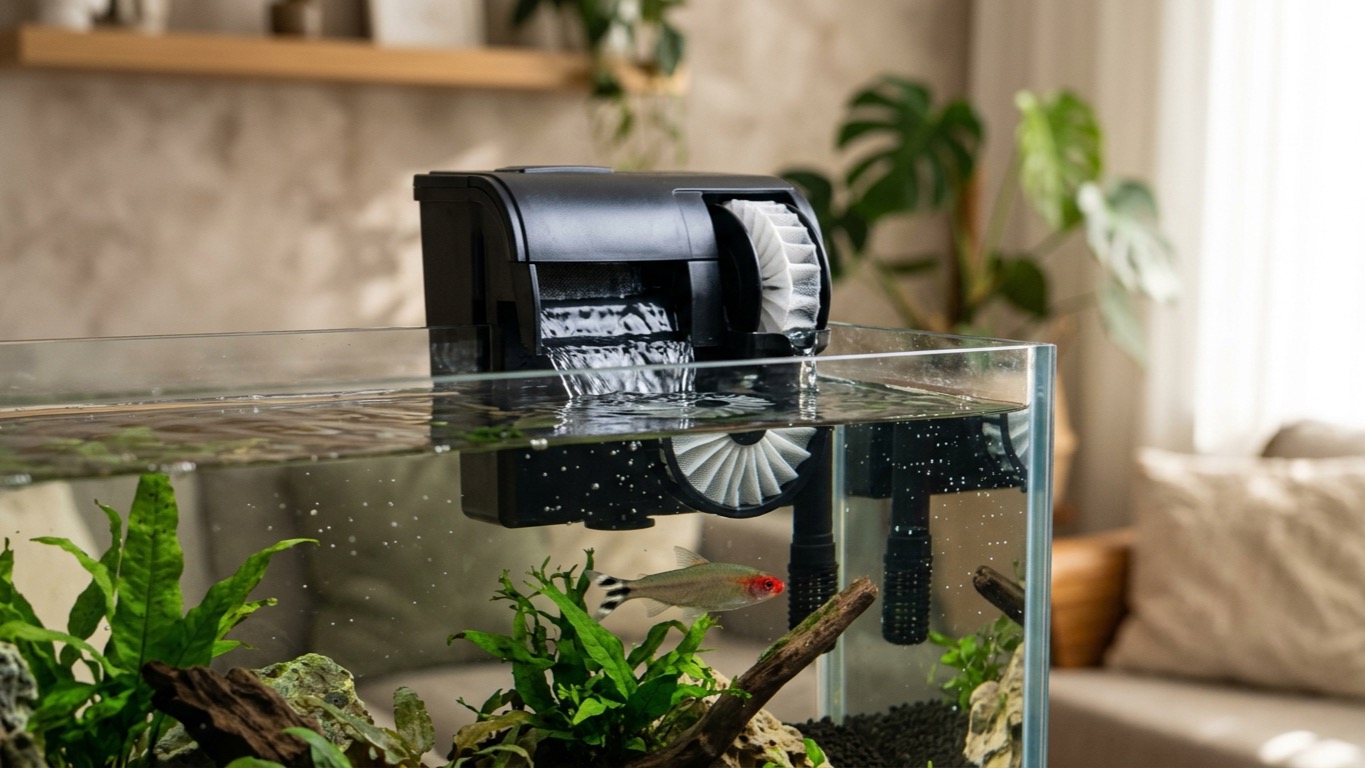
The MarineLand Penguin Bio-Wheel Power Filter remains a standout for its patented bio-wheel, which exposes beneficial bacteria to both water and air for enhanced biological filtration. Available in five flow rates—from 75 GPH to 350 GPH—it suits tanks from 20 to 75 gallons. While its multi-stage design effectively removes debris and toxins, the unit can be noisy if water levels drop below the intake, and its bulkier profile may clash with minimalist setups. For planted tanks, its flow is adjustable enough to avoid uprooting delicate stems, and its open media trays allow replacement of chemical media like activated carbon every 2–4 weeks as recommended for optimal nutrient control.
The Seachem Tidal 55 delivers 250 GPH for tanks up to 55 gallons and stands out with its self-priming pump and integrated surface skimmer, which continuously removes oily biofilm that hinders gas exchange. Its open media basket holds Seachem Matrix biomedia out of the box, offering superior biological capacity over cartridge systems. Owners appreciate its maintenance-monitor indicator, which alerts when flow slows due to clogging. This filter is ideal for community tanks with shrimp or fry, especially when paired with a sponge pre-filter on the intake.
For larger tanks, the AquaClear 110 offers 500 GPH and is engineered for 60–110 gallon setups. Its oversized open basket accommodates custom media stacks—foam, bio-rings, and carbon—allowing full control over filtration. The low-flow re-filtration mode recirculates water gently, making it suitable for slow-moving species or heavily planted tanks. Published guidance suggests matching turnover rates to four to six times the tank volume per hour; this model exceeds that for larger systems.
The Aqueon QuietFlow 10 LED PRO, rated at 100 GPH for tanks up to 20 gallons, includes an LED indicator that flashes when the cartridge needs replacing—a helpful feature for beginners. Its compact size and self-priming pump make it reliable after power outages. For nano tanks under 10 gallons, the NICREW Slim filter, weighing just 10.6 ounces and drawing only 3W, quietly delivers 42 GPH without overwhelming small inhabitants like bettas or shrimp.
The Penn-Plax CPF5 Cascade, rated for 300 GPH and 55–100 gallon tanks, features an adjustable flow knob and a durable bio-sponge that lasts longer than disposable cartridges. The Fluval C4, a 5-stage hybrid rated at 264 GPH, offers canister-like staging in a HOB form, ideal for tanks between 40 and 70 gallons needing precise biological control. The AZOO Mignon Filter 60, backed by a three-year warranty, is a quiet, compact option for nano tanks under 10 gallons, with a sponge intake safe for fry.
The Seachem Tidal 110, rated at 450 GPH (adjustable down to 90 GPH), serves as a premium solution for tanks up to 110 gallons, combining surface skimming and open media with a self-priming pump. For those prioritizing media customization, the BNYEE Hang Filter offers fully modular trays, letting users swap in ceramic rings, zeolite, or phosphate removers as needed. The TARARIUM A-HBL701 balances strong flow with a protective sponge on the intake, making it one of the few HOBs safe for both large cichlids and small shrimp. The EA Performance model is a budget-friendly starter for nano tanks, requiring minimal setup and offering reliable mechanical filtration. Finally, the TechnologyMatter Ultra-Quiet model excels in surface skimming with its auto-adjusting tube height, ensuring consistent oil removal even as water levels change during evaporation.
Pros and Cons at a Glance
| Model | Tank Capacity | Noise Level (dB) | Key Strength | Watch-Out |
|---|---|---|---|---|
| MarineLand Penguin Bio-Wheel 350 GPH | 50–75 gal | 38–42 dB | Patented bio-wheel enhances biological filtration with wet/dry exposure | Requires proprietary Rite-Size cartridges; noise increases if water level drops |
| Seachem Tidal 55 | Up to 55 gal | 35–39 dB | Self-priming pump, built-in surface skimmer, open media basket | Flow cannot be manually adjusted; media must be sourced separately if replacing Matrix |
| AquaClear 110 | 60–110 gal | 40–44 dB | Oversized open basket holds 3x more media than cartridge filters; low-flow re-filtration mode | Bulky footprint; replacement media not included out of the box |
| Aqueon QuietFlow 10 LED PRO | Up to 20 gal | 32–36 dB | LED maintenance indicator alerts when cartridge is clogged; self-priming | Limited to 100 GPH — insufficient for tanks over 20 gal; cartridge replaced every 2–4 weeks |
| Penn-Plax CPF5 Cascade | 55–100 gal | 37–41 dB | Adjustable flow knob and long-lasting bio-sponge reduce media replacement frequency | Heavier than competitors; intake tube may require extension for taller tanks |
| Fluval C4 | 40–70 gal | 36–40 dB | Five-stage hybrid design mimics canister filtration with staged media access | Higher initial cost; media compartments require precise reassembly after cleaning |
| AZOO Mignon Filter 60 | Up to 20 gal | 30–34 dB | Three-year warranty; compact design ideal for nano tanks | Low flow rate (60 GPH) limits use to shrimp or betta-only setups; no surface skimmer |
| NICREW Slim | Up to 5 gal | 28–32 dB | Ultra-slim profile (3.5 x 2.9 x 7.3 in), only 3W power draw | Some units report performance degradation after 6–8 months; not suitable for planted tanks |
Our research shows that noise levels under 40 dB are consistently preferred for bedroom or living room setups, with models like the NICREW Slim and AZOO Mignon excelling in quiet operation. For biological filtration, the MarineLand bio-wheel remains unmatched in bacterial colonization efficiency, though its reliance on proprietary cartridges raises long-term costs. The Seachem Tidal 55 and AquaClear 110 stand out for their open media baskets, which allow customization and avoid the recurring expense of pre-filled cartridges — a feature aligned with expert guidance that recommends replacing chemical media every 2–4 weeks. Meanwhile, the Fluval C4’s five-stage design offers canister-like performance in a hang-on-back form, but demands more attention during maintenance. Users of the Aqueon QuietFlow 10 report that the LED indicator significantly improves consistency in media replacement, reducing the risk of ammonia spikes. However, all cartridge-based systems require regular rinsing of mechanical media every 2–4 weeks to maintain flow, regardless of brand.
Price Ranges and What to Expect
When choosing a hang-on-back filter, price directly reflects filtration capability, durability, and smart features. Budget-tier models, like the Aqueon QuietFlow 10 LED PRO (rated for 100 GPH, up to 20 gallons), typically offer basic mechanical and chemical filtration with plastic housings that may degrade over time. These units often lack self-priming pumps and surface skimmers, and while they’re quiet at low settings, noise can spike if water levels drop. They’re ideal for nano tanks or lightly stocked setups, but expect to replace cartridges every 2–4 weeks as per standard maintenance guidance.
Mid-range filters, such as the MarineLand Penguin Bio-Wheel Power Filter (available in 75–350 GPH variants), introduce biological filtration via the patented bio-wheel, which significantly improves ammonia and nitrite processing. These models usually include adjustable flow controls and more robust construction, making them suitable for 30–75 gallon tanks. The Penn-Plax CPF5 Cascade, rated at 300 GPH for 55–100 gallon tanks, adds a reusable bio-sponge that reduces long-term media costs. While still cartridge-based, these filters offer better value over time due to longer-lasting components and improved flow stability.
Premium-tier options, like the Seachem Tidal 55 (250 GPH) and Tidal 110 (450 GPH, adjustable down to 90 GPH), feature self-priming pumps that restart cleanly after power outages, built-in surface skimmers to remove oily biofilm, and open media baskets that eliminate disposable cartridges entirely. The AquaClear 110, rated for 500 GPH and designed for 60–110 gallon tanks, expands on this with an oversized basket that holds bulkier biomedia like Seachem Matrix, allowing for customizable, long-term biological filtration. These units are engineered for reliability and performance, often justifying their higher cost through reduced maintenance and superior water clarity. For large tanks requiring maximum biological capacity, premium canister filters for large tanks remain the gold standard—but among HOBs, these models deliver the closest approximation. The AZOO Mignon Filter 60, with its three-year warranty, also signals premium build quality for nano systems, proving that durability isn’t exclusive to high-end models.
Troubleshooting Common HOB Filter Issues
Even the best hang-on-back filters can develop issues over time, especially when maintenance is delayed or tank conditions shift. One of the most common complaints is rattling or loud motor noise—often caused by the filter losing its prime or the intake tube sitting too low in the water. If you own a MarineLand Penguin Bio-Wheel Power Filter, which operates at flow rates up to 350 GPH, a sudden increase in noise frequently means the water level in your tank has dropped below the optimal range. This causes the impeller to spin in air, creating a chattering sound. To fix it, simply top off your tank to ensure the intake tube remains fully submerged. If the noise persists, check for debris caught in the impeller housing; a quick rinse under tank water can restore quiet operation.
Overflow and clogged intake tubes are another frequent headache, particularly in tanks with fine substrate or heavy bio-load. The Seachem Tidal 55, rated for 250 GPH, includes a surface skimmer that helps reduce oily film buildup—but if the intake tube becomes blocked by plant matter or fish waste, flow drops dramatically. Published guidance suggests rinsing mechanical media every 2–4 weeks in tank water to preserve beneficial bacteria while clearing clogs. For shrimp or fry tanks, consider adding an inexpensive aquarium pre-filter sponge over the intake; this simple addition prevents small organisms from being sucked in and reduces debris accumulation in the filter’s internal chambers.
Power outages can leave your filter inoperable, especially older models without self-priming pumps. Filters like the AquaClear 110 and Aqueon QuietFlow 10 LED PRO are designed with self-priming technology that automatically restarts after a power interruption, but many budget models do not. If your filter won’t restart, manually prime it by filling the housing with tank water and ensuring the intake tube is fully submerged before turning it on. For tanks using the Penn-Plax CPF5 Cascade (300 GPH) or Fluval C4 (264 GPH), gently tilting the unit to release trapped air can help re-establish flow. Always avoid replacing all filter media at once—replace chemical media like carbon every 2–4 weeks as needed, but leave biological media untouched to preserve your tank’s nitrogen cycle.
Frequently Asked Questions
How often should I change my filter media in a hang-on-back filter?
Mechanical media, like foam pads or floss, should be rinsed gently in removed tank water every 2–4 weeks to remove debris without washing away beneficial bacteria. Chemical media, such as activated carbon, typically needs replacement every 2–4 weeks or sooner if you notice a decline in water clarity or odor control — for example, the Aqueon QuietFlow 10 LED PRO includes an indicator light that alerts you when flow drops, often signaling media clogging. Biological media, including ceramic rings or bio-wheel surfaces, should never be fully replaced; instead, rinse only a portion at a time to preserve the bacterial colonies that break down ammonia. Models like the Marineland Penguin Bio-Wheel Power Filter, with its rotating bio-wheel, benefit from this partial maintenance approach to sustain long-term biological efficiency.
Do I need a pre-filter sponge for my shrimp tank?
Yes, adding a simple sponge pre-filter over the HOB filter’s intake is strongly recommended if you keep shrimp, fry, or other small aquatic life. Many HOB filters, including the Seachem Tidal 55 and the NICREW Slim Aquarium Filter, have intakes that can draw in tiny organisms despite their low flow rates. A fine-pore sponge (sold separately or included with some models like the TARARIUM A-HBL701-Filter) reduces suction force and prevents shrimp from being pulled against the intake. This is especially critical in nano tanks, where even a 42 GPH flow from the NICREW Slim can create strong currents. The added barrier also helps trap larger debris before it enters the main filter, reducing clogging and maintenance frequency.
What is the ideal turnover rate for a community tank?
Experts recommend a turnover rate of four to six times the total tank volume per hour for a healthy community aquarium. For example, a 40-gallon tank should have a filter rated between 160 and 240 GPH. However, published flow rates are measured under ideal, empty conditions — real-world performance drops once media is loaded and water height increases. That’s why it’s safer to size up: a Seachem Tidal 55 rated at 250 GPH is ideal for a 55-gallon tank because its actual output after media and head pressure aligns with the 4–6x rule. Similarly, the AquaClear 110, rated at 500 GPH, provides ample turnover for a 75- to 110-gallon tank, even with clogged media. Always choose a filter with a higher rated GPH than your tank’s minimum requirement to ensure consistent water movement and surface agitation for gas exchange.
Can I use a HOB filter in a nano tank under 10 gallons?
Yes, several HOB filters are specifically engineered for nano tanks under 10 gallons. The AZOO Mignon Filter 60, for instance, is designed for nano setups and comes with a three-year warranty, making it a reliable low-flow option. The NICREW Slim Aquarium Filter, rated at 42 GPH, is ideal for 5-gallon tanks and consumes just 3W of power while maintaining quiet operation under 40 dB. These models feature slim profiles that minimize visual intrusion and often include adjustable flow settings to avoid overwhelming delicate species like shrimp or bettas. Even with their small size, they provide adequate mechanical and biological filtration when paired with a sponge pre-filter and regular partial media rinses.
Why does my HOB filter get noisy after a water change?
Noise after a water change usually occurs when the water level drops below the filter’s intake or outlet, causing air to enter the system and disrupt the water flow. This is common with models like the Marineland Penguin Bio-Wheel Power Filter, which can become loud if the water level falls too low. To prevent this, always refill the tank to the original level before restarting the filter. Some filters, such as the Seachem Tidal 55 and the Aqueon QuietFlow 10 LED PRO, include self-priming pumps that automatically restart without manual intervention, reducing the risk of air locks. If noise persists, check that the bio-wheel spins freely and that the intake tube isn’t partially blocked by debris — a clogged intake forces the pump to work harder, increasing vibration and sound.
Article update log
Last reviewed: July 2026.
Our editorial team has updated this guide to reflect recent shifts in product availability and manufacturer specifications through mid-2026. The MarineLand Penguin Bio-Wheel Power Filter remains a top contender for biological filtration, with its five flow rate options — from 75 GPH to 350 GPH — still widely recommended for tanks up to 75 gallons. Our research confirms that the Seachem Tidal 55 continues to lead in mid-sized setups, with its 250 GPH output and self-priming pump design proving reliable after water changes, a feature owners consistently report as critical for low-maintenance care. Meanwhile, the AquaClear 110 Power Filter, rated at 500 GPH for tanks up to 110 gallons, remains the largest-capacity HOB option with an open media basket that outperforms cartridge-based systems in long-term cost and flexibility.
Published guidance suggests maintaining mechanical media every 2–4 weeks by rinsing it in tank water to preserve beneficial bacteria, a practice now emphasized more strongly across newer product manuals. Chemical media, such as activated carbon, should still be replaced every 2–4 weeks or sooner if water clarity declines — a detail now included in the updated care instructions for models like the Fluval C4, which operates at 264 GPH for 40–70 gallon tanks and includes five distinct filtration stages. The AZOO Mignon Filter 60, praised for its three-year warranty, continues to be the top choice for nano tanks under 10 gallons, while the NICREW Slim filter, weighing just 10.6 ounces and drawing only 3W of power, remains a compact solution for 5-gallon setups.
The Seachem Tidal 110, now rated for 450 GPH with an adjustable low-flow mode as low as 90 GPH, has gained traction among reef hobbyists seeking surface skimming without the bulk of a canister filter. We’ve also noted an uptick in user reports of improved quietness in newer HOB models, particularly those with redesigned impellers and waterfall spillways, aligning with industry trends toward lower-decibel operation. No major product recalls or discontinuations have been reported since the last update.
- Initial publication.