Quick answer: Siphon the slime sheets, restore flow, shorten the light period, and export leftover food. Use a labeled cyanobacteria treatment only after that work. A bottle does not replace a clogged filter.
Home-aquarium cyanobacteria is bacterial slime you clear by siphoning mats, raising flow, and exporting nutrients. This page is a Waterpuppy research-desk comparison, and we did not culture samples, run tank trials, or inspect livestock.
Comparing published specs from four maker pages, two products require a 20 to 25 percent water change at 48 hours. The U.S. EPA’s cyanotoxin advisory page sets a 10-day microcystin level of 0.3 µg/L for young children. That figure is tap-water guidance, not a home-tank test target.
What this article covers and what it leaves out
We used one selection rule for products, and we skipped everything that failed it.
The Waterpuppy Label Rule is simple. A product is in only if the maker page names cyanobacteria, blue-green slime, or red slime as a target.
That rule let in four currently sold treatments:
- UltraLife Blue Green Slime Stain Remover, from UltraLife Reef Products
- Boyd Chemiclean 2 g, from Boyd Enterprises
- Fritz Slime Out, from Fritz Aquatics
- API Marine Algaefix, from API Fishcare
The same rule left out general freshwater algaecides that list only green water or hair algae. It also left out kitchen peroxide mixes, ranked lists, and livestock medical claims.
If a dose is not on a page in our source set, it is not in this guide. Our research team compared published specs, not tank results.
Identify the slime before you treat
Cyanobacteria is a bacterium that can make toxins, not a true alga.
The CDC’s freshwater bloom page says cyanobacteria are also called blue-green algae and can produce toxins that make people and animals sick. Contact can be touch, breathed-in droplets, or a swallowed splash.
The same CDC page says a dying bloom can use up oxygen as cells decay, so fish and other gill breathers may then lack air. That is a lake-and-river page, not a tank manual. Still treat the sheets as waste you do not smear on skin or taste.
The U.S. EPA’s cyanotoxin advisory page published 10-day drinking-water health advisories in 2015. For microcystins, that page lists 0.3 µg/L for bottle-fed infants and pre-school children, and 1.6 µg/L for school-age children and adults.
For cylindrospermopsin, the same EPA page lists 0.7 µg/L for young children and 3.0 µg/L for older children and adults. Do not hunt those units on a hobby test strip. Use them as a reason to bag the slime and wash your hands.
Look for these tank signs:
- Slimy sheets that peel off in one piece
- Blue-green, black, or rust-red color on sand, glass, or rock
- A swampy smell after you lift a mat
- Patches in still corners, not in the strongest current
If the growth is hard green spots or long hair strands, you may have true algae instead, and this guide does not cover those forms.
Causes the desk can name
Slime spreads where waste sits, flow is weak, and light stays on.
Boyd Enterprises’ Chemiclean page says the powder works by oxidizing trapped organic sludge. UltraLife Reef Products’ slime-remover page says the mix speeds the breakdown of organic solids.
A clogged filter makes those waste pockets worse. Dead corners hold food, plant bits, and fish waste. Our Top Fin EF-S filter guide walks through small-tank flow and media care.
Long light periods feed any photosynthetic film. We do not publish an hour count here, because none of our source pages set one. Shorten the photoperiod, and block extra room light while you clean.
Hungry plants can take leftover nutrients that would otherwise sit in the water, but that only helps if you also export waste. Our beginner planted-tank plant list is the matching plant page.
pH is a separate chemistry job, not a slime cure. If you also need a raise for the fish you keep, use our guide to raising aquarium pH. Do not chase a new pH number just because slime showed up.
Common fuel sources look like this:
- Extra food left on the sand
- A dirty prefilter or stalled sponge
- Still water behind hardscape
- Lights that stay on after the room is bright
Fix those four before you buy a treatment.
Remove it with the Waterpuppy Four-Check
Do siphon, flow, light, and export work before you open a bottle.
The Waterpuppy Four-Check is the husbandry sequence we use on this desk, not a product rank.
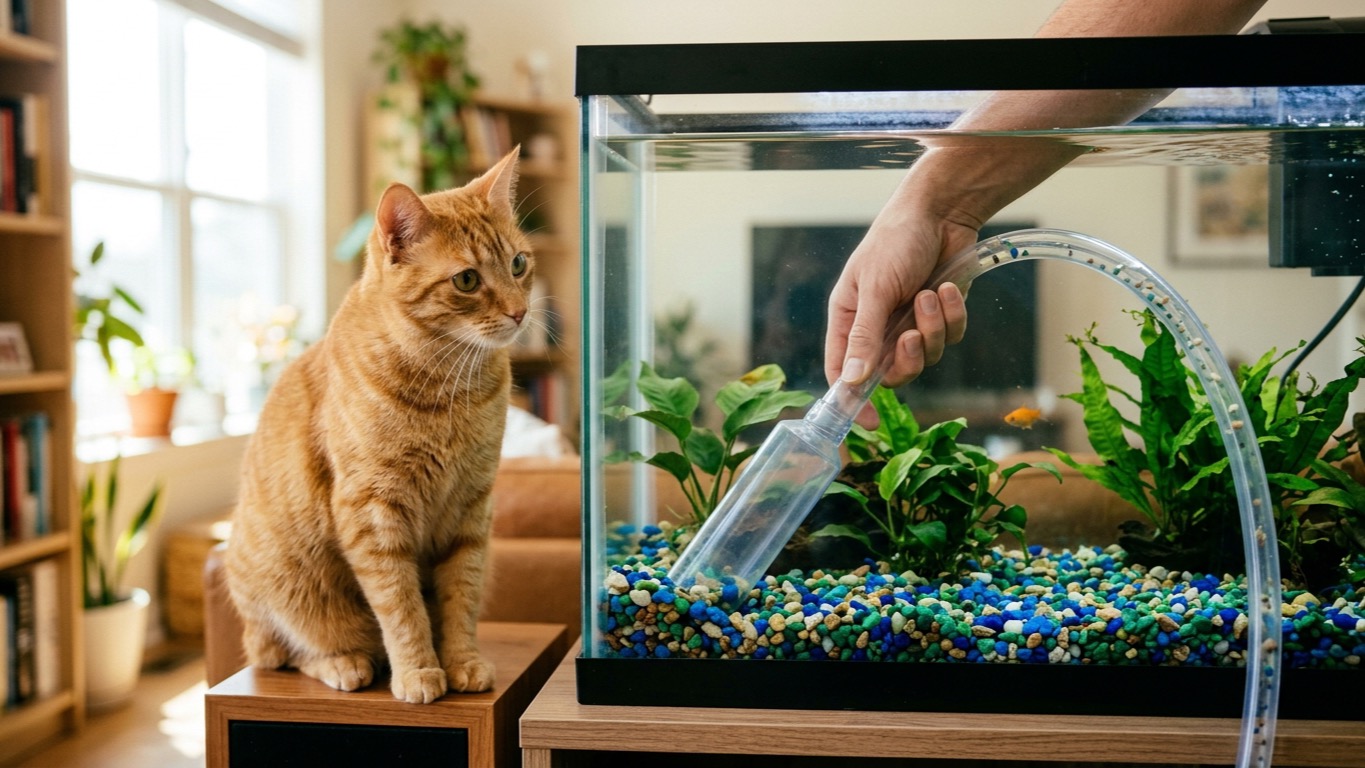
- Siphon. Lift sheets in one piece during a water change. Scrape glass, then vacuum the sand under the stain.
- Flow. Aim returns into still corners. Rinse mechanical media in tank water so the pump can push again.
- Light. Shorten the daily light period. Cover the tank if room light still hits the glass.
- Export. Cut leftover food. Remove dead leaves. Keep the waste out after the mats are gone.
Do the siphon first, because a killed mat still decays. Add an airstone before any chemical step that raises oxygen demand.
Three maker pages in our set call for extra air or steady aeration:
- UltraLife Reef Products tells you to add airstones before and during treatment, because oxygen use rises.
- Boyd Enterprises tells you to raise oxygen with heavy aeration or a large air stone.
- Fritz Aquatics tells you to maintain aeration and water flow, and to turn off the skimmer and chemical media first.
API Fishcare’s Marine Algaefix page does not add that air step. Follow each label, not a blended homemade dose.
Compare labeled treatments by attribute
Labels disagree on dose, wait time, and the size of the water change.
Our research team compared published specs from the four maker pages below. The table is an attribute grid, not a ranking.
| Product | Form | Target named on the maker page | Published dose | Wait and water change on the label |
|---|---|---|---|---|
| UltraLife Blue Green Slime Stain Remover | Powder | Blue-green slime stains in freshwater | 2 level spoonfuls per 15 gal; spoon 0.625 CC | Repeat after 48 hours if needed; wait 1 week before more doses; no water change required |
| Boyd Chemiclean 2 g | Powder | Red, black, blue-green, and methane (bubble) cyanobacteria | 1 scoop per 10 gal; micro spoon 0.15 cc; 2 g treats up to 300 gal | Up to 48 hours, then a 20% water change |
| Fritz Slime Out | Powder packets | Cyanobacteria stains in fresh and saltwater | 1 packet per 25 gal (95 L); 10-pack treats 250 gal | 25% water change after 48 hours |
| API Marine Algaefix | Liquid | Green algae, “Red Slime,” and brown algae in saltwater | 1 ml per 10 gal (38 L), or 5 ml per 50 gal (190 L) | Repeat every 3 days until controlled, then weekly; siphon dead growth |
UltraLife Reef Products also sells 15-gallon, 150-gallon, and 1,000-gallon sizes. Mix the powder in a cup of tank water, then pour it back. The same page says you do not need to change water or pull the filter.
Boyd Enterprises’ Chemiclean page also lists a 6 g jar that treats up to 900 gallons. A 2 fl oz liquid SKU on that page treats up to 720 gallons. During treatment, that page tells you to shut off UV and ozone, and to pull carbon or Chemi-pure.
Fritz Aquatics’ Slime Out page also lists a 20-pack that treats 500 gallons (1,893 L). It says the mix contains no algaecides, phosphates, or erythromycin succinate. It also says the treatment does not harm nitrifying bacteria when used as directed.
API Fishcare’s Marine Algaefix page adds a 50 ml dose per 500 gallons (1,890 L). That page says the product will not harm marine fish, corals, or other invertebrates when used as directed. It also says it is a violation of federal law to use the product off the label.
Match the bottle to the water you actually keep:
- Freshwater slime sheets: start with UltraLife Blue Green Slime Stain Remover or Fritz Slime Out after the Four-Check.
- Marine red slime: start with Boyd Chemiclean 2 g, Fritz Slime Out, or API Marine Algaefix after the Four-Check.
- Do not mix two labels in the same 48-hour window.
Read the air and media steps again before you dose. Boyd Chemiclean and Fritz Slime Out both want chemical filtration out during treatment. UltraLife Reef Products says you can leave filtration in place.
Keep it from coming back
Prevention is the same Four-Check after the mats are gone.
A clean glass pane is not the finish line, because waste that rebuilt the first bloom will rebuild the next one.
Keep this weekly loop:
- Feed only what fish finish in a few minutes.
- Siphon leftover food and plant debris.
- Rinse mechanical media before flow drops.
- Keep lights on a timer, then leave them off at night.
Boyd Enterprises says Chemiclean can be used monthly as maintenance after you follow the full 48-hour cycle. That is a label option, not a requirement. Fritz Aquatics tells you to pair Slime Out with nutrient export if stains return.
API Fishcare’s weekly Marine Algaefix dose is a maintenance step after control, not a substitute for a vacuum. If plants are part of the plan, pick species that can live in your light and water. Then keep them growing so leftover nutrients have somewhere to go.
If flow is the weak point, fix the filter before you buy another bottle. If you are also moving pH, do that as its own measured job.
Stop and re-check if any of these show up after a dose:
- Fish gasp at the surface
- The filter output looks weaker than yesterday
- New slime returns in the same dead corner
- You cannot name the label step you just used
Do not double the dose to fix those flags.
FAQ
Is cyanobacteria the same as green algae?
No. The CDC freshwater bloom page calls cyanobacteria blue-green algae, but they are bacteria. True green hair or spot algae is a different problem. This guide covers only the slimy bacterial sheets named on the four maker pages above.
How do I remove it without a chemical?
Use the Waterpuppy Four-Check. Siphon the sheets, restore flow, shorten light, and export leftover food. Add air if a large mat is dying, because the CDC page says decaying cyanobacteria can use up oxygen.
When should I use a labeled treatment?
Use one after you have siphoned what you can lift, and only if the stain still spreads. Match freshwater or saltwater to the maker page. Do not blend two labels in the same wait window.
Do I have to do a water change after dosing?
It depends on the label you chose. Boyd Enterprises requires a 20% change after 48 hours, while Fritz Aquatics requires a 25% change after 48 hours. UltraLife Reef Products says no water change is required, and API Fishcare tells you to siphon dead growth and repeat every 3 days.
Can the slime make people or pets sick?
The CDC freshwater page says cyanobacteria toxins can make people and animals sick after touch, droplets, or a swallowed splash. That page is written for lakes and rivers, not aquariums. Still bag the mats, keep pets from drinking tank water, and wash your hands.
Why does the slime come back in the same corner?
That corner still holds waste or still water. Boyd Enterprises and UltraLife Reef Products both point at organic solids as the fuel. Clean the filter, move the flow, and cut leftover food before you dose again.
Does raising pH stop cyanobacteria?
No source in our set gives a pH target that clears aquarium slime. pH is a fish-chemistry number, not a stain remover. If you still need a raise for the species you keep, use the pH raise guide as a separate job.