Quick answer: Wipe the brown film off the glass and cut silica in the source water. Scrape and siphon until the dust stops coming back. Skip algaecides until you know the film is leftover diatoms.
Brown film that wipes off tank glass is diatoms, and they need dissolved silica to keep spreading. This page is a home-tank research brief, and
We used one selection rule: the brown coat had to be soft, wipe off glass, and sit in a freshwater home tank. We left out reef slime, hair algae, green water, and any sick-fish case.
We call that filter the Wipe-and-Cut Rule: wipe first, then cut the silica source. Buy media only if the film returns after the source water is cleaner.
How to tell brown algae from other brown messes
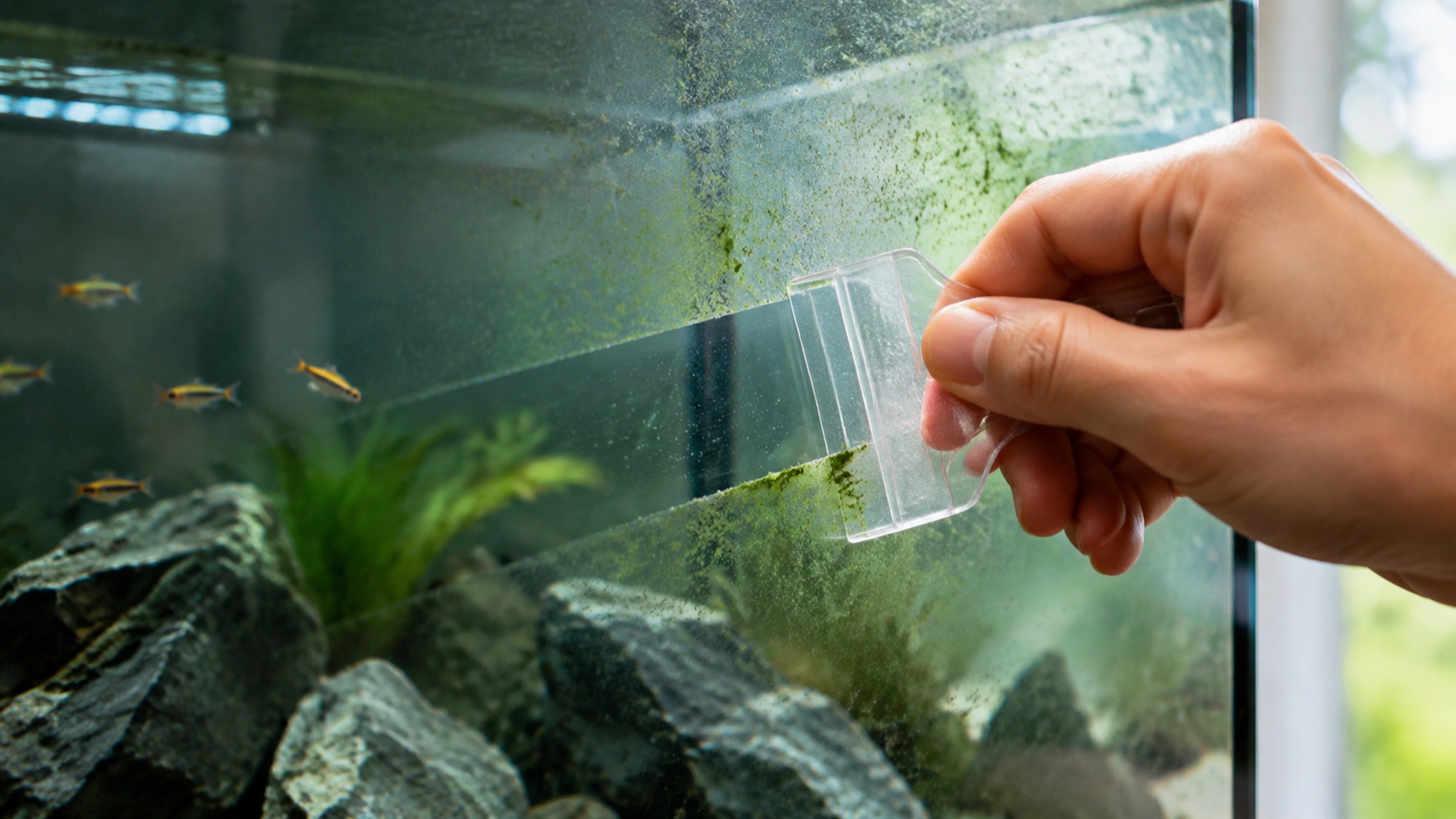
If the coat is dusty and wipes off glass, treat it as diatoms.
True brown algae in a home tank is usually a clan of silica-shelled cells called diatoms. The coat looks like rust dust or tan powder on glass, sand, and leaves.
Do the wipe test before you buy a bottle or a bag of media.
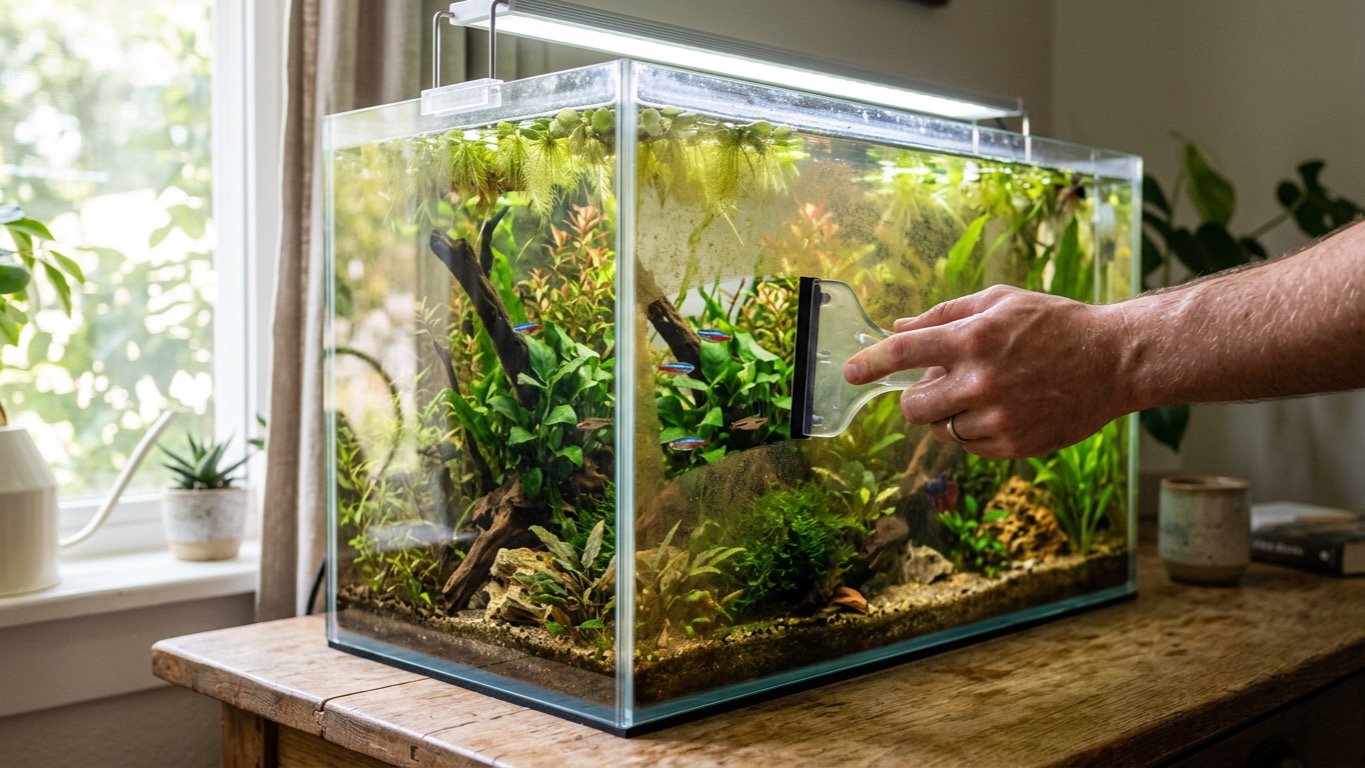
- Drag a clean finger or algae pad across the glass.
- If a brown smear comes off with little effort, treat it as diatoms.
- If the smear is slimy, stringy, or full of bubbles, stop. That is a different problem.
Diatoms are not the same as green spot algae, which is hard and stays put. Hair algae hangs in threads, and green water turns the whole tank soupy.
This page does not cover those other growths. If fish look sick, stop the algae plan and get help from a licensed clinic.
What feeds brown algae in a fish tank
Diatoms need dissolved silica, and many public source waters carry a lot of it.
Diatoms build glass-like cell walls from dissolved silica, so extra light alone does not explain a brown wipe-off film. If silica keeps entering, the dust can return after every scrape.
Our research team analyzed published water numbers, not tank trials. The U.S. Geological Survey report on West Virginia public source water sampled raw taps from June 2019 through May 2021.
That report’s silica table is the number set we use here.
- Silica showed up in all 272 samples that were tested.
- The range was 1.13 to 33.10 mg/L as SiO2.
- The median was 9.17 mg/L as SiO2.
- The table lists no EPA maximum contaminant level for silica.
- It also lists no health advisory and no secondary standard for silica.
The EPA’s secondary drinking-water list covers 15 nuisance chemicals, and silica is not on that list. The EPA page sets a secondary limit of 500 mg/L for total dissolved solids and a pH band of 6.5 to 8.5. Those are taste and plumbing guides, not algae scores, so a tap can be legal to drink and still feed diatoms.
Nitrate is a separate number from silica. The EPA’s National Primary Drinking Water Regulations set a nitrate limit of 10 mg/L measured as nitrogen. That infant-health cap is not an algae-control target for a glass box.
The same USGS report found nitrate above the lab reporting level at 210 of 270 sites, or 78 percent.
- Nitrate median: 0.29 mg/L as nitrogen
- Nitrate maximum: 12.36 mg/L at one site
- Sites above the 10 mg/L EPA cap: 1
- Orthophosphate median: 0.01 mg/L as phosphorus
Comparing those published specs, silica was the nutrient that was always present. Nitrate was common but usually far below the human drinking-water cap. If you only chase nitrate, you can miss the fuel diatoms actually need.
Why a new tank gets a brown coat
A new tank often has leftover silica and few plants, so diatoms win early.
A tank that is still settling its nitrogen cycle has more open surfaces and fewer plants, so diatoms colonize bare glass and sand first. The brown coat is a phase, not a proof that you failed.
If you are still in that start-up window, read our page on how long to cycle a fish tank. Finish the cycle, and do not flood the tank with extra food while you wait.
Common silica paths include untreated tap or well water and new sand or rock that sheds dust.
You do not have to throw out the sand on day one. Cut the dissolved load first, then decide if the hardscape is still shedding.
Do not starve the tank of light for a week as a first move. A blackout does not remove silica, and it can stress plants you still need.
A one-week plan to clear the glass
Wipe, siphon, and change water on a set schedule before you buy a bottle.
Day 1 is identification and source water.
- Do the wipe test on the front glass.
- Collect tap or well water in a clean cup before it hits the tank.
- If you can, test that source water for silica, nitrate, and phosphate.
- If you cannot test silica, treat high-silica source water as the default when the film returns after every change.
Days 2 through 7 are mechanical work.
- Wipe glass and decor with an aquarium-safe pad.
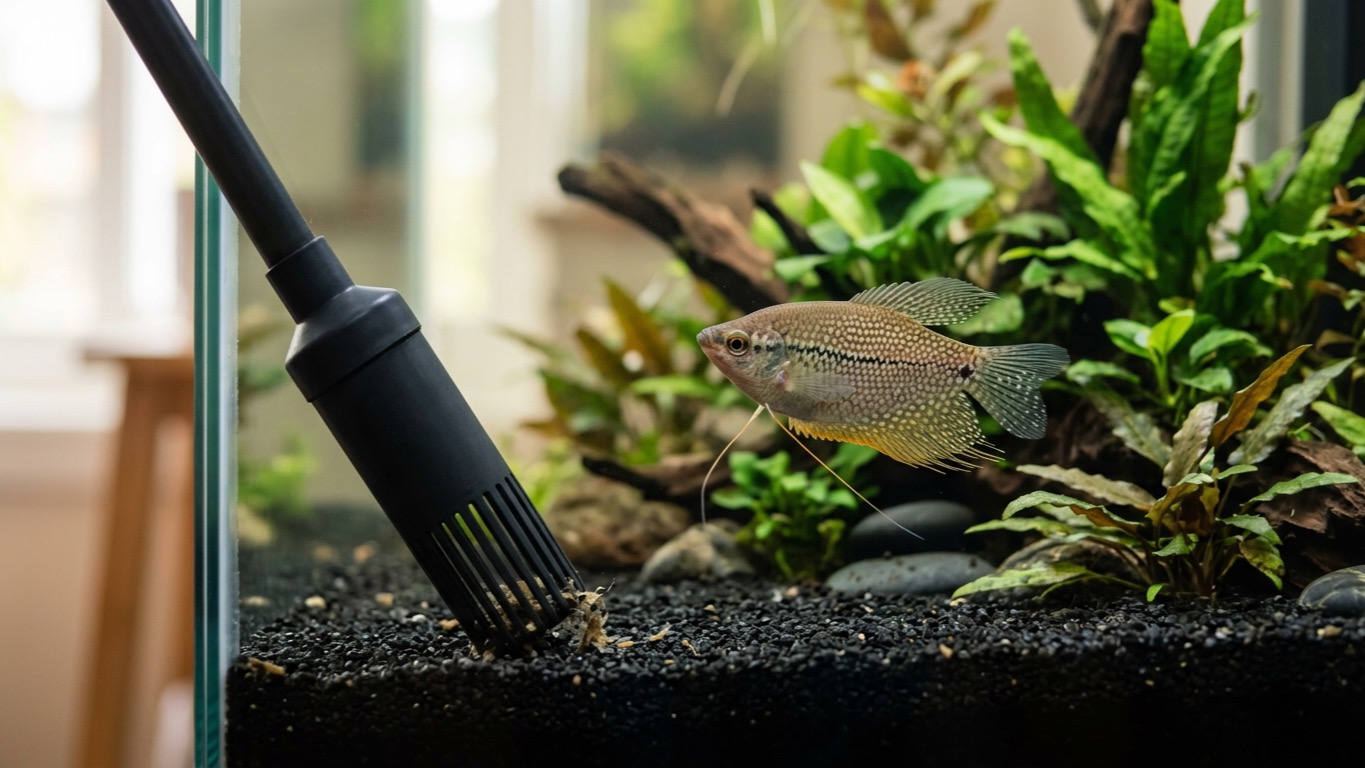
- Vacuum the sand or gravel so the brown fluff leaves the tank.
- Change a portion of the water with the cleaner source you can get.
- Rinse filter foam in old tank water, not tap water.
- Feed less for that week so waste does not refill the nutrient pool.
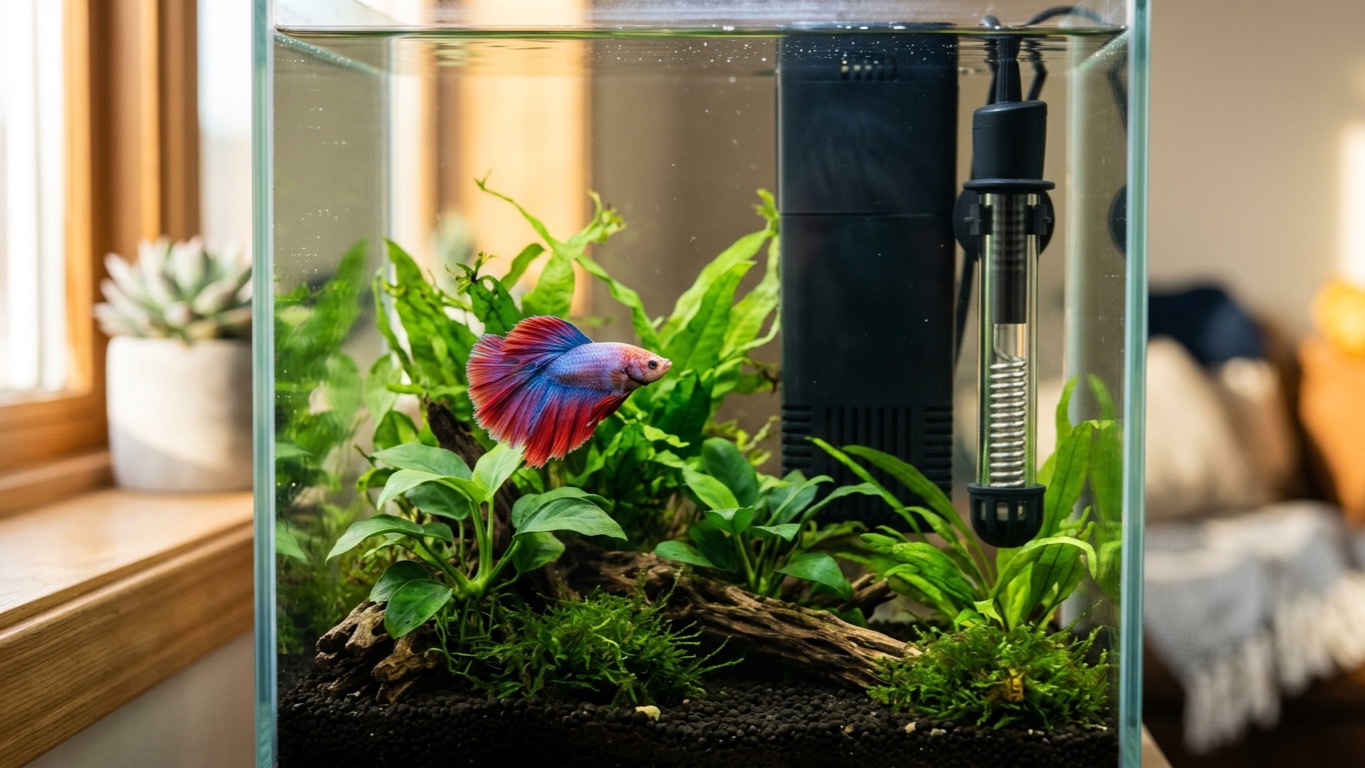
Keep the heater on, because a swing in temperature is a separate stress. If your gear is a combo unit, see our guide to the best fish tank filter and heater in one. That page covers how those units move water while they hold heat.
Repeat the wipe after each change so you can see if the smear is thinner. If the smear is just as thick after you switched water, the fill water is still the source.
When a media bag or bottle matches the problem
Use silicate-binding media if the film returns after you clean the source, and skip bottles that do not name diatoms.
Comparing published specs, two product pages talk past each other: one names silicate, and one names other algae types.
The manufacturer’s page for Seachem PhosGuard states it removes phosphate and silicate in fresh and salt water.
- Freshwater dose: 85 mL, or 1/3 cup, per 400 L (100 U.S. gallons)
- Saltwater dose: the same 85 mL per 200 L (50 U.S. gallons)
- Recheck after 4 days
- Replace the media if the target ion has not dropped to about 0.02 mg/L
- Phosphate binding on the page’s table: 0.87 mg per gram
Our research team compared that 0.02 mg/L check point with the USGS median silica of 9.17 mg/L. The source-water median is about 460 times that media check point.
The PhosGuard FAQ says the media can exhaust in 4 to 5 days when phosphate is very high. It also says not to tumble the beads in a reactor, because dust can form.
Put the beads in a filter bag and place the bag where water must pass through it. A clogged cartridge that water bypasses will not do this job. If you need a refresher on media seats, see our page on the best fish tank filter cartridges.
API’s product page for ALGAEFIX is a different tool.
- Dose: 1 mL per 10 gallons (38 L), or 5 mL per 50 gallons (190 L)
- Repeat every 3 days until the algae on that label is controlled, then dose once a week
That page names green-water blooms and string or hair algae. It does not name brown diatoms. It also says not to use the product with freshwater shrimp, crabs, or lobsters.
Seachem’s Flourish Excel page is not an algae protocol.
- Initial dose after a water change greater than 40 percent: 1 capful (5 mL) per 40 L (10 U.S. gallons)
- Later dose: 1 capful per 200 L (50 U.S. gallons), daily or every other day
- Each cap thread is about 1 mL
The same Excel page says the company does not produce or market the product as an algicide. We mention it so you do not overdose a plant carbon as if it were a brown-algae cure.
Do not stack an algaecide, a carbon dose, and a big media charge on the same day. Pick the matching tool, wait, and retest.
How to stop brown algae from coming back
Keep silica out, keep waste down, and keep water moving across clean media.
Prevention is source control, not a weekly poison, because a refill near that USGS median of 9.17 mg/L can stain the glass again.
Use this keep-it-gone list.
- Prefer reverse-osmosis or other low-silica water for changes if your tap stays high.
- If you stay on tap, run a silicate-binding media and replace it when the 4-day check fails.
- Plant the tank so leaves, not bare glass, take leftover nutrients.
- Do not overfeed. Uneaten food becomes nitrate and phosphate.
- Keep the filter unclogged so water actually hits the media bag.
- Wipe the glass on change day so shells leave the tank.
The EPA nitrite limit of 1 mg/L as nitrogen is another drinking-water cap, not a tank target. The USGS West Virginia set found no site above that nitrite cap. Still, a nitrite spike in a new tank means the cycle is not done.
Fix the cycle first, because algae media will not finish a cycle for you.
If the brown film vanishes and a green film takes its place, you solved the diatom phase. That is a new problem with a new rule, not a reason to double the last bottle.
FAQ
Is brown algae in a fish tank dangerous to fish?
The brown wipe-off film is diatoms, not a listed EPA drinking-water poison. The USGS silica table lists no health-based cap for silica in that source-water set.
We are not a clinic and we do not judge fish health from a stain. If fish gasp, clamp, or stop eating, get in-person help.
How do I know it is brown algae and not cyanobacteria?
Diatoms wipe off as dry-looking rust dust, while cyanobacteria is often slimy, sheet-like, and can smell. If a sheet lifts in rubbery pieces, do not use the Wipe-and-Cut Rule. That case was outside our selection rule.
Does tap water cause brown algae?
It can, when the tap carries dissolved silica. In the USGS West Virginia set, all 272 silica tests were above the reporting level.
The lowest value was still 1.13 mg/L as SiO2. A legal tap is not the same as a low-silica tap.
Will snails or otocinclus remove brown algae for good?
Grazers can eat the film you already see, but they cannot cut silica in the fill water. If the source stays rich, the dust returns on the next week’s glass. Use animals as helpers, not as the plan.
Should I do a blackout to kill brown algae?
A blackout does not remove dissolved silica, and diatoms also grow in dim tanks. Wipe, change water, and cut the source instead.
Can I use API ALGAEFIX for brown diatoms?
API’s ALGAEFIX page names green water and hair algae. It does not name brown diatoms.
The dose on that page is 1 mL per 10 gallons every 3 days, then weekly. It is also labeled as unsafe for freshwater shrimp, crabs, and lobsters.
How long until brown algae goes away?
The film lasts as long as dissolved silica keeps arriving and cells keep settling. If the smear thins after you change the source and keep wiping, you are on the right path.