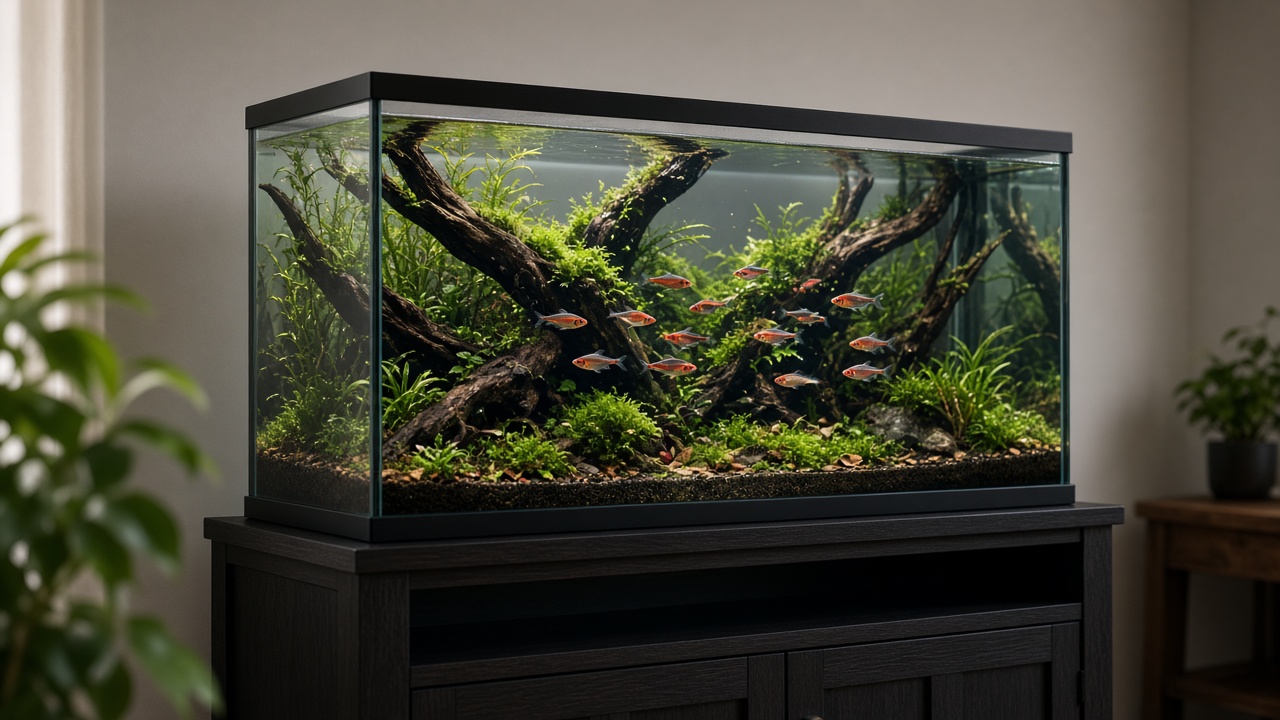
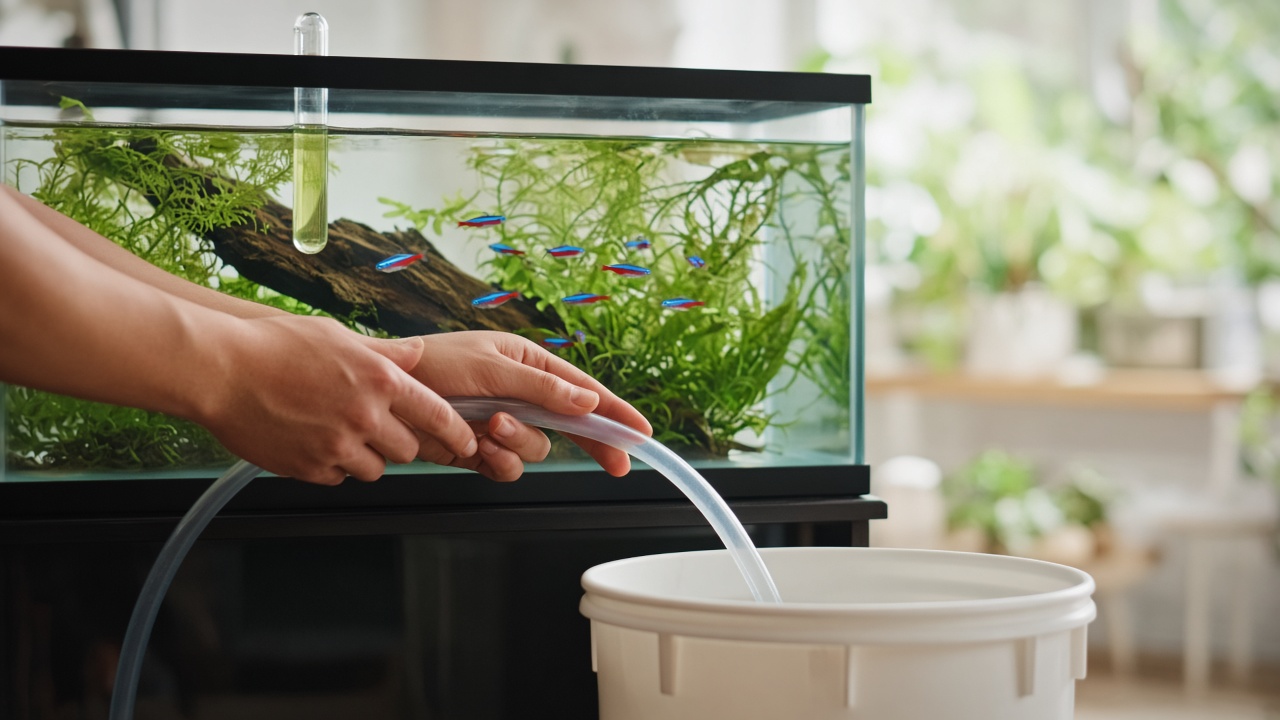
Quick answer: Size a fish tank heater from tank gallons and the gap between room air and target water. Aqueon’s chart calls for 100 watts on a 20-gallon tank with a 10°F lift. Choose a fully submersible unit with a printed gallon rating, then check the water with a separate thermometer.
A 20-gallon tropical tank in a 68°F room needs a 100-watt fish tank heater.
This page is a desk comparison of published wattage charts from Fluval, Aqueon, EHEIM, and Tetra. We did not run heat-loss trials, open heater housings, or keep fish on these units.
A heater made this article only if its 2026 maker page listed both watts and a maximum tank volume. We left out in-line heaters, under-tank pads, reptile heaters, and combo filter-heaters.
The Waterpuppy Maker-Chart Rule
Maker charts already turn gallons and room-to-water lift into a watt number you can buy.
Our research team analyzed four current maker charts and did not invent a fifth wattage rule. We used the printed gallon caps and the printed watt SKUs.
The Waterpuppy Maker-Chart Rule has three numbers:
- Tank gallons, filled to the normal water line
- Lift, which is target water temperature minus the coldest room air
- The watt SKU on the maker chart for that pair
If two charts disagree, we take the higher watt SKU. Aqueon’s setup guide is the most complete lift table we compared, while Fluval, EHEIM, and Tetra publish a single gallon cap per SKU.
Top 7 Fish tank heater
The picks below are the 7 fish tank heaters on sale right now, listed with what each suits best and an honest drawback. Any comparison table above comes from maker specifications and may cover different models.
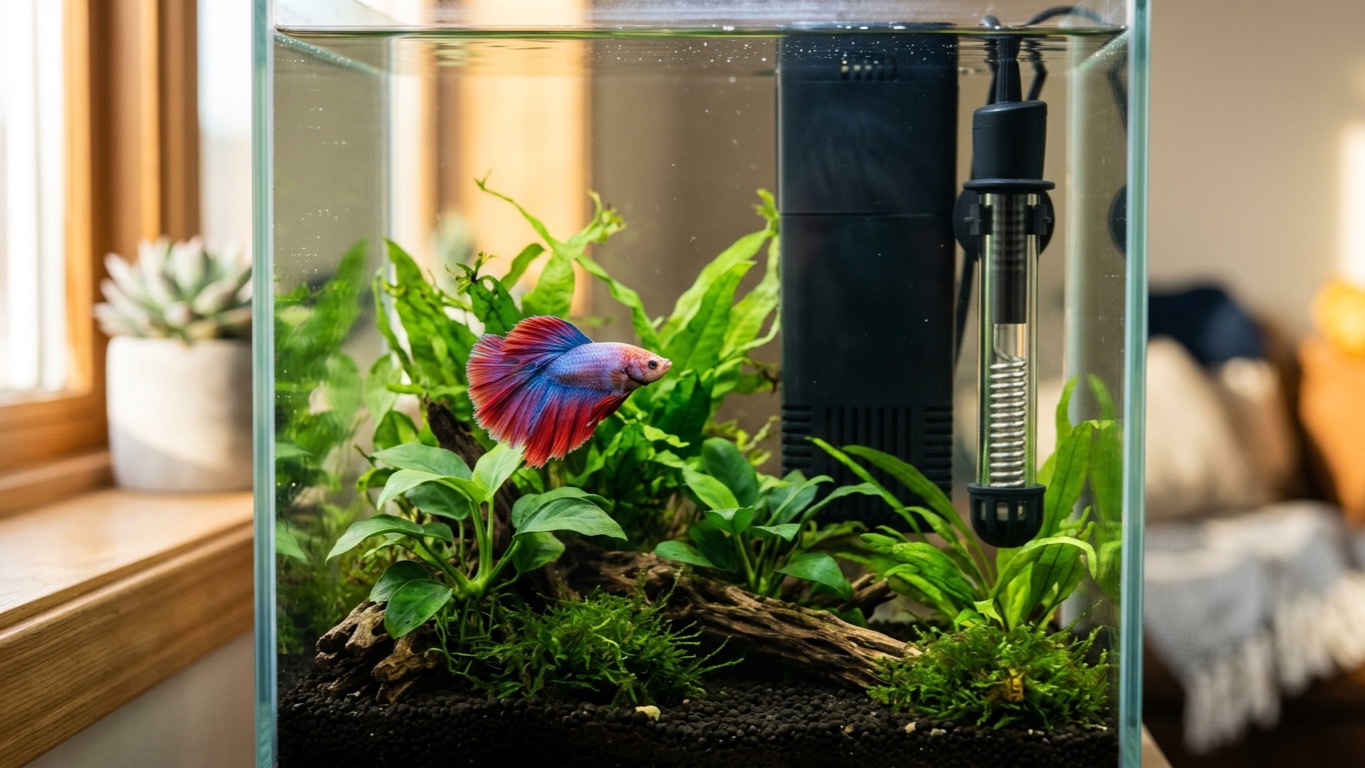
1. hygger Small Aquarium Betta Heater
Best for: compact heating for small desktop betta tanks
We compared this unit to standard heaters and found it ideal for nano-aquariums. Owners report it is perfect for maintaining stable temperatures in small volumes where larger equipment would be intrusive.
Pros: Space-saving design; Easy to install Cons: Limited temperature control
2. HiTauing Aquarium Heater
Best for: precise temperature monitoring with digital display
Owners report that the external controller makes adjustments much easier than reaching into the tank. We compared this to manual dial heaters and found the digital accuracy provides better peace of mind.
Pros: External controller; Clear temperature readout Cons: Controller unit not waterproof
3. Orlushy Submersible Aquarium Heater
Best for: durable heating for medium-sized community tanks
We compared the build quality of this model to budget alternatives and noted its robust construction. Owners report that it holds steady temperatures effectively in standard 20 to 40-gallon setups.
Pros: Shatter-resistant glass; Reliable suction cups Cons: Bulky profile
4. AQUANEAT Aquarium Heater
Best for: budget-conscious hobbyists starting their first tank
We compared this to premium heaters and found it serves as a functional, no-frills entry point. Owners report it is a reliable choice for those needing a basic heater on a tight budget.
Pros: Highly affordable; Simple plug-and-play operation Cons: Lacks advanced safety features
5. hygger Aquarium Heater 300W/500W/800W/1000W
Best for: high-wattage heating for large display aquariums
We compared the heating capacity of this series to smaller units and found it necessary for large-volume tanks. Owners report that the high-wattage options reach target temperatures quickly in oversized systems.
Pros: Powerful output range; Integrated safety guard Cons: Requires significant tank clearance
6. HITOP 300W Adjustable Aquarium Heater
Best for: versatile temperature adjustment for general aquariums
We compared this adjustable model to fixed-temp heaters and found it offers much better flexibility for different fish species. Owners report that once calibrated, it maintains a consistent environment.
Pros: Adjustable dial interface; Good value for money Cons: Calibration can be finicky
7. Novique Aquarium Heater 300W Submersible Water Thermostat Fish Tank
Best for: cost-effective replacement for standard tank setups
We compared this to other 300W options and found it to be a straightforward, utilitarian choice. Owners report that it performs well as a secondary or backup heater for larger tanks.
Pros: Compact form factor; Low price point Cons: Basic build materials
Comparison: Fish tank heater at a Glance
| Product | Best for | Approx. price | Where to buy |
|---|---|---|---|
| hygger Small Aquarium Betta Heater | compact heating for small desktop betta tanks | $16.99 | Check price |
| HiTauing Aquarium Heater | precise temperature monitoring with digital display | $25.49 | Check price |
| Orlushy Submersible Aquarium Heater | durable heating for medium-sized community tanks | $25.99 | Check price |
| AQUANEAT Aquarium Heater | budget-conscious hobbyists starting their first tank | $9.39 | Check price |
| hygger Aquarium Heater 300W/500W/800W/1000W | high-wattage heating for large display aquariums | $47.99 | Check price |
| HITOP 300W Adjustable Aquarium Heater | versatile temperature adjustment for general aquariums | $17.97 | Check price |
| Novique Aquarium Heater 300W Submersible Water Thermostat Fish Tank | cost-effective replacement for standard tank setups | $13.79 | Check price |
Want to browse every option? See the full range of fish tank heater on Amazon →
Watts per gallon from four maker charts
Listed watts-per-gallon at each maker’s max tank size runs from 2.5 to 5.0.
Comparing published specs, the Fluval E series sits near 3 watts per gallon at the printed cap. Fluval’s E100 page lists 100 watts for 30 U.S. gallons, which is 3.3 watts per gallon.
The same Fluval table lists 200 watts for 65 gallons, or 3.1 watts per gallon. The E300 line on that table is 300 watts for 100 gallons, or 3.0 watts per gallon.
Aqueon’s heater guide uses a 68°F to 72°F room as the baseline, and the 10°F column is the common tropical case.
- 20 gallons, 10°F lift: 100 watts, or 5.0 watts per gallon
- 30 gallons, 10°F lift: 100 watts, or 3.3 watts per gallon
- 55 gallons, 10°F lift: 150 watts, or 2.7 watts per gallon
- 75 gallons, 10°F lift: 200 watts, or 2.7 watts per gallon
- 100 gallons, 10°F lift: 300 watts, or 3.0 watts per gallon
EHEIM’s thermocontrol e 100 page lists 100 watts for about 100 to 150 liters. That 150-liter cap is about 40 U.S. gallons, or 2.5 watts per gallon.
Tetra’s HT page lists the HT30 as 100 watts for 10 to 30 gallons. At the 30-gallon top, that is 3.3 watts per gallon.
The HT10 is 50 watts for 2 to 10 gallons, which is 5.0 watts per gallon at the 10-gallon top.
Small tanks sit at the high end of the range, while large tanks sit near 3 watts per gallon on these charts.
Current heaters compared by listed attributes
These five current models differ by set range, alerts, and housing, not by a rank.
| Model | Watts | Maker tank figure | Set range | Accuracy or alert | Housing |
|---|---|---|---|---|---|
| Fluval E100 | 100 W | Up to 30 U.S. gal | 0.5° steps | VueTech color shift at ±2°F | 11.75 in tall electronic tube |
| Fluval E200 | 200 W | Up to 65 U.S. gal | 0.5° steps | VueTech color shift at ±2°F | 14 in tall electronic tube |
| Aqueon Pro 150 | 150 W | 150 W on Aqueon’s 55-gal, 10°F cell | 68–88°F | Electronic thermostat ±1° | Shatterproof thermal plastic |
| EHEIM thermocontrol e 100 | 100 W | 100–150 liters | 20–32°C | Control accuracy ±0.5°C | 309 mm tall, 36 mm glass tube |
| Tetra HT30 | 100 W | 10–30 gal | Preset 78°F | Red lamp heating, green standby | Electronic preset tube |
Fluval’s E100 page says VueTech turns blue when water is low, green in the safe zone, and red when water is high. The alert trips if the set point varies by 1°C or 2°F. The same page lists 0.5 degree steps and a 5-year limited warranty.
Aqueon’s Pro page lists five watt sizes: 50, 100, 150, 200, and 300. The adjustable range is 68°F to 88°F, and the thermostat is listed as accurate to ±1°.
The 50-watt body on that page measures 1.5 by 1.75 by 9 inches. The page does not print a separate length for the 150-watt body.
EHEIM’s thermocontrol e 100 page lists a 20°C to 32°C set band. That is 68°F to about 90°F, with control accuracy of ±0.5°C.
The cable is about 170 centimeters, the warranty is 3 years, and EHEIM lists 10 sizes covering 20 to 1,200 liters.
Tetra’s HT page covers tanks from 2 to 55 gallons. The HT40 is 150 watts for 30 to 40 gallons, and the HT55 is 200 watts for 40 to 55 gallons.
Tetra tells buyers to use a hood or glass canopy so heat stays in the tank.
How to pick wattage for your room
Use Aqueon’s 5°F, 10°F, and 15°F columns when the room is not a mild 68°F to 72°F.
Write down three numbers before you shop.
- Target water temperature (Aqueon’s setup guide uses 75°F to 80°F for tropical fish)
- Coldest room air next to the tank, not the daytime average
- Tank gallons at the normal fill line, not a lower water line
Subtract room air from target water to get the lift.
Then read Aqueon’s heater guide:
- 5°F lift on a 20-gallon tank: 50 watts
- 10°F or 15°F lift on a 20-gallon tank: 100 watts
- 5°F or 10°F lift on a 55-gallon tank: 150 watts
- 15°F lift on a 55-gallon tank: 200 watts
- 5°F or 10°F lift on a 75-gallon tank: 200 watts
- 15°F lift on a 75-gallon tank: 300 watts
Aqueon keeps 100-gallon tanks at 300 watts in every lift column. The same guide lists two 200-watt heaters for 120- and 125-gallon tanks, plus two 300-watt heaters for 150- to 210-gallon tanks.
If your room often sits below 68°F, do not use Fluval’s 30-gallon cap on the E100 as a hard ceiling. Fluval’s E100 page still prints “up to 30 gallons.” Aqueon’s 15°F column already moves a 30-gallon tank from 100 watts to 150 watts.
Where to put the heater and when to plug it in
Place the heater in moving water, wait to plug it in, and keep a thermometer far from the tube.
Aqueon’s setup guide says to set an adjustable heater to 75°F to 80°F for tropical fish. Place it near the filter inlet, the filter outflow, or an air diffuser.
Submersible heaters may sit horizontally, and you should not plug the heater in yet.
Aqueon’s steps then say to fill the tank, start the filter, and wait 10 minutes. Plug the heater in after that wait, and put the thermometer at the opposite end of the tank.
That placement only works if the filter actually moves water, because a clogged cartridge can leave a dead corner.
See our best fish tank filter cartridges guide for rinse and swap timing.
Aqueon’s setup page also says not to add live plants or fish for at least 48 hours. The nitrogen cycle lasts longer than that first weekend. See how long to cycle a fish tank for the full wait.
Keep a drip loop on the cord, a step Aqueon repeats for every electrical item on the tank.
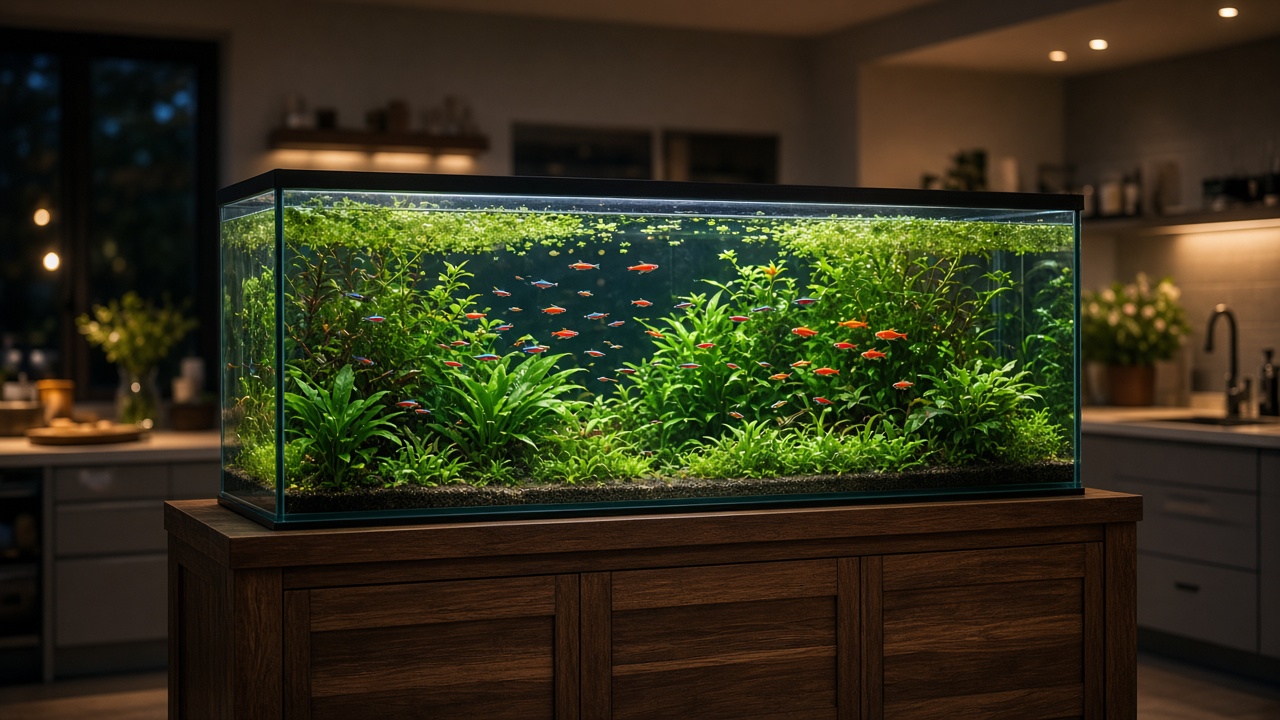
Two heaters versus one
Aqueon calls for two heaters once the tank hits 100 gallons.
The 100-gallon row still shows one 300-watt unit, and the next two rows split the load.
A 120- or 125-gallon tank gets two 200-watt heaters, and a 150- to 210-gallon tank gets two 300-watt heaters.
Two smaller tubes spread heat along a long tank, and a failed unit then causes a smaller swing.
EHEIM’s thermocontrol-e line already sells 200, 250, 300, and 400 watt SKUs for large volumes. The 200-watt model is listed for about 300 to 400 liters.
The 300-watt model is listed for about 600 to 1,000 liters. The 400-watt model is listed for about 1,000 to 1,200 liters.
You can still split those large volumes across two mid-size SKUs, and Aqueon’s 120-gallon row is the clearest printed example.
What this guide leaves out
This guide covers only stand-alone submersible heaters with a printed wattage and gallon cap.
We did not cover filter-and-heater combo units, which share one housing and one power cord.
For that layout, see best fish tank filter and heater in one.
We also left out:
- In-line heaters that sit on canister tubing
- Under-tank heat pads
- Reptile heaters
- External controllers sold without a heater tube
- Brands whose maker pages we could not open in this pass
We did not score models, and we did not group them by price. The table above is an attribute list from maker pages.
FAQ
How many watts per gallon does a fish tank heater need?
Maker charts do not use one fixed number. Fluval’s E100 cap is 3.3 watts per gallon, while Aqueon’s 20-gallon, 10°F cell is 5.0 watts per gallon.
EHEIM’s 100-watt cap at 150 liters is about 2.5 watts per gallon. Use the chart cell for your gallons and lift, then buy that watt SKU.
Is a 50-watt heater enough for a 10-gallon tank?
Aqueon’s guide lists 50 watts for a 10-gallon tank at a 5°F, 10°F, or 15°F lift. Tetra’s HT10 is also 50 watts for 2 to 10 gallons.
Stay at 50 watts only if the room sits near 68°F to 72°F. A colder basement may need the next SKU.
Should I buy an adjustable heater or a preset 78°F heater?
Tetra’s HT line is preset to 78°F and needs no dial. Aqueon sets tropical targets at 75°F to 80°F, so 78°F sits in that band.
Buy adjustable if you keep species that need a set point outside 78°F. Aqueon’s Pro range is 68°F to 88°F, and EHEIM’s range is 20°C to 32°C.
Do I still need a thermometer if the heater has a display?
Yes, because Aqueon’s setup guide says the water can differ from the dial due to flow and tank location. Place a stick-on thermometer above the gravel, away from the heater, and out of direct sun. Fluval’s VueTech display is a second reading, not a replacement for that check.
Can one heater run a 75-gallon tank?
Aqueon’s 10°F column lists 200 watts for 75 gallons. The 15°F column lists 300 watts.
Fluval’s E100 spec table rates the E200 at 65 gallons, so a 75-gallon tank sits above that cap. Fluval lists the E300 for 100 gallons.
What if my tank is 100 gallons or larger?
Aqueon suggests multiple heaters for aquariums 100 gallons or larger. The printed split starts at 120 gallons with two 200-watt units.
Use two tubes on opposite ends, each near flow. Confirm both ends with the thermometer, not with one heater lamp.
Can I use these heaters in saltwater?
Fluval’s E100 page says the E series is for freshwater and saltwater. Aqueon’s Pro page says the same.
EHEIM lists the thermocontrol e 100 for fresh water and sea water. Follow the maker’s rinse and mounting notes for marine tanks.