Quick answer: Start with Tropica Limnobium laevigatum for long roots and low light. Add Tropica Salvinia minima when you want short, hair-coated leaves. Skip giant salvinia and pond lettuce.
Tropica lists Limnobium laevigatum as a low-light, low-CO2 floater with 5–15 cm leaves.
This page is a spec comparison of five Tropica plants sold for aquarium surfaces. We did not run tank trials, write a ranked top-five list, or include pond species named on the US noxious-weed rule.
How we chose these five plants
A plant enters this article only if Tropica still sells it and the maker page lists a surface habit plus light and CO2.
That Closed-Cup Surface Rule is the only filter we used, and we applied it to every candidate.
Our research team analyzed five Tropica product pages side by side. We copied the maker’s light, CO2, height, growth, and origin fields, and we left blank rows blank.
What stayed in:
- Tropica Limnobium laevigatum 1-2-GROW
- Tropica Phyllanthus fluitans 1-2-GROW
- Tropica Salvinia minima 1-2-GROW
- Tropica Riccia fluitans 1-2-GROW
- Tropica Spirodela polyrrhiza 1-2-GROW
What stayed out:
- Loose pond bags with no maker spec sheet
- Water lettuce and other pond-scale rosettes Tropica does not list here
- Any Salvinia named as giant salvinia in 7 CFR 360.200
- Rooted stems that only sit in midwater
If you also want easy plants that live on wood or gravel, use our low-maintenance planted aquarium plants for beginners guide.
Top 7 Floating aquarium plants
The picks below are the 7 floating aquarium plants on sale right now, listed with what each suits best and an honest drawback. Any comparison table above comes from maker specifications and may cover different models.
1. 60+ Leaves Water Spangles
Best for: budget-friendly coverage for small nano tanks
We compared these Water Spangles to other fast-growers and found them to be a reliable choice for beginners. Owners report that they establish quickly, making them ideal for hobbyists looking to manage water quality on a budget.
Pros: Rapid propagation; Excellent nitrate absorption Cons: Can block too much surface light
2. Canton Aquatics Red Root Floaters Live Plant
Best for: hobbyists seeking vibrant color in low-tech setups
This offering from Canton Aquatics provides a striking visual contrast for aquascapes. We compared these to generic floaters and noted that owners often highlight the intense red hues achieved under moderate lighting.
Pros: Deep red coloration; Compact growth habit Cons: Sensitive to water surface agitation
3. Aquarigram 60+ Leaves Red Root Floaters Live Floating Plants for
Best for: bulk planting for larger community aquariums
For those needing to cover a larger surface area quickly, this bulk pack is a practical solution. Owners report that while some transit damage is possible, the remaining plants adapt well to established tanks.
Pros: High leaf count; Good value per stem Cons: Shipping stress can cause leaf melt
4. Awesome Aquatic 10+ Live Red Root Floater Plants Phyllanthus fluitans
Best for: small-scale propagation projects
We compared this smaller quantity option to bulk alternatives and found it perfect for starting a colony in a smaller tank. Owners report that these plants arrive in good condition and thrive with consistent light.
Pros: Healthy root structures; Easy to manage Cons: Small quantity per order
5. Red Root Floater Live Aquarium Plants
Best for: creating natural shade for shy fish species
These Red Root Floaters are favored by owners looking to create a dim, natural environment for sensitive fish. We compared their root development to other species and found they are superior for adding depth and texture to the water column.
Pros: Long, decorative roots; Provides excellent shelter Cons: Requires consistent fertilization
6. 70+Leaves Red Root Phyllanthus Fluitans Aquarium Plant Buy 2 G E T 1
Best for: maximizing value with promotional plant deals
This bundle stands out for those looking to maximize their investment in aquarium greenery. Owners report that the promotional structure makes it one of the most cost-effective ways to fill a tank surface.
Pros: Generous plant volume; Frequent bundle incentives Cons: Requires careful acclimation
7. 6 Mini Amazon Frogbit + 6 Water Spangles Combo
Best for: mixed-species surface variety for diverse aesthetics
We compared this combo to single-species packs and found the mix of Amazon Frogbit and Water Spangles offers a more natural, tiered look. Owners report that the two species complement each other well in terms of light and nutrient needs.
Pros: Diverse leaf textures; Balanced growth patterns Cons: Frogbit can grow quite large
Comparison: Floating aquarium plants at a Glance
| Product | Best for | Approx. price | Where to buy |
|---|---|---|---|
| 60+ Leaves Water Spangles | budget-friendly coverage for small nano tanks | $12.99 | Check price |
| Canton Aquatics Red Root Floaters Live Plant | hobbyists seeking vibrant color in low-tech setups | $10.78 | Check price |
| Aquarigram 60+ Leaves Red Root Floaters Live Floating Plants for | bulk planting for larger community aquariums | $17.99 | Check price |
| Awesome Aquatic 10+ Live Red Root Floater Plants Phyllanthus fluitans | small-scale propagation projects | $12.69 | Check price |
| Red Root Floater Live Aquarium Plants | creating natural shade for shy fish species | $17.89 | Check price |
| 70+Leaves Red Root Phyllanthus Fluitans Aquarium Plant Buy 2 G E T 1 | maximizing value with promotional plant deals | $17.95 | Check price |
| 6 Mini Amazon Frogbit + 6 Water Spangles Combo | mixed-species surface variety for diverse aesthetics | $12.98 | Check price |
Want to browse every option? See the full range of floating aquarium plants on Amazon →
What Tropica’s light and CO2 numbers mean
Tropica defines medium light as 0.5 W/L and medium CO2 as 6–14 mg/L on every plant page in this set.
Those two lines sit under the light and CO2 rows, so they are the scale, not a tank recipe.
Here is how the five pages score on that Tropica scale:
- Low light: Limnobium, Phyllanthus, Salvinia minima, and Spirodela
- Medium light: Riccia fluitans only
- Low CO2: Limnobium, Phyllanthus, Salvinia minima, and Spirodela
- Medium CO2: Riccia fluitans only
- High CO2, listed as about 15–25 mg/L: none of the five
Four of five plants list Low light and Low CO2, and only Riccia lists Medium for both fields.
Low CO2 on a Tropica page means the plant is not placed in the 6–14 mg/L band. It does not prove a tank with no injected gas will fail.
Riccia is the exception in this set, and Tropica’s Riccia page says the liverwort thrives best with added CO2.
Keep those numbers attached to Tropica, and do not treat a blog watt chart as the same scale.
Roots, shade, and which floater fits which tank
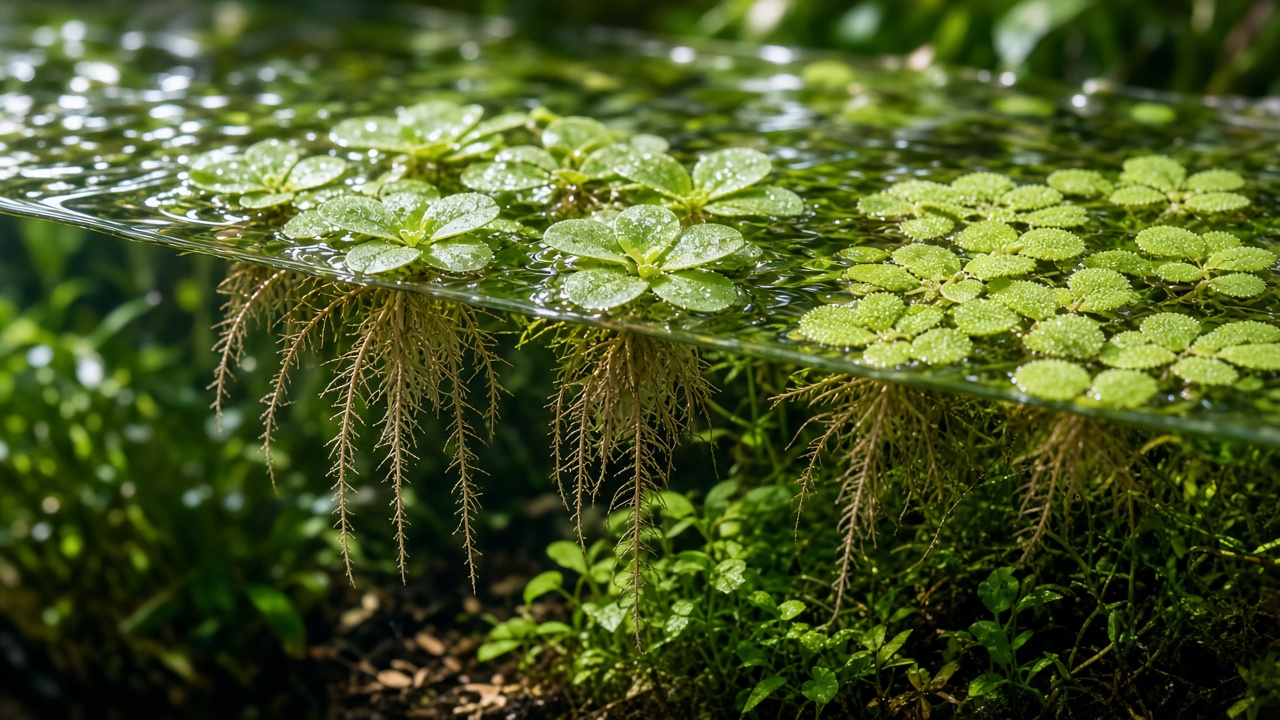
Long-root frogbit hides surface fish, while short-leaf Salvinia and duckweed cover water without a root curtain.
Tropica’s Limnobium page describes fine, long, decorative roots and says those roots give cover to gouramis and other surface fish.
That same page lists the plant as 1–5 cm tall with leaves 5–15 cm wide. That leaf deck is the largest in this set.
Tropica’s Salvinia minima page describes a 1–3 cm floating fern and notes small hairs that make the leaves water resistant.
Salvinia does not send a long root curtain, so use it when you want shade without a hanging forest.
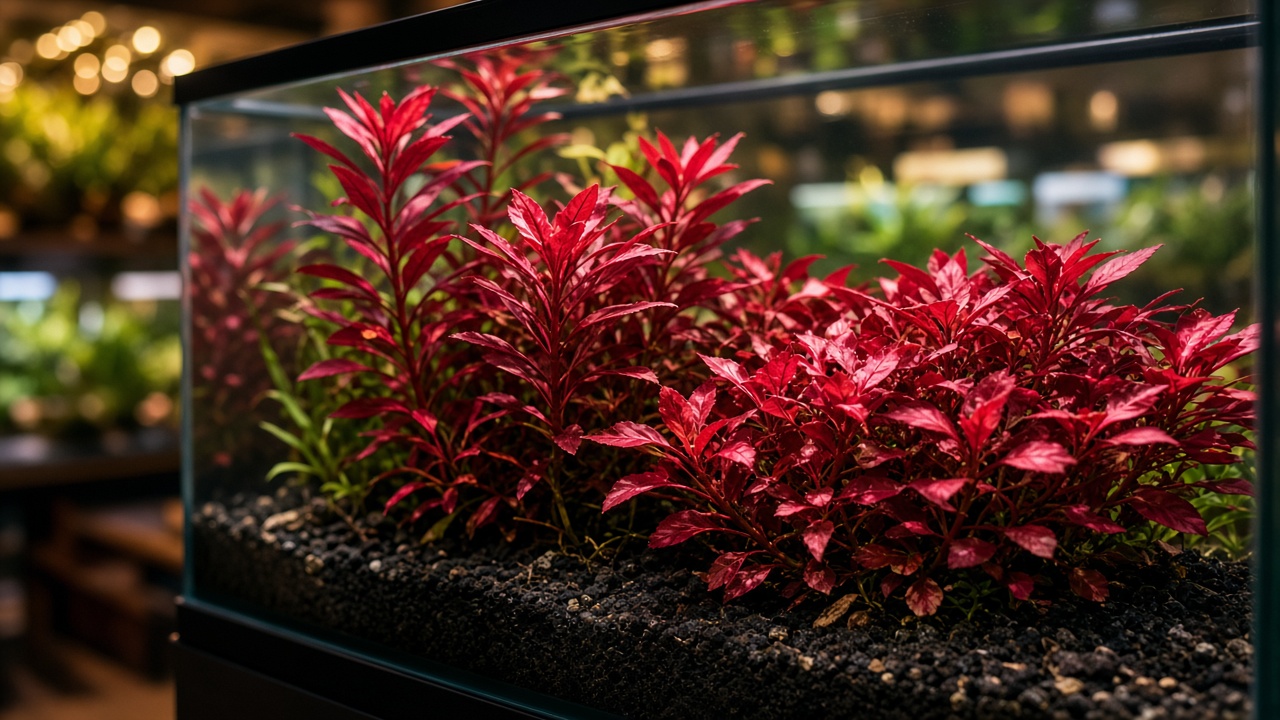
Tropica’s Phyllanthus page says each node holds one heart-shaped leaf, and the plant can make white flowers with six petals.
The same page says stronger light turns the leaves browner, which is a color shift, not a new species.
Tropica’s Spirodela page calls the plant Greater Duckweed and describes small, round, green fronds on the surface.
Tropica’s Riccia page describes a 1–5 cm cosmopolitan liverwort that can float or be tied to a stone.
Riccia still grows toward the surface, and Tropica says new shoots keep rising, so you may need scissors.
Match the root habit to the tank job:
- Long roots and fry cover: Limnobium laevigatum
- Short fern shade: Salvinia minima
- Red-brown leaf color under strong light: Phyllanthus fluitans
- Tiny fronds and fast surface fill: Spirodela polyrrhiza
- Moss-like clumps that can be tied down: Riccia fluitans
Growth, thinning, and nutrients
Tropica says frogbit slows when nutrients drop, so thinning and water-column feed both matter.
The Limnobium page calls growth Medium and says the plant grows much slower when the nutrient level falls.
Tropica treats that slowdown as a nutrient signal, so pale or stalled frogbit is a cue to check the water column.
The Salvinia minima page says the fern grows quickly if nutrition and light are enough. Light-colored leaves signal a micronutrient shortage.
The Spirodela page says the plant grows rapidly and recommends regular thinning so submerged plants still get light.
The Phyllanthus page lists growth as Medium and does not give a doubling time, and the Riccia page also lists growth as Medium.
Tropica notes oxygen bubbles on Riccia leaf tips when conditions are good.
All five Tropica pages list the same two-month height band for these plants: 3–5+ cm. That field is the average height after two months in the tank.
It is not root length, and frogbit roots can hang far below that leaf height.
When growth stalls, dose the water, not the gravel, because floaters feed from the column.
For liquid options and dose styles, use our aquarium plant fertilizer guide.
Do not bury a true floater in aquarium gravel for plants, because gravel is for rooted stems, swords, and crypts.
Thin on a schedule you can keep:
- Lift a handful of extra cover from the surface.
- Leave open water so lower plants still see the lamp.
- Bag the extras. Do not dump them in a creek, pond, or storm drain.
Spec comparison of five Tropica surface plants
Four of five Tropica pages list Low light and Low CO2, and all five list a 3–5+ cm two-month height.
Our research team built this table from the five maker pages, and empty Tropica fields stay blank because we did not fill gaps.
| Product | Light | CO2 | Height after 2 months | Growth rate | Origin | Size note from Tropica |
|---|---|---|---|---|---|---|
| Tropica Limnobium laevigatum 1-2-GROW | Low | Low | 3–5+ cm | Medium | South America | 1–5 cm tall; leaves 5–15 cm wide |
| Tropica Phyllanthus fluitans 1-2-GROW | Low | Low | 3–5+ cm | Medium | South America | One leaf per node; flowers with six petals |
| Tropica Salvinia minima 1-2-GROW | Low | Low | 3–5+ cm | Not listed | Cosmopolitan | 1–3 cm fern; water-resistant leaf hairs |
| Tropica Riccia fluitans 1-2-GROW | Medium | Medium | 3–5+ cm | Medium | Cosmopolitan | 1–5 cm tall liverwort; type listed as moss |
| Tropica Spirodela polyrrhiza 1-2-GROW | Low | Low | 3–5+ cm | Not listed | North America | Greater Duckweed; small round fronds |
Counts from that table:
- 4 of 5 list Low light
- 4 of 5 list Low CO2
- 5 of 5 list 3–5+ cm after two months
- 3 of 5 list a Medium growth rate
- 2 of 5 leave growth rate blank
Limnobium is the only page that states a 5–15 cm leaf width, so it is the widest leaf figure in the set.
Salvinia is the only page that states a 1–3 cm fern size, so it is the shortest named leaf figure.
Riccia is the only page that lists Medium light and Medium CO2, and it is also the only moss type.
How to add a tissue-culture floater
Rinse the closed-cup gel, then float the plant, and do not bury a true floater in gravel.
Tropica’s Limnobium page and Riccia page both describe an aquarium plant from tissue culture in a closed cup.
Use this order:
- Open the sealed cup.
- Lift the plant mass out in one piece.
- Rinse the clear gel off under tap water.
- Tease the mass into small clumps with your fingers.
- Set frogbit, Salvinia, Phyllanthus, and Spirodela on the water.
- For Riccia, float the clumps or tie them to a stone with fishing line, as Tropica describes.
Keep leaf tops as dry as you can. Tropica’s Salvinia page stresses water-resistant hairs, and wet mats still rot if a filter blasts them.
Turn the filter outlet to the side or down, since a strong surface jet parks plants in one corner and soaks the leaves.
Lids change the game because condensation drips on leaves, so leave a gap or wipe the cover if water sits on the tops.
Open-top tanks suit Limnobium, and Tropica’s page says the plant is particularly suitable for open aquariums. New leaves may rise above the water when light and nutrients are high.
What we left out, and why it matters
We excluded giant salvinia because 7 CFR 360.200 names four Salvinia species as US noxious weeds.
The Legal Information Institute publishes that rule, and the aquatic-weed list includes these names:
- Salvinia auriculata (giant salvinia)
- Salvinia biloba (giant salvinia)
- Salvinia herzogii (giant salvinia)
- Salvinia molesta (giant salvinia)
- Azolla pinnata (mosquito fern, water velvet)
Tropica’s sold cup in this article is Salvinia minima, listed as a 1–3 cm cosmopolitan fern.
Do not treat the word salvinia on a bag as the same plant, and ask for the Latin name before you buy.
We also left out water lettuce and water hyacinth, because they are pond-scale floaters Tropica does not list among these five cups.
We left out loose duckweed pinches with no maker page, and Spirodela polyrrhiza is in because Tropica publishes a spec sheet for it.
Never release extra plants into a lake, ditch, or backyard pond; bag them for trash.
This is a home-aquarium research desk that compares published specs and does not write care orders for sick animals.
FAQ
Do floating aquarium plants need injected CO2?
Usually no, because four of the five Tropica pages list Low CO2. Tropica defines a medium CO2 need as 6–14 mg/L and a high need as about 15–25 mg/L. Riccia fluitans is the one Medium-CO2 plant in this set, and Tropica’s Riccia page says it thrives best with added CO2.
Which floating plant has the longest roots?
Tropica’s Limnobium laevigatum page is the only one in this set that highlights long, fine, decorative roots. The page lists the plant as 1–5 cm tall with leaves 5–15 cm wide, but it does not publish a root-length number. Salvinia minima and Spirodela are short-leaf cover plants on their Tropica pages.
Can I keep floaters in a low-light tank?
Yes for four of these five, because Tropica lists Low light for Limnobium, Phyllanthus, Salvinia minima, and Spirodela. Tropica defines medium light as 0.5 W/L, and Riccia is the Medium-light plant. Pair floaters with easy rooted plants from our beginner planted-tank list if the floor still looks bare.
Why do red root floater leaves stay green?
Tropica’s Phyllanthus fluitans page says stronger light makes the leaves browner. The page lists Low light and Low CO2, and it lists growth as Medium. If the leaves stay green, the maker copy points to weaker light, not a bad cup.
How often should I thin floating plants?
Tropica does not print a weekly number, but the Spirodela page says to thin regularly so lower plants still get light. The Limnobium page says you may need to remove some plants for the same reason. Scoop extras into a bag, and do not rinse them into outdoor water.
Is Salvinia minima the same as giant salvinia?
No. Tropica sells Salvinia minima and lists it as a 1–3 cm cosmopolitan fern. 7 CFR 360.200 lists Salvinia auriculata, Salvinia biloba, Salvinia herzogii, and Salvinia molesta as giant salvinia, and those four are US noxious weeds.
Do I plant floaters in gravel?
No. Tropica’s pages describe these plants on the water surface, or, for Riccia, tied to a stone. Use our planted-tank gravel guide when you add swords or crypts, and feed floaters from the water with a liquid plant fertilizer.