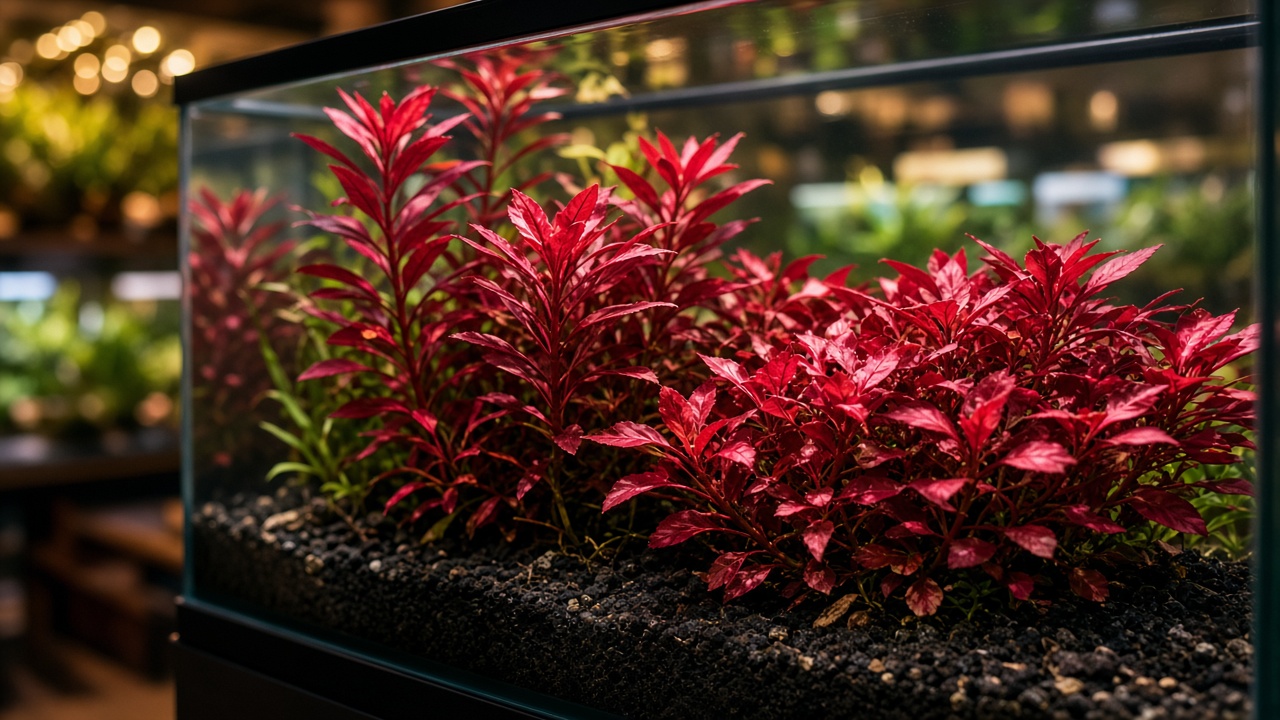
Quick answer: Match the plant to the light rating on its maker card, not to the shop photo. Start with Tropica Ludwigia palustris Super Red when light is low. Use Alternanthera reineckii Mini only if you can meet Tropica’s Medium light and Medium CO2 numbers.
Nine red plants made this list only if Tropica or Dennerle prints a Low, Medium, or High light rating. This page is a published-spec comparison of those nine named plants. We did not grow them in house, and we did not rank them.
Our research team compared current maker plant cards, not tank photos. A plant is in if the card shows red, pink, copper, or violet leaves and a printed light rating. A plant is out if the card is green-only, the name is only a shop nickname, or we could not open the maker page.
The rule for what made this list
A plant is in only if Tropica or Dennerle prints a leaf color and a light rating.
That is the whole gate. We did not add plants because a store called them easy red. We did not add floaters with no card, or swords sold only as mixed pots.
Our research team read nine cards that passed that gate. Three carry a Low label, four carry Medium, and two carry High. The table quotes six cards with numbers, and the other three are named for placement only.
Tropica’s cards define Medium light as 0.5 W/L. They define Medium CO2 as 6–14 mg/L and High CO2 as about 15–25 mg/L.
Top 7 Red aquarium plants
The picks below are the 7 red aquarium plants on sale right now, listed with what each suits best and an honest drawback. Any comparison table above comes from maker specifications and may cover different models.
1. Mipukbay Red Aquarium Plants
Best for: Beginners seeking affordable live plant variety
We compared various entry-level plant bundles and found this option suitable for those just starting their aquascaping journey. Owners report that while these plants offer a nice red hue, they require consistent lighting and nutrient supplementation to maintain their color.
Pros: Budget-friendly pricing; Adds immediate natural aesthetics Cons: Variable species quality upon arrival
2. CANTON AQUATICS Alternanthera Rosanervig
Best for: Aquascapers wanting unique leaf vein patterns
This variety stands out for its unique aesthetic appeal compared to standard red stem plants. Owners report that providing high-intensity lighting and CO2 injection is essential to prevent the plant from fading to green.
Pros: Striking pinkish-red coloration; Distinctive veined leaf structure Cons: Requires high light for best color
3. FdcLixuvol 2 Pcs Aquarium Plants Fish Tank Decorations Artificial
Best for: Low-maintenance setups avoiding live plant care
We compared artificial options for hobbyists who prefer a hands-off approach to tank decor. Owners report that these plastic plants provide an immediate pop of red without the risk of melting or nutrient deficiencies.
Pros: Zero maintenance required; Safe for all fish species Cons: Lacks the biological benefits of live plants
4. Underwater Treasures Silk Red Hygro
Best for: Softening tank edges with silk foliage
Silk plants are a great alternative for those who want the look of red vegetation without the biological requirements. Owners report that the soft material is ideal for tanks housing long-finned fish that might snag on plastic alternatives.
Pros: Gentle on delicate fish fins; Natural-looking movement in water Cons: Can accumulate algae over time
5. aoukoslt Red Artificial Flowers
Best for: Adding decorative accents to small nano tanks
If you need a quick splash of color in a small container, these artificial flowers offer an easy solution. Owners report that they are best used as focal points rather than primary cover for shy fish.
Pros: Compact size for tight spaces; Vibrant, fade-resistant color Cons: Very limited biological utility
6. QUOZUO Aquarium Large Plants Decoration
Best for: Creating large, bold centerpieces in bigger tanks
We compared various large-scale decorations and found this piece provides significant visual impact for larger aquariums. Owners report that the weighted base makes it easy to position securely in deep substrates.
Pros: Substantial height and volume; Sturdy weighted base included Cons: Can look unnatural if placed incorrectly
7. Marcus Fish Tanks
Best for: Serious hobbyists prioritizing healthy aquatic growth
For those committed to the science of live plant keeping, this source is frequently recommended for its high-quality specimens. Owners report that with proper water parameters, these plants adapt well and develop deep, rich red tones.
Pros: Reputable source for healthy stems; Consistent growth potential Cons: Requires dedicated fertilization regimen
Comparison: Red aquarium plants at a Glance
| Product | Best for | Approx. price | Where to buy |
|---|---|---|---|
| Mipukbay Red Aquarium Plants | Beginners seeking affordable live plant variety | $13.99 | Check price |
| CANTON AQUATICS Alternanthera Rosanervig | Aquascapers wanting unique leaf vein patterns | $10.78 | Check price |
| FdcLixuvol 2 Pcs Aquarium Plants Fish Tank Decorations Artificial | Low-maintenance setups avoiding live plant care | $7.89 | Check price |
| Underwater Treasures Silk Red Hygro | Softening tank edges with silk foliage | $9.99 | Check price |
| aoukoslt Red Artificial Flowers | Adding decorative accents to small nano tanks | $5.78 | Check price |
| QUOZUO Aquarium Large Plants Decoration | Creating large, bold centerpieces in bigger tanks | $9.99 | Check price |
| Marcus Fish Tanks | Serious hobbyists prioritizing healthy aquatic growth | $11.87 | Check price |
Want to browse every option? See the full range of red aquarium plants on Amazon →
Low-light red plants
These three keep a warm color when Tropica’s card says Low light, so they are the first buy for a shaded tank.
Cryptocoryne wendtii ‘Mi Oya’ is the red-brown crypt we can quote with sizes. Tropica’s plant card says the hammered leaves run 20–35 cm, and the leaf crown is 15–30 cm wide.
Tropica lists height after two months at 20–30+ cm. Light demand is Low, and CO2 demand is Low. Tropica also notes wild streams above 30 °C, so heat is not the first failure point.
Plant the crown just above the tank floor, and do not bury the center. New crypts often drop old leaves after a move, so wait for new leaves before you pull the plant.
Ludwigia palustris ‘Super Red’ is the low-light stem we quote from Tropica. Tropica’s card says each stalk is 2–4 cm wide and 10–30 cm high.
Light demand is Low, and CO2 demand is Low. Tropica says it turns red more easily than Ludwigia repens ‘Rubin’, and that side shoots increase after you cut the tops.
Cryptocoryne wendtii ‘Tropica’ is the third Low-light name on our nine-card count. We do not quote extra sizes for it here. Use it as a dark, low, hammered-leaf patch next to Mi Oya, not as a tall red stem.
Low-light setup, in order:
- Set the lamp so the floor is not a bright white glare.
- Plant crypts with the crown free of gravel.
- Cut Super Red tops and replant them as new stems.
- Skip extra CO2 if you are only running these three.
Medium-light red plants
These four need Tropica’s Medium light figure of 0.5 W/L if you want the red to stay, not just the plant to live.
Alternanthera reineckii ‘Mini’ is the short red carpet on Tropica’s card. Tropica says a trimmed mat can sit at about 5–10 cm, with Medium growth.
Light demand is Medium, and CO2 demand is Medium, which Tropica writes as 6–14 mg/L. Tropica also says high light and added CO2 improve the look. If you cannot hit that CO2 band, pick Super Red or Mi Oya instead.
Nymphaea lotus is the red-brown lily Tropica sells as a bulb. Tropica’s card says it can grow 20–80 cm tall, with height after two months at 20–30+ cm.
Light demand is Medium, and CO2 demand is Low. Tropica says to prune roots and leaves if you do not want floating pads. It also asks for a rich tank floor and a large tank, as a single plant.
Alternanthera reineckii ‘Rosanervig’ is the pink-nerved stem in our Medium group. We do not quote a second height range for it. Treat it as a midground bush, and give it the same Medium light and Medium CO2 band Tropica prints for Mini.
Ludwigia glandulosa is the fourth Medium name on our count, and we do not quote extra widths for it. Place it as a slower red stem behind Mini. If the lower leaves pale, raise light before you add more stems.
Medium-light setup, in order:
- Aim for Tropica’s 0.5 W/L Medium mark at the planted area.
- Add CO2 if you keep Mini or Rosanervig.
- Leave Nymphaea as one plant, not a thicket.
- Trim Mini often so it stays a 5–10 cm mat, as Tropica describes.
High-light red plants
These two fade or stretch unless the tank can meet Tropica’s High CO2 band of about 15–25 mg/L.
Rotala macrandra is the only High-light stem we quote with a full Tropica card. Tropica calls the Japan form demanding, and lists height after two months at 20–30+ cm.
Light demand is High, and CO2 demand is High. Tropica says soft water and added CO2 are vital for the red. Tropica also says to cut the longest stems 5–10 cm from the floor and replant them.
Proserpinaca palustris ‘Cuba’ is the second High name on our nine-card count, and we do not quote a second size band for it. Use it only if Rotala is already holding color. If Rotala goes green, this plant will not save the scape.
High-light setup, in order:
- Confirm you can hold Tropica’s 15–25 mg/L High CO2 band.
- Cut Rotala 5–10 cm from the floor, as Tropica writes.
- Replant the tops in the same group.
- Do not add a third High-light red until those cuts root.
If you cannot measure CO2, skip this pair and buy Super Red and Mi Oya instead.
Spec comparison of six current products
The table compares six products we can still open on Tropica or Dennerle pages, with no rank and no price column.
| Product | Light on card | CO2 on card | Height on card | Form |
|---|---|---|---|---|
| Tropica Alternanthera reineckii Mini | Medium (0.5 W/L) | Medium (6–14 mg/L) | 5–10+ cm after two months | Stem |
| Tropica Cryptocoryne wendtii Mi Oya | Low | Low | 20–30+ cm; leaves 20–35 cm | Rosette |
| Tropica Ludwigia palustris Super Red | Low | Low | 10–30 cm; stalks 2–4 cm wide | Stem |
| Tropica Nymphaea lotus | Medium | Low | 20–30+ cm after two months; up to 20–80 cm | Bulb |
| Tropica Rotala macrandra | High | High (15–25 mg/L) | 20–30+ cm after two months | Stem |
| Dennerle Ludwigia palustris Super Red | High–medium | 20–30 mg/L | Up to 40 cm | Midground stem |
Read the last two Super Red rows as one conflict, not two winners. Tropica’s Super Red card lists Low CO2. Dennerle’s Super Red card lists 20–30 mg/L and a 20–28 °C range.
Dennerle also lists pH 5–8 and height up to 40 cm. Same trade name, two printed CO2 stories. Plan for the stricter card if color is the goal.
CO2, iron, and trim numbers from maker cards
Color tracks the printed energy band, so Mini uses Tropica’s 6–14 mg/L Medium CO2 and Rotala uses about 15–25 mg/L.
Super Red sits in Tropica’s Low band, then jumps to 20–30 mg/L on Dennerle’s card. Our research team did not average those two Super Red figures. We report both.
Trim rules we can quote:
- Mini: Tropica says careful cutting can hold a 5–10 cm red-violet mat.
- Super Red: Tropica says cutting makes more side shoots.
- Rotala: Tropica says cut stems 5–10 cm from the floor and replant.
- Nymphaea: Tropica says prune roots and leaves to block floating pads.
Iron matters for new leaves, but we are not quoting a bottle dose on this page. Follow the iron product’s own label, and watch new growth. Yellow tissue between veins is a shortage you correct with fertilizer.
If Mini stays green at Medium light, check CO2 before you buy a stronger lamp. If Super Red stays green at Low light, check that the tops are in the beam. If Rotala stays green at High light, check the 15–25 mg/L CO2 band before you add more stems.
Where these plants fit in real tanks
Pick the light band first, then pick the animal load.
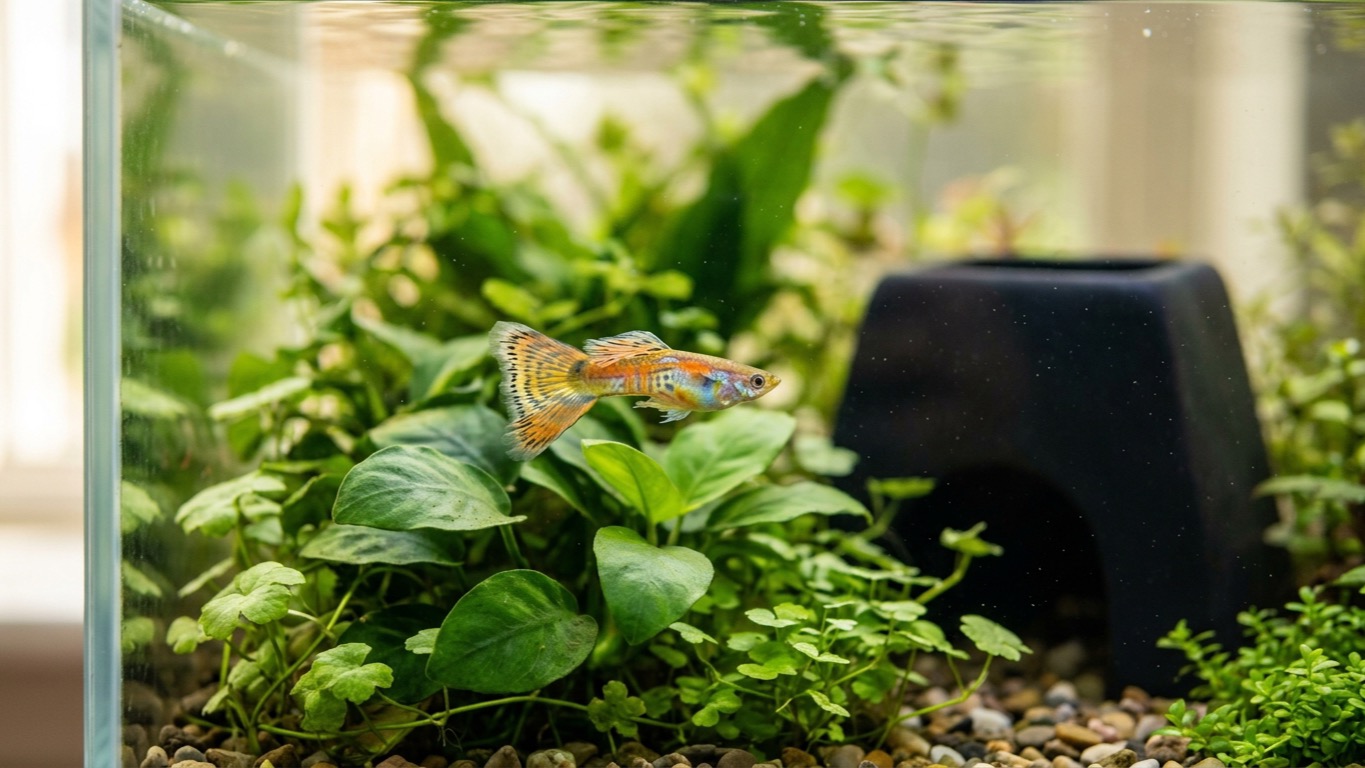
A calm planted betta tank can use Mi Oya and Super Red. Both sit on Tropica Low cards. Mini is a poor first betta plant if the tank has no CO2.
Nymphaea is a poor betta plant if the tank is small. Tropica calls it a solitary plant for large aquariums and lists a 20–80 cm spread.
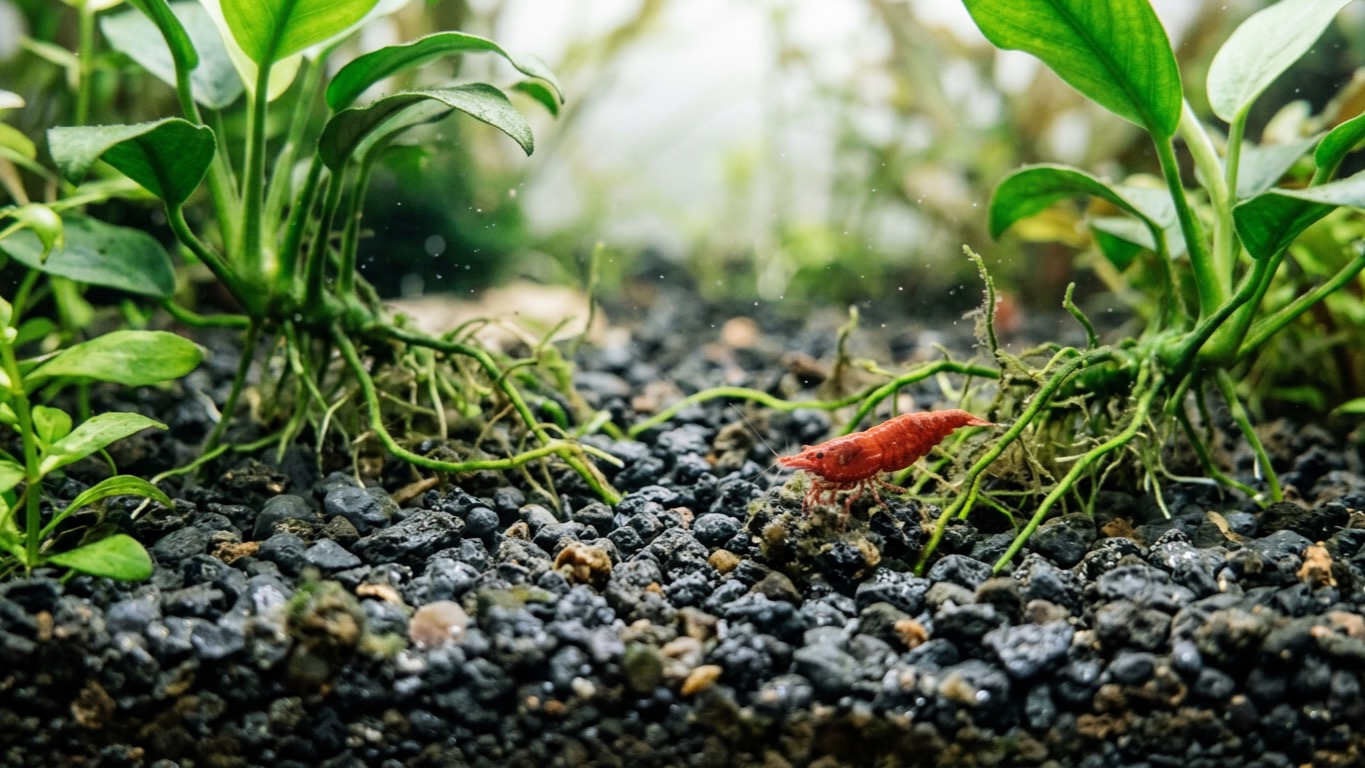
A shrimp tank setup should start from sealed tissue-culture cups when the card offers them. Tropica sells Mini and Mi Oya that way, so rinse the gel, split the clump, and plant small groups. Skip High-light Rotala until that tank already holds stable CO2.
A red claw crab tank is a bad home for soft red stems. Crabs shred leaves, so treat Super Red and Mini as food. Do not buy Rotala for a crab tank.
Placement cheat sheet:
- Foreground: Mini at the 5–10 cm height Tropica prints.
- Midground: Super Red at 10–30 cm, or Dennerle’s form up to 40 cm.
- Mid-to-back crypt patch: Mi Oya at 20–30+ cm with 15–30 cm crowns.
- Single focal bulb: Nymphaea, then cut pads as Tropica directs.
- Back high-energy group: Rotala, cut 5–10 cm from the floor.
Do not mix High-light Rotala into a Low-light crypt tank and hope the lamp averages out. The cards describe one plant, not an average tank.
FAQ
Do red aquarium plants need CO2?
Not all of them. Tropica lists Low CO2 for Mi Oya, Super Red, and Nymphaea lotus, and Medium CO2 of 6–14 mg/L for Mini. Rotala needs about 15–25 mg/L on Tropica’s card, while Dennerle Super Red lists 20–30 mg/L.
Why do my red plants turn green?
The usual cause is a miss on the printed light or CO2 band. Mini needs Tropica’s Medium light of 0.5 W/L and Medium CO2. Rotala needs High light and the 15–25 mg/L band, while Super Red is Low on Tropica and 20–30 mg/L on Dennerle.
What is the easiest red aquarium plant on this list?
Tropica Super Red is the easiest stem we can quote, at Low light and Low CO2. Mi Oya is the easiest crypt we can quote, also at Low light and Low CO2. Mini is not the easy pick, because its card is Medium and Medium.
Can I keep red plants with a betta?
Yes, if you stay on the Low-light names. Mi Oya and Super Red fit a planted betta tank that cannot run High CO2. Skip Rotala, and skip a full Nymphaea in a small tank, because Tropica’s card allows 20–80 cm of leaf.
How tall do these red plants get?
Quote the card, not a forum guess. Mini trims to about 5–10 cm, Tropica Super Red stands 10–30 cm, and Dennerle lists Super Red up to 40 cm. Mi Oya is 20–30+ cm, Nymphaea can reach 20–80 cm, and Rotala is 20–30+ cm after two months.
Are tissue-culture cups better for shrimp?
They are cleaner to start. Tropica ships Mini and Mi Oya in closed cups, so rinse the gel off before you plant. That avoids snails and leftover nursery water, but Mini still needs Medium light and 6–14 mg/L CO2.
Should I buy Rotala macrandra first?
No, buy it last. Tropica calls it demanding and asks for High light, High CO2, soft water, and cuts 5–10 cm from the floor. If you cannot do that trim and that CO2 band, buy Super Red.