Quick answer: Float hornwort or loosely weight the stem. Do not bury it in substrate. Trim the stems often so they do not shade other plants.
Hornwort has no true roots, so float it or loosely weight the stem; burying the stem causes rot. This page is a Waterpuppy research-desk guide that compares published nursery specs. We did not run tank trials, grow-out logs, or water assays.
Selection rule: We cover only Ceratophyllum demersum sold as a named bunch or nursery portion for indoor freshwater tanks. We skip mixed “oxygenator” bags, pond-only bulk sacks, tissue-culture cups, and other Ceratophyllum species.
What hornwort is in a home tank
Hornwort is a rootless freshwater stem plant that feeds from the water, not from soil.
Sellers list the scientific name Ceratophyllum demersum and often use the common name coontail. Tropica’s plant page states the plant has no roots as such, and Rutgers New Jersey Agricultural Experiment Station fact sheet FS1236 says the same.
Rutgers FS1236 describes fanshaped leaves in whorls of five or more, with forks and small teeth. That rough feel is normal and is not a sign the plant is dying.
In the wild, Rutgers FS1236 reports stems that may reach lengths over 4.6 m (15 feet). Indoor bunches stay far shorter if you trim, and Tropica lists stems up to 80 cm tall and 5 cm wide. Dennerle Plants lists height up to 120 cm.
Rutgers FS1236 also says coontail cannot tolerate periods of total emergence, so keep every stem wet and off the lid.
This plant sits with other low-maintenance planted aquarium plants for beginners because it needs no soil. It still needs regular cutting, so treat it as easy, not hands-off.
How to float hornwort
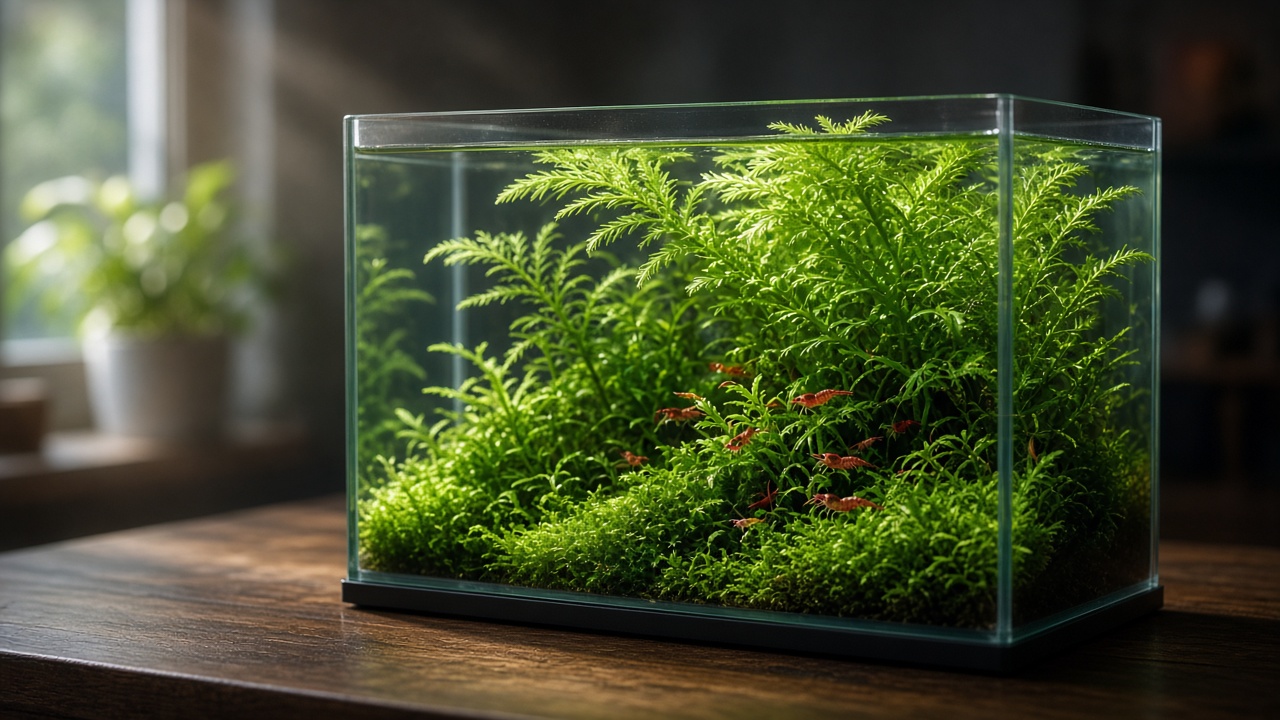
Floating is the simplest setup: rinse the stems, then leave them on the surface.
Our research team compared five maker pages that still list this plant. Aquarium Plants Factory’s Hornwort page says it has no roots and never will. That page tells you to let it float, or wedge a stem between rocks or wood.
Aquatic Arts’ Hornwort Extra Large Bunches page calls it a floating stem plant with no roots. Canton Aquatics’ Hornwort 3 Stems page and Tropica’s card also treat floating as a normal setup.
Use this float method:
- Rinse the stems in a bowl of tank water.
- Remove lead weights, ties, and foam if the pack has them.
- Lift out mushy or black pieces before they stay in the tank.
- Lay the firm green stems on the surface under the light.
- Keep the mat away from the filter intake grate.
Needles break off in strong current and can clog a hang-on-back intake. Our hang-on-back filter guide covers intake screening if you need a sponge or guard.
Aquarium Plants Factory’s grower notes say the plant grows fast enough to shade everything below. That page tells you to thin the mat every week or two.
How to plant or stand the stems
You can stand hornwort up, but you are only holding the stem, not rooting it.
Tropica’s plant page says you can still plant it in the bottom of an aquarium. Dennerle Plants places it in the background, and Aquatic Arts lists middle-to-background placement with anchoring. Canton Aquatics says stems can go into substrate or float.
Aquarium Plants Factory’s page is stricter on depth. It says those pale threads are modified leaves, not roots, and that a buried base just rots.
If you want upright stems, use this method:
- Keep only the lowest 1–2 cm of stem against the hold point.
- Wrap a plant weight around the base, or tuck it between two stones.
- Do not bury a long run of stem in sand or gravel.
- Leave space between stems so light reaches the needles.
- Pull the stem free if the buried tip turns brown and soft.
Do not use root tabs as the main food source, because the plant has no true roots. Canton Aquatics says liquid fertilizers and root tabs are optional, and Aquarium Plants Factory says substrate is not required.
How to trim and reuse cuttings
Cut any firm green stem; the top piece is a new plant.
Dennerle Plants lists propagation as head cuttings and side shoots. Aquarium Plants Factory lists stem cuttings, and Canton Aquatics tells you to trim and replant top cuttings.
Use this trim sequence:
- Cut above a healthy whorl with sharp scissors.
- Float the top piece, or weight only its base.
- Discard soft, bare, or black lower stems.
- Net loose needles after each cut so they do not rot.
- Repeat when the mat blocks light or crowds the surface.
Aquarium Plants Factory’s grower notes say the lower section goes bare and does not refoliate, so keep the green tops and throw out bald bases.
Aquatic Arts’ product page states that, with adequate nutrients, hornwort stems can easily grow 1 inch per week. That is a maker growth claim, not a tank log from us.
Rutgers FS1236 notes that wild plants reproduce by fragments, so a piece left in a bucket can start a new clump. Bag the trimmings, and do not dump them in a pond, ditch, or stream.
Water, light, and CO2 from maker cards
Published ranges overlap, but they do not match, so copy the card that came with your bunch.
Our research team lined up the five product pages in this article. Four pages list a temperature band, and the listed floors do not agree.
- Dennerle Plants lists 1–28°C (about 34–82°F).
- Aquatic Arts lists 50–77°F.
- Canton Aquatics lists 59–86°F.
- Aquarium Plants Factory lists 64–82°F.
That is a 30°F spread between Dennerle’s listed floor and Aquarium Plants Factory’s listed floor. Stay inside the card for the bunch you bought, and do not average the four ranges into one number.
pH listings are tighter than the temperature bands:
- Aquatic Arts, Aquarium Plants Factory, and Canton Aquatics each list pH 6.0–7.5.
- Dennerle Plants lists pH 6–8.
- Tropica’s plant card does not list a pH range.
If your kit reads below 6.0, see our guide on how to raise pH in an aquarium. Raise pH slowly, because sudden swings are a common reason stems shed needles.
Light and carbon listings also differ by maker:
- Tropica lists low light demand and low CO2 demand. Its card defines a medium CO2 need as 6–14 mg/L and a high demand as about 15–25 mg/L.
- Dennerle Plants lists strong light and CO2 at 10–20 mg/l.
- Aquarium Plants Factory lists low to medium light and says CO2 is not required.
- Canton Aquatics says the plant thrives under low light and that CO2 is not required.
You do not need a CO2 cylinder to keep this plant. Dennerle’s 10–20 mg/l figure is its listed range, not a must-buy rule.
Tropica’s low-CO2 label matches the “not required” line on the two U.S. bunch pages. Rutgers FS1236 says wild coontail grows at relatively low light and can stay green in winter.
Five bunches compared by listed attributes
We included a pack only if the maker page names Ceratophyllum demersum and lists stem count, temperature, pH, or height.
| Product | Listed pack | Maker temperature | Maker pH | Maker size note |
|---|---|---|---|---|
| Tropica Ceratophyllum demersum 021A POR | Stem portion | Not listed | Not listed | Up to 80 cm tall, 5 cm wide; 5–30+ cm after two months |
| Dennerle Plants Ceratophyllum demersum | Portion | 1–28°C | 6–8 | Height up to 120 cm |
| Aquatic Arts Hornwort Extra Large Bunches | 2 or more axes, 10+ stems | 50–77°F | 6.0–7.5 | Stems can grow 1 inch per week |
| Aquarium Plants Factory Hornwort | About 2–3 loose stems | 64–82°F | 6.0–7.5 | Mature height 10–20 in |
| Canton Aquatics Hornwort 3 Stems | 3 stems | 59–86°F | 6.0–7.5 | Background or floating |
Listed stem counts run from 2–3 stems on Aquarium Plants Factory’s page to 10+ stems on Aquatic Arts’ page.
Listed max height runs from Aquarium Plants Factory’s 10–20 in up to Dennerle’s 120 cm. Tropica sits in the middle at 80 cm, with a two-month height of 5–30+ cm.
A three-stem pack is a smaller start, not a weaker plant. A 10+ stem pack fills a larger tank faster and needs earlier thinning.
Needle drop, pests, and what to discard
Needle drop after shipping is common; keep firm green stems and remove the mess.
Aquarium Plants Factory’s Hornwort page says to expect needle drop on arrival and after any big change, then regrowth within a week or two. Keep the firm green stems, and do not toss the whole bunch on day one.
Canton Aquatics notes that plants may arrive slightly yellow after dark shipping. Its shipping text says to float them near the light for 3 days if you bought that pack.
Aquatic Arts says the plant is grown in an outdoor nursery and cannot promise a 100% snail-free plant. Rinse well; a plant dip is their recommendation, not a step we ran.
Checklist after a new bunch arrives:
- Rinse in tank water, not tap water with conditioner still mixing.
- Pick off obvious snails and egg clutches.
- Float the stems for the first few days.
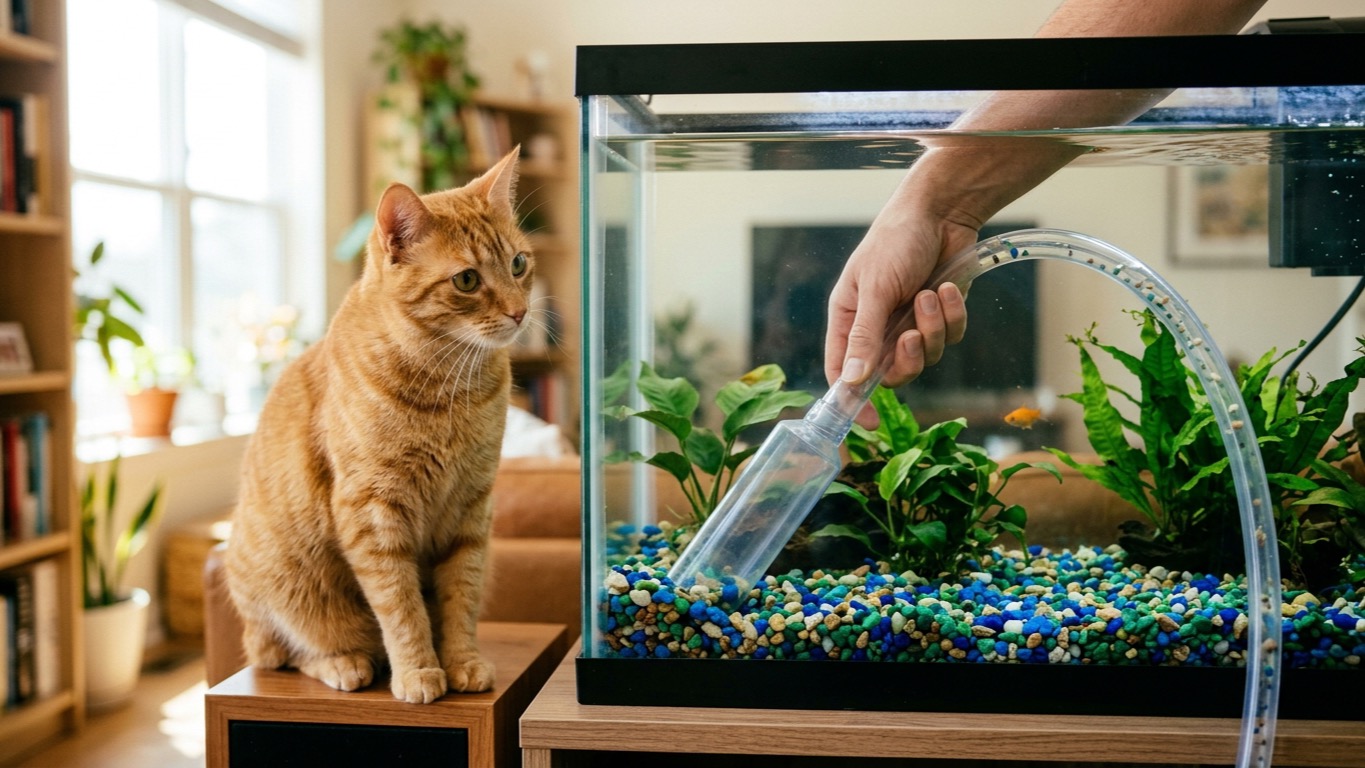
- Siphon shed needles so they do not rot in the gravel.
- Wait one to two weeks before you judge the bunch, per Aquarium Plants Factory’s regrow window.
If stems turn mushy at a buried base, you planted too deep, so lift them and float them or re-weight the tip only.
Discard any stem that is slimy and brown, and keep only pieces that still feel firm.
Do not release extra stems outdoors. Rutgers FS1236 says coontail is native across the United States and can form dense colonies at depths up to 6 meters (20 feet).
FAQ
Does hornwort need to be planted in substrate?
No. Tropica’s plant page and Rutgers FS1236 both state that this plant lacks true roots. Float it, or hold only the base; Aquarium Plants Factory’s page warns that a buried base can rot.
Why is my hornwort shedding needles?
Aquarium Plants Factory’s page lists needle drop after arrival and after a big condition change. New water, a large water change, or a jump in flow can trigger it. Keep the firm stems, net the shed needles, and wait one to two weeks before you replace the bunch.
Can I keep hornwort in an unheated tank?
Check the card you bought, because the listed floors do not match.
- Dennerle Plants lists a floor of 1°C.
- Aquatic Arts lists 50°F.
- Canton Aquatics lists 59°F.
- Aquarium Plants Factory lists 64°F.
An unheated room that stays above your pack’s listed floor can work. A room that drops below that floor does not match that maker’s range.
Does hornwort need CO2 injection?
Canton Aquatics and Aquarium Plants Factory both say CO2 is not required. Tropica lists a low CO2 demand and defines medium demand as 6–14 mg/L. Dennerle Plants lists 10–20 mg/l on its profile, so you can skip a CO2 kit unless you already run one for other plants.
How often should I trim hornwort?
Aquarium Plants Factory’s grower notes say to thin the mat every week or two. Aquatic Arts lists growth of 1 inch per week when nutrients are adequate. Cut sooner if stems cover the surface or block light to plants below.
How many stems are in one order?
It depends on the seller, so read the pack line before you order.
- Aquarium Plants Factory lists about 2–3 stems.
- Canton Aquatics lists 3 stems.
- Aquatic Arts lists 2 or more ascending axes and 10+ stems total.
Tropica and Dennerle Plants sell a portion, not a U.S. stem count.
Is hornwort only for tropical community tanks?
No. Maker cards span cool and warm bands, and Rutgers FS1236 says wild coontail can stay green and keep growing in winter. Match your heater setting to the pack you bought instead of forcing one tropical-only rule.