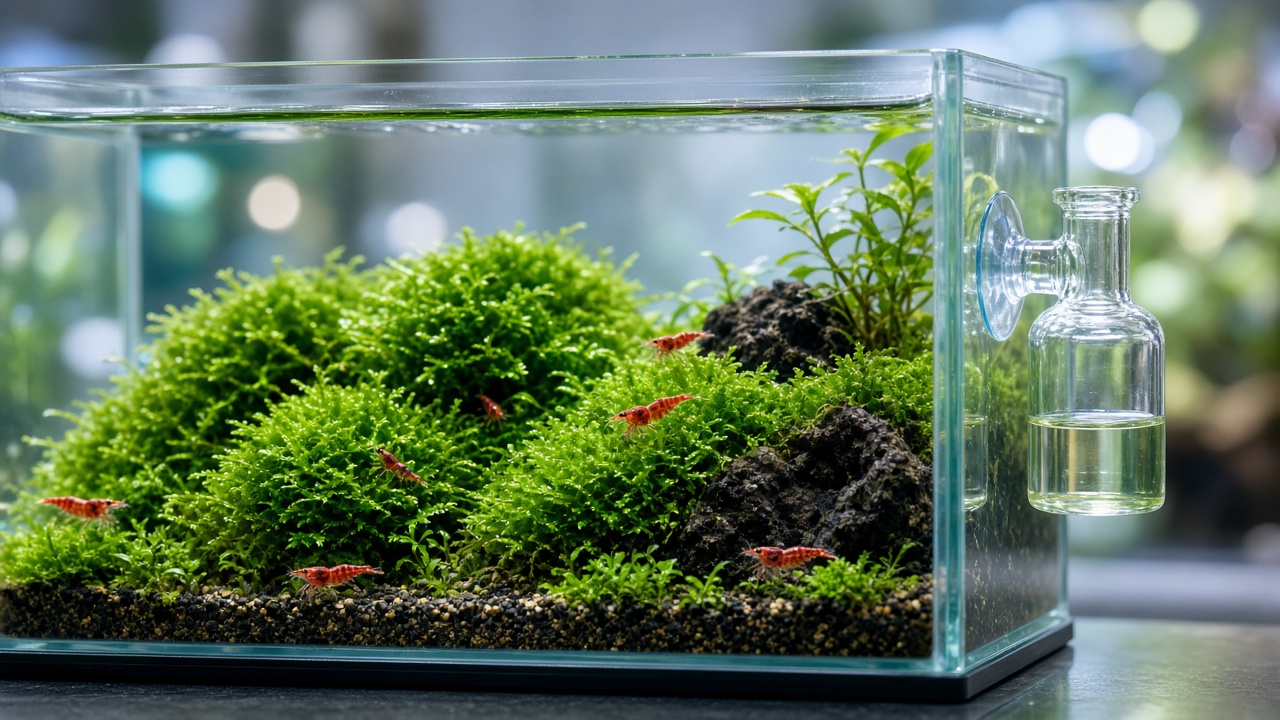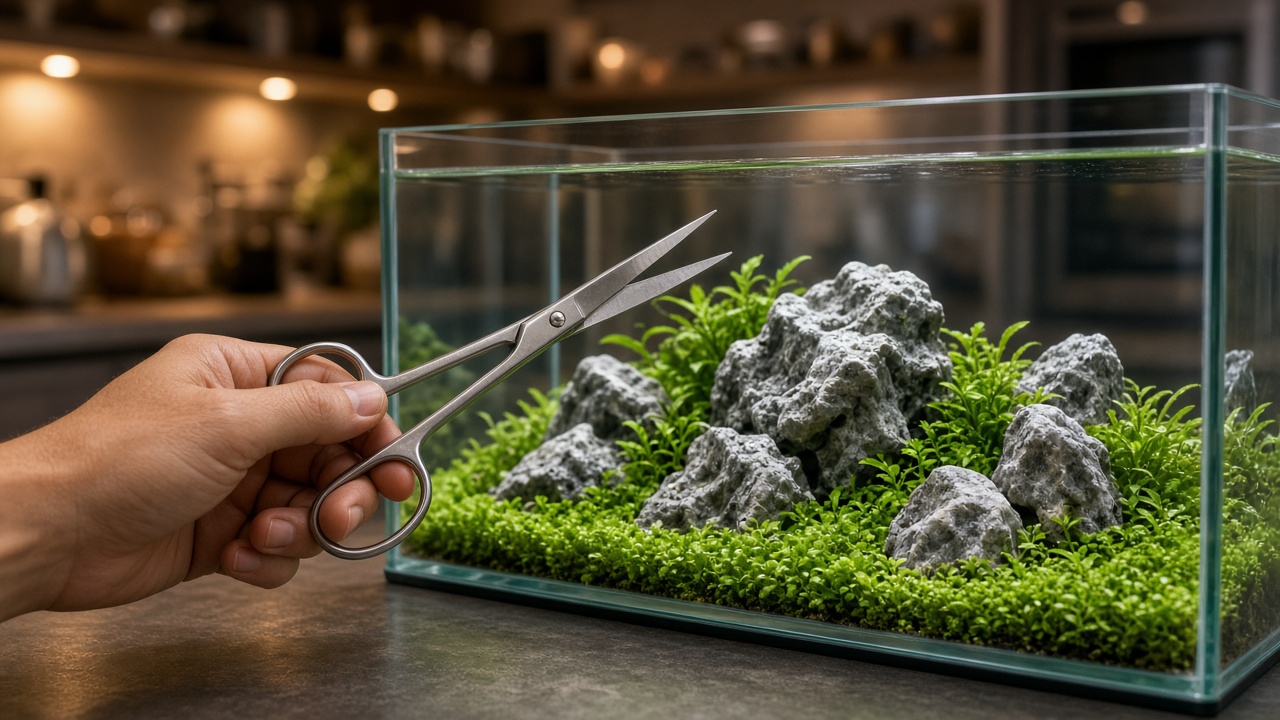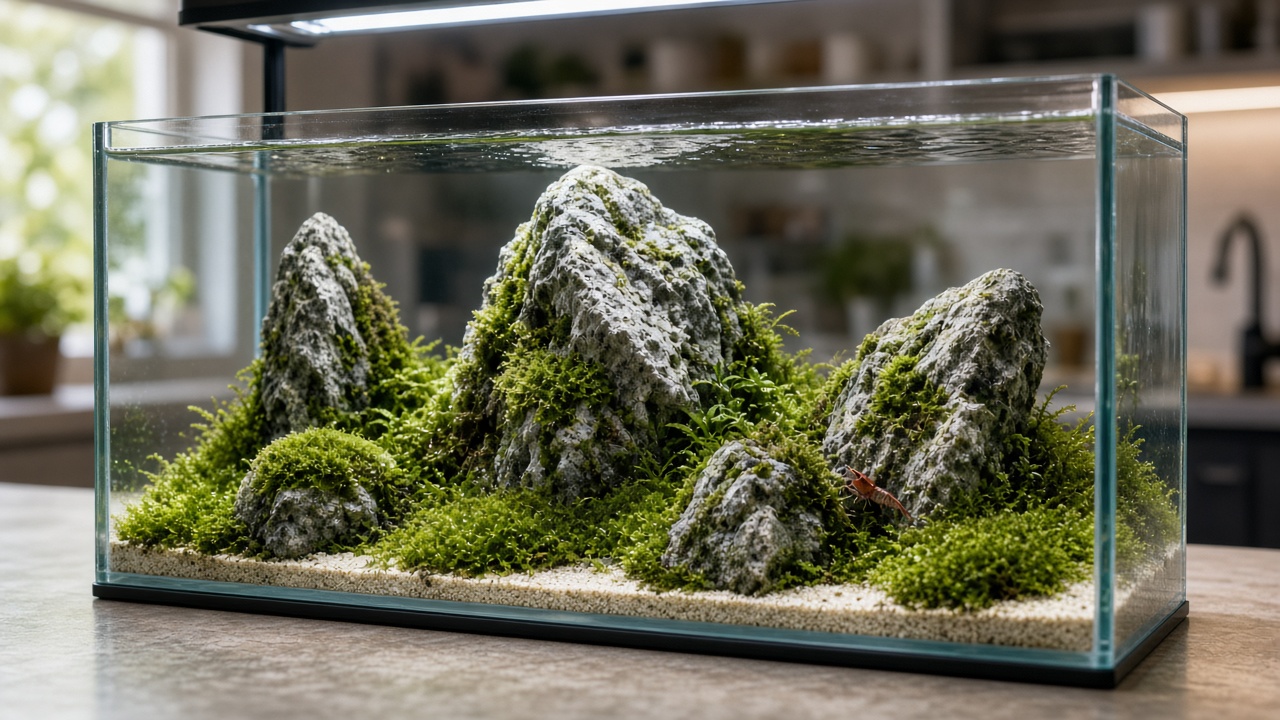
Quick answer: Build the tank around matching stones in an odd count. Set the largest stone off-center. Plant one low carpet species and leave driftwood out.
A classic iwagumi uses 3, 5, or 7 stones of one rock type and one carpet plant. This page is a setup brief from comparing published specs: we did not run tanks, score stones, or rank kits.
What we covered, and what we left out
We include a product only when its maker page lists a number we can quote.
That is the Waterpuppy spec rule for this guide. A carpet plant enters only if Tropica’s table lists a height band and a CO2 band in mg/L.
A soil or filter enters only if Aqua Design Amano lists a bag volume or a flow rate. We skip unsized stone SKUs, driftwood, stem plants, and livestock lists.
Our research team also counted Tropica’s “layouts containing this plant” lists, and those counts are a desk tally, not a grow-out.
What an iwagumi aquascape is
An iwagumi is a planted tank whose hardscape is stone only.
The stones carry the scene, and plants stay low so the rocks stay visible. Empty water in front of the group is part of the layout, not wasted space.
The usual stone names are plain role labels:
- Oyaishi is the largest stone and the one viewers should see first.
- Fukuishi is the second stone and exists to balance the main rock.
- Soeishi is a smaller side stone that supports the main group.
- Suteishi are small leftover pieces that should not steal focus.
Use one rock type so color and grain match, because two rock types make the group read as a pile, not a slope.
Skip wood, even if a wood-and-stone tank can look fine, because that mix is a different style.
Stone count and placement
Use 3, 5, or 7 stones, then stop.
Even counts look staged, and more than seven stones usually hides the main rock. If the group looks busy, remove a stone before you add one.
Place stones in this order:
- Set the oyaishi first, about two-thirds of the way across the front glass.
- Keep that main stone out of the exact center of the tank.
- Tilt the main stone slightly so its grain leans one way.
- Set the fukuishi next, smaller than the main stone, on the open side.
- Add one soeishi against the main group to lock the triangle.
- Add suteishi last, and only if a gap still looks empty from the front.
Keep the tallest stone well below the water line, because a stone that almost breaks the surface looks like a lid prop, not a hill.
Push each stone into the soil so it cannot tip after you fill. View the tank from the front after every move, because side views lie.
Carpet plants we included
Pick one carpet from Tropica’s listed CO2 bands, then plant only that species.
Tropica’s plant-info tables use the same CO2 scale on every page we read. A medium need is 6–14 mg/L, and a high need is about 15–25 mg/L.
Tropica also states that medium light is 0.5 W/L. Use that figure as the maker’s floor for a medium listing, not a high-light target.
Our research team counted Tropica’s published layout lists for the four carpets below.
- Eleocharis pusilla ‘Mini’ appears in 29 of Tropica’s published layouts.
- Micranthemum callitrichoides ‘Cuba’ appears in 23 layouts, from 12 L to 300 L.
- Micranthemum tweediei ‘Monte Carlo’ appears in 11 of those published layouts.
- Glossostigma elatinoides appears in 2 layouts on Tropica’s own pages.
That tally is original to this desk and is not a rank. It only shows how often Tropica files each plant in its own layout gallery.
| Product | Height after 2 months | Light demand | CO2 band | Growth rate |
|---|---|---|---|---|
| Tropica Micranthemum callitrichoides ‘Cuba’ | 3–5+ cm | High | 15–25 mg/L | Medium |
| Tropica Micranthemum tweediei ‘Monte Carlo’ | 3–5+ cm | Medium | 6–14 mg/L | Medium |
| Tropica Glossostigma elatinoides | 3–5+ cm | High | 15–25 mg/L | Not listed |
| Tropica Eleocharis pusilla ‘Mini’ | 3–5+ cm | Medium | 6–14 mg/L | Slow |
Two of the four plants list high CO2, and two list medium CO2, so that split is the useful choice, not a score.
Tropica’s Cuba page says the leaves are millimeter-sized. Plant small clumps a few centimeters apart, then trim the carpet or the lower layer dies from shade.
Tropica’s Monte Carlo page lists a 3–5+ cm height after two months. It also lists medium light and medium CO2, which is the lower-demand pair on this table.
Tropica’s Glossostigma page calls the plant 2–3 cm tall in the text. The same page says it grows upward if light is poor, so plant about one-eighth of a pot every few centimeters.
Tropica’s Mini page says the leaves stay 3–5 cm and lists growth as slow. Plant many small portions across the floor, not one clump.
Do not mix two carpets on the first try, because a mixed lawn hides stone bases and is harder to trim even.
Soil and tank size
Use a bagged aquasoil with a listed volume, then slope it from back to front.
Aqua Design Amano’s Aqua Soil page lists Amazonia Ver.2 in 3 L and 9 L bags. The same page lists Amazonia Ver.2 Powder Type in a 3 L bag only.
The maker says the soil is black earth and ships with Amazonia Supplement. A 60 cm tank is the size Aqua Design Amano matches to its mid-size Super Jet filters.
The Super Jet Filter page lists the ES-600 for a W60 × D30 × H36 cm tank. The same page also lists the ES-300 Ver.2 for tanks up to W600 × D300 × H360 mm.
Work the soil like this:
- Open the 3 L or 9 L bag only when the tank is already in its final spot.
- Spread any included supplement on the glass bottom if the bag includes it.
- Add soil deeper at the back of the tank and thinner at the front.
- Press soil against each stone base so later gaps do not collapse.
Powder-type soil is the 3 L bag. Use that bag as a thin top layer for Cuba or Glossostigma, because fine plants hold better in fine grains.
Do not rinse aquasoil in a colander, or you will wash out the grains the maker sold you.
Light, CO2, and filter numbers
Match Tropica’s CO2 band and Aqua Design Amano’s listed flow before you add fish.
Tropica’s high-CO2 plants on this page are Cuba and Glossostigma at 15–25 mg/L. Monte Carlo and Mini sit at 6–14 mg/L, so pick a medium-band plant if you cannot hold a steady CO2 reading.
Aqua Design Amano’s Super Jet Filter page lists these ES-600 numbers.
- Flow is 5.5 L/min at 50 Hz and 6.0 L/min at 60 Hz.
- Power draw is 13 W at 50 Hz and 16 W at 60 Hz.
- Canister volume is listed as 6 L on that same page.
- The supplied media is Bio Rio G in a 3.5 L charge.
The same page lists ES-300 Ver.2 at 6.0 L/min, 6 W, and a 3 L canister. It also lists pump noise under 35 dB at 1 m for that small series.
Our research team converted the ES-600’s 6.0 L/min (60 Hz) figure to 360 L per hour. Against the listed W60 × D30 × H36 cm box, that is about 5.6 volumes per hour if the box were filled.
That last figure is a desk conversion, not a bench reading. Keep the filter off until the fill water is clear, because cloudy soil in a canister is a mess you cannot undo.
For light, use Tropica’s 0.5 W/L medium mark as the floor. Cuba and Glossostigma are listed as high light, so they need more than that floor.
Start the photoperiod short in week one, and add time only after the carpet roots.
Setup steps
Dry-fit the stones, then plant, then fill.
Do the work in this order:
- Clean the glass and place the tank where it will stay.
- Add Amazonia Ver.2 next, then shape a back-to-front slope.
- Set the oyaishi first, then set the supporting stones.
- Pack soil around every stone base so the group cannot lean.
- Split the carpet into small portions and plant them on a grid.
- Fill slowly onto a plate or bag so the soil does not blow out.
- Start CO2 and light only after the water is clear and the filter is running.
Plant on a grid of about 2–3 cm for Cuba and Glossostigma. Tropica’s Cuba page says clumps a few centimeters apart will spread, and Tropica’s Glossostigma page says the same spacing with one-eighth pot pieces.
Leave a bare strip of soil in front of the oyaishi if you want the stone to read as a cliff. A full carpet to the glass is fine, and that choice is not a rule.
Do not add fish on fill day; cycle the tank first, because this desk does not set livestock counts.
The first weeks
Trim early, change water often, and do not raise light to chase a lawn.
Open soil and strong light grow algae in empty water, and that is the usual iwagumi failure, not a bad stone.
In the first weeks:
- Keep light hours shorter than you want the finished tank to use.
- Hold dissolved CO2 in the Tropica band for the plant you chose.
- Pull loose leaves from the carpet and wipe green film off the glass.
- Trim Cuba before the mat gets thick, because Tropica’s Cuba page warns that shade kills the lower layer.
- Leave Mini longer between cuts, because Tropica lists its growth as slow.
If the carpet lifts, you waited too long to trim, so cut it, replant the healthy pieces, and discard the brown underside.
If Glossostigma stands up, Tropica’s page already named the cause: poor light. Lower neighboring shade, and do not add a second plant to hide it.
A thin carpet with clean stones beats a thick carpet that buries the oyaishi. Use that look as the style test.
FAQ
How many stones should I use?
Use 3, 5, or 7 stones of one rock type, and start with three if the tank is short. Add a supporting stone only if the main group still looks unfinished, then check that the total stays odd.
Can I put driftwood in an iwagumi?
No, wood changes the style, and this page covers stone-only layouts. If you want wood, build a nature layout instead and do not call it iwagumi.
Which of these carpets lists the lower CO2 need?
Tropica lists Monte Carlo and Eleocharis pusilla ‘Mini’ at 6–14 mg/L CO2, while Cuba and Glossostigma list about 15–25 mg/L. Pick the medium band if you cannot measure CO2.
What soil bag sizes does Amazonia Ver.2 ship in?
Aqua Design Amano’s Aqua Soil page lists Amazonia Ver.2 in 3 L and 9 L, and Powder Type is listed as 3 L only. Count tank length × width × depth of soil, then buy to that volume.
What filter numbers fit a 60 cm iwagumi?
Aqua Design Amano lists the ES-600 for a W60 × D30 × H36 cm tank at 6.0 L/min on 60 Hz. The same page lists ES-300 Ver.2 at 6.0 L/min with a 3 L canister for tanks up to that footprint. Choose by canister volume, not by a rank.
Do I need more than one plant species?
No, one carpet species is the rule this page uses. Tropica’s four listed plants already cover high and medium CO2. A second species hides stone bases and makes trimming uneven.
How do I keep algae down in all that open water?
Hold CO2 in the maker band and keep early light hours short. Tropica’s high-light plants punish a dim start by stretching, and they also punish a long, bright start with film on the glass. Trim Cuba on a short cycle so dead under-layers do not feed algae.