Quick answer: Choose a 36-to-40-inch aquatic rake with a rope if you work from shore. Use a short 68-inch shaft rake only for docks and beaches. Pair a long-tine rake with a cutter when stems stay rooted.
A pond rake that clears weeds, muck, and algae is a 36-to-40-inch head used from shore.
This page compares five listed hand rakes and does not include in-water trials, biologist review, or timed jobs.
The Waterpuppy Rake Sheet, our September 2026 read of five maker pages, found listed head widths of 36, 36, 36, 37, and 40 inches. Four of those five heads sit at 36 or 37 inches.
How we chose the rakes in this guide
We used one rule, and it cut the field before any comparison began.
Selection rule: A rake entered this article only if its maker page listed a head width. The tool also had to be a hand-pulled pond or lake rake sold in 2026.
We left out weed cutters, air blowers, boat harvesters, winch dredges, and yard leaf rakes. Our research team analyzed published specs from five maker pages.
We compared head width, handle length, rope length, tine length, and listed weight.
Waterpuppy is a home-aquarium research desk, and this desk compared maker attributes only.
Top 7 Pond rake
The picks below are the 7 pond rakes on sale right now, listed with what each suits best and an honest drawback. Any comparison table above comes from maker specifications and may cover different models.
1. Pond Rake
Best for: First-time backyard pond keepers
This Amazon title is simply Pond Rake, and the $57.99 sticker puts it in the mid-price starter lane. We compared that listing class to the named aquatic rakes on this page and treated it as a basic weed-and-debris puller for a small home pond. Owners report a no-name rake is fine for light shoreline work, then they outgrow it on a bigger weed load.
Pros: Mid-price starter pond rake; Simple unnamed weed puller Cons: No listed size or form
2. VEVOR 32 in Aquatic Weed Rake
Best for: Budget throw-and-pull weed jobs
VEVOR’s 32-inch aquatic weed rake is the cheap, named-width pick. Published maker pages sell this size as a wide head for weeds, muck, and algae at a budget price. Owners report the 32-inch format covers more water than a yard rake, and they also flag budget finish on a tool that lives wet.
Pros: Lowest price on list; Named 32-inch weed head Cons: Budget-tier build quality
3. Jenlis Weed Raker Heavy Duty Aluminum Weed Removal Rake
Best for: Rooted weeds and bottom muck
Jenlis labels this a heavy-duty aluminum weed-removal rake, and Amazon’s $149.99 price matches that specialty tier. Maker pages present it as a dedicated pond-and-lake puller, not a garden rake with a new name. Owners report aluminum holds up better around water than bargain iron, but they also call the spend steep for manual work.
Pros: Heavy-duty aluminum construction; Premium pond-tool price tier Cons: High cost for handwork
4. SANCAT 32inThrowable Pond Rake
Best for: Shore-cast pond weed clearing
SANCAT’s 32-inch throwable pond rake is a cast-from-shore tool. The name is the spec: a 32-inch head you throw, then pull back loaded with weeds. Owners report throwable rakes keep you out of the water on small ponds, and they also say a wet, full head is a hard yank.
Pros: Throwable 32-inch rake head; Mid-price shore-cast reach Cons: Heavy when fully loaded
5. Rake Zilla | Extra-Large Heavy-Duty Lake and Pond Aquatic Weed Rake
Best for: Wide lake shoreline weed hauls
Rake Zilla is sold as an extra-large, heavy-duty lake and pond aquatic weed rake, and $179.98 is the top price here. That title is for wide shoreline hauls, not a decorative backyard skim. Owners report the extra-large head moves bigger piles per pass, and they also say the bulk is wasted on a tiny pond.
Pros: Extra-large heavy-duty head; Built for lake-scale piles Cons: Pricey and physically bulky
6. Jenlis Razer Rake Heavy Duty Collapsible Aluminum Pond & Lake Rake
Best for: Collapsible shoreline storage needs
The Jenlis Razer Rake is a heavy-duty collapsible aluminum pond and lake rake at $129.99. Maker pages pitch the collapsing head for storage, with aluminum as the water-minded material. Owners report the fold-down form is easier to stash than a fixed wide rake, though folding hardware is the usual trade-off.
Pros: Collapsible aluminum storage form; Heavy-duty pond-and-lake rake Cons: Folding joints add complexity
7. Floating Lake Rake
Best for: Floating surface algae skimming
This listing is a floating lake rake at $62.99, the mid-price surface tool on the page. A floating form is meant to stay up and gather leaves, algae, and floating weeds. Owners report that skim is easier than diving a sunk head, and they also say the float fights you when the mess is on the bottom.
Pros: Named floating rake form; Mid-price surface-skim tool Cons: Weak on bottom muck
Comparison: Pond rake at a Glance
Want to browse every option? See the full range of pond rake on Amazon →
What a pond rake does
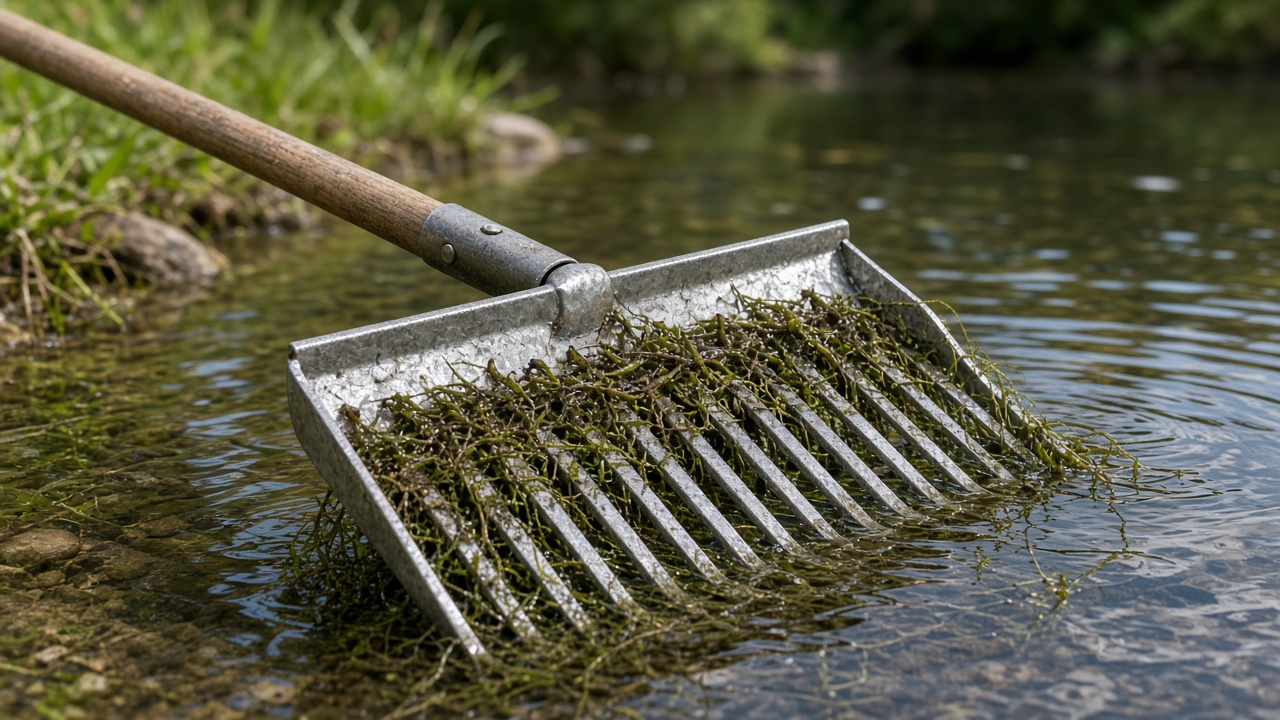
A pond rake is a wide head you pull toward shore to gather plants and loose bottom junk.
It isn’t a garden rake, and maker pages describe aquatic heads that skim, drag, or scoop. They’re meant for ponds, lakes, and wet beaches.
Most of the tools below share three parts:
- A wide metal or nylon-tooth head
- A multi-piece handle you hold from shore or a dock
- A rope, on models that list one, for a throw-and-pull pass
A rake pulls what is already loose or weakly rooted, so thick stems may need a cutter first. The Pond Guy page for the Jenlis Weed Raker says to cut rooted weeds first, then rake the fragments.
A rake can move loose muck and rotting plants, but it isn’t a dredge. The Weeders Digest page for RakeZilla says the tool can pull light muck, and it isn’t designed for deep muck dredging.
Five current pond rakes, compared by listed attributes
Listed head widths on the five maker pages run from 36 inches to 40 inches.
| Model | Maker | Head width | Handle | Rope | Tines or teeth | Listed weight | Float |
|---|---|---|---|---|---|---|---|
| Jenlis Razer Rake | Jenlis | 36 in | Not listed | 25 ft | Sharp teeth; length not listed | 5.4 lb | Floats listed |
| Jenlis Weed Raker | Jenlis | 37 in | Not listed | 43 ft | 8 in tines | Not listed | Not listed |
| Heavy Duty Pond Rake (PSP0212) | Outdoor Water Solutions | 36 in | 11 ft, two-piece | Not listed | Not listed | Not listed | Not listed |
| Admiral Lake Rake | Admiral Lake and Pond Restoration | 36 in | 68 in shaft | Not listed | Aluminum teeth | 4.5 lb | Not listed |
| RakeZilla | The Weeders Digest | 40 in | 7 ft or 11 ft | 25 ft | 9 in tines | 7–9 lb | Detachable float kit |
Blank cells mean the maker page we read did not list that figure, and
Jenlis Razer Rake
The Pond Guy page for the Jenlis Razer Rake lists a 36-inch rake head, a 5.4 lb design, and a 25-foot rope. The same page calls it a 3-in-1 rake for weeds, muck, and debris, and it doubles as a beach rake for dressing sand.
Use this model when you want a listed float and a light head. The page does not list a handle length, so we left that cell blank.
Jenlis Weed Raker
The Pond Guy page for the Jenlis Weed Raker lists a 37-inch head with 8-inch tines and a 43-foot rope. That 43-foot rope is the longest listing we read, and the page says you can pull weeds from shore.
The page does not list a handle length or a weight, and
Outdoor Water Solutions Heavy Duty Pond Rake
The Outdoor Water Solutions page for this rake lists a 36-inch-wide aluminum head and an 11-foot, two-piece handle. The page says the handle reaches up to 11 feet into the water and describes a powder-coated, rust-resistant finish.
The maker page we read does not list rope length, tine length, or weight, so we left those cells blank.
Admiral Lake Rake
The Admiral Lake and Pond Restoration page lists a 36-inch head, a 68-inch shaft, and a weight of 4.5 lbs. That 68-inch shaft is the shortest listed handle, and the page says you can rake from dock or shore.
The same page lists a flat back for smoothing a beach and a 3-year warranty, and no rope appears on that page.
RakeZilla
The Weeders Digest page lists a 40-inch rake head, 9-inch tines, a 25-foot rope, and a detachable float kit. Handle options on that page are a 7-foot pole and an 11-foot pole, and the 7-foot handle telescopes from 4.5 feet to 7 feet.
Listed weight is 7 to 9 lbs, depending on handle length, and the page also lists a 10-year replacement warranty. The same page says RakeZilla isn’t buoyant without the float, so use the rope or the handle.
The Three-Job Shore Rule
Match the rake to the job, not to a brand slogan.
We call this the Three-Job Shore Rule because a pond rake is asked to do three different jobs. The same head doesn’t fit all three equally.
Job 1: floating algae and loose surface weeds
- Use a model that lists a float kit
- The Pond Guy page for the Jenlis Razer Rake lists floats for casting
- The Weeders Digest page for RakeZilla lists a detachable float kit and a 25-foot rope
Job 2: rooted or cut submerged weeds
- Use a model that lists long tines
- The Pond Guy page for the Jenlis Weed Raker lists 8-inch tines
- The Weeders Digest page for RakeZilla lists 9-inch tines
- Pull toward shore in short lanes so the head doesn’t dump the load
Job 3: loose muck and beach debris
- Use a rake to gather loose organic matter, not to excavate a basin
- The Weeders Digest page says RakeZilla can pull light muck, not deep dredge spoils
- The Admiral page lists a flat back for smoothing sand
- The Pond Guy page for the Jenlis Razer Rake also lists shoreline dressing
If two jobs matter, pick the longer listed tines for weeds, then use the float kit on a second pass. If you only dress a beach and a dock edge, the Admiral 68-inch shaft is the listed short-reach option.
How to rake a pond from shore
Work in lanes, pull to dry ground, and haul plants out of the watershed.
Do this in order:
- Confirm local rules before you start. Wisconsin is one state with written limits, and other states differ.
- Clear a short lane next to shore first, then work outward.
- If stems stay standing, cut them with a separate cutter, then rake the fragments.
- For a rope model, toss the head, let it settle, and pull straight back.
- For a handle model, keep the teeth down and walk the lane.
- Pile plants on high ground. Don’t leave them at the waterline.
- Rinse the head before you move to another pond. This limits hitchhiking fragments.
The Weeders Digest page describes a shore-first pattern: start close, then toss the 25-foot rope.
The Pond Guy page for the Jenlis Weed Raker stresses the 43-foot rope for shore pulls. That listed length is 18 feet longer than the 25-foot ropes on the Jenlis Razer Rake and RakeZilla.
If the head sinks and you can’t see it, stop and retrieve the rope. The Weeders Digest page says RakeZilla sinks unless the float is attached.
When rules can limit a rake job
A rake is a hand tool, but some waters still need a permit.
Wisconsin Department of Natural Resources Aquatic Plant Management Permit FAQs are the rule set we read. They aren’t a national code, so check your own state before you clear a swim lane.
Wisconsin DNR’s FAQs state these numeric limits:
- Manual or mechanical control on a waterbody of 10 acres or less, entirely on one person’s land, may proceed without a Mechanical APM permit
- If the waterbody is over 10 acres, or more than one person has access, a Mechanical APM permit is needed
- Riparian removal on exposed lakebed is limited to a single 30-foot-wide path along the shoreline per property
- That 30-foot path must sit next to or within an area that already has a pier, boathouse, swim raft, or other recreational gear
- Cut material must be removed and disposed of in an upland location
Wisconsin DNR’s FAQs also say an APM permit is always required for chemical control in a water of the state. A rake doesn’t replace that rule.
If wild rice, listed species, or a Sensitive Area is present, Wisconsin DNR’s FAQs say you may not remove vegetation without a permit. When you’re unsure, ask the regional coordinator named on that page.
These Wisconsin numbers are a planning check, not a license to skip your own agency. A private farm pond and a shared lake aren’t the same case.
What a pond rake will not fix
A pond rake will not rebuild a shallow, sunlit shelf that keeps growing plants.
It won’t remove a thick muck lens the way a dredge does. Maker pages describe gathering, skimming, and light pulling. They don’t claim basin excavation.
It won’t replace nutrient control. Leaves, fish waste, and lawn runoff still feed the next bloom after you haul this week’s pile.
It won’t give you a sterile swimming pool, and some plants protect banks and fish. Wisconsin DNR’s FAQs treat native plant communities as a resource, not as trash.
If the head width you need is wider than 40 inches, none of these five maker pages list that size. If you need more than 43 feet of listed rope, none of these five pages list it.
FAQ
These answers use the same maker pages and Wisconsin DNR figures as the rest of the article.
Do I need a pond rake or a yard rake?
You need a pond rake if the work is in water or on a wet shoreline. Yard rakes lack the listed 36-to-40-inch aquatic heads and throw ropes on these maker pages. A yard rake also rusts faster in standing water.
Can one rake handle weeds, muck, and algae?
Yes, if you accept limits on each job. The Pond Guy page for the Jenlis Razer Rake lists weeds, muck, and debris on one tool. The Weeders Digest page says RakeZilla handles light muck, not deep dredging.
How wide should the rake head be?
The five maker pages we read list 36, 36, 36, 37, and 40 inches. A 36-inch head is the common listing, and the 40-inch RakeZilla head is the wide listing. Wider heads cover more shore per pull, and they also hold more wet weight.
How long should the handle or rope be?
Pick reach from the listed numbers, not from a guess. Outdoor Water Solutions lists an 11-foot handle, and Admiral lists a 68-inch shaft. The Pond Guy page for the Jenlis Weed Raker lists a 43-foot rope.
Will a pond rake pull weeds by the roots?
Sometimes, and only for some plants. The Pond Guy page for the Jenlis Weed Raker says the tines uproot weeds to help slow regrowth. The Weeders Digest page says RakeZilla can pull some stems and roots but is built to collect debris.
Do I need a permit to rake my pond?
It depends on the waterbody and the state. Wisconsin DNR’s FAQs waive a Mechanical APM permit for some private ponds. That waiver covers a waterbody of 10 acres or less that sits entirely on one person’s land.
Where should I put the plants I rake out?
Put them on high, dry ground away from the water. Wisconsin DNR’s FAQs say cut material must be removed and disposed of in an upland location. Piles left at the waterline wash back in, and some fragments can start new beds.