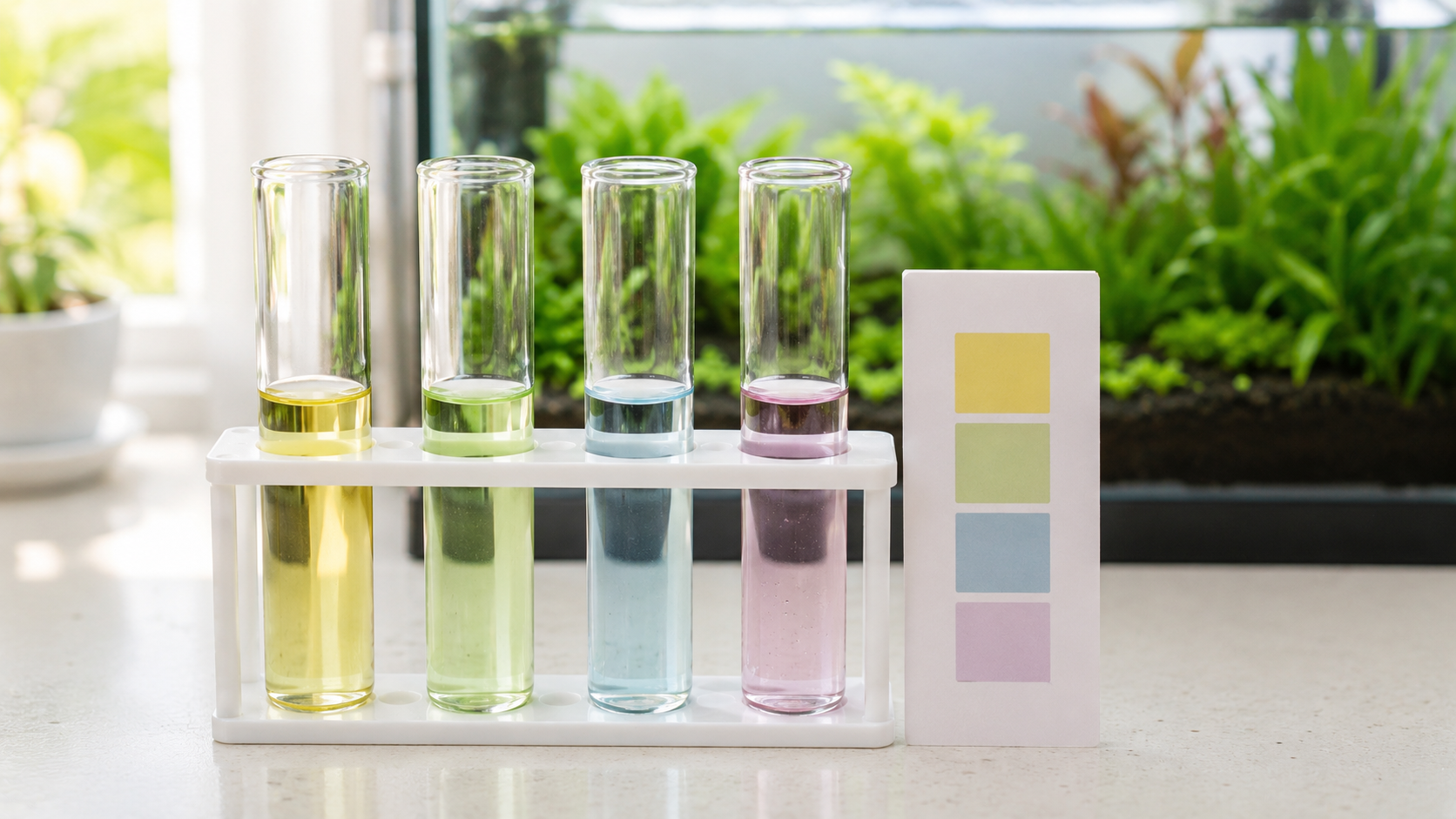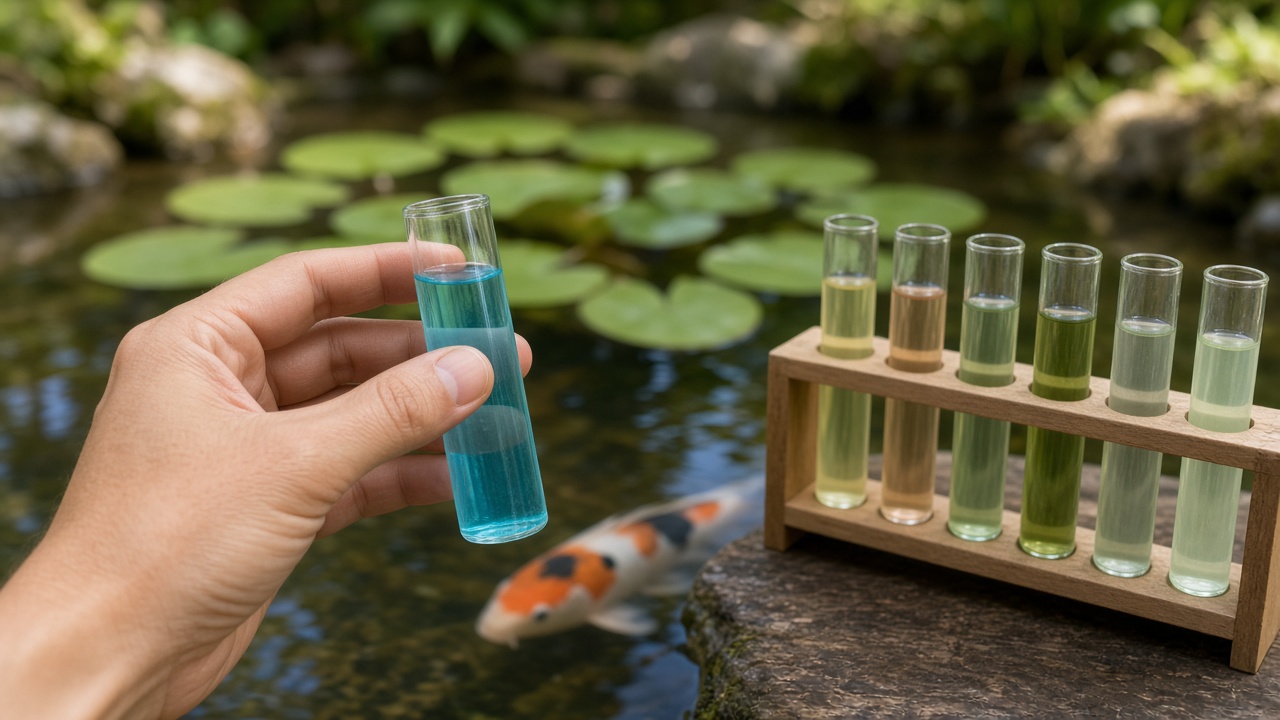
Quick answer: Buy the API Pond Liquid Master Test Kit for pH, ammonia, nitrite, and phosphate. Pair it with API Pond 5-in-1 strips or Tetra Pond Test 7in1 for hardness. Add a Hanna HI713 Checker only if phosphate color charts stay hard to read.
A pond test kit is a box of drops or strips that reads pond water. The API Pond Liquid Master Test Kit lists over 500 tests for pH, ammonia, nitrite, and phosphate. That line is the product pick for a backyard pond.
This page compares published specs, and we did not run bench trials or keep koi. University of Missouri Extension’s pond guide says nighttime dissolved oxygen should stay at or above 5.0 ppm. That number is why a kit is a reading tool, not a guess.
Our research team analyzed maker pages and that extension table, then compared listed counts instead of store ranks.
What this guide includes and leaves out
We used one selection rule and then we stopped adding kits.
Selection rule: We included only currently sold kits whose maker page lists a test count. Each kit also had to list ammonia, nitrite, phosphate, or KH. We left out indoor-only kits, salt kits, and kits with no published test count.
That rule put five kits on the table:
- API Pond Liquid Master Test Kit
- API Pond 5-in-1 Pond Test Strips
- Tetra Pond Test 7in1
- Hanna Instruments HI713 Phosphate Checker
- Aquascape KH/Alkalinity Test Kit
We did not add indoor aquarium kits, which belong in our freshwater aquarium test kit guide. We also skipped bacteria testers and salt meters, because those tools do not answer a basic pond-water search.
Top 7 Pond water test kit
The picks below are the 7 pond water test kits on sale right now, listed with what each suits best and an honest drawback. Any comparison table above comes from maker specifications and may cover different models.
1. API POND 5 IN 1 POND TEST STRIPS Pond Water Test Strips 25-Count
Best for: Quick routine maintenance checks for pond owners
We compared these strips to liquid alternatives and found them ideal for rapid weekly monitoring. Owners report they are perfect for spotting sudden water quality shifts without the hassle of vials.
Pros: Fast results; Easy to interpret Cons: Less precise than liquid tests
2. JNW Direct Pond Water Test Kit for Ponds
Best for: Beginners needing a simple, all-in-one testing solution
This kit is frequently recommended for those new to pond care who want a straightforward process. We compared the ease of use here to professional kits and found this much more accessible for casual hobbyists.
Pros: User-friendly design; Clear color charts Cons: Limited strip quantity
3. AAwipes 8-in-1 Aquarium Test Kit for Fish Tanks
Best for: Budget-conscious hobbyists managing smaller water features
Owners report that this kit offers excellent value for those keeping smaller decorative ponds. We compared the price-to-parameter ratio and found it stands out as a highly economical choice for routine testing.
Pros: Very affordable; Comprehensive parameter coverage Cons: Packaging feels basic
4. Half Off Ponds 4-in-1 Water Quality Test Kit
Best for: Dedicated enthusiasts requiring consistent, reliable water d
We compared this kit to standard retail options and noted its superior build quality for serious pond management. Users report that the precision provided justifies the investment for maintaining delicate ecosystems.
Pros: High-quality reagents; Professional-grade accuracy Cons: Higher price point
5. 5Strands Blue-Green Algae Water Test Kit for Lakes & Ponds
Best for: Detecting specific toxic blue-green algae blooms
This kit serves a unique purpose for pond owners worried about harmful algal blooms. We compared its utility to general water kits and found it is an indispensable safety tool for large, natural-style ponds.
Pros: Specialized diagnostic capability; Essential for safety Cons: Niche application only
6. AAwipes Aquarium Ammonia Test Strips 8-in-1 |100 Strips | Quick &
Best for: High-volume monitoring of ammonia levels
Owners report that having a high count of strips makes frequent ammonia monitoring stress-free. We compared this to multi-parameter kits and found it superior for those specifically managing heavy fish loads.
Pros: Large quantity of strips; Focuses on critical toxins Cons: Lacks other water parameters
7. API Freshwater Master Test Kit 800-Test Freshwater Aquarium Water Kit
Best for: Advanced aquarists needing laboratory-level precision
We compared this to pond-specific kits and found that its reputation for accuracy remains unmatched in the hobby. Experienced owners report that the liquid titration method provides the most reliable data for complex water chemistry.
Pros: Extremely high accuracy; Huge number of tests Cons: Complex testing process
Comparison: Pond water test kit at a Glance
| Product | Best for | Approx. price | Where to buy |
|---|---|---|---|
| API POND 5 IN 1 POND TEST STRIPS Pond Water Test Strips 25-Count | Quick routine maintenance checks for pond owners | $14.98 | Check price |
| JNW Direct Pond Water Test Kit for Ponds | Beginners needing a simple, all-in-one testing solution | $16.99 | Check price |
| AAwipes 8-in-1 Aquarium Test Kit for Fish Tanks | Budget-conscious hobbyists managing smaller water features | $9.96 | Check price |
| Half Off Ponds 4-in-1 Water Quality Test Kit | Dedicated enthusiasts requiring consistent, reliable water d | $39.00 | Check price |
| 5Strands Blue-Green Algae Water Test Kit for Lakes & Ponds | Detecting specific toxic blue-green algae blooms | $34.95 | Check price |
| AAwipes Aquarium Ammonia Test Strips 8-in-1 /100 Strips / Quick & | High-volume monitoring of ammonia levels | $11.98 | Check price |
| API Freshwater Master Test Kit 800-Test Freshwater Aquarium Water Kit | Advanced aquarists needing laboratory-level precision | $39.99 | Check price |
Want to browse every option? See the full range of pond water test kit on Amazon →
What to test in pond water
Test ammonia and nitrite first, then test pH, then test one algae marker.
We call that the Pond Four Rule: ammonia, nitrite, pH, and either phosphate or nitrate. Hardness is a fifth reading when pH swings after rain.
University of Missouri Extension’s Table 1 lists acceptable ranges for sport-fish ponds:
- Dissolved oxygen: no less than 5.0 ppm
- pH: 7.0 to 9.0
- Alkalinity: 50 to 300 ppm
- Hardness: 100 to 300 ppm
- Un-ionized ammonia: less than 0.02 ppm
- Total ammonia as N: 2 to 4 ppm
- Free carbon dioxide: less than 20 ppm
- Residual chlorine: no more than 0.0003 ppm
The same guide says pond pH often moves between 6.5 and 9 during a single day. A fish kill is more likely if pH falls below 5 or rises above 10.
Nighttime oxygen below 3 ppm distresses fish, and many species may die below 2 ppm. Most home kits do not read dissolved oxygen, so buy a kit for the Pond Four Rule first. Treat oxygen as a separate meter if fish gasp at dawn.
Phosphate and nitrate both feed algae blooms in warm weather. The API pond liquid kit lists phosphate, not nitrate, on its product page.
The API strip pack and the Tetra strip pack list nitrate, not ammonia. That split is why one box rarely covers every reading you need.
Alkalinity holds pH steady when rain or tap water hits the pond. University of Missouri Extension says ponds below 50 ppm alkalinity are hard to manage, while some limestone ponds reach 200 ppm or higher.
Liquid kits, strips, and digital checkers
Match the method to the reading, and do not buy one format for every job.
Liquid drop kits use reagent bottles and a color card, and the API pond liquid kit is this type. API’s page lists six bottles, four tubes, laminated charts, and over 500 tests. API also says to test weekly, which matches a simple backyard pond routine.
Dip strips are faster for a weekly scan, and API’s 5-in-1 page lists 25 strips in a snap-tight tube. Tetra’s 7in1 page also lists 25 strips, so either tube can cover a quick hardness check.
Strips help with hardness and a quick nitrate glance, but they are a poor stand-in for ammonia.
Digital checkers read one chemical as a number on a small screen. Hanna Instruments’ HI713 page lists a phosphate range of 0.00 to 2.50 ppm.
Hanna Instruments lists 0.01 ppm resolution and accuracy of ±0.04 ppm plus 4% of the reading at 77°F. The checker is 86.0 by 61.0 by 37.5 mm and weighs 64 g.
Use this split:
- Liquid kit: ammonia, nitrite, pH, and phosphate
- Strips: weekly KH, GH, nitrate, and chlorine checks
- Digital checker: phosphate when the color card is unclear
API’s liquid page does not list KH or GH, and Tetra’s strip page skips ammonia and phosphate. Hanna’s checker page lists phosphate only, and Aquascape’s page lists KH only, so no single kit here covers every line in the Missouri table.
Five kits compared by listed attributes
Comparing published specs, only one of the five kits lists an ammonia test.
| Kit | Method | Readings listed by the maker | Tests listed | Other listed facts |
|---|---|---|---|---|
| API Pond Liquid Master Test Kit | Liquid drops | pH, ammonia, nitrite, phosphate | Over 500 | Six bottles; four tubes; weekly testing |
| API Pond 5-in-1 Pond Test Strips | Dip strips | pH, nitrite, nitrate, KH, GH | 25 | Swirl twice; wait 30 seconds for nitrite and nitrate |
| Tetra Pond Test 7in1 | Dip strips | pH, KH, GH, nitrite, nitrate, chlorine, CO2 | 25 | Swirl about 2 seconds; read after 1 minute |
| Hanna HI713 Phosphate Checker | Handheld colorimeter | Phosphate | 6 starter tests; 25-test refill (HI713-25) | Range 0.00–2.50 ppm; 1.5V AAA battery |
| Aquascape KH/Alkalinity Test Kit (96019) | Liquid titration | KH / alkalinity | 60 | Sold for ponds and aquariums |
Three of the five kits list a hardness or KH test, and two list a 25-strip count. Only the API liquid kit lists more than 500 tests.
Hanna Instruments’ product page lists the HI713 at $74.99. Aquascape’s product page lists the KH kit at $34.99.
API’s pond pages say the company has made pond products for almost 60 years, which is brand history, not a score. Hanna’s page lists a one-year warranty on the HI713, and Aquascape’s page says the KH kit can support an IonGen system.
Add tools in this sequence if you keep fish:
- API Pond Liquid Master Test Kit for the Pond Four Rule
- API Pond 5-in-1 strips or Tetra Pond Test 7in1 for hardness
- Aquascape KH/Alkalinity Test Kit if you want drop-count KH
- Hanna HI713 if phosphate stays high and algae returns
Skip the checker if the liquid phosphate test is easy to read. Skip a second strip brand if you already own one strip tube.
A simple weekly test routine
API’s strip page and API’s liquid page both say to test once a week.
Do the liquid tests on a set day each week. Use strips after heavy rain, a big water top-off, or a heat wave. Keep a notebook and write the date, the reading, and the weather.
How to run API Pond 5-in-1 strips
API’s page lists these steps:
- Dip the strip in the pond and swirl two times.
- Lift it level, pads up. Do not shake off water.
- Read GH, KH, and pH at once.
- Wait 30 seconds. Then read nitrite and nitrate.
- Keep wet fingers out of the tube. Close it tight.
How to run Tetra Pond Test 7in1
Tetra’s page lists these steps:
- Dip the strip.
- Swirl about two seconds.
- Tap off extra water.
- Read the tin chart after one minute.
Tetra also says not to touch the pads or hold the strip under running water.
How to run the liquid kit
Follow API’s booklet for each bottle, because each test uses a different drop count. API’s page says the kit also works on tap water, so test new fill water before it hits the pond.
Residual chlorine in the Missouri table is 0.0003 ppm or “no detectable amount.” Tetra’s page says chlorine should not show on the strip.
If ammonia or nitrite is not zero, do not add fish. Cut feeding and increase aeration if you have a pump, then plan a partial water change with treated water.
Our aquarium water-change guide covers swap timing in a closed tank. Change pond water to dilute a bad reading, not on a guess.
Outdoor tubs that hold turtles need the same ammonia check. See our turtle tank setup guide for the tank side of that job.
How pond kits differ from indoor tank kits
Pond kits track algae and weather, while indoor kits track a small filter.
API’s pond liquid kit lists phosphate on the maker page, and that reading helps explain green water in summer. Many indoor kits list nitrate instead of phosphate, so do not assume a tank kit is a pond kit.
Strips add chlorine because hose water often carries it, and Tetra’s 7in1 page lists chlorine and carbon dioxide. API’s 5-in-1 page does not list chlorine, so the Tetra strip pack covers that tap-water gap.
Hardness matters more outside after storms, because rain can drop KH in a shallow garden pond. University of Missouri Extension ties low alkalinity to wild pH swings, which is why the Aquascape KH kit is on this list.
A pond also loses oxygen at night, and the Missouri guide says oxygen falls after dark because plants stop making it. A test kit will not fix that drop, though an aerator might.
Use the kit to catch ammonia and pH while you watch fish at sunrise. Do not use this page as a farm-pond oxygen plan.
The Missouri guide covers sport-fish ponds, yet a garden pond uses the same pH and ammonia numbers.
FAQ
Do pond test strips replace a liquid ammonia test?
No. Comparing published specs, only the API Pond Liquid Master Test Kit lists ammonia.
The API 5-in-1 strips list nitrite and nitrate, not ammonia. Tetra Pond Test 7in1 also skips ammonia, so keep the liquid kit as the ammonia tool.
How often should I test pond water?
API’s pond strip page says to test once a week, and API’s liquid kit page says the same. Test again after a large water add, a storm, or a fish death. Write every result so a one-day spike is easy to see.
What pH should I aim for?
University of Missouri Extension’s table lists pH 7.0 to 9.0 for sport-fish ponds. The same guide says daily pH often sits between 6.5 and 9.
A kill is more likely below 5 or above 10, so steady pH matters more than chasing one decimal.
Why does the pond liquid kit test phosphate?
API’s pond liquid page lists phosphate with pH, ammonia, and nitrite, because phosphate is an algae nutrient in outdoor water. The strip kits on this page list nitrate instead.
Use phosphate when green water is the problem, and use nitrate as a weekly backup on strips.
Do I need a Hanna HI713 Checker?
Only if the liquid phosphate card is hard to match. Hanna Instruments lists a range of 0.00 to 2.50 ppm and a 0.01 ppm step.
The starter pack includes reagents for 6 tests, and the HI713-25 refill lists 25 tests. Skip the checker if the drop test is already clear.
Can I use an indoor aquarium kit in a pond?
You can read pH and nitrite with many indoor kits, but you may miss phosphate, which the pond liquid kit lists. Use a pond-labeled kit for outdoor water, and use our freshwater aquarium test kit page for indoor tanks.
What should I do after a bad ammonia reading?
Stop feeding and check the filter and any aerator, then plan a partial water change with dechlorinated water. Retest the next day and write the new number, and if fish gasp at dawn, treat oxygen as a separate problem.
The Missouri guide flags oxygen below 3 ppm as distress.