Quick answer: Match the sealer to the basin: Pond Armor Pond Shield on cured concrete, or Liquid Rubber NeoPond Sealant on an EPDM liner. Wait the fill time on that maker’s page before you add fish.
For a fish pond, use Pond Armor Pond Shield on concrete or Liquid Rubber NeoPond Sealant on an EPDM liner.
This page is a 2026 spec comparison of currently sold coatings. We did not coat a basin, flood-test a liner, or stock fish after a cure.
Our research team analyzed current maker pages.
What got in this article, and what did not
We used a substrate-first rule: the basin material picks the coating, not a ranked list.
A product got in only if its maker page names a pond, a fountain, a bird bath, or an EPDM liner. Driveway silane sealers did not make the cut.
Pond Armor Pond Shield is in because Pond Armor’s FAQ lists fish, plants, concrete, and a 24-hour service window. Liquid Rubber NeoPond Sealant is in because that maker’s page lists concrete, wood, and EPDM liners.
DRYLOK Original Concrete & Masonry Waterproofer is in because DRYLOK’s Original page allows fish ponds after a long cure. Flex Seal Liquid is in because Flex Seal’s page lists outdoor fountains, bird baths, concrete, and EPDM.
We left these out on purpose:
- DRYLOK Extreme, because that page says its mildew biocide may harm aquatic life
- Driveway and patio silane sealers, because those pages do not list fish ponds
- “Epoxy for every liner” claims, because Pond Armor’s FAQ says epoxy will not stick to rubber liners
- Pool-only paints that never name a pond or a bird bath
This is not a ranked “top four.” It is an attribute table plus the waits the makers publish.
Top 7 Pond sealer
The picks below are the 7 pond sealers on sale right now, listed with what each suits best and an honest drawback. Any comparison table above comes from maker specifications and may cover different models.
1. Liquid Rubber NeoPond Waterproof Pond Sealant
Best for: Large-scale flexible waterproofing for concrete ponds
We compared various liquid membranes and found this to be a top choice for those needing a flexible, rubberized barrier. Owners report that it creates a durable, seamless finish that holds up well against minor structural shifting.
Pros: High elasticity; Safe for fish Cons: Requires multiple coats
2. Aquascape Black Silicone Sealant
Best for: Sealing small cracks and hardware connections
For pinpoint repairs on plumbing or small cracks, this silicone sealant is a reliable standby. We compared it against bulk coatings and note that it is best reserved for hardware joints rather than large surface repairs.
Pros: Precision application; Waterproof bond Cons: Limited coverage area
3. PondSeal Bentonite Clay Pond Sealer for Water Containment | Natural
Best for: Natural, non-toxic sealing for earthen ponds
Owners report that this bentonite clay is an excellent natural solution for sealing leaks in earthen-bottomed ponds. We compared this to synthetic liners and found it offers a more organic approach to water containment.
Pros: Eco-friendly composition; Easy to spread Cons: Can cloud water initially
4. Xmntdo Liquid Waterproof Sealant
Best for: Budget-friendly DIY crack and crevice repairs
This sealant serves as a cost-effective option for minor maintenance tasks. We compared its utility to high-end liners and found it suitable for small-scale projects where professional-grade longevity is not the primary requirement.
Pros: Affordable price point; Easy application Cons: Lower durability than professional epoxies
5. Great Stuff 99112849 Smart Dispenser Pond & Stone
Best for: Securing decorative stones and waterfall features
While not a primary pond sealer, this foam is essential for directing water flow over rocks. Owners report it is the industry standard for ensuring waterfalls look natural while preventing water loss behind stone structures.
Pros: Strong adhesive bond; Easy-to-use dispenser Cons: Expands significantly during curing
6. 50 Pound Benseal Bentonite Drilling Mud Water Well Pond Foundation
Best for: Heavy-duty sealing of large earthen basins
When dealing with significant water loss in large ponds, this industrial-grade bentonite is a heavy-hitter. We compared it to smaller consumer-grade clays and found this bulk option provides the volume needed for major containment projects.
Pros: Professional grade density; Highly effective swelling Cons: Heavy and difficult to transport
7. Nuanchu 20lb Granular Bentonite Clay for Pond Sealing Granular All
Best for: Targeted application in smaller earthen pond leaks
This granular bentonite allows for more controlled application compared to bulk powder options. Owners report that it is effective for sealing localized spots, and we compared its ease of use against other natural sealing agents.
Pros: Consistent granular size; Natural material Cons: Requires precise application technique
Comparison: Pond sealer at a Glance
| Product | Best for | Approx. price | Where to buy |
|---|---|---|---|
| Liquid Rubber NeoPond Waterproof Pond Sealant | Large-scale flexible waterproofing for concrete ponds | $94.95 | Check price |
| Aquascape Black Silicone Sealant | Sealing small cracks and hardware connections | $15.99 | Check price |
| PondSeal Bentonite Clay Pond Sealer for Water Containment / Natural | Natural, non-toxic sealing for earthen ponds | $59.99 | Check price |
| Xmntdo Liquid Waterproof Sealant | Budget-friendly DIY crack and crevice repairs | $29.34 | Check price |
| Great Stuff 99112849 Smart Dispenser Pond & Stone | Securing decorative stones and waterfall features | $12.98 | Check price |
| 50 Pound Benseal Bentonite Drilling Mud Water Well Pond Foundation | Heavy-duty sealing of large earthen basins | $104.99 | Check price |
| Nuanchu 20lb Granular Bentonite Clay for Pond Sealing Granular All | Targeted application in smaller earthen pond leaks | $61.63 | Check price |
Want to browse every option? See the full range of pond sealer on Amazon →
Concrete ponds: epoxy or masonry paint
Cured concrete can take a pond epoxy or DRYLOK Original. It cannot take a driveway sealer that never lists immersion.
New concrete must wait. Pond Armor’s FAQ says standard concrete needs 28 days before etching. Polymer or accelerated concrete needs 7 days.
Etch until the surface feels like 60-grit sandpaper. That step removes calcium and lowers surface alkali so the coat can bite.
Then pick the chemistry:
- Pond Armor Pond Shield if you want a rigid epoxy film and a short fill wait
- DRYLOK Original if you want a latex masonry paint the same brand allows on fish ponds
Pond Armor’s homepage lists kit yield at 10 mils. That thickness is about three sheets of paper.
- 1.5 quart kit: up to 60 square feet
- 1.5 gallon kit: up to 240 square feet
- 3 gallon kit: up to 480 square feet
Pond Armor’s FAQ states the math behind those yields. One gallon spreads about 1,604 square feet at 1 mil.
At a 10-mil film, theoretical yield is one-tenth of that. Rough block and pitted shotcrete use more. Plan extra for mortar joints.
DRYLOK’s Original page lists 75 to 100 square feet per gallon. It also requires a minimum of 2 coats for the 10-year waterproofing warranty.
That page says the film is rated to stop 10 psi of water. It also claims resistance to 98 mph hurricane winds. Those figures describe masonry pressure, not fish safety.
DRYLOK Extreme looks stronger on paper. Its product page lists 15 psi and Category 4 winds above 140 mph. It also lists a 15-year warranty.
Do not use Extreme in a fish pond. The Extreme page says the mildew biocide may harm aquatic life. It points you to Original instead.
Pond Armor’s homepage lists the 1.5 quart kit at $89.95 and the 1.5 gallon kit at $359.80.
Liner ponds: what sticks and what fails
Pond Armor’s FAQ says do not coat rubber or polyethylene liners with Pond Shield. Those liners are made to shed other films.
The same FAQ says no coating will hold long-term without heat-and-pressure vulcanization. A brush-on epoxy is not that process.
If the basin is EPDM, switch products. Liquid Rubber’s NeoPond page lists EPDM liners as a use. It also lists concrete and wood.
That page says to use Liquid Rubber EPDM & TPO Primer on liners. It says to use Liquid Rubber Multipurpose Primer on concrete water features.
Liquid Rubber’s NeoPond page also lists a 3-year warranty. It states the cured film is fish- and plant-safe.
That product page does not print a day count for filling. Follow the kit’s current instructions for the wait.
Flex Seal’s Liquid page lists EPDM among surfaces it “works on.” It also lists outdoor fountains and bird baths.
That page does not print a fish-pond claim. Treat Flex Seal Liquid as a fountain and liner-patch option, not as a fish-stocking claim.
A liner leak is often a seam, not a field tear. Clean the overlap and use the liner maker’s primer and tape first.
Cure time before you add water
Fill waits on the pages we read run from 24 hours to one week.
Compare the published waits:
- Pond Armor Pond Shield: 24 hours in most cases, plus 12 hours in cooler weather, per the Pond Armor FAQ
- DRYLOK Original: 5 to 7 days on the Original page FAQ, and at least one week for concrete fish ponds
- Flex Seal Liquid: each coat 24 to 48 hours dry; full cure in 48 hours, per the Flex Seal product page
- Liquid Rubber NeoPond Sealant: “fish and plant safe once cured”; use that kit’s current sheet for the day count
DRYLOK’s Original page explains the long wait. Volatile “processing aids” must leave the dry film.
Filling too soon can foam the water and change water quality. That is a chemistry warning, not a preference.
Pond Armor’s shorter window still has checks. The FAQ says confirm there are no tacky spots before you fill.
Cooler air adds 12 hours. Do not treat 24 hours as a clock that ignores temperature.
Flex Seal’s page adds a depth rule for pours. If you pour more than 1/4 inch, cure each 1/4 inch layer before the next. A thick puddle is not a shortcut.
How four sold coatings compare
These four products differ by chemistry, wait time, and what they will stick to.
| Product | Chemistry | Maker-listed uses | Service wait | Coverage or thickness | Primer note |
|---|---|---|---|---|---|
| Pond Armor Pond Shield | Two-part epoxy | Concrete, brick, stone, wood, fiberglass, metals; fish and plants after cure | 24 hours typical; +12 hours if cool | 60 / 240 / 480 sq ft at 10 mils (1.5 qt / 1.5 gal / 3 gal) | Self-priming; primer optional on pitted concrete |
| Liquid Rubber NeoPond Sealant | Water-based membrane | Concrete, wood, EPDM liners; fish and plants once cured | Follow the kit sheet; page says safe once cured | 1 gal and 5 gal sizes listed | EPDM & TPO Primer on liners; Multipurpose Primer on concrete |
| DRYLOK Original Concrete & Masonry Waterproofer | Latex masonry waterproofer | Masonry, brick, stucco, block, poured concrete; fish ponds after full cure | 5–7 days; one week for fish ponds | 75–100 sq ft per gallon; minimum 2 coats | Bare masonry; not for wood or metal |
| Flex Seal Liquid | Rubberized liquid | Concrete, masonry, wood, EPDM; outdoor fountains and bird baths | 24–48 hours per coat; 48-hour full cure | Pour layers no thicker than 1/4 inch each | Clean, dry surface; sand to raise tooth |
No rank column belongs here. A 60-square-foot epoxy kit and a masonry paint are not the same job.
Pond Armor custom colors have a floor. The FAQ says a custom color needs a minimum order of five 1.5-gallon kits. Stock colors avoid that buy-in.
How to apply without wasting a kit
Prep and thickness decide whether a kit holds water.
Measure the wetted area first. Include walls, shelves, and the floor. Then buy by the maker’s yield, not by the waterline only.
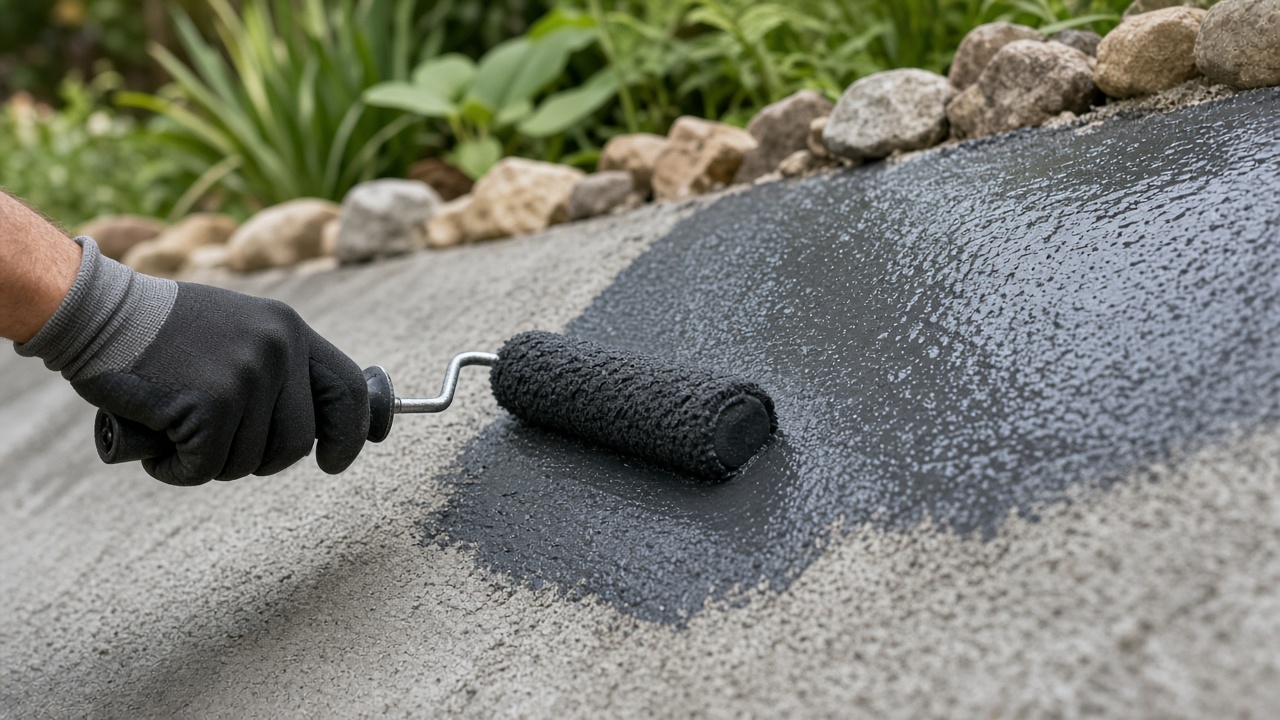
For Pond Armor Pond Shield on concrete:
- Wait 28 days on standard concrete, or 7 days on polymer concrete.
- Degrease if you suspect oil or old silicone.
- Etch to a 60-grit feel. Rinse and dry.
- Fill cracks before the epoxy. Pond Armor’s homepage lists Crack RX as the crack caulk.
- Mix only a small first batch. Incomplete mix will not cure.
- Hit 10 mils minimum. Use two thinner coats on rough block.
- Recoat within 10 hours with no sanding. After 12 hours, scuff with 60-grit.
- Inspect every square foot in raking light. Touch thin spots before you fill.
- Wait 24 hours, or 36 hours if the air is cool.
For DRYLOK Original on masonry:
- Air and surface must be 50°F or higher.
- Do not thin the paint.
- Brush or back-brush the first coat into pores and pinholes.
- Recoat after 2 to 3 hours.
- Apply at least 2 coats. Add a third on any pinhole.
- Wait 5 to 7 days, and at least one week, before you fill a fish pond.
For Liquid Rubber NeoPond Sealant:
- Prime EPDM with EPDM & TPO Primer.
- Prime concrete with Multipurpose Primer.
- Follow the kit’s coat count and fill wait.
- Do not skip primer. The product page says primer promotes adhesion.
For Flex Seal Liquid on a fountain or a small liner patch:
- Start with a clean, dry, grease-free surface.
- Sand to raise tooth.
- Brush, roll, dip, or pour.
- Dry 24 to 48 hours between coats.
- Keep pours at or under 1/4 inch per layer.
- Allow 48 hours for a full cure.
After any fill, check water quality before you add fish.
What this guide will not do for you
We left out products the same makers warn you not to use in fish ponds. We also did not rank coatings or group kits by price tier.
A leaking pond can be a cracked shell, a failed seam, or a plumbing fitting. A sealer will not fix a moving structural crack.
Pond Armor’s FAQ says spot-coating a crack is a weak plan. Water can bypass a patch through porous concrete. Repair the crack, then coat the whole wetted shell.
If the basin is still new concrete, the 28-day wait is the job. Painting day 10 wastes the kit.
FAQ
Can I use a driveway sealer as a pond sealer?
No, not unless that maker’s page lists a pond, a fish pond, or a fountain. Our rule dropped driveway silane sealers for that reason. A water-beading patio coat is not an immersion film.
How long before I can add water and fish?
Use the wait on the product you bought. Pond Armor’s FAQ says 24 hours for Pond Shield, plus 12 hours when it is cool.
DRYLOK’s Original page says 5 to 7 days, and at least one week for concrete fish ponds. Flex Seal’s page says a 48-hour full cure.
Will epoxy stick to my rubber pond liner?
Pond Armor’s FAQ says no. Rubber and polyethylene liners shed coatings.
The FAQ says long-term adhesion needs heat-and-pressure vulcanization. Use a liner-listed membrane such as Liquid Rubber NeoPond Sealant, or replace the liner.
Can I use DRYLOK Extreme in a koi pond?
No. The DRYLOK Extreme page says the mildew biocide may harm aquatic life. That same page tells you to use DRYLOK Original on fishponds and bird baths.
Original still requires the 5-to-7-day cure.
How thick should pond epoxy be?
Pond Armor’s FAQ sets a 10-mil minimum. That is about three sheets of paper.
Smooth concrete may take one 10-mil coat. Rough block often needs two coats of about 5 mils each. Thin spots leak.
Do I need a primer?
It depends on the product. Pond Armor calls Pond Shield self-priming. Primer is optional on pitted concrete to cut outgassing bubbles.
Liquid Rubber’s NeoPond page says yes: EPDM & TPO Primer on liners, Multipurpose Primer on concrete. DRYLOK Original is meant for bare masonry, not for wood or metal.
Is Flex Seal Liquid a fish-pond sealer?
Flex Seal’s Liquid page lists outdoor fountains, bird baths, concrete, and EPDM. It does not print a fish-pond stocking claim on that page. If you keep fish, pick a product whose maker page names fish or fish ponds after a stated cure.