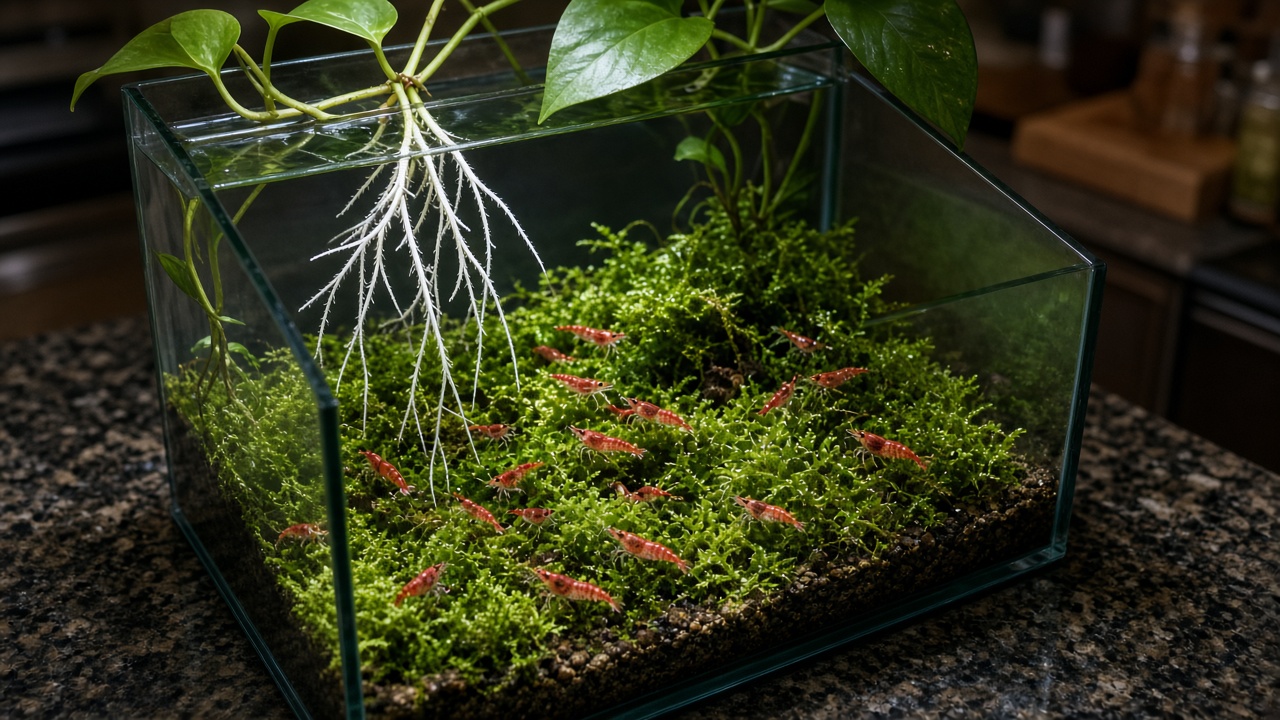
Quick answer: Grow pothos as an emersed houseplant on a freshwater tank, with every leaf in air and only clean roots in the water. Treat it as extra nitrate uptake. It does not replace a filter or a weekly test kit.
Pothos can grow in a freshwater aquarium only if roots sit in water and every leaf stays in air. This page is a freshwater setup guide built from published maker specs.
We only cover emersed-leaf, freshwater pothos setups that rest on a published maker spec.
Our research team compared product pages, not tank logs. A method or product enters this article only if it meets the Waterline Cut.
That rule has three parts:
- Leaves and stems stay fully above the waterline.
- Only washed roots, or fresh cuttings, enter freshwater.
- The maker page states a freshwater use or a listed indoor-plant spec.
We skip soil pots in the tank, fully submerged houseplants, saltwater setups, and gear with no published spec.
Costa Farms names the plant Epipremnum aureum on its Golden Pothos medium page. The same page says vines can climb or trail more than 5 feet if you do not prune them.
A long vine will flop into the tank unless you pin it. For plants that live fully underwater, see our low-maintenance planted aquarium plants for beginners.
How to put pothos roots in a tank
Wash every bit of potting mix off before any root touches aquarium water.
Nursery soil holds fertilizer and fines that cloud water and dump extra nutrients. Costa Farms’ medium Golden Pothos page tells soil growers to water when the top two inches of mix dry out.
That soil advice is for a pot, not a tank. In a tank, soil is a contaminant you must remove.
Use this sequence:
- Choose a cutting with at least one node, or a small plant you can bare-root.
- Rinse roots under tap water until the water runs clear.
- Pick off remaining peat, bark, and slow-release pellets.
- Set the stem on the rim, lid, or filter hood.
- Let only roots hang into the water.
- Pin the vine so no leaf can sag below the surface.
If you start from a cutting, leave two or three nodes near the water and keep every leaf blade dry. A wet leaf sits in still water, breaks down, and adds waste.
Costa Farms’ medium page lists the plant at $34.00. Buy it as a houseplant, then convert it; do not drop the grower pot into the aquarium.
Costa Farms’ medium page asks for indirect sunlight and a spot with windows nearby. Tank LEDs aimed only at the gravel will not feed leaves that sit above the hood.
Nitrates and weekly tests
Pothos roots can take nitrate from water, but they do not replace a test kit or a water change.
Fish waste becomes ammonia, then nitrite, then nitrate. Plants can use that nitrate as food, which is the useful part of an emersed pothos.
It is not a measured removal rate. Our research team found no maker page that states a percent drop for pothos in a home tank, so we do not invent one.
API Fishcare’s Freshwater Master Test Kit page says to test weekly for best results. The same page says the kit measures six levels: ammonia, pH, high range pH, nitrite, and nitrate.
It ships with four test tubes, a holding tray, and a laminated color card. If nitrate stays high after the vine grows, change water; the plant is not keeping up.
API’s kit page also states that a pH of 7.0 is neutral. A reading above 7.0 is alkaline, and a reading below 7.0 is acidic.
If your fish need a higher value, follow a pH plan, not a plant. See our guide on how to raise pH in an aquarium.
Keep this nitrate checklist:
- Test on a fixed weekday and log ammonia, nitrite, and nitrate.
- Change water when your log shows a steady rise.
- Trim roots if they pack the filter intake.
Pothos is a helper, not a cycle. New tanks still need time for bacteria, so do not stock extra fish because a vine is present.
Hang the plant so leaves stay dry
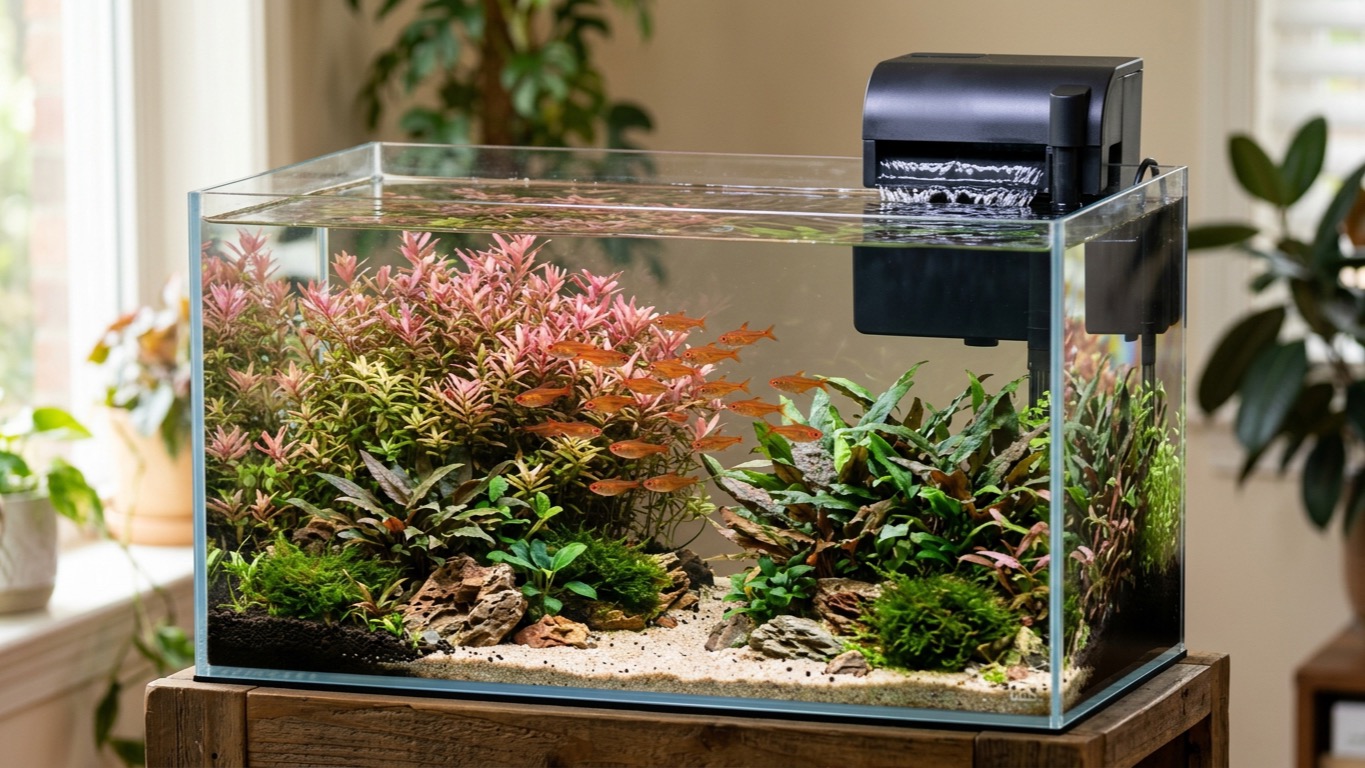
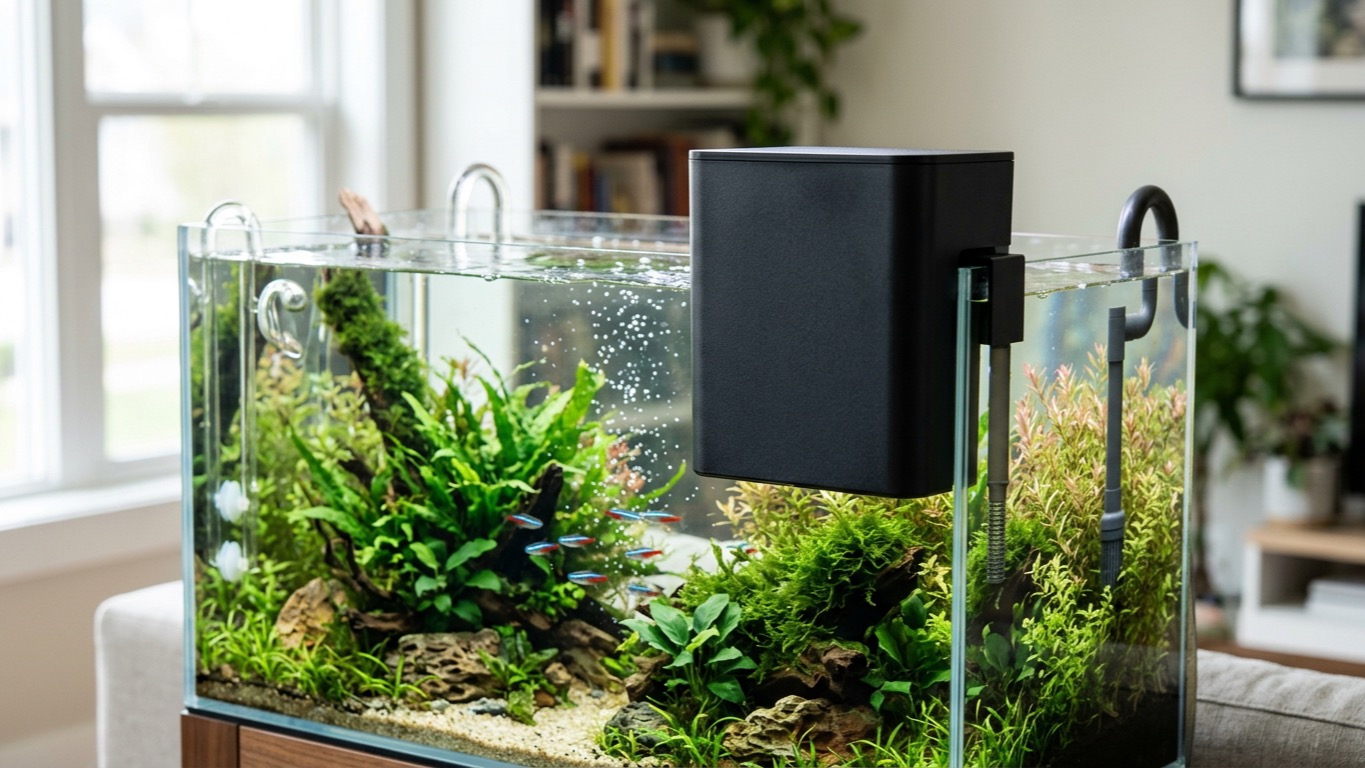
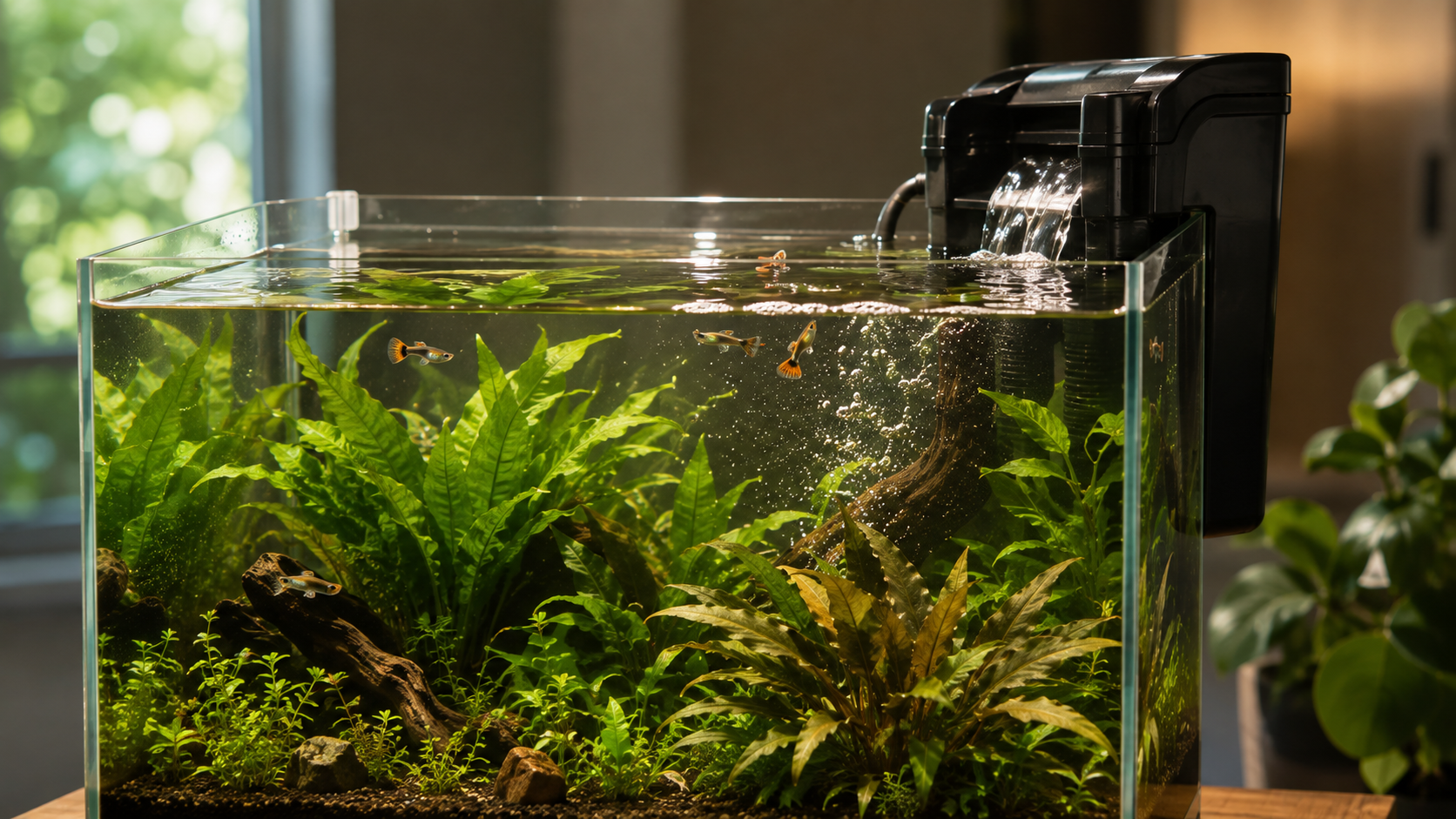
A hang-on-back filter gives pothos a wet shelf and keeps leaves above the rim.
The easiest perch is the rear ledge of a hang-on-back box. Roots drop into the filter chamber or the tank, and leaves stay in room air.
Keep roots away from the impeller, because packed roots starve flow and can overheat a pump. Our hang-on-back filter guide walks through compact cartridge care.
Aqueon’s page for the PRO QuietFlow Aquarium Power Filter lists a 5-stage path. It names dense floss, carbon, a Bio-Holster, a Bio-Media grid, and a specialty pad.
The Size 10 unit on that page measures 6.3 by 3.8 by 6.4 inches. The line is sold in sizes 10, 20, 30, 50, and 75.
Place the stem like this:
- Set the node on the filter lid or the tank rim.
- Drape roots into moving water, and leave a gap around the intake grate.
- Guide new vine growth along a wall, and trim any leaf that leans toward the water.
If your tank has a tight lid, cut a small rear slot that fits the stem, not the leaves.
Fertilizer: when published doses work against you
If you want lower nitrate, skip plant food that adds nitrate on purpose.
Aquarium Co-Op’s Easy Green All-in-One Fertilizer page says 1 ml in 10 gallons adds 3 ppm of nitrate. The same page says one 500 ml bottle treats 5,000 gallons. It tells growers to keep 20 to 50 ppm of nitrate.
That dose helps hungry submerged plants. It fights a pothos-for-nitrate plan, because you would add the waste ion you hoped the vine would remove.
Seachem’s Flourish page takes the other path. It says Flourish does not contain significant levels of nitrogen or phosphorus.
The listed dose is 1 capful, which is 5 mL, for each 250 L, or 60 US gallons, once or twice a week. Each cap thread is about 1 mL, and Seachem recommends refrigeration 3 months after opening.
Seachem’s guaranteed analysis lists total nitrogen at 0.07 percent and available phosphate at 0.01 percent. Iron is listed at 0.32 percent, so Flourish is a micro-element mix, not a nitrate source.
Compare the two doses in plain terms:
- Easy Green: 1 ml per 10 gallons, adding 3 ppm nitrate.
- Easy Green low light: one dose a week at 10 to 20 PAR.
- Easy Green medium light: two doses a week at 20 to 35 PAR.
- Flourish: 5 mL per 60 US gallons, one or two times a week.
Aquarium Co-Op lists the 500 ml Easy Green bottle at $23.99 and the 120 ml bottle at $11.99. The 120 ml page dose is 2 drops per gallon, and that still adds 3 ppm of nitrate per full dose.
For a pothos-root tank with few underwater plants, skip Easy Green. If you later add a heavy carpet of true aquatic plants, reread both labels.
Attribute comparison of current products
We compared listed attributes and did not rank these items or sort them by price.
| Product | Maker-listed job | Published size or dose | Nitrogen note | Stated setting |
|---|---|---|---|---|
| Costa Farms Golden Pothos, medium | Indoor trailing houseplant | Trails more than 5 feet if unpruned | Not a tank fertilizer | Indirect sunlight indoors |
| API Freshwater Master Test Kit | Weekly freshwater tests | Four test tubes; six listed levels | Reads nitrate; does not add it | Freshwater aquariums |
| Seachem Flourish | Micro-element plant supplement | 5 mL per 60 US gallons, 1–2 times weekly | Nitrogen 0.07 percent; not a macro N source | Natural freshwater planted tanks |
| Aquarium Co-Op Easy Green All-in-One Fertilizer | All-in-one plant fertilizer | 1 ml per 10 gallons; 500 ml treats 5,000 gallons | Adds 3 ppm nitrate per dose | Low to high light planted tanks |
| Aqueon PRO QuietFlow Aquarium Power Filter, Size 10 | Hang-on-back power filter | 6.3 by 3.8 by 6.4 inches; 5-stage path | No nitrate dose listed | Freshwater and saltwater aquariums |
Read the nitrogen column first, because that column is why Easy Green and Flourish are not swaps. One adds nitrate by design, and one keeps nitrogen low by design.
Costa Farms also says the medium plant can go only 1 to 2 weeks without water in soil. That figure is a pot warning, not a tank watering schedule.
Once roots hang in a tank, the plant sits in water all day. Your job shifts to leaf position and nitrate logs.
Pets, soil, and other limits
ASPCA lists golden pothos as toxic to dogs and to cats.
The ASPCA Golden Pothos page names Epipremnum aureum and lists insoluble calcium oxalates as the toxic principle. Signs on that page include oral irritation, drooling, vomiting, and trouble swallowing.
The page gives ASPCA Poison Control at (888) 426-4435. Keep trailing vines off the floor and off the sofa, because a tank-top plant is still a houseplant.
Costa Farms’ medium page also warns that the plant may cause discomfort if ingested, and that sap may irritate sensitive skin. We do not extend the ASPCA dog-and-cat listing to fish, because that page does not discuss fish.
Wash soil off so pellets never enter the tank, and keep rotting leaves out of the water.
Other hard limits still apply:
- Do not use pothos as the only filter.
- Do not skip the weekly API test window.
- Do not stuff roots into an impeller.
- Do not leave soil or nursery pots in the water.
If a leaf yellows, cut it above the water. If roots turn to mush, trim to firm white tissue, and if nitrate will not fall, change water and check feeding.
FAQ
Can I grow pothos fully underwater?
No. This article’s Waterline Cut bars that method, because submerged leaves sit in still water and break down. Use pothos only as an emersed plant. If you want greenery below the surface, pick true aquatic plants from our beginner planted-tank list.
Will pothos lower nitrates enough to skip water changes?
No. Maker pages do not publish a pothos removal rate for home tanks. API Fishcare’s Freshwater Master Test Kit page still tells you to test weekly. Change water when nitrate climbs, even if the vine looks lush.
Where should I put the roots?
Hang them in open water or in a hang-on-back chamber, and keep them off the impeller. The Aqueon PRO QuietFlow Size 10 body is 6.3 by 3.8 by 6.4 inches, so a small tank has little spare room. Leave a clear path for flow.
Should I dose Easy Green in a pothos-root tank?
Only if you also keep hungry underwater plants and you accept more nitrate. Aquarium Co-Op’s page says 1 ml per 10 gallons adds 3 ppm of nitrate, which is the opposite of a nitrate-export plan. Seachem Flourish, at 5 mL per 60 US gallons, is the low-nitrogen option on our list.
How long will the vine get?
Costa Farms’ medium Golden Pothos page says it can climb or trail more than 5 feet if you do not prune it. Guide that length along a wall, and trim before it reaches a pet.
Is golden pothos safe around cats and dogs?
ASPCA lists it as toxic to dogs and cats because of insoluble calcium oxalates. Keep leaves out of reach. If a pet chews the plant, the ASPCA page points you to Poison Control at (888) 426-4435.
How do I know the setup is working?
You know from a log, not from leaf shine. Test weekly with a kit such as the API Freshwater Master Test Kit, then compare nitrate across a month. If the number rises while stocking stays steady, change water and cut feeding.