Quick answer: Choose a rigid preformed pond liner when you want a set shape and a listed depth. Match the maker’s length, width, and depth to a level hole. Skip a preformed shell if you need a custom outline or more than 24 inches of water.
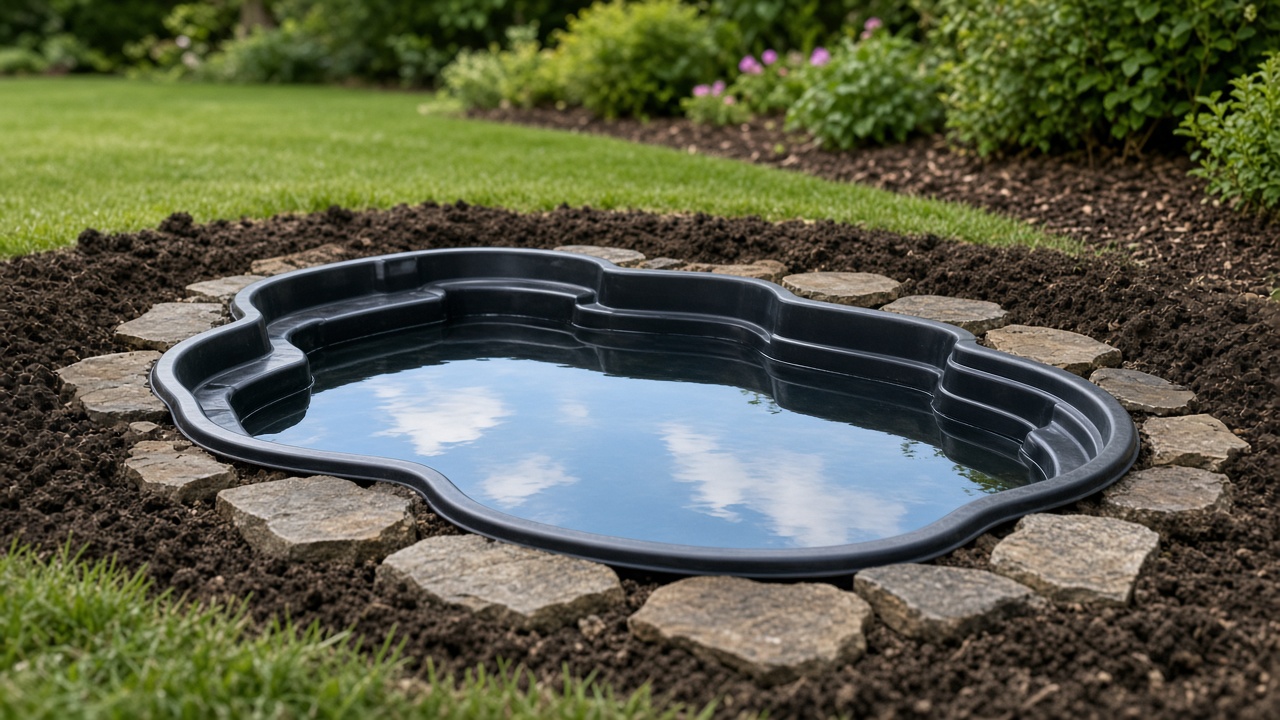
A preformed pond liner is a rigid one-piece basin; skip it if you need more than 24 inches of depth.
This page is a size-and-install brief from published maker specs and Texas A&M AgriLife Extension Earth-Kind pages. We did not bury shells, run leak trials, or assign ranks.
How we chose which shells to cover
We used one published-spec rule to decide which rigid shells belong on this page.
We included a shell only if it is rigid, one-piece, and currently listed. The maker page also had to show gallons plus outside length, width, and depth.
We left out flexible sheet liners, livestock stock tanks, and fountain bowls under 30 gallons. We did not add any shell we could not confirm on a maker page.
Our research team analyzed those published listings and did not handle the products in a yard. The Waterpuppy Preformed Depth Count is our tally of MacCourt Products’ pond-liner page.
That page lists 18 shells, and capacities run from the 30-gallon Peanut to the 275-gallon St. Croix.
Top 7 Preformed pond liner
The picks below are the 7 preformed pond liners on sale right now, listed with what each suits best and an honest drawback. Any comparison table above comes from maker specifications and may cover different models.
1. POPOSOAP Preformed Pond Liner
Best for: Patio lily-pond beginners
This is the only rigid preformed basin on this list. The maker describes a one-piece plastic shell with molded plant shelves that you drop into a dug outline. Owners treat it as a patio start; the published depth is too shallow for real koi.
Pros: Rigid ready-made basin; Molded plant shelves Cons: Shallow fixed-shape basin
2. Pond boss Waterfall Spillway
Best for: Adding a liner waterfall
This is a waterfall spillway, not a liner. Maker pages show a compact weir that sits on an existing liner and needs a separate pump and tubing. Owners add it after the pond is already lined.
Pros: Cheap waterfall add-on; Compact liner-edge weir Cons: Not a pond liner
3. UWIOFF Pond Liner
Best for: Small irregular DIY ponds
This UWIOFF listing is a budget flexible sheet, not a rigid tub. Published copy pitches a thin plastic roll you cut to a small backyard hole. Owners often say the sheet stays stiff and keeps fold marks.
Pros: Low entry price; Flexible cut-to-fit sheet Cons: Stiffer than rubber liners
4. Adroiteet 10 x 15 FT Pond Liner
Best for: Midsize backyard water gardens
The name locks the size: a 10 by 15 ft flexible sheet at a mid-list price. The maker frames it as a cut-to-fit outdoor pond liner, not a drop-in shell. Owners get medium-yard coverage if they dig and shape the hole first.
Pros: Named 10-by-15 coverage; Mid-pond price tier Cons: Not a rigid shell
5. Firestone 45mil EPDM Rubber Pond Liner 15ft.x20ft.
Best for: Deep custom fish ponds
This 15 by 20 ft, 45-mil EPDM sheet is the premium rubber option here. Published specs describe a thick, flexible membrane for custom depth and shape. Owners accept the high price and heavy roll because it drapes into shelves a hard shell cannot form.
Pros: Thick 45-mil rubber; Large 15-by-20 sheet Cons: Heavy premium price
6. MYFAMIREA 25 x 30FT Pond Liner
Best for: Wide shallow wildlife ponds
This 25 by 30 ft sheet is the large-coverage buy, priced well below the Firestone roll. The maker describes a polyethylene liner with hemmed edge buttonholes, not a rigid basin. Owners report a tarp-like feel and tears if the sheet is dragged, so underlayment matters.
Pros: Huge 25-by-30 coverage; Lower cost per foot Cons: Unwieldy tarp-style sheet
7. UWIOFF Small Pond Liner
Best for: Tiny fountain basins
This is the cheapest listing and is sized for a fountain, planter, or tiny water feature. It is still a flexible cut-to-fit liner, not a preformed tub. Owners use leftover pieces for beds and containers; it will not cover a backyard pond.
Pros: Lowest listed price; Compact small-feature size Cons: Too small for ponds
Comparison: Preformed pond liner at a Glance
| Product | Best for | Approx. price | Where to buy |
|---|---|---|---|
| POPOSOAP Preformed Pond Liner | $198.99 | Check price | |
| Pond boss Waterfall Spillway | $29.95 | Check price | |
| UWIOFF Pond Liner | $19.50 | Check price | |
| Adroiteet 10 x 15 FT Pond Liner | $48.79 | Check price | |
| Firestone 45mil EPDM Rubber Pond Liner 15ft.x20ft. | $315.00 | Check price | |
| MYFAMIREA 25 x 30FT Pond Liner | $138.99 | Check price | |
| UWIOFF Small Pond Liner | $17.99 | Check price |
Want to browse every option? See the full range of preformed pond liner on Amazon →
Size: gallons, footprint, and how much dirt you move
Read the listed gallons and the listed outside size before you buy any shell.
MacCourt Products’ pond-liner page lists the Aruba at 50 gallons and 57 inches by 30 inches. The same page lists the Jamaica at 100 gallons and 78 inches by 53 inches.
The St. Croix listing on that page is 275 gallons and 90 inches by 66 inches. POPOSOAP’s page for the 33 Gallon Rigid Preformed Plastic Pond lists model P143 at 33 gallons.
That POPOSOAP page lists the outside size as 35.4 inches long by 26.7 inches wide. Texas A&M AgriLife Extension Earth-Kind’s design page gives a soil rule you can apply to any listed gallon figure.
For every 1 gallon of water, that page counts 0.134 cubic feet of soil to remove. It says a 100-gallon pond needs more than 13.4 cubic feet of soil, plus extra for edging and sand.
The same Earth-Kind design page sizes a small commercial preformed shell at 50 to 65 gallons. It lists about 6.7 to 8.7 cubic feet of soil, or 0.25 to 0.32 cubic yards.
That load is about 2 to 3 wheelbarrows, so plan a place for the spoil before you dig. Earth-Kind’s design page also sets a surface-area floor for a balanced pond. It calls about 50 square feet the minimum, which is a 10-foot by 5-foot rectangle or an 8-foot circle.
The Waterpuppy Preformed Surface Check compared that floor with MacCourt’s listed footprints.
We treated each listing as a rectangle, and none of the 18 footprints reach 50 square feet. The Key Largo listing is 91 inches by 72 inches, which is 45.5 square feet before the molded shape cuts the surface.
A preformed liner can still hold plants and a few fish, but it does not meet Earth-Kind’s 50-square-foot floor on the MacCourt list we counted.
Depth: the 18-inch rule and the one 24-inch shell
Depth is the first number that decides whether a preformed liner fits your plan.
Texas A&M AgriLife Extension Earth-Kind’s design page says pond depth should range from 18 to 24 inches. That page also says more than 3 feet is not needed and becomes a maintenance hazard.
Our research team counted depths on MacCourt Products’ pond-liner page. Thirteen of the 18 listed shells are 18 inches deep, and three shells are listed at 12 inches.
One shell, the Rectangle, is listed at 7 inches, and only one listed MacCourt shell reaches 24 inches. MacCourt’s Grand Cayman page lists that model at 165 gallons and 78 inches by 54 inches by 24 inches.
The SKU on that Grand Cayman page is LP7824. MacCourt’s pond-liner page says the deepest pond is 24 inches and that extra depth helps fish in colder regions.
POPOSOAP’s P143 page lists height at 11.8 inches, which sits below Earth-Kind’s 18- to 24-inch depth range. Treat that shell as a small patio basin, not a deep fish pond.
Earth-Kind’s design page flags a local rule used in many towns. In most urban areas, a pond over 18 inches deep needs a fence 6 feet or taller.
Earth-Kind’s wildlife page gives a stocking cap in plain numbers: no more than 1 inch of fish per 3 to 5 gallons of water. That page’s example is a circular pond 5 feet across and 18 inches deep, holding about 160 gallons.
The same wildlife page says koi need a pond larger than 6 feet across and at least 18 inches deep. Most retail preformed shells miss that 6-foot span on at least one side.
Material and wall thickness from maker pages
Compare the wall thickness and plastic type the maker actually prints on the product page.
MacCourt Products’ pond-liner page says its ponds are formed from 200- to 250-mil sheets of high-density polyethylene. That page says only Grade A material is used and that the plastic is non-toxic to plants, fish, and pets.
POPOSOAP’s P143 page lists heavy-duty ABS at 120 mil, a product weight of 8.38 pounds, and a 12-month warranty. Those two published walls are not the same class, because MacCourt’s listed sheet is thicker than POPOSOAP’s 120-mil wall.
MacCourt’s page says the ponds will not chip, crack, or fade. POPOSOAP’s page says the ABS resists cracking, UV damage, and outdoor weather.
Earth-Kind’s design page lists life spans for other liner types, not for these HDPE or ABS shells. It lists fish-grade PVC at 7 to 15 years and fish-grade rubber at 30 years. Do not apply those year figures to a polyethylene or ABS shell.
How to install a preformed pond liner
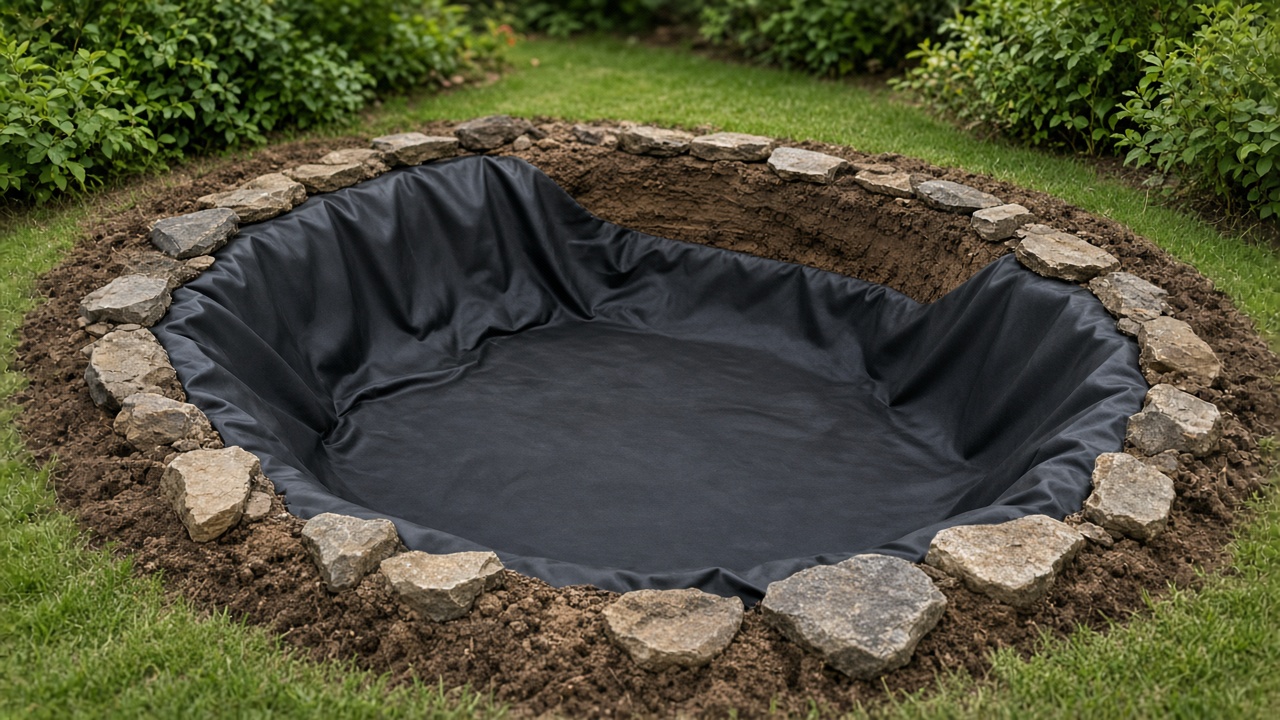
Set the shell on sand, keep it level, and raise water and backfill together.
Texas A&M AgriLife Extension Earth-Kind wrote these steps for fiberglass preformed ponds, and the same sequence is what makers describe for rigid plastic shells. POPOSOAP’s P143 page also says to dig, level with sand, and fill edge gaps with sand.
Follow this order from the Earth-Kind fiberglass page:
- Set the shell in place and outline its shape with a hose or rope.
- Add about 2 to 4 inches to the width for backfill.
- Dig the shelves 2 inches deeper than the molded shelf.
- Dig the bottom 2 inches deeper for a sand cushion.
- Pack a 2-inch sand bed and set the shell.
- Slope the edging 1 inch per foot away from the pond.
- For a grass edge, leave the rim 1 1/2 inches above the lawn.
- Fill with water and backfill at the same time, 4 inches at a time.
- Tamp the backfill with a blunt tool, and do not overcompact the shell.
- Recheck level as you go, and add edging only after the pond is full.
Use the Aruba numbers as a worked hole size. MacCourt’s pond-liner page lists the Aruba at 57 inches by 30 inches by 18 inches.
Add Earth-Kind’s 2 to 4 inches of side room, and the hole is about 61 to 65 inches by 34 to 38 inches. Add the 2-inch sand bed and dig about 20 inches deep at the lowest point.
Earth-Kind says it is better to add fill on the low side than to cut the high side. A long board and a carpenter’s level will show a tilt before water hides it.
POPOSOAP’s P143 page says the basin can sit above ground or in a hole. A buried shell still needs that sand bed and that side support.
Current shells compared by listed attributes
This table uses only numbers printed on maker pages and is not a ranked list.
| Product | Listed capacity | Listed outside size | Listed depth | Listed material |
|---|---|---|---|---|
| POPOSOAP 33 Gallon Rigid Preformed Plastic Pond (P143) | 33 gal | 35.4 in × 26.7 in | 11.8 in | 120 mil ABS |
| MacCourt Aruba | 50 gal | 57 in × 30 in | 18 in | 200–250 mil HDPE |
| MacCourt Jamaica | 100 gal | 78 in × 53 in | 18 in | 200–250 mil HDPE |
| MacCourt Grand Cayman (LP7824) | 165 gal | 78 in × 54 in | 24 in | 200–250 mil HDPE |
| MacCourt Lagoon | 250 gal | 92 in × 66 in | 18 in | 200–250 mil HDPE |
| MacCourt St. Croix | 275 gal | 90 in × 66 in | 18 in | 200–250 mil HDPE |
MacCourt’s HDPE range is stated for the line on the pond-liner page. It is not printed again on every model page.
The Grand Cayman holds less water than the Lagoon or the St. Croix. It is still the only listed MacCourt shell at Earth-Kind’s 24-inch depth cap.
The St. Croix listing is the largest gallon figure on MacCourt’s page. Its 18-inch depth still sits at the bottom of Earth-Kind’s 18- to 24-inch range.
POPOSOAP’s P143 is the lightest listed shell in this set, and the maker page lists 8.38 pounds.
When a preformed liner is the wrong tool
Skip a preformed shell when the hole you want is deeper, larger, or a different shape.
Pick a flexible liner if you need more than 24 inches of water. MacCourt’s own page stops at 24 inches, and Earth-Kind’s design page allows up to that same band and no more than 3 feet.
Pick a flexible liner if you need 50 square feet of surface. None of the 18 MacCourt footprints we measured as rectangles reach that Earth-Kind floor.
Pick a flexible liner if the outline must follow a patio, a tree, or a crooked bed. A molded shell cannot change shape after you buy it, and Earth-Kind’s design page says a preformed shell limits shape options.
Skip a preformed shell for adult koi, because Earth-Kind’s wildlife page wants a pond larger than 6 feet across and at least 18 inches deep. The MacCourt St. Croix listing is 90 inches by 66 inches. That rectangle is 7.5 feet by 5.5 feet, so the short side misses the 6-foot koi span.
A 33-gallon patio shell is fine for plants and a tiny water feature. It is not a stand-in for Earth-Kind’s balanced-pond size or depth.
FAQ
What is a preformed pond liner?
It is a rigid, one-piece basin with a factory shape, and the maker lists a gallon figure plus an outside length, width, and depth. You dig a hole that matches that mold and do not cut or weld a sheet.
How deep should a preformed pond liner be?
Texas A&M AgriLife Extension Earth-Kind’s design page says 18 to 24 inches. Thirteen of 18 MacCourt shells we counted are listed at 18 inches, and only the Grand Cayman is listed at 24 inches. An 11.8-inch patio shell sits below that range.
How much extra space should I dig around the shell?
Earth-Kind’s fiberglass-preformed page says add about 2 to 4 inches of width for backfill. Dig shelves and the floor 2 inches extra for sand, then backfill in 4-inch lifts while you add water.
Can I keep fish in a preformed pond liner?
Earth-Kind’s wildlife page caps stocking at 1 inch of fish per 3 to 5 gallons. A 50-gallon Aruba listing would then hold about 10 to 16 inches of fish, total. That page also wants koi in a pond larger than 6 feet across, and most preformed shells miss that span.
Does a 33-gallon preformed liner work in a small yard?
POPOSOAP’s P143 page lists 33 gallons, 35.4 inches by 26.7 inches, and 11.8 inches of height. That footprint fits a patio or a tight bed, but it does not meet Earth-Kind’s 18-inch depth floor or 50-square-foot surface floor.
Do I need a fence for an 18-inch preformed pond?
Earth-Kind’s design page says most urban areas require a 6-foot fence for a pond over 18 inches deep. An 18-inch shell may sit on that line, and a 24-inch Grand Cayman is over it, so ask your city before you dig.
Should I fill the pond before I backfill?
No. Earth-Kind’s fiberglass-preformed page says add water and soil at the same time and raise both in 4-inch stages. The water holds the wall while the backfill supports the shelves.