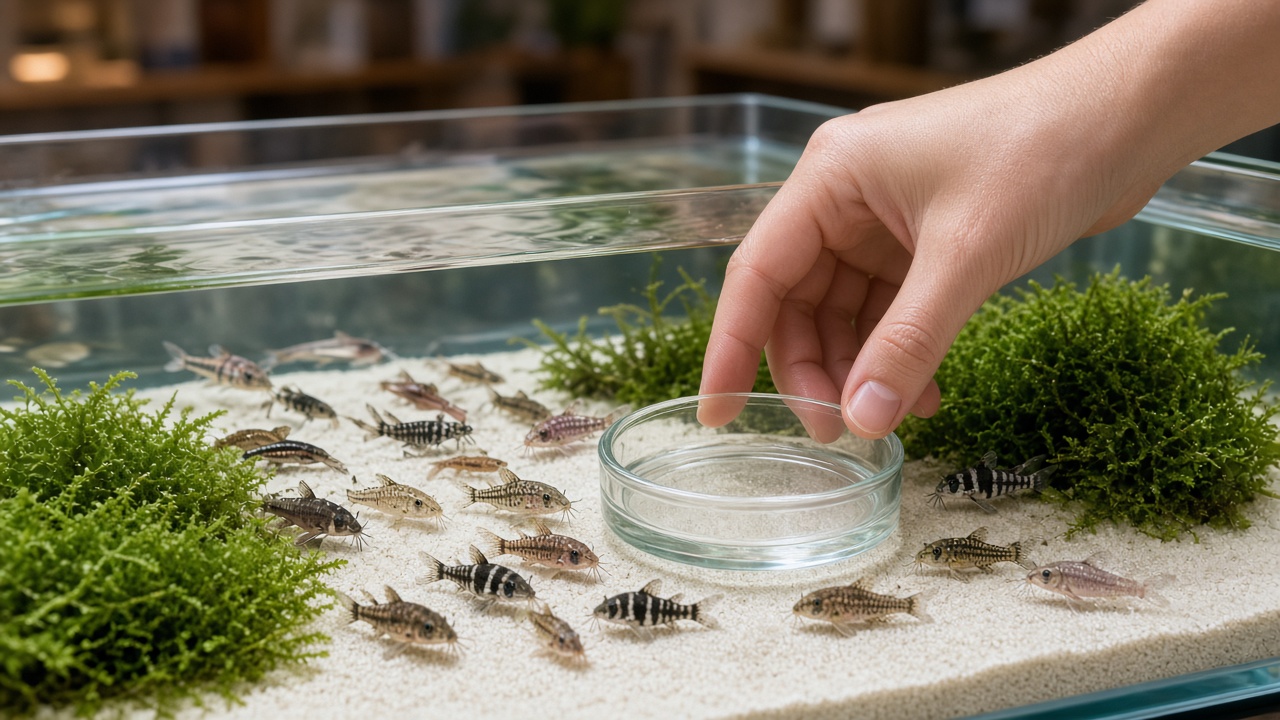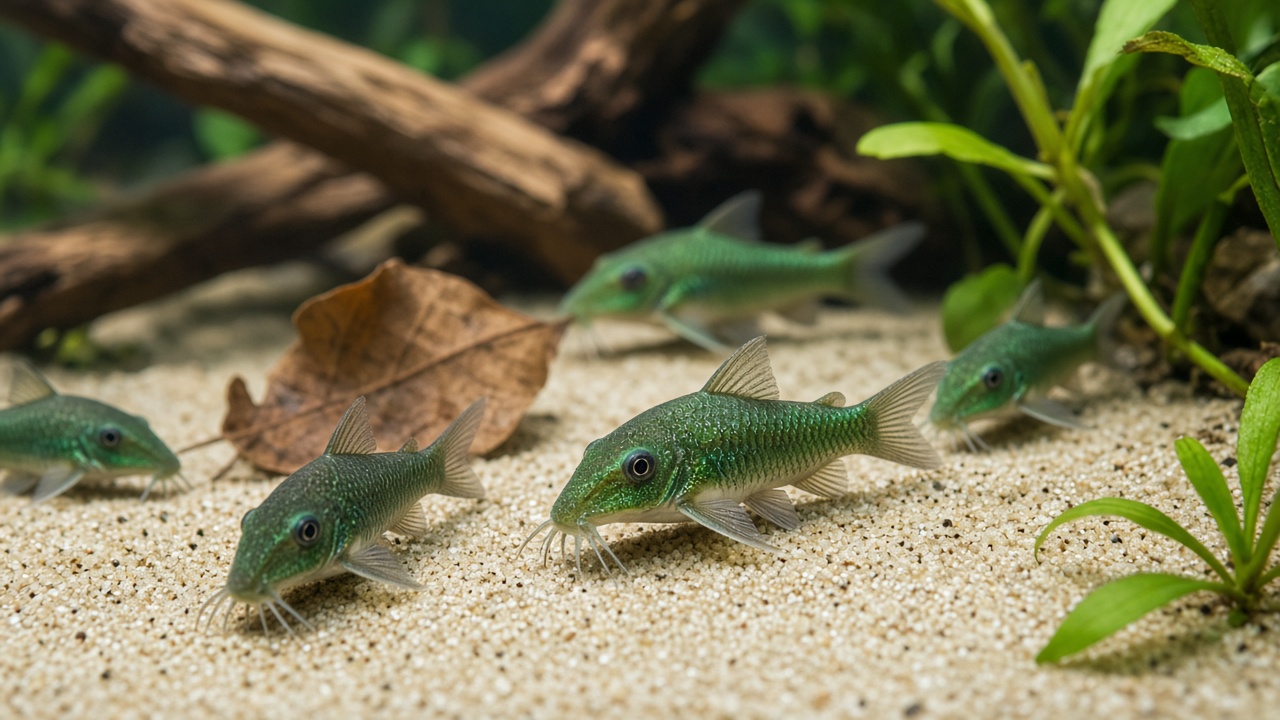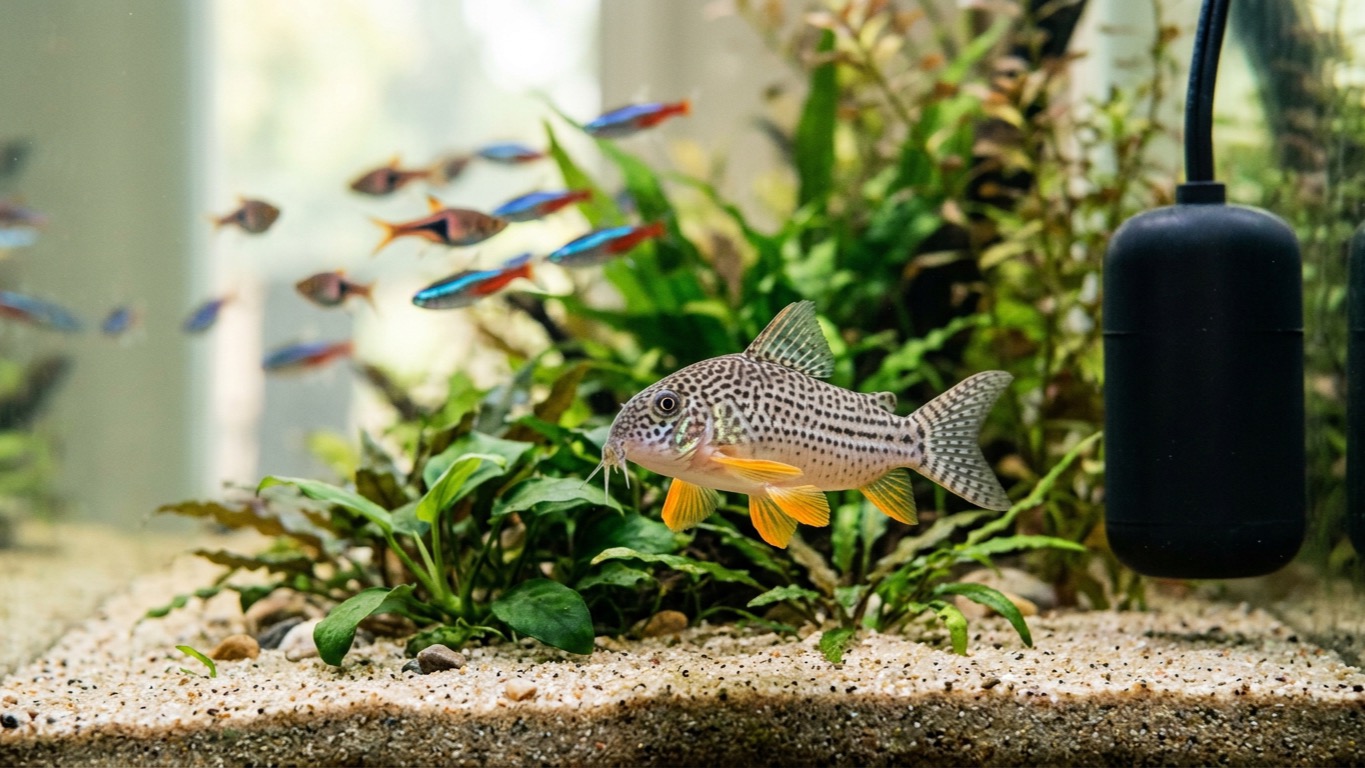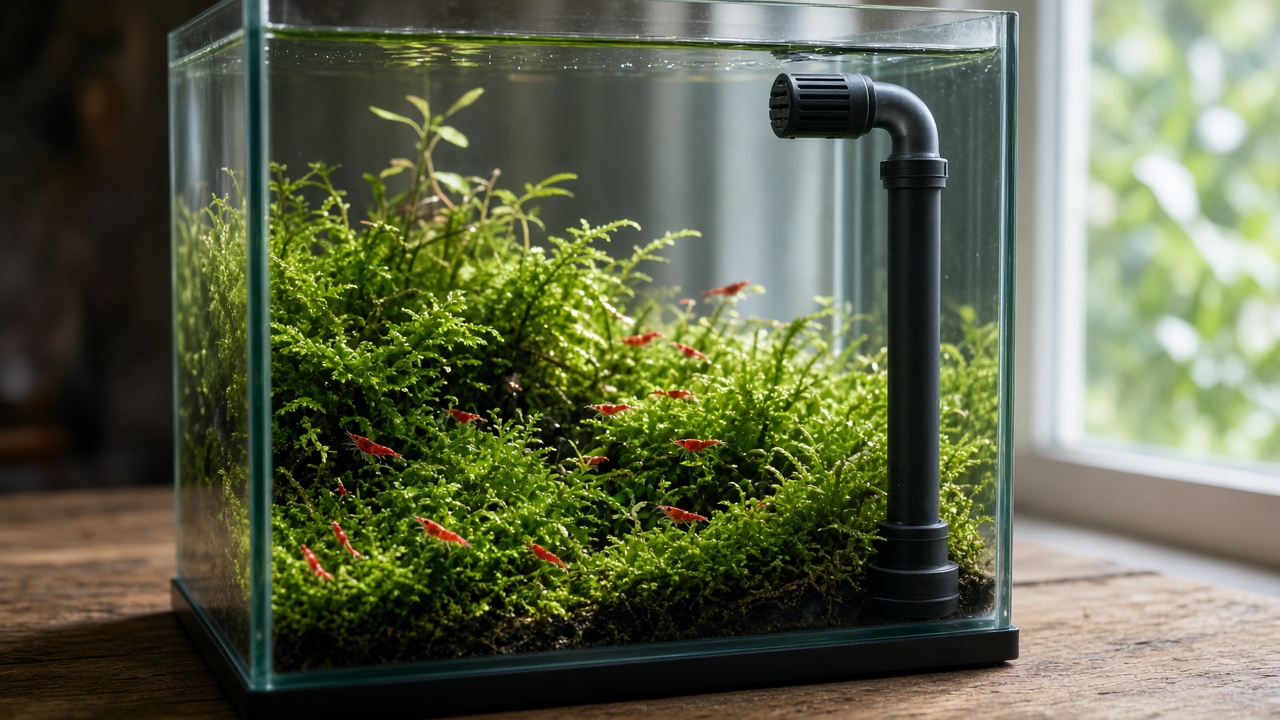
Quick answer: Keep pygmy corys in an Aqueon Rectangle LED Kit size 10 or larger, and feed a sinking micro food. Hold water at 22–26°C and pH 6.0–8.0, the ranges FishBase lists. Use a school that fits our floor rule below.
FishBase lists the pygmy cory at 2.1 cm standard length, pH 6.0–8.0, and 22–26°C. This page compares FishBase records with maker specs;
What a pygmy cory is
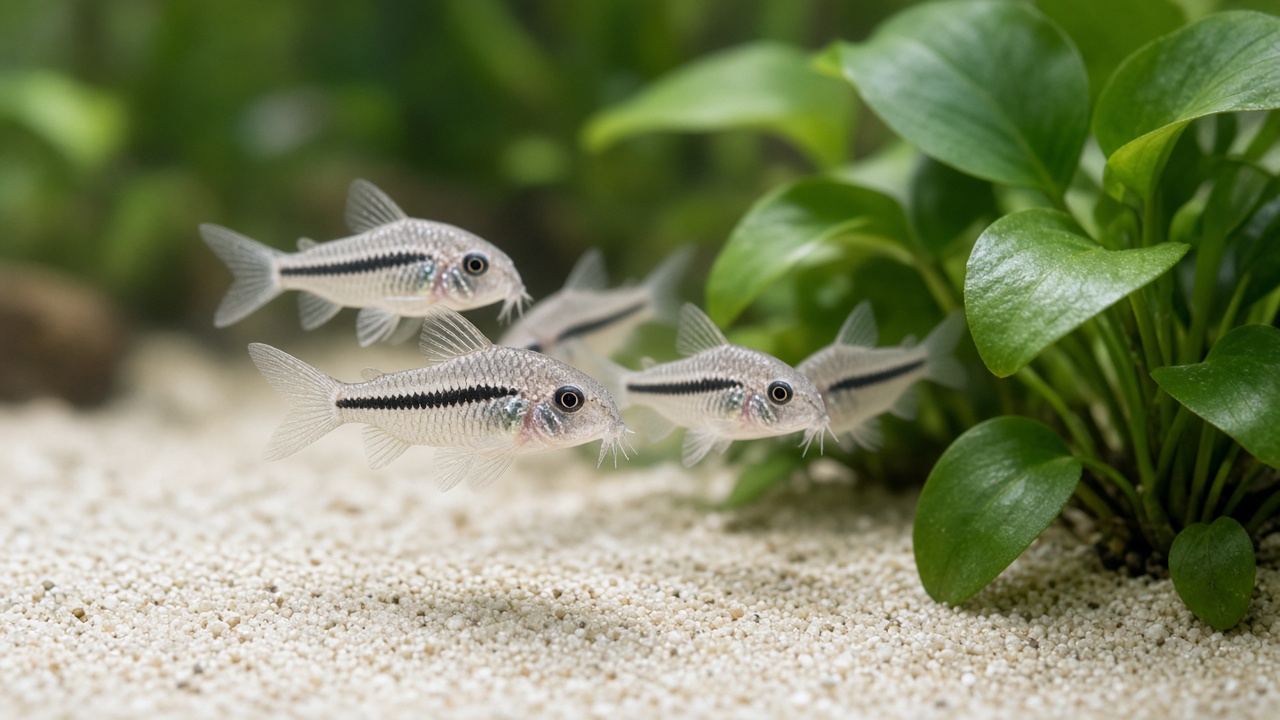
A pygmy cory is a small armored catfish from South America’s Madeira River basin.
FishBase now files the species as Gastrodermus pygmaeus (Knaack, 1966), while shops still sell it as Corydoras pygmaeus. It belongs to Callichthyidae, the armored catfish family, in the subfamily Corydoradinae.
FishBase lists a maximum standard length of 2.1 cm, which is the body without the tail fin. That published length is the size this page uses for tank and food math.
FishBase also lists these water bands:
- Temperature: 22–26°C (72–79°F)
- pH: 6.0–8.0
- Hardness: 2–25 dH
The species is demersal, so it uses the lower water more than the top. FishBase also flags facultative air-breathing, so a short gulp at the surface can be normal.
FishBase sets the trophic level at 3.0 ± 0.3, which means it eats small animal prey, not leftover flakes alone. IUCN assessed it Least Concern on 15 October 2020, and FishBase calls the species harmless with commercial aquarium use.
The Published-Spec Rule
This page uses one rule to decide what belongs and what does not.
We include a tank or food only when the maker publishes a number we can quote. We include species facts only when FishBase publishes them. That paired filter is the Published-Spec Rule for this file.
What got in:
- FishBase numbers for Gastrodermus pygmaeus
- Aqueon Rectangle LED Kit sizes 10, 20 High, 29, and 55
- Sinking or small-mouth foods with a listed protein minimum
What did not:
- Desktop kits that are not on Aqueon’s Rectangle LED page
- Floating-only flake diets
- Head-count rules copied from hobby blogs
- Medicine schedules or disease charts
- Wild-catch shipping advice
Our research team analyzed those published pages and compared the listed specs side by side.
If you want a larger, warmer cory instead, read our Sterbai Cory Care guide.
Tank size: use listed length, not a copied gallon slogan
Floor length matters more than a short, tall box for a 2.1 cm fish.
Aqueon’s Rectangle LED Kit page lists four sizes: 10, 20 High, 29, and 55. The size 10 kit measures 22.88 inches long, 12.75 inches wide, and 13.88 inches high. That length is the smallest footprint this page covers.
That same Aqueon page says the kit’s preset heater holds 78°F. FishBase’s band is 22–26°C, which is 72–79°F, so Aqueon’s 78°F set point sits inside that band.
The size 10 kit is the starting tank we cover for a pygmy-only group. Step up when you add other fish, using the 20 High, 29, or 55 sizes Aqueon lists on the same page.
Skip kits that are not on that Rectangle LED page. Short desktop boxes do not give a 2.1 cm school a straight floor path.
Aqueon also lists a five-stage QuietFlow filter on that kit. Aim the flow along a wall, not across the sand, because these fish forage on the bottom and will tire in a hard jet.
Use a fine, smooth sand bed, since coarse gravel can scrape barbels.
Cover the tank, because a facultative air-breather will visit the surface. Leave a small air gap so that gulp is easy.
School size: the one-third floor rule
FishBase does not publish a school-size number, so this desk does not invent one from blogs.
We use a floor rule built from two published figures. FishBase lists 2.1 cm standard length, and Aqueon lists 22.88 inches for the size 10 Rectangle LED Kit, which is about 58 cm.
The rule is simple: keep the school’s combined 2.1 cm length under one-third of the tank’s listed length.
On the size 10 kit, one-third of 58 cm is about 19 cm, and 19 divided by 2.1 is nine. So this page covers up to nine pygmy corys in that kit, and no other fish.
When you add tankmates, move to a size Aqueon lists above 10, which means 20 High, 29, or 55. Recheck the same one-third math on that kit’s listed length before you buy more fish.
A pair or a trio fails the rule on purpose, because the point is a group that can travel as a line on the glass. One or two fish will hide and skip food.
Do not mix this math with a “one inch per gallon” slogan. That slogan is not on FishBase or the Aqueon page.
Diet: sinking food small enough for a 2.1 cm mouth
Feed a sinking or slow-sinking food whose maker lists both the protein and the particle.
FishBase’s trophic level of 3.0 means animal prey is part of the diet, so leftover flake on the sand is not a plan. Put food on the floor where the fish already forage.
Comparing published specs, NorthFin Community Formula is the smallest particle we cover. The maker’s page lists 0.5 mm and 1 mm pellets.
Fluval’s Bug Bites Bottom Feeder Granules list a 1.4–2.0 mm granule, which can be half the fish’s 2.1 cm body. Break that granule or pick the 0.5 mm NorthFin pellet.
Hikari Tropical Micro Pellets are listed for small-mouthed tropical fish, and Hikari Tropical Sinking Wafers are listed for Corydoras catfish. Both belong on this page because those maker lines match the mouth and the family.
Maker feeding windows, in the makers’ own units:
- Fluval Bug Bites Bottom Feeder Granules: as much as fish eat in two minutes, two or three times daily
- Hikari Tropical Micro Pellets: two to three times daily, what they finish in a few minutes
- Hikari Tropical Sinking Wafers: what they finish in 20 minutes, then remove leftovers
- NorthFin Community Formula: protein and pellet size listed; no feeding clock on that page
Fluval’s page also says to finish an open tub within 6 months. It lists up to 40% black soldier fly larvae as the first ingredient. Fluval’s guaranteed analysis on that page includes:
- 32.0% minimum crude protein
- 12.0% minimum crude fat
- 1.50% minimum calcium
- 0.80% minimum phosphorus
- 2,500 IU/kg minimum vitamin A
Hikari’s Micro Pellets page lists 43% minimum crude protein, 7% minimum crude fat, and 1.1% minimum phosphorus. Hikari’s Sinking Wafers page lists 36% minimum crude protein, 9.0% minimum crude fat, and 0.8% minimum phosphorus. NorthFin’s Community Formula page lists 40% minimum protein, 5% minimum fat, and 5% maximum fiber.
| Product | Format | Protein min | Fat min | Fiber | Particle or use note |
|---|---|---|---|---|---|
| Fluval Bug Bites Bottom Feeder Granules | Sinking granule | 32% | 12% | 6% max | 1.4–2.0 mm |
| Hikari Tropical Micro Pellets | Granule | 43% | 7% | 7% max | Listed for small mouths |
| Hikari Tropical Sinking Wafers | Soft wafer | 36% | 9% | 4% max | Maker lists Corydoras |
| NorthFin Community Formula | Slow-sinking pellet | 40% | 5% | 5% max | 0.5 mm and 1 mm |
Use NorthFin Community Formula 0.5 mm or Hikari Tropical Micro Pellets as the daily staple. Keep Hikari Tropical Sinking Wafers as a broken-up Corydoras wafer, not a whole disc. Use Fluval Bug Bites Bottom Feeder Granules only if you crush the 1.4–2.0 mm granule first.
Skip floating flakes as the only food. Midwater fish will take them first, and the 2.1 cm cory on the sand gets the dust.
Water, sand, and daily care
Match FishBase first, then keep the numbers still.
Stay inside 22–26°C and pH 6.0–8.0. FishBase also allows 2–25 dH, and that hardness band is wide, so stability matters more than chasing a single degree.
Aqueon’s size 10 Rectangle LED Kit ships with a heater set at 78°F, which is 25.6°C and inside the FishBase range. Confirm the reading with the stick-on thermometer the same kit includes.
Change water on a fixed day, and match temperature in the bucket to the tank. A 2.1 cm fish feels a swing faster than a large cory.
Keep the filter intake sponge-guarded, because pygmy corys are small enough to ride a bare intake. Aqueon lists a QuietFlow power filter on that kit, so check that the intake is covered before the school goes in.
Do not treat them as a cleanup crew. FishBase’s trophic level of 3.0 is a diet clue, not a stand-in for feeding them.
If they race to the surface often, check heat and surface ripple first. Facultative air-breathing is normal in small doses, while constant racing points to a water problem.
Eggs and what FishBase actually records
FishBase records a clutch method. It does not record an easy home-breeding recipe.
The female holds 2–4 eggs between her pelvic fins, and the male fertilizes them for about 30 seconds. She then sticks the eggs to a surface, and the pair repeats until about 100 eggs are attached.
That is the whole published sequence this desk will quote.
If you want fry, you need a separate box and a plan for 100 sticky eggs. That work is outside this page, which stops at the FishBase clutch numbers.
FAQ
How big does a pygmy cory get?
FishBase lists a maximum standard length of 2.1 cm, and standard length leaves off the tail fin. Shop listings that say one full inch sit above that record. Plan food and tank length around 2.1 cm, not around a larger guess.
What tank size do pygmy corys need?
This page covers the Aqueon Rectangle LED Kit size 10 as the smallest tank. That kit is 22.88 inches long, 12.75 inches wide, and 13.88 inches high. Move to Aqueon’s 20 High, 29, or 55 sizes when other fish share the tank.
How many pygmy corys should I keep together?
FishBase does not list a head count. Our floor rule caps the school’s combined 2.1 cm length at one-third of the tank’s listed length. On Aqueon’s 22.88-inch size 10 kit, that cap is nine fish and no tankmates.
What should I feed pygmy corys?
Use a sinking micro food with a published protein number. NorthFin Community Formula lists 0.5 mm pellets and 40% minimum protein, and Hikari Tropical Micro Pellets list 43% minimum protein for small mouths. Crush Fluval Bug Bites Bottom Feeder Granules if you use that 1.4–2.0 mm size.
What temperature and pH do they need?
FishBase lists 22–26°C and pH 6.0–8.0, and that temperature band is 72–79°F. Aqueon’s Rectangle LED Kit heater is preset to 78°F, which sits inside the band. FishBase also lists hardness from 2 to 25 dH.
Why do they dart to the surface?
FishBase flags facultative air-breathing, so a short gulp at the top can be normal. If the whole school races without rest, check temperature and filter flow. Keep the heater near Aqueon’s 78°F set point and soften any jet on the sand.
Can pygmy corys live with sterbai corys?
FishBase lists the pygmy at 2.1 cm standard length, so it is the much smaller fish. For the larger species, use our Sterbai Cory Care page. If you house both, use an Aqueon size above 10 and feed a 0.5 mm pellet first.