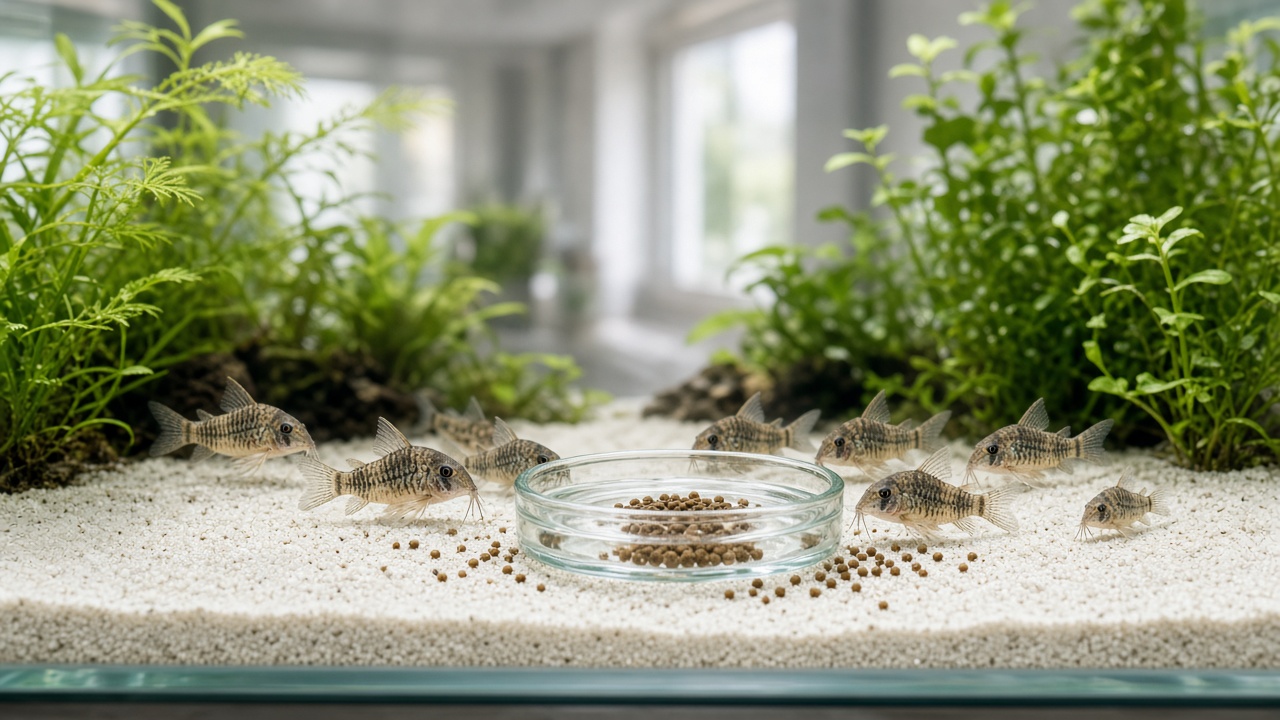
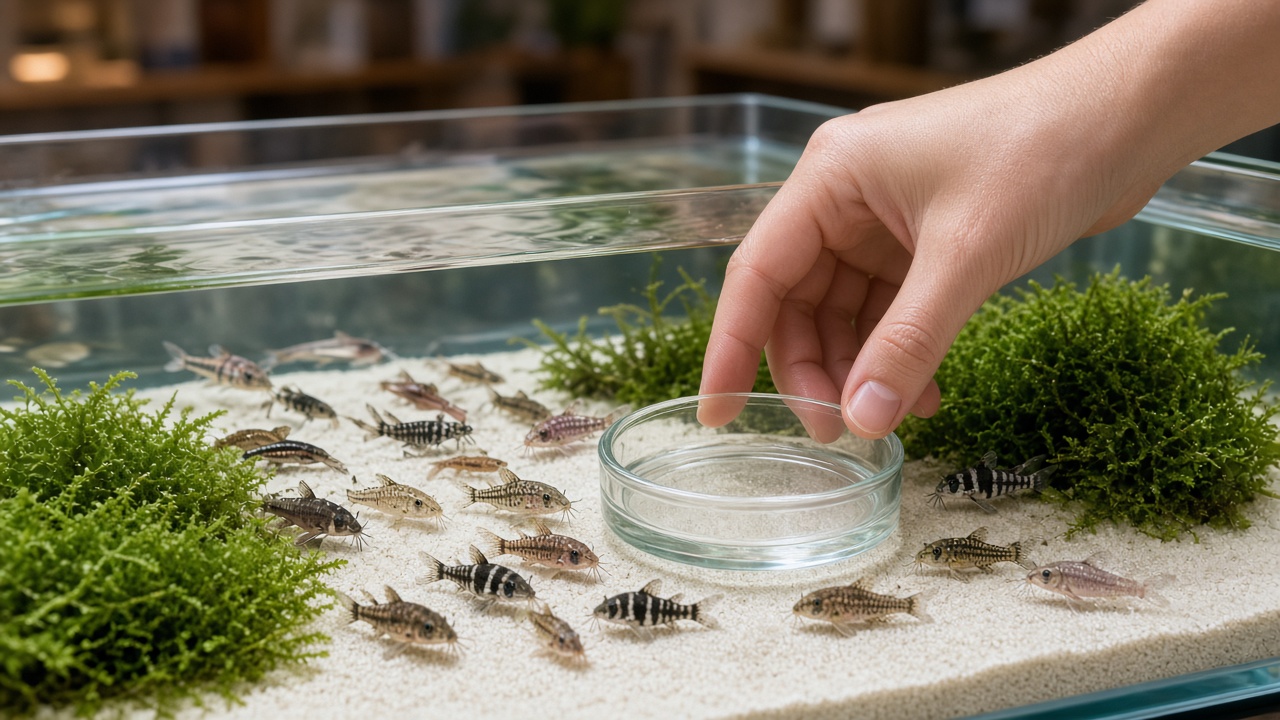
Quick answer: Use a sinking wafer or sinking pellet as the daily staple. Choose a piece small enough for the fish to gulp. Do not rely on floating flakes as the only food.
Corydoras catfish food must sink; a wafer or pellet that reaches the substrate is the staple.
This page compares five sinking-food labels;
Corydoras forage on the tank floor while midwater fish often take floating food first. A sinking staple is the ration that actually reaches them. Our research team analyzed maker pages plus one university label guide, then compared listed protein, size, and feed windows.
The selection rule we used
We covered a food only when the maker page listed a sinking format and a guaranteed analysis.
That rule is the Sink-Size-Protein check, and a food had to pass every gate below.
- The maker page calls the food sinking, or lists negative buoyancy.
- The page publishes a guaranteed analysis with crude protein.
- The food is sold now as a wafer, granule, or pellet, not a flake.
We left out floating flakes, frozen packs, and pleco sticks with no small-mouth size. We also left out any brand whose maker page
The five foods that met the rule are Hikari Sinking Wafers, Fluval Bug Bites Bottom Feeder Granules, and Tetra Wafer Mix. Omega One Catfish Pellets Sinking and New Life Spectrum Regular Pellet also met it.
If a maker page skipped a millimeter size, we still included the food, marked the size as not listed, and did not guess a diameter.
Top 7 Corydoras catfish food
The picks below are the 7 corydoras catfish foods on sale right now, listed with what each suits best and an honest drawback. Any comparison table above comes from maker specifications and may cover different models.
1. Fluval Bug Bites Bottom Feeder Fish Food
Best for: Insect-diet keepers on a budget
Fluval’s Bug Bites line is an insect-based sinking food sold for bottom feeders. Maker pages list black soldier fly larvae as the lead protein, which matches how wild corydoras forage. Owners say the bits reach the sand before midwater fish steal the meal.
Pros: Insect-based sinking formula; Low everyday tub price Cons: Small tub needs rebuying
2. Ultra Fresh Bottom Feeder Fish Food
Best for: Picky corys that refuse dry wafers
Ultra Fresh markets this as a bottom-feeder diet for corydoras, loaches, and similar grazers. Published copy leans on prawn and squid in a soft pie that sinks and holds together. Owners of fussy groups say the seafood smell pulls fish that ignore dry wafers.
Pros: Prawn-forward sinking pies; Aimed at corydoras Cons: Pricier than basic pellets
3. Hikari® Sinking Wafers® for Bottom-Feeding Tropical Fish
Best for: Everyday community corydoras tanks
Hikari developed these sinking wafers for corydoras, loaches, and other downward-mouthed bottom feeders. The discs drop to the substrate and soften so a school can graze without racing midwater flakes. Owners treat this as the everyday cory staple and pull leftovers before they sit.
Pros: Cory-specific sinking wafers; Soft disc for grazing Cons: Midrange single-pack price
4. API BOTTOM FEEDER PELLETS WITH SQUID Fish Food 1.3-Ounce Container
Best for: First-time keepers buying a trial tub
API’s 1.3-ounce tub is a small, cheap entry into sinking bottom-feeder pellets. The label calls out squid, and the maker lists the food for catfish, plecos, and loaches. Owners use it as a starter more than a bulk staple because the container empties fast.
Pros: Lowest listed price; Tiny trial-size tub Cons: Runs out very quickly
5. Aqueon Shrimp Pellets Sinking Food for Tropical Fish
Best for: Mixed tropical tanks with corys
Aqueon sells these as sinking shrimp pellets for tropical fish, not a cory-only formula. The pellets drop to the sand where corydoras can find them after flakes get eaten upstairs. Owners like the familiar pet-store brand but note midwater fish will steal pellets dumped in one spot.
Pros: Familiar sinking shrimp pellets; Midrange pet-store price Cons: Not a cory-only formula
6. BugGraze Bottom Dweller Feast 3-in-1 Sinking Pellets
Best for: Tanks mixing corys, loaches, and plecos
BugGraze’s 3-in-1 mix combines sinking pellets, wafers, and granules in one pouch. That spread of shapes is aimed at mixed bottom crews so smaller corys and larger plecos can each find a piece. Owners like the one-bag convenience; the $11.49 tag is the premium single pouch on this list.
Pros: Three sinking food forms; Suits mixed bottom crews Cons: Highest single-pouch price
7. Hikari Tropical Sinking Wafers 3.88oz 2-Pack
Best for: Multi-tank keepers stocking wafers in bulk
This is the same Hikari sinking wafer diet sold as a 3.88-ounce two-pack. The larger boxes suit keepers who run a full cory school or more than one tank. Owners buy the twin pack to stop running out of the single tub, and they pay $17.04 up front for that extra volume.
Pros: Two large wafer boxes; Better for big schools Cons: Highest upfront spend
Comparison: Corydoras catfish food at a Glance
Want to browse every option? See the full range of corydoras catfish food on Amazon →
Why the food has to sink
Corydoras gulp food from the substrate with downward-facing mouths, so a floating flake stays in the wrong place.
Hikari Sales USA states that Sinking Wafers were developed for corydoras catfish and other bottom feeders. The same page calls the food a soft disc for fish that gulp, which matches how these fish feed.
Fluval’s Bottom Feeder page lists a sinking granule of 1.4–2.0 mm and calls that format ideal for bottom feeders. New Life Spectrum’s page lists negative buoyancy, and most of those pellets sink.
University of Florida IFAS explains a second reason to read the label. Pellet size and density decide whether fish can ingest the food, and mouth gape is the wrong test.
A community tank makes the sink rule stricter. Small tetras and rasboras take food at midwater, and a betta takes food at the surface.
The corydoras group still needs a separate sinking ration. For the surface-feeding side of a mixed tank, see our best food for betta fish guide.
What the labels actually list
Listed crude protein on these five foods runs from 32 percent to 51 percent.
University of Florida IFAS says a typical aquarium feed holds 35 percent to 50 percent protein, with moisture near 10 percent. Our spec comparison put four of the five foods inside that protein band. Fluval Bug Bites Bottom Feeder lists 32.0 percent minimum protein, which sits 3 points below the IFAS band.
Here is the protein each maker page lists:
- Fluval Bug Bites Bottom Feeder Granules: 32.0 percent minimum
- Hikari Sinking Wafers: 36.0 percent minimum
- New Life Spectrum Regular Pellet: 37 percent minimum
- Omega One Catfish Pellets Sinking: 38 percent minimum
- Tetra Wafer Mix: 51 percent
University of Florida IFAS also says guaranteed-analysis profiles follow National Research Council work on farmed catfish and salmonids. The page does not give a corydoras-only nutrient standard. Treat the 35–50 percent band as a label check, not a species law.
Fat and fiber also differ across the set. Fluval lists 12.0 percent minimum fat, the highest fat number here, while Hikari lists 9.0 percent and Omega One lists 10 percent. Tetra and New Life Spectrum both list 8 percent minimum fat.
University of Florida IFAS says feeds with fiber above 8 percent have low feeding value. None of the five pages lists a fiber maximum above 7 percent.
- Hikari: 4.0 percent maximum fiber
- Tetra: 2 percent fiber
- Omega One: 2.0 percent maximum fiber
- Fluval: 6.0 percent maximum fiber
- New Life Spectrum: 7 percent maximum fiber
Moisture on all five pages sits between 8 percent and 10 percent. That matches the IFAS aquarium-feed figure of about 10 percent.
Five sinking foods compared
These five foods are current retail formulas, and the columns are maker-listed attributes only.
| Product | Format and listed size | Crude protein (min) | Crude fat (min) | Crude fiber (max) | Moisture (max) |
|---|---|---|---|---|---|
| Hikari Sinking Wafers | Soft wafer, 6.5–7.5 mm | 36.0% | 9.0% | 4.0% | 10.0% |
| Fluval Bug Bites Bottom Feeder Granules | Sinking granule, 1.4–2.0 mm | 32.0% | 12.0% | 6.0% | 10.0% |
| Tetra Wafer Mix | Sinking wafer; mm size not listed | 51% | 8% | 2% | 8% |
| Omega One Catfish Pellets Sinking | Sinking pellet; mm size not listed | 38% | 10% | 2.0% | 8.5% |
| New Life Spectrum Regular Pellet | Sinking pellet, 1–1.5 mm | 37% | 8% | 7% | 10% |
Hikari Sales USA names corydoras catfish on the Sinking Wafers page and lists a 6.5–7.5 mm wafer. The analysis also lists 0.8 percent minimum phosphorus and 8,800 IU/kg minimum vitamin A. Packages on that page run from 25 g to 1 kg.
Fluval lists black soldier fly larvae as the first ingredient and says the formula contains up to 40 percent of those larvae. The 45 g pack is the S-M granule, and Fluval also lists 1.50 percent minimum calcium plus 2,500 IU/kg minimum vitamin A.
Tetra’s Wafer Mix page lists shrimp meal at 3.7 percent and spirulina at 1.7 percent. The same page lists vitamin D3 at 2,047 IU/kg.
Omega One’s Catfish Pellets page lists salmon, whole herring, and whole shrimp near the top of the ingredient list. The analysis lists 8 percent maximum ash, and the page does not publish a pellet diameter.
New Life Spectrum lists regular pellets at 1 mm to 1.5 mm. The page also lists 10,000 IU/kg minimum vitamin A and 600 IU/kg minimum ascorbic acid.
Match the piece size to the fish
Use the listed millimeter size, not the front-of-pack photo.
Among foods that publish a size, the span is 1.0 mm to 7.5 mm. New Life Spectrum Regular Pellet sits at 1–1.5 mm, and Fluval sits at 1.4–2.0 mm. Hikari Sinking Wafers sit at 6.5–7.5 mm.
Use this size split:
- Pygmy, habrosus, and hastatus groups: choose a listed granule or pellet at or under 2.0 mm.
- Bronze, panda, and similar medium corydoras: a 6.5–7.5 mm wafer can work if the fish can break it.
- Mixed tanks with both sizes: feed the small granule first, then add a wafer only if larger fish still miss food.
Tetra and Omega One do not list a millimeter size on the pages we read. If you cannot see the piece in the store, pick a food that prints the size.
Our editorial team says the disc is a smaller size for common community tanks. Fluval says a few granules spread food better than one large tablet. Both notes point the same way: small pieces reach more fish.
University of Florida IFAS says to choose pellet size by how easily the fish can ingest it. Do not choose by how wide the mouth can open.
How to feed without leftover waste
Follow the maker’s listed time window, then remove what remains.
The listed windows in this set are not the same.
- Fluval: feed what fish eat in two minutes, two or three times daily.
- Hikari: feed what fish eat in 20 minutes, then remove leftovers.
- Fluval also says an opened tub should be used within 6 months.
University of Florida IFAS says dry pellets usually hold about 13 percent moisture or less. The same page says those feeds can sit at room temperature for at least 90 days from manufacture. After opening, Fluval’s 6-month window is the stricter day-to-day rule in this set.
A practical routine looks like this:
- Turn the filter flow down for a few minutes so food is not blown away.
- Drop the sinking food in two or three spots on the sand or gravel.
- Watch the clock against the maker window. Two minutes for Fluval. Twenty minutes for Hikari.
- Siphon pieces that still sit after that window.
- Repeat two or three small meals rather than one large dump.
Do not feed by “a pinch per fish,” because that pinch is not on any of these labels. The time window is the rule the makers printed.
If midwater fish steal wafers as they fall, feed those fish first with their own staple. Then add the sinking food so corydoras are not waiting on scraps.
Mistakes that leave corydoras hungry
The common failure is a floating-only diet in a crowded community tank.
Floating flakes can feed the fish that swim up, but they do not replace a sinking staple. Leftover flakes also break apart and foul the water. University of Florida IFAS ties poor feed management to worse water quality.
The second failure is an oversized piece. A 6.5–7.5 mm Hikari wafer is a gulp item for a medium corydoras, and it is a large object for a pygmy. If the wafer still sits after the listed window, the piece was too big or the portion was too high.
The third failure is treating one label number as a rank. Tetra lists 51 percent protein, while Fluval lists 32.0 percent protein and 12.0 percent fat. Those are different formulas, not a scoreboard.
The fourth failure is mixing ash figures that are not the same test. Omega One lists 8 percent maximum ash and Fluval lists 9.0 percent, while Hikari lists 16.0 percent as an as-fed maximum. University of Florida IFAS says normal ash often falls between 7 percent and 12 percent on a dry-matter basis.
Keep the check simple:
- The food sinks.
- The listed piece fits the fish.
- The listed protein sits near the IFAS 35–50 percent band, unless you have a reason to pick outside it.
FAQ
Can corydoras live on floating flakes alone?
No. Floating flakes stay off the substrate, and corydoras gulp food on the floor. Flakes can be a rare extra, but they are not the daily staple.
How often should I feed corydoras catfish?
Fluval’s Bottom Feeder page says two or three times daily, in amounts eaten in two minutes. Hikari’s Sinking Wafers page says to feed what they finish in 20 minutes, then remove leftovers. Use the label that matches the bag you bought.
What should pygmy corydoras eat?
Choose a listed sinking granule or pellet at or under 2.0 mm. Fluval Bug Bites Bottom Feeder lists 1.4–2.0 mm, and New Life Spectrum Regular Pellet lists 1–1.5 mm. A 6.5–7.5 mm wafer is the wrong starting size for that mouth.
Is a high protein number always the better food?
No. Tetra Wafer Mix lists 51 percent protein, and University of Florida IFAS puts typical aquarium feeds at 35 percent to 50 percent protein. A number inside that band is a label check, not a rank.
Do I need a shrimp pellet or an insect granule?
Either can be a staple if it sinks and fits the mouth. Omega One lists whole shrimp, Fluval lists black soldier fly larvae at up to 40 percent, and Hikari lists fish meal with silkworm pupae. Do not stack three full portions in one feeding.
How long can I leave a wafer on the substrate?
Leave it only for the maker’s window: Hikari says 20 minutes, then remove leftovers, and Fluval’s granule window is two minutes. Food that sits past the window becomes waste and can cloud water.
Can I use the same food for a betta and for corydoras?
Not as the only food, because a betta eats at the surface and corydoras eat on the floor. Feed the betta a surface staple, then add a sinking food. Our best food for betta fish guide covers that surface side.