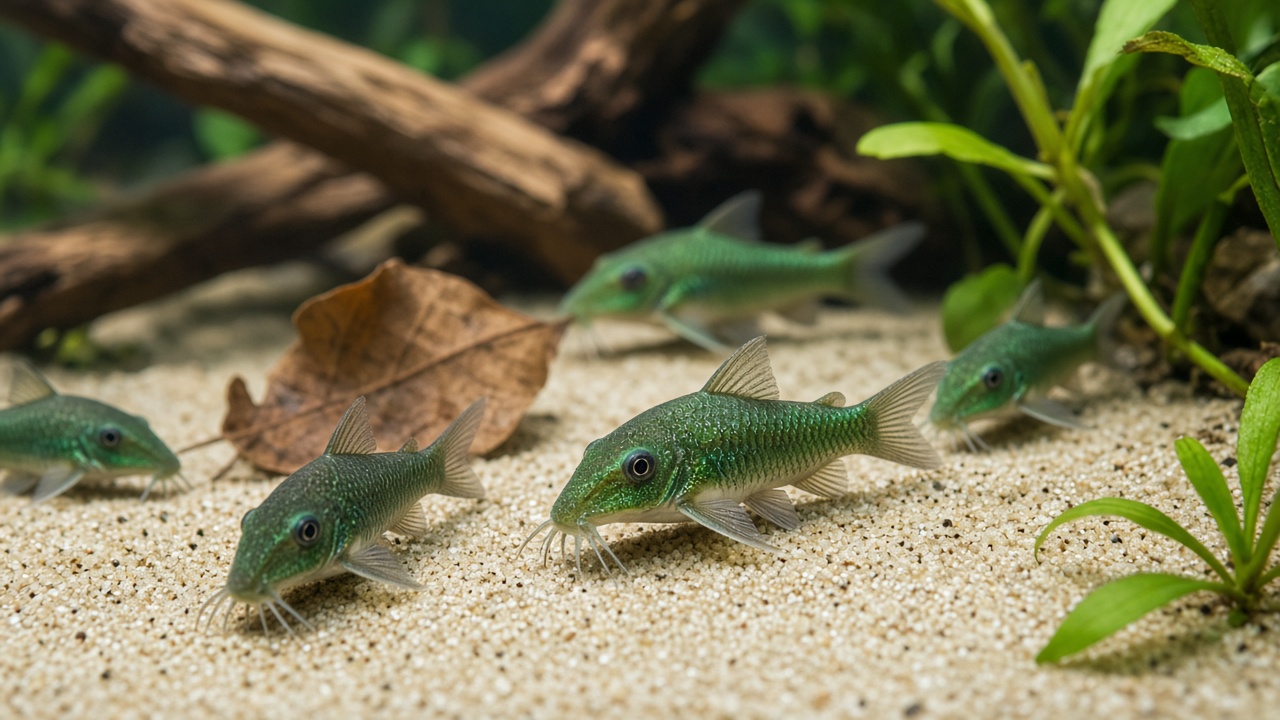
Quick answer: Keep emerald cory catfish in a school of six to eight on a 48-by-18-inch tank floor. Feed sinking wafers that reach the sand. Do not treat them as leftover cleaners.
Emerald cory catfish reach 3.1 inches standard length and need six to eight fish on a 48-by-18-inch floor. This page is a desk comparison of published specs, and
We included one species profile we read in full, plus products with a listed protein percent, milliliter dose, or test count.
That is the selection rule for this guide. A page without a number we could quote stayed out.
We used Seriously Fish’s Corydoras splendens profile for size, school, tank floor, and water ranges. We used maker pages from Hikari, Seachem, and API Fishcare for food, conditioner, and tests.
We left out heaters, décor, gravel brands, and any food without a published guaranteed analysis. We also left out store blogs and care pages
Our research team analyzed three Hikari maker pages side by side. Listed crude protein on those pages runs from 33% to 44%. That 11-point spread is a label comparison, not a feeding trial.
What an emerald cory is and how large it gets
Seriously Fish lists adult emerald cory catfish at 80 mm standard length, which is 3.1 inches.
The fish on that page is Corydoras splendens. Shops still sell it as emerald cory, emerald brochis, or common brochis.
Seriously Fish notes the species once sat in Brochis and cites Britto 2003 for the move into Corydoras. The Brochis name still shows up on bags.
This is a larger armored catfish, not a two-inch bronze cory. Standard length stops at the tail base, so total length with the tail is a bit longer.
Seriously Fish separates it from other former Brochis species by fin rays. C. splendens has 10 to 12 dorsal-fin rays.
Compare those counts on the same profile:
- C. splendens: 10 to 12 dorsal-fin rays
- C. britskii: 15 to 18 rays, usually 15
- C. multiradiatus: usually 17 to 18 rays
- Other Corydoras, plus Aspidoras and Scleromystax: 6 to 8 rays
Juveniles on that page look mottled, and dealers sometimes sell those young fish as hi-fin corys. Adult females grow a bit larger, and Seriously Fish says they look rounder and higher-bodied than males.
The type locality on that profile is the Rio Tocantins in Brazil. The same page records the fish in Brazil, Peru, Ecuador, and Colombia, in still waters such as backwaters and oxbows.
These catfish gulp air. Seriously Fish calls them facultative air breathers with a modified intestine, so a trip to the surface for air is normal.
School size and tank footprint
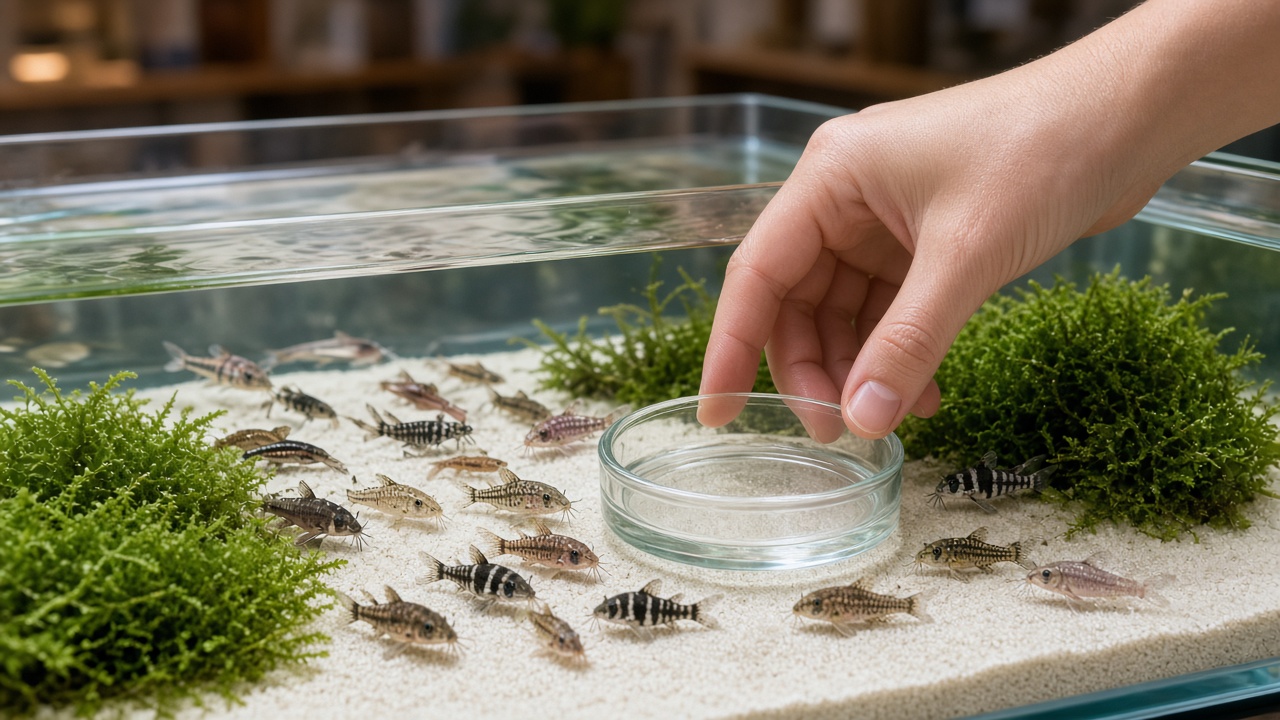
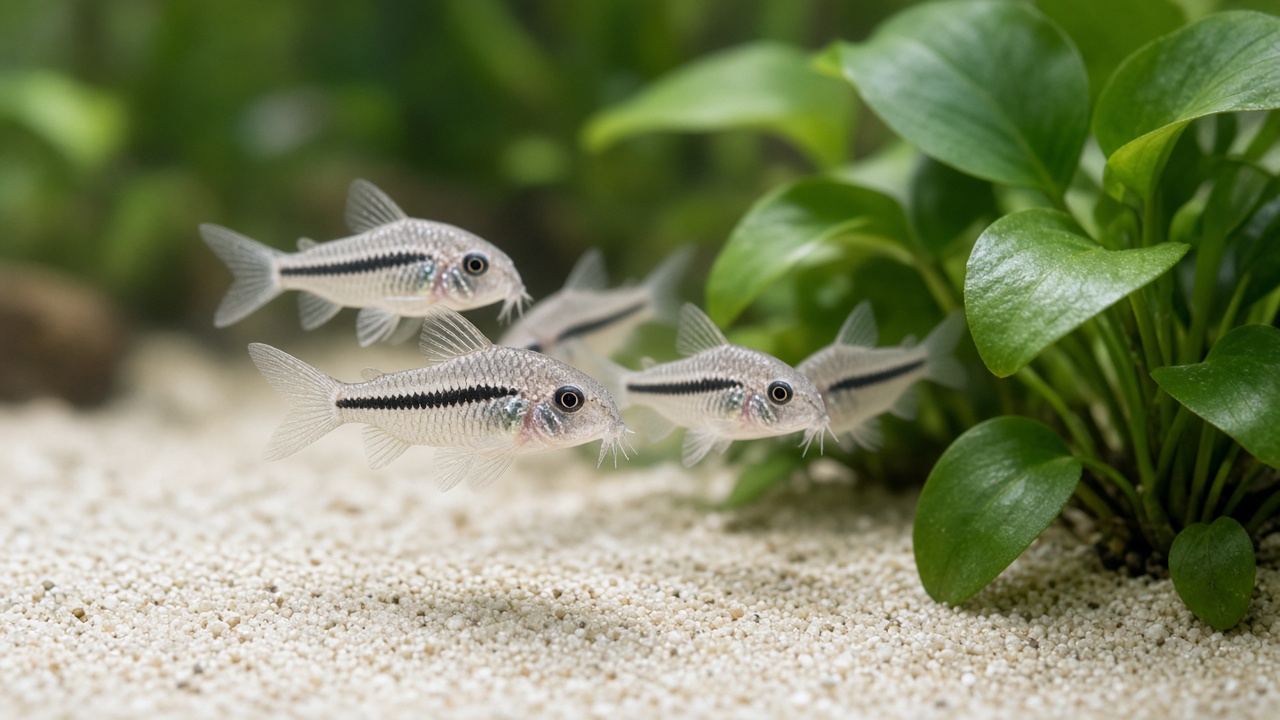
Seriously Fish says keep this species in a group of at least 6 to 8 fish.
A pair is not a school, and one fish used as a cleaner sits outside that rule.
The same profile sets a minimum tank base of 120 by 45 cm. That is 48 by 18 inches, or an equal floor.
Seriously Fish converts that box to about 243 liters, or about 64 US gallons. Floor area is the constraint, not a tall nano cube.
Our research team compared that published floor to common short tanks. A 48-by-18-inch base is a long community footprint, not a 10-gallon starter kit.
Use this checklist when you shop for a tank:
- School: 6 to 8 emerald corys, not one or two
- Floor: at least 48 by 18 inches, or the same area
- Volume on that profile: about 64 US gallons
- Shape: long and open on the bottom, not tall and narrow
They forage on the sand all day, so a short wide tank gives them room to walk. A tall tank wastes space they rarely use.
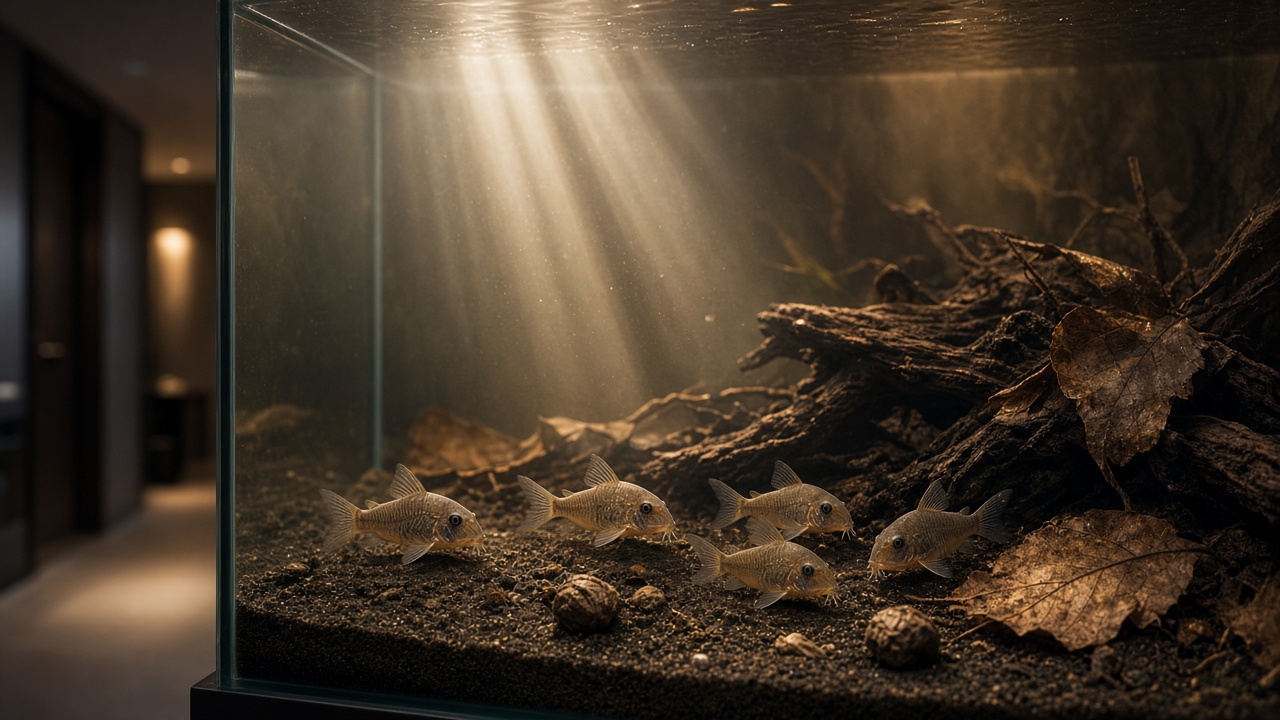
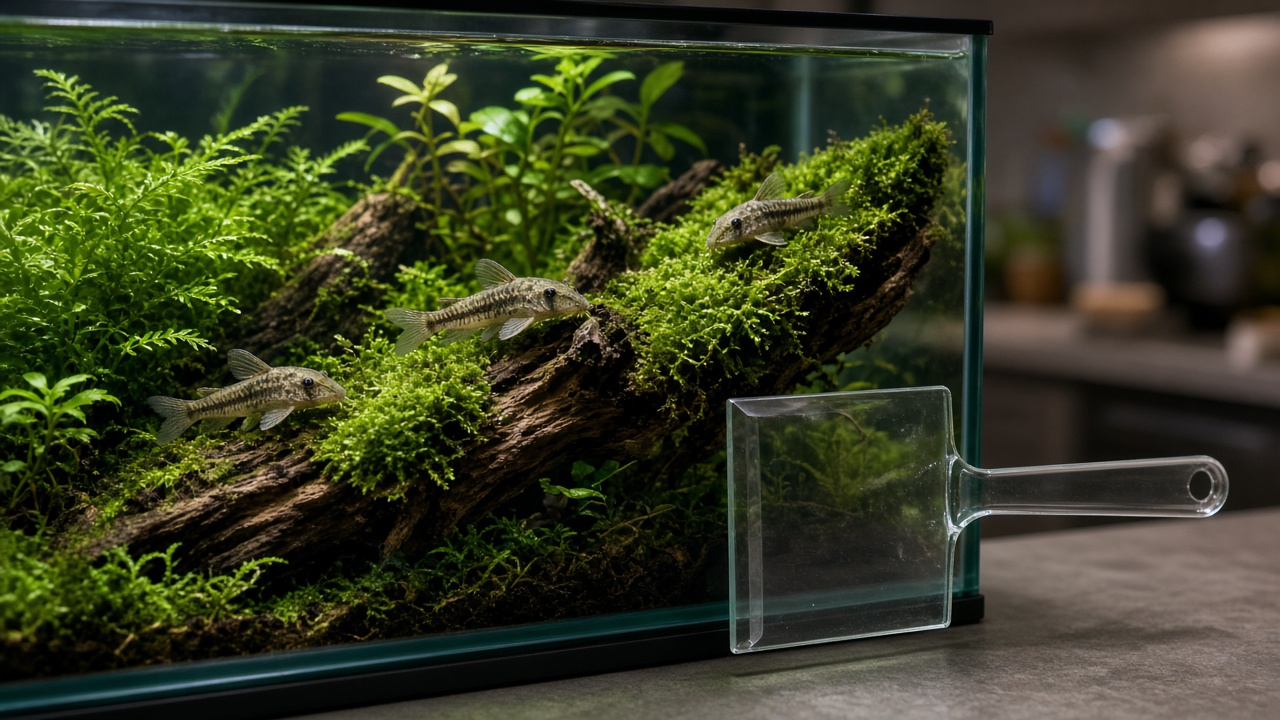
Cover still matters. Seriously Fish says décor is personal choice, but some cover should be present so the school can settle.
Fine sand is the first substrate on that profile. Rounded gravel is listed as a backup if you keep it very clean.
Do not use sharp gravel, because barbels rake the bed for food. Grit that cuts those barbels is a setup error, not a style choice.
If you already keep a smaller warm-water cory, read our Sterbai cory care guide next. Sterbai corys stay smaller and often share warmer community tanks, while emerald corys need the larger floor listed above.
Water ranges from the species profile
Seriously Fish lists a wide water window: 68 to 82°F, pH 5.0 to 8.0, and hardness of 2 to 15 dGH.
Those are published ranges, not a single target. Stay inside the window and avoid big overnight swings.
The high end of that 68 to 82°F band is warm, and warm water holds less oxygen. Leave a quiet surface so they can gulp air.
API Fishcare’s page for the Freshwater Master Test Kit says test weekly. That page says the kit measures six aquarium levels and names these checks:
- Ammonia
- pH
- High-range pH
- Nitrite
- Nitrate
The same API page says a pH of 7.0 is neutral. Values above 7.0 are alkaline, and values below 7.0 are acidic. The kit ships with four test tubes, a holding tray, and a laminated color card.
Seachem’s Prime page is the conditioner we used for new-water math. The listed dose is 1 capful, which is 5 mL, for each 50 US gallons of new water.
Dose notes from Seachem’s page:
- Each cap thread is about 1 mL
- Add it to new water first when you can
- The bind can last up to 48 hours
- If ammonia or nitrite is above 2 ppm, the page allows up to 5 times the listed dose
- If water is above 86°F and chlorine or ammonia is low, use a half dose
For the 64-gallon volume on the species profile, the listed 5 mL per 50 gallons scales to about 6.4 mL of Prime on new water. Measure that and do not guess from the bottle.
Diet: sinking foods with maker-listed numbers
Seriously Fish calls Corydoras foraging omnivores that need sinking food, not leftover scraps. They take most sinking dried foods, plus small live or frozen items such as bloodworm and Tubifex.
The same profile is blunt on leftovers. Do not expect them to live on scraps, and do not use them to clean the tank.
Hikari’s page for Tropical Sinking Wafers names Corydoras catfish as a daily-diet fish. That is the staple we used for this desk comparison.
Hikari’s guaranteed analysis on that wafer is:
- Crude protein: min. 36%
- Crude fat: min. 9.0%
- Crude fiber: max. 4.0%
- Moisture: max. 10%
- Ash: max. 16%
- Phosphorus: min. 0.8%
Hikari’s feeding line on that page is a 20-minute window. Feed only what they finish in 20 minutes, then remove leftovers after that window.
Hikari’s Tropical Algae Wafers page lists a lower-protein disc aimed at plecos and other algae eaters. It also calls the disc a treat for omnivorous fish.
Hikari’s guaranteed analysis on Algae Wafers is:
- Crude protein: min. 33%
- Crude fat: min. 4.0%
- Crude fiber: max. 3.0%
- Moisture: max. 10%
- Ash: max. 17%
- Phosphorus: min. 0.8%
Hikari’s feeding window on that disc is 2 hours. The page says many bottom feeders feed at night, so feed late in the day if you use this as a treat.
Hikari’s Tropical Micro Wafers page lists the highest protein of the three foods. The wafer floats, then sinks, and the page names catfishes among the daily-diet fish.
Hikari’s guaranteed analysis on Micro Wafers is:
- Crude protein: min. 44%
- Crude fat: min. 8%
- Crude fiber: max. 2%
- Moisture: max. 10%
- Ash: max. 13%
- Phosphorus: min. 1%
Hikari’s feeding line on that page is two to three times daily. Feed only what fish finish in a few minutes.
Our research team lined up those three protein figures. Algae Wafers list 33%, Sinking Wafers list 36%, and Micro Wafers list 44%.
Use the sinking wafer as the daily food. Use the algae disc as a slow treat, and use the micro wafer only if midwater fish will not steal it all.
A simple feeding plan that stays inside those maker windows:
- Drop Hikari Tropical Sinking Wafers on the sand once or twice a day.
- Watch the 20-minute window on Hikari’s page, then siphon crumbs after that.
- Offer Hikari Tropical Algae Wafers on some nights as a 2-hour treat.
- Add a small frozen item, such as bloodworm, a few times a week.
- Skip flake-only feeding, because flakes often never reach the school.
| Product | Form | Maker-listed protein or dose | Maker-listed fat, extras, or count | Maker-stated use window |
|---|---|---|---|---|
| Hikari Tropical Sinking Wafers | Soft sinking wafer | min. 36% crude protein | min. 9.0% crude fat | Finish in 20 minutes |
| Hikari Tropical Algae Wafers | Sinking disc | min. 33% crude protein | min. 4.0% crude fat | Finish within 2 hours |
| Hikari Tropical Micro Wafers | Float-then-sink wafer | min. 44% crude protein | min. 8% crude fat | 2 to 3 times daily |
| Seachem Prime | Liquid conditioner | 5 mL per 50 US gallons | Bind listed up to 48 hours | New water or tank volume |
| API Freshwater Master Test Kit | Liquid test kit | 6 aquarium levels on the page | 4 test tubes | Test weekly |
Tankmates and what not to mix
Seriously Fish calls the species peaceful and gregarious, so keep it with other calm fish. It belongs in a community tank, not under large cichlids.
Good matches are small tetras, rasboras, and other midwater fish that stay out of the sand. Poor matches are large cichlids that eat bottom fish, or loaches that hog every wafer.
Do not stock one emerald cory under a crowd of goldfish or oscars. The school rule still applies even in a big tank.
Do not mix them with other large bottom fish that need the same 48-inch floor unless the tank is much longer. Two bottom schools on one short floor will fight for wafers.
They are not a janitor crew. Seriously Fish says they must not be used as tank cleaners, so feed them on purpose.
Eggs on the species profile are laid close to the water surface. This page does not cover a breeding program.
FAQ
How big do emerald cory catfish get?
Seriously Fish lists 80 mm standard length, or 3.1 inches. That is the body without the full tail. Females grow a bit larger and look rounder.
How many emerald corys should live together?
Seriously Fish says a group of at least 6 to 8. That is the school size we used for every tank note on this page. One or two fish do not meet that rule.
What tank size do emerald cory catfish need?
Seriously Fish lists a 120 by 45 cm base, which is 48 by 18 inches. The same profile lists about 243 liters, or about 64 US gallons. Buy length first.
What water temperature and pH do they accept?
Seriously Fish lists 68 to 82°F and pH 5.0 to 8.0. Hardness on that page is 2 to 15 dGH. Pick a stable point inside those ranges and test weekly.
What should I feed emerald cory catfish?
Use a sinking staple. Hikari’s Tropical Sinking Wafers page lists min. 36% crude protein and a 20-minute feed window. Add a varied item such as bloodworm.
Can I keep one emerald cory to clean the gravel?
No. Seriously Fish says keep 6 to 8 and never rely on leftovers. One fish on gravel is two errors at once, so use fine sand and feed wafers on the bed.
Do they need a bubbler if they gulp air?
A surface gulp is normal. Seriously Fish describes a modified intestine that takes air. Still keep the 68 to 82°F range and an open surface.