Quick answer: Buy a named freshwater cory, not a mixed bag, and keep one type together. Bronze, peppered, and sterbai are the three names U.S. shops stock most often. Match the tank’s warmth to that type before you add fish.
Eschmeyer’s Catalog lists 214 valid Corydoradinae species; this page covers 12 sold for home tanks. This page is a species map from bag labels, and we did not catch wild fish, run tank trials, or open clinic files.
This is our selection rule: a type enters this article only if U.S. shops sell it under a stable common name for freshwater home tanks. We left out C-numbers, CW-numbers, brackish catfish, and one-off imports with no bag name.
Foods follow a second cut of that same shop-name rule. We included a product only if the maker page is live and names catfish, bottom feeders, or all freshwater fish. Frozen packs and foods with no listed size stay out.
What “cory” means on a shop bag
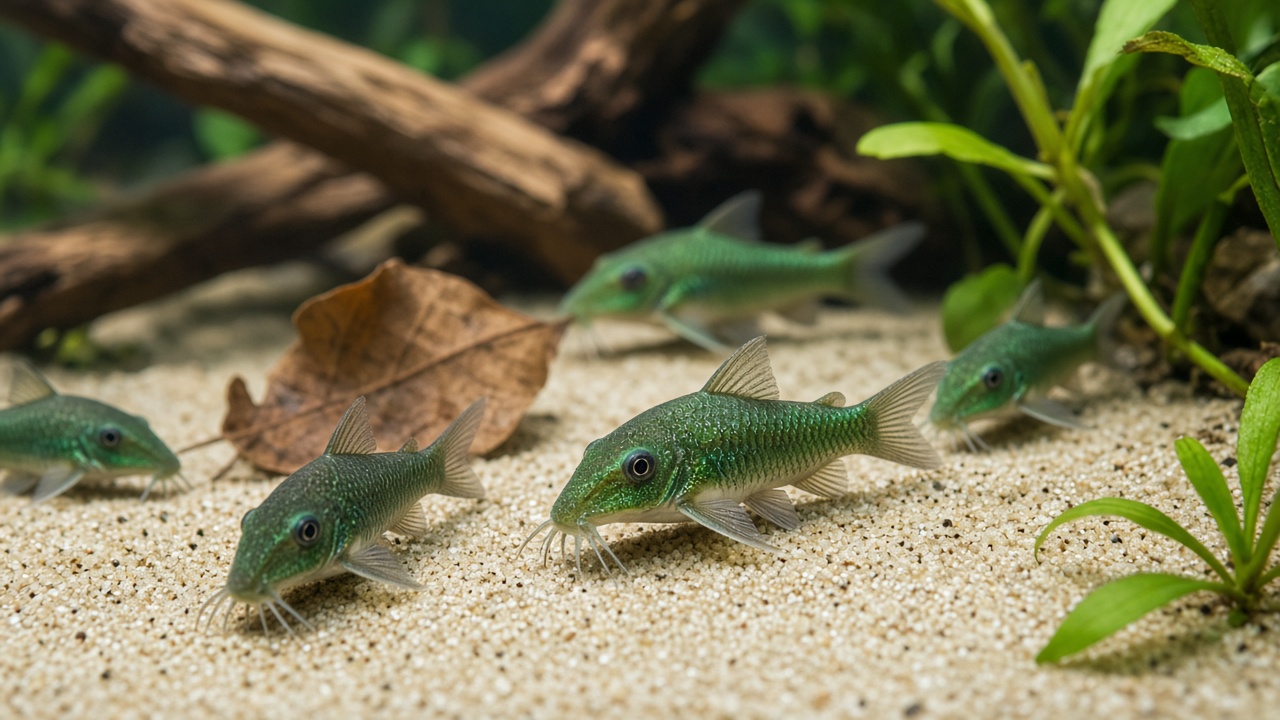
A cory on a bag is a small South American armored catfish sold for freshwater tanks.
Eschmeyer’s Catalog of Fishes, posted by the California Academy of Sciences, is the count we used. That family table, current through 2026, lists 214 valid species in Corydoradinae and 7 valid genera in that subfamily.
The same table lists 259 available species-group names in Corydoradinae. Available names include synonyms, so 214 is the valid count. The table notes 23 Corydoradinae species named in the last ten years, 2017–2026.
The Academy’s same summary, dated 13 August 2026, lists 19,343 valid freshwater fish species in total. Our 12 types are a shop slice of that subfamily, not a full catalog.
Bag labels still print “Corydoras” on almost every cup. The Catalog now splits the old pile across those 7 genera, and we keep the shop names so you can match a lid sticker.
Our research team compared those Catalog counts with bag names, not with wild lots, and we did not rename fish at the shop.
The 12 types this page covers
These 12 names are the ones a U.S. shop can usually order as a labeled group.
Use the shop-name rule above, and skip the bag if it has no species name.
Everyday community types:
- Bronze cory, sold as Corydoras aeneus, including the albino form of the same type
- Peppered cory, sold as Corydoras paleatus
- Sterbai cory, sold as Corydoras sterbai
Smaller types shops sell as “dwarf” or “panda”:
- Panda cory, sold as Corydoras panda
- Pygmy cory, sold as Corydoras pygmaeus
- Habrosus cory, sold as Corydoras habrosus, also called salt-and-pepper
- Tail-spot cory, sold as Corydoras hastatus
Pattern types that shops mix up:
- Three-line cory, sold as Corydoras trilineatus, often called false julii
- Julii cory, sold as Corydoras julii
Larger or warmer types:
- Emerald cory, sold as Brochis splendens or Corydoras splendens
- Adolfoi cory, sold as Corydoras adolfoi
- Venezuelan orange cory, sold as Corydoras venezuelanus
Bronze and peppered are the default starter names. They show up in mixed community tanks and tolerate a wide shop-water range.
Sterbai is the warm-water pick among these 12 shop names. Read our Sterbai cory care page when the tank already runs warm for discus or angels.
Panda, pygmy, habrosus, and tail-spot stay smaller than bronze. They need a calm sand bed and food that is small enough to gulp.
Three-line and julii look alike on a bad photo. Three-line fish have stripes that break into a net, and true julii bags are less common.
Ask the shop to print the scientific name on the bag lid.
Emerald corys are deeper-bodied than bronze and need more open sand. Adolfoi shows a pale blaze and a dark shoulder blotch. Venezuelan orange corys are an aeneus-group fish with more orange on the flanks.
We did not assign adult lengths here, because none of our six source pages publish a length for each of these 12 names.
Tank setup that fits all 12
Sand, a group of one named type, and food that hits the bottom are the three setup rules.
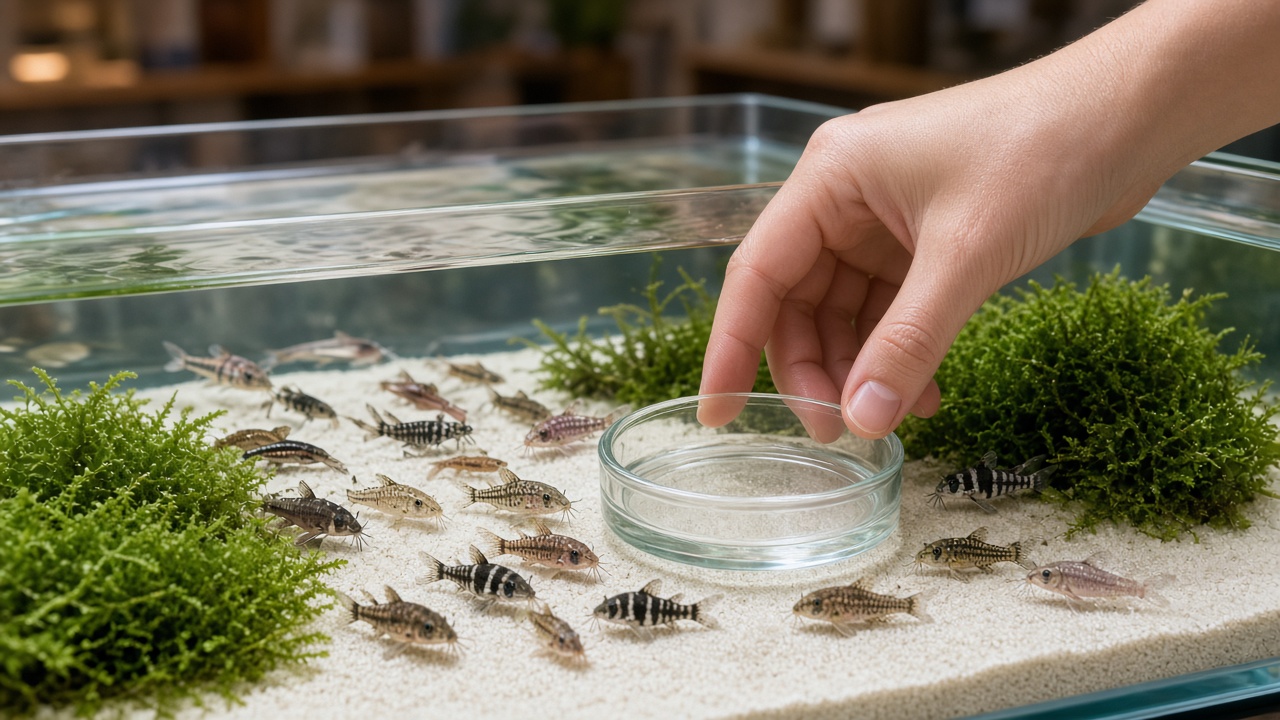
Corys sift with barbels, and sharp gravel cuts those barbels. Use smooth sand or rounded grains, not crushed rock.
Keep one named type together on the same sand bed. Mixed “cory assortments” hide size gaps and temperature gaps. A bronze and a pygmy do not use the tank the same way.
A long footprint beats a tall column for fish that stay on the sand. These fish patrol the sand, not the glass near the lamp.
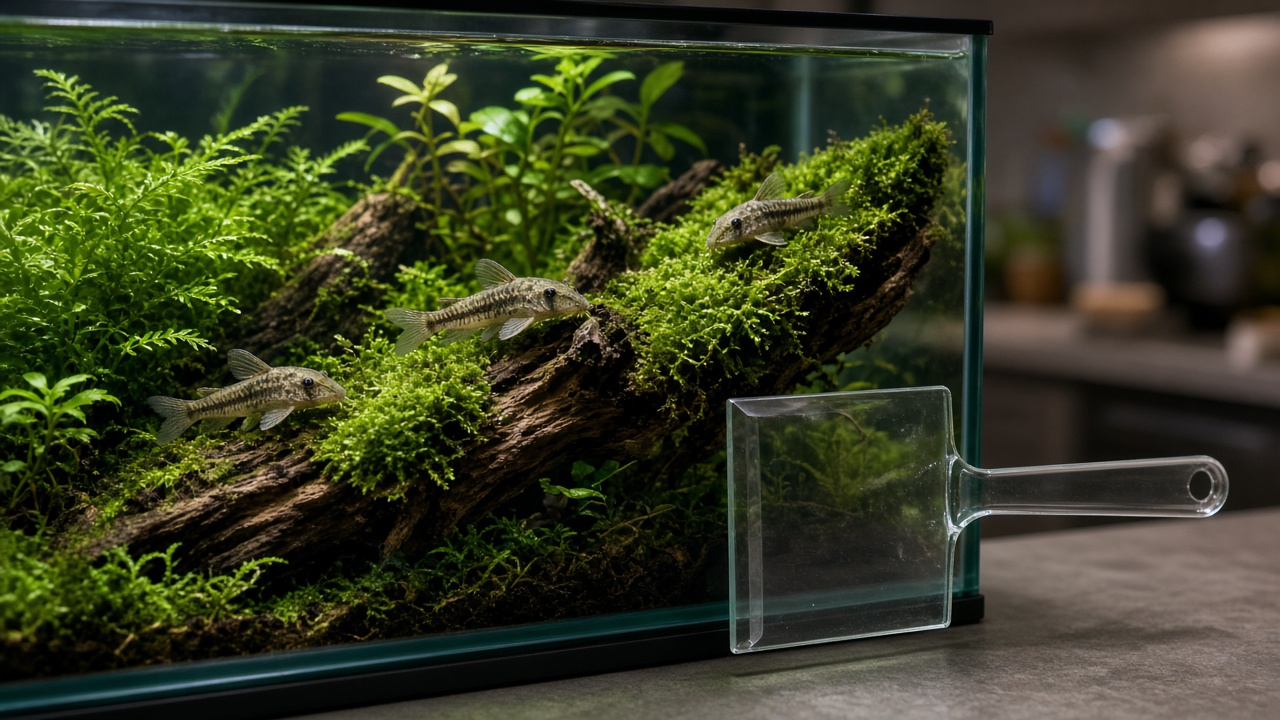
Live moss on wood gives cover without burying the sand. Our moss planted tank guide covers moss that ties onto wood and rock.
Skip these setup choices:
- Bare gravel with sharp edges
- A single cory “for cleanup”
- A hang-on feeder that never reaches the sand
- A brackish mix, which is not a freshwater cory tank
Do not invent a gallon number from this page. Maker food pages do not set tank volume, and the Catalog does not either.
Foods we compared from maker pages
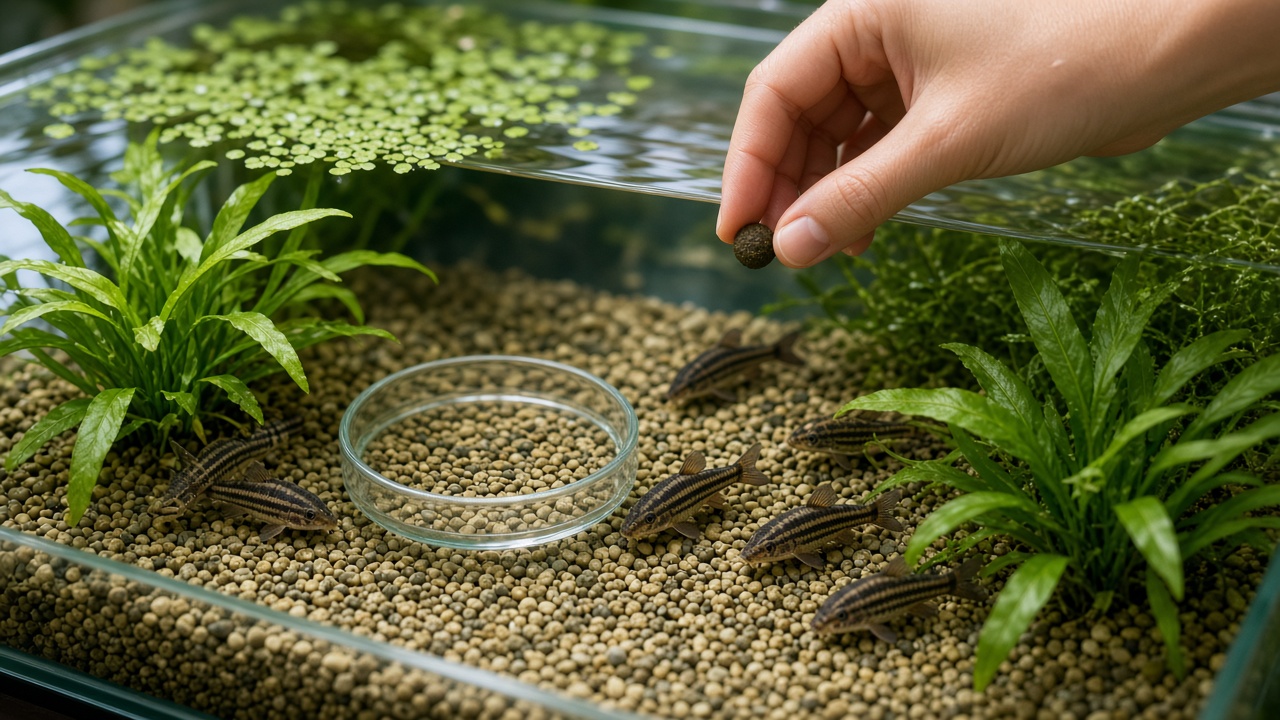
A sinking wafer or pellet should reach the sand before mid-water fish eat it.
Our research team analyzed five currently sold foods on their maker pages. We compared listed form, protein, fat, pack size, and feed window. We did not rank them, and the table is an attribute grid only.
Hikari’s Tropical Sinking Wafers page names Corydoras catfish as a daily-diet use. That page lists the guaranteed analysis below and three pack sizes.
Omega One’s Freshwater Flakes page calls the flakes a daily diet for all freshwater fish. Flakes are not a bottom-only wafer, but some bits still sink, which is why the page is in the table.
Tetra’s PRO Cory Wafers page calls the food a sinking 2-in-1 wafer with shrimp and potato protein. Tetra’s ShrimpWafers page names omnivorous bottom feeders, including catfish, and neither Tetra page lists a protein percent.
API’s Bottom Feeder Pellets with Squid page names catfish, plecostomus, and loaches. API’s page claims the food produces up to 30% less ammonia than leading competitor foods, and that is API’s claim, not our lab result.
| Product | Form | Crude protein (min) | Crude fat (min) | Pack sizes on the maker page | Feed note on the maker page |
|---|---|---|---|---|---|
| Hikari Tropical Sinking Wafers | Soft wafer | 36% | 9.0% | 0.88 oz (25 g), 1.76 oz (50 g), 3.88 oz (110 g) | Eat within 20 minutes |
| Omega One Freshwater Flakes | Flake | 39% | 11% | 0.42 oz, 1 oz, 2.2 oz, 5.3 oz, 5 lbs | Not listed |
| Tetra PRO Cory Wafers | Sinking wafer | Not listed | Not listed | 2.12 oz, 5.29 oz | Not listed |
| Tetra ShrimpWafers | Wafer | Not listed | Not listed | 3 oz | Not listed |
| API Bottom Feeder Pellets with Squid | Sinking pellet | Not listed | Not listed | 1.3 oz, 1.7 oz, 4 oz, 7.9 oz | Twice a day |
Hikari’s page also lists these limits:
- Crude fiber max. 4.0%
- Moisture max. 10%
- Ash max. 16%
- Phosphorus min. 0.8%
Omega One’s page also lists these limits:
- Crude fiber max. 2%
- Moisture max. 8.5%
- Ash max. 8%
API’s product text says to feed only what fish consume within 30 minutes. The same API page’s instructions block says to feed only what fish consume within 3 minutes. Use the shorter window if the two lines conflict.
Feed in this order:
- Kill the bright glare so fish will drop to the sand.
- Drop a sinking wafer or pellet on an open sand patch.
- Watch that mid-water fish do not steal the piece.
- Lift leftover food after the maker’s stated window.
Hikari’s 20-minute window is the longest stated time in this set. API’s instruction block is the shortest, at 3 minutes.
Tank mates that fit, and one that does not
Peaceful freshwater mid-water fish fit a cory tank; brackish gobies do not.
Corys stay on the sand and do not police a betta or eat a snail plague.
Good tank-mate patterns:
- Small tetras, rasboras, or livebearers in a freshwater box
- One named cory type on the sand
- Shrimp and snails if you accept some lost babies
Skip these mixes:
- Large cichlids that eat a cory whole
- Other sand sifters that crowd the same patch
- Any brackish species sold as a goby for mix-and-match tanks
Bumblebee goby care is a different water type. Those gobies are not a freshwater cory partner, so do not add them to the same box.
We did not build a stocking formula, because maker food pages do not list tank-mate counts.
How to buy and stock a group
Buy one labeled type, in one order, from one bag name, and skip mixed cups.
Shops split a school across cups, so ask for the same scientific name on every lid.
Use this buy list:
- Read the scientific name on the bag, not only the common name.
- Reject “assorted cory” cups with no species line.
- Match pygmy and habrosus to a small wafer, not a large disc.
- Match sterbai to a warm tank, not a cool goldfish box.
- Quarantine the new group in a separate box before they share sand.
Bronze, peppered, and sterbai are the three names most shops can fill as a group. Panda and adolfoi show up in waves, and true julii is the name to double-check.
If the shop only has two fish of a rare name, wait. Our rule is a named group, not a pair used as decor.
Look at barbels before you pay, because short, pink, or missing barbels often mean sharp gravel in the last tank. That is a shop-condition check, not a disease name.
FAQ
How many freshwater cory species are there?
Eschmeyer’s Catalog, from the California Academy of Sciences, lists 214 valid species in Corydoradinae. The same table lists 259 available names and 7 valid genera. This page covers 12 types that shops sell for home freshwater tanks, which is a shop slice, not the full Catalog.
Which cory type should a first tank use?
Use bronze or peppered if the shop can sell a labeled group of one name. Use sterbai if the tank already runs warm. Skip pygmy, habrosus, and tail-spot until the sand is fine and the food is small.
Can I mix different cory types in one tank?
You can, but it breaks the shop-name rule we used here. Types differ in size and in the warmth they accept, and a mixed bag also hides mislabeled julii and three-line fish. One named type is the clean test.
Do leftover flakes feed corys well enough?
Leftover flakes are not enough as the only food. Omega One’s flake page lists 39% minimum crude protein and calls the food a daily diet for all freshwater fish, not a wafer. Hikari’s Tropical Sinking Wafers page names Corydoras catfish and lists 36% minimum crude protein on a wafer that sinks.
Are pygmy corys the same species as bronze corys?
No. Shops sell pygmy corys as Corydoras pygmaeus and bronze corys as Corydoras aeneus, and they do not use the tank the same way. Pygmy fish need smaller bites and a calmer sand bed.
Can freshwater corys live with bumblebee gobies?
No. Bumblebee gobies are a brackish care problem, not a freshwater cory partner, so keep corys in fresh water. Use the bumblebee goby page for that species, not this one.
What food form actually reaches the sand?
Use a sinking wafer or pellet so food reaches the sand. Hikari Tropical Sinking Wafers, Tetra PRO Cory Wafers, Tetra ShrimpWafers, and API Bottom Feeder Pellets with Squid are the sinking forms in our table. Omega One Freshwater Flakes can leave bits on the sand, but that page does not describe a wafer.