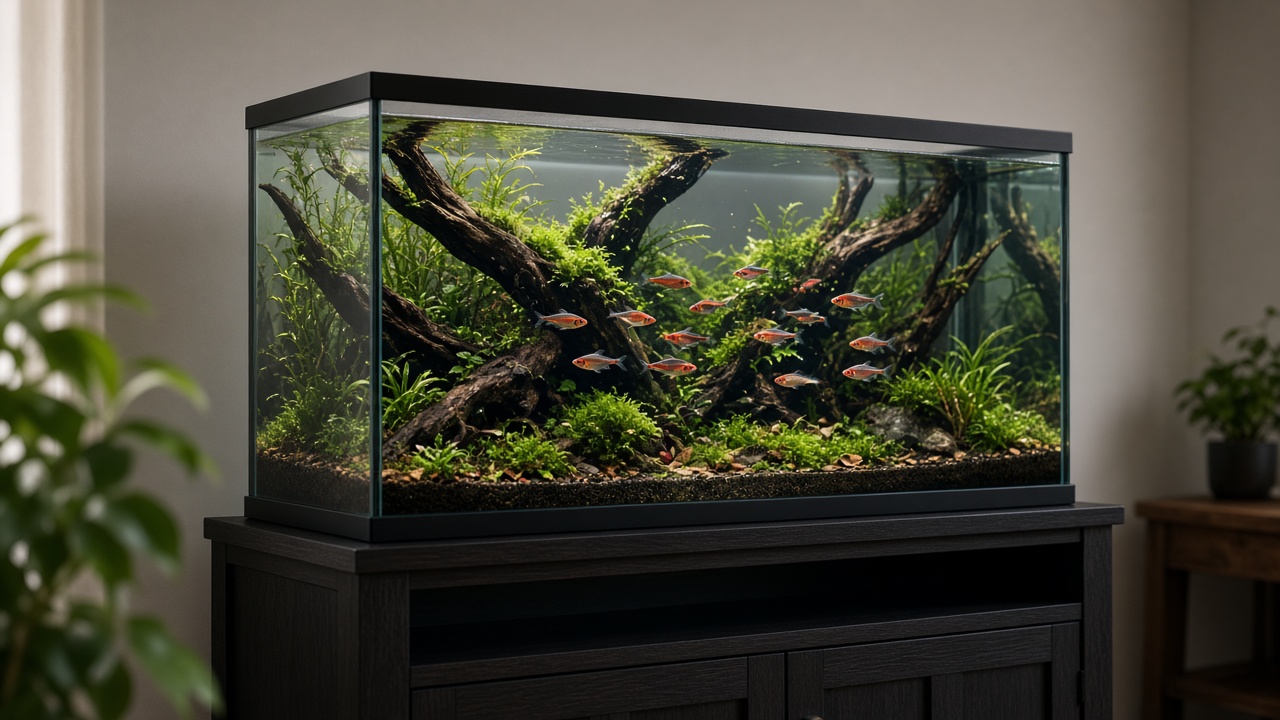
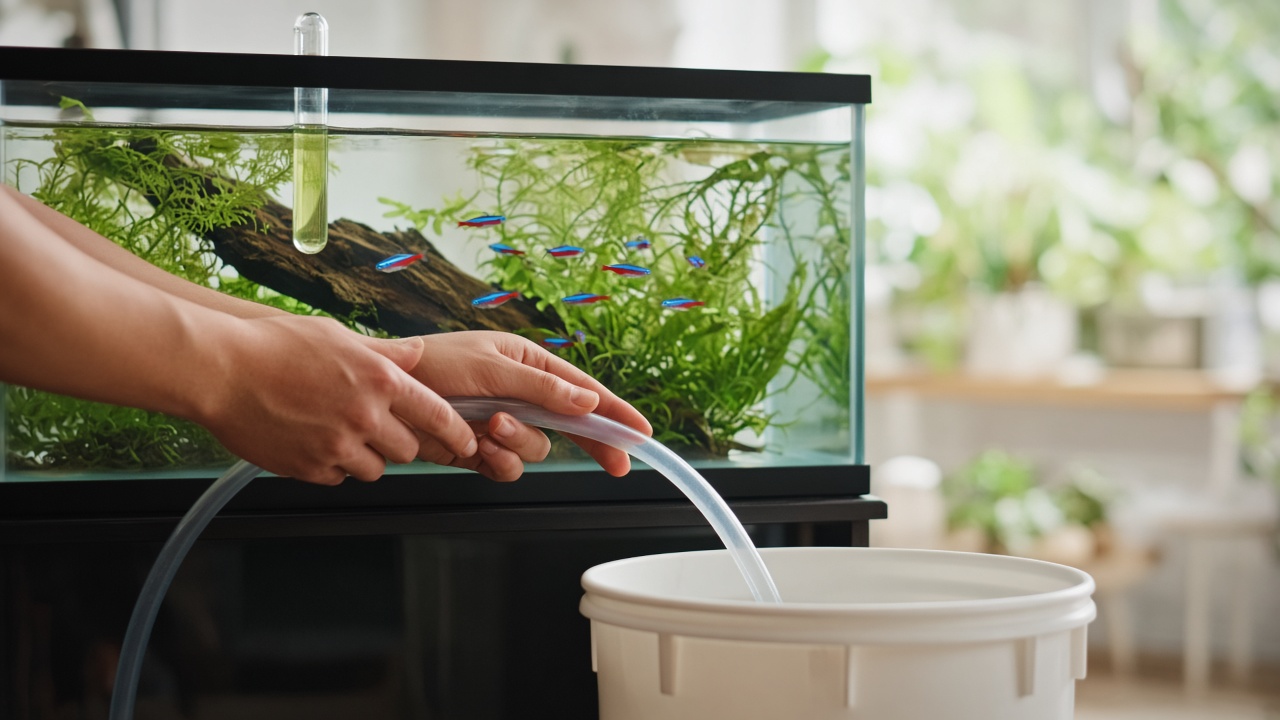
Quick answer: Match the haze color before you change a lot of water. White haze in a new tank is usually a bacterial bloom, and green water is free-floating algae. Test ammonia and nitrite the same day.
Cloudy tank water is bacteria, algae, tannins, or debris, and the haze color tells you which of those four. This page is a color-sorted spec guide; we did not culture water, stock trial tanks, or rank products.
We use one rule for what gets in, called the Color-First Inclusion Rule. A case is in only if you can name the water color from across the room.
Saltwater tanks, ponds, surface films, and glass-only algae are out. Our research team analyzed published maker pages and agency rules.
Read the color before you touch the water
The color of the haze is the first clue, and it is cheaper than a guess.
Look at the tank in daylight, stand back so you see the water, and name the color in one word.
| Color you see | Likely cause | First move |
|---|---|---|
| White or gray | Bacterial bloom | Test ammonia and nitrite; leave a new filter alone |
| Green | Suspended algae | Cut light; test nitrate; do not add fish |
| Tea brown | Tannins | Add carbon if you want clear water |
| Dusty brown | Stirred debris | Let it settle; vacuum later |
| Yellow, foamy | Decay | Remove the dead matter; test the water |
EPA’s rule at 40 CFR 141.173 caps drinking water haze at 0.3 NTU, its cloudiness unit, in 95 percent of monthly samples. That same rule says the water must never exceed 1 NTU. Home tanks do not use those meters.
Visible haze still means particles are in the water, and color tells you which particles.
White or gray haze
White haze means the water is full of bacteria, not dirt you can scoop.
Aqueon’s cloudy-water guide says a new tank is almost empty of life on day one. Free-floating microbes then multiply in the water, and the bacteria that live on filter media have not caught up yet.
The MSD Veterinary Manual states that new tank syndrome usually shows up in the first 6 weeks. The same page says a tropical-tank biofilter can take up to 8 weeks to become established. For that timeline, see how long to cycle a fish tank.
Aqueon’s guide says the first 30 days are the wrong time to scrub a new filter. Cleaning then removes the few useful bacteria that have started. Extra water changes in that window often bring the haze back within a day or two.
If the tank is new and tests are low, leave the filter alone and feed less.
If the tank is older, white haze is a warning. Aqueon ties that gray water to waste-eating bacteria after a dead fish, dead plants, or leftover food. The main risk it names is low oxygen.
Do this for white or gray water:
- Test ammonia and nitrite the same day.
- Look for a dead fish, a rotting plant, or uneaten food.
- If the tank is under 30 days old and tests are low, do not clean the new cartridge.
- If the tank is established, do a normal partial change and vacuum the gravel.
- Increase surface ripple or add an air stone until the haze fades.
Aqueon uses a rough stocking start of one inch of adult fish per net gallon, because more fish means more waste for a bloom. Do not add fish while the water is milk.
Green water
Green water is algae hanging in the water, not dirt on the glass.
Aqueon’s guide names two drivers: too much light, and extra nitrate and phosphate.
Aqueon says planted tanks may need 8 to 12 hours of light a day. Tanks without plants can run 6 hours or less. A tank by a window can get both the fixture and the sun.
Aqueon says you can shut the light off for 2 to 3 days as a short reset. That move is a patch if nutrients stay high. A UV sterilizer, it says, can clear green water in a few days.
Do this for green water:
- Put the tank on a timer.
- Aim for 8 to 12 hours if you have live plants.
- Aim for 6 hours or less if you do not.
- Block direct sun if the tank sits by a window.
- Test nitrate.
- Vacuum waste and skip a feeding day.
Do not add more fish to a green tank, because more waste feeds the bloom. Glass algae and green water are not the same problem.
Brown, yellow, or tea-colored water
Brown is not one cause, so ask whether the water looks like tea or like stirred dust.
Tea-colored water that stays tinted after a night of rest is often tannins. Aqueon says driftwood and some plants release tannic acid. The water turns yellow or brown, and pH can drop.
Aqueon says tannins are not a poison to fish, and if you want clear water it points to activated carbon.
Aqueon’s replacement-cartridge page says its dual-sided cartridges use dense floss with over 25 percent more activated carbon than leading brands. That page also says to replace the cartridge every 4 weeks. One listed Extra Small pack measures 5.24 inches by 1.75 inches by 5.7 inches.
For cartridge types and swap timing, see best fish tank filter cartridges. Aqueon says you can soak new driftwood in hot water for at least a few hours before it goes in.
Dusty brown water that clears from the top down is usually substrate. New sand and some gravels shed fines. Let the dust settle, then vacuum.
Yellow water that looks a bit foamy is often decay. Aqueon lists rotting plants, a dead fish, or leftover food. Remove the source, then test.
Aqueon says high ammonia can damage gills and organs. High nitrite can block oxygen in the blood. For that case it tells you to change about 50 percent of the water, then test again.
Aqueon’s routine change for a tidy tank is about 25 percent a month, or less if you change weekly. That is not the 50 percent ammonia emergency change.
What to test the same day
Cloud color is a start, but it does not replace a test kit.
API Fishcare’s freshwater water-problem guide says the first useful step is water testing. That page says the API Freshwater Master Test Kit measures pH, ammonia, nitrite, and nitrate. It also says the kit performs over 800 tests.
Aqueon says to test ammonia and nitrite as soon as new water clouds. In many new tanks those readings are zero. Zero ammonia does not mean you should add more fish.
The MSD Veterinary Manual says fishless cycling starts by adding ammonia to at least 1 to 5 mg/L. That is a planned dose in an empty tank. It is not a target for a tank that already holds fish.
The same MSD page says total alkalinity at or below 50 mg of CaCO3 per liter can stall a biofilter. It says to buffer so total alkalinity is at least 100 mg of CaCO3 per liter. Cloudy water plus a crashing pH is not a harmless bloom.
Seachem’s Prime page states a standard dose of 1 capful, which is 5 mL, for each 50 U.S. gallons of new water. Each cap thread is about 1 mL.
Use those published doses this way:
- Double dose: high chloramine, per Seachem
- Up to 5 times the normal dose: nitrite emergency above 2 ppm
- Redose every 24 to 48 hours: the bind lasts up to 48 hours
- Half dose: water above 86°F with low chlorine or ammonia
A conditioner is not a substitute for a water change when ammonia is high. Aqueon still wants about 50 percent changed in that case.
Test in this order:
- Ammonia
- Nitrite
- Nitrate
- pH
Write the numbers down and compare them the next day.
What not to do while the tank is cloudy
The wrong cleanup makes the haze last longer.
Aqueon’s new-tank list is blunt. Do not buy a new filter just because the water looks milky. Do not clean that new cartridge in the first 30 days unless something else is wrong.
Do not flood the tank with extra water changes in that first month if ammonia and nitrite are not rising. Do not feed more than the fish can eat in about 2 minutes, once or twice a day. Extra food feeds the bloom and can raise ammonia.
Do not add a second load of fish to rush the cycle. The MSD Veterinary Manual says new tank syndrome often starts after a quiet stretch, then fish stop eating and die.
Do not bleach the gravel and the filter on the same day. You will dump waste into the water and strip the bacteria that could have processed it. Do not use a clarifier as the first move when ammonia is high.
When filters and water changes help
Filters and water changes help after you know the color and the test numbers.
In an established tank, Aqueon says cloudy water will not usually fade if you ignore it. A normal partial change plus a gravel vacuum is the first cleanup for waste haze.
Swap chemical media on a schedule. Aqueon’s cartridge page says every 4 weeks for those carbon cartridges. If a combo unit both filters and heats, a clogged cartridge can cut flow and heat at once.
For how those combo units are built, see best fish tank filter and heater in one. Carbon helps tea-colored tannin water. It does little for green algae in the water column.
If 25 percent changes leave pea-soup water, the light schedule is still wrong. If white haze returns the next day in a two-week-old tank, you are feeding the bloom.
FAQ
These are the cloudy-water questions keepers ask first.
Why did my new tank turn cloudy after two days?
Aqueon says a new tank has almost no settled bacteria on day one. Free-floating microbes then bloom on leftover food. The MSD Veterinary Manual puts the risky window at the first 6 weeks, so test ammonia and nitrite before you add more fish.
Is cloudy water itself what harms the fish?
Not always. White haze can be a bloom while tests stay at zero, and Aqueon says tea-brown tannins are not a poison. Ammonia and nitrite are the numbers that can harm fish, so test those the same day.
Should I change half the water for white haze?
Only if the tests say so. Aqueon says extra changes in the first 30 days can bring white haze back worse within a day or two. It reserves a change of about 50 percent for high ammonia or nitrite.
Why is the water green if the filter is running?
Green water is algae in the water, not debris the pad can trap. Aqueon names extra light and extra nitrate or phosphate. A UV unit, Aqueon says, can clear that green in a few days.
How do I tell tannins from dirty brown water?
Tannin water looks like weak tea and stays tinted after it sits overnight. Dust water looks gritty and settles from the top down. Aqueon says carbon is a fast way to pull tannins if you want clear water.
Can a water conditioner replace a water change?
No. Seachem’s Prime page says the product can bind ammonia, nitrite, and nitrate for up to 48 hours. Aqueon still tells you to change about 50 percent of the water when those toxins are high, then test again.
How long should I wait for cloudy water to clear?
Aqueon says a new-tank bloom is part of cycling and should be left to run if tests are safe. The MSD Veterinary Manual says the biofilter itself can take up to 8 weeks. Green water can fade in 2 to 3 dark days if light was the cause.