Quick answer: Buy 2–5 mm inert gravel for most community tanks. Switch to a plant soil if you want heavy root feeders. Skip neon-coated bags that list no grain size.
Use 2–5 mm inert gravel at 1–2 pounds per gallon for a typical freshwater tank. This page is a 2026 buying brief on grain size, color, and plants. We did not keep fish in these bags, and we did not rank products.
Our research team compared published specs on maker pages. We did not run tank trials.
How we chose the bags on this page
A bag is in this article only if the maker lists a typical grain size in millimeters, a current pack size, or both.
That rule decides what got in and what stayed out. A color name alone did not earn a row.
We left out four groups on purpose:
- Painted craft rock with no grain size
- Marine aragonite and crushed coral
- African cichlid mixes that buffer hardness
- Store-brand neon gravel that lists only a color
The table later on this page is an attribute chart, not a ranked list.
For planted-tank detail, use our best aquarium gravel for plants guide. This page stays on buying basics for a mixed home tank.
Top 7 Aquarium gravel
The picks below are the 7 aquarium gravels on sale right now, listed with what each suits best and an honest drawback. Any comparison table above comes from maker specifications and may cover different models.
1. GloFish Aquarium Gravel
Best for: vibrant neon-themed tanks with LED lighting
We compared this to standard natural gravels and found it is the go-to choice for hobbyists seeking a high-contrast, glowing look under blue spectrum lights. Owners report that the coating is durable, though it is clearly designed for stylized setups rather than biotope-accurate tanks.
Pros: High-visibility neon colors; Safe for all freshwater fish Cons: Artificial aesthetic may not suit natural aquascapes
2. Aqua Natural Aquarium Substrate
Best for: beginners wanting a clean, natural substrate look
Owners report that this substrate provides a professional, tidy appearance that complements most freshwater community tanks. We compared its consistency to generic options and noted that its uniform sizing makes it easier to maintain during gravel vacuuming sessions.
Pros: Uniform particle size; Neutral pH impact Cons: Requires thorough rinsing before initial use
3. Fluval 12694 Plant and Shrimp Stratum for Freshwater Fish Tanks
Best for: high-tech planted tanks and delicate shrimp colonies
We compared this mineral-rich substrate to inert gravels and found it superior for nutrient-demanding aquatic plants. Owners report significant success in shrimp breeding, as the porous texture provides excellent surface area for beneficial bacteria.
Pros: Promotes strong root growth; Naturally buffers water parameters Cons: Can be messy if disturbed frequently
4. OUPENG Pebbles Polished Gravel
Best for: small decorative bowls or accenting tank features
When we compared this to rough-cut gravel, the polished finish stood out for its aesthetic appeal in desktop aquariums. Owners report that the smooth surface is gentle on bottom-dwelling fish, making it a safe, decorative choice for smaller setups.
Pros: High-gloss polished finish; Smooth edges prevent injury Cons: Not suitable for heavy root-feeding plants
5. FANTIAN 5 lbs Aquarium Gravel
Best for: budget-conscious hobbyists setting up small tanks
We compared this to premium substrates and found it serves as a reliable, cost-effective base for basic fish-only tanks. Owners report that the gravel is clean enough for immediate use, though it lacks the nutrient-rich properties of specialized plant soils.
Pros: Economical price point; Versatile color options Cons: Bag size is limited for larger aquariums
6. YISZM 5lbs Aquarium Gravel
Best for: adding a pop of color to community tanks
Owners report that this gravel maintains its color well over time without leaching into the water column. We compared it to other dyed substrates and found it offers a good balance of durability and visual impact for those who prefer a non-natural aesthetic.
Pros: Non-toxic color coating; Consistent sizing Cons: May look artificial in heavily planted tanks
7. YISZM 20lbs Natural River Rocks
Best for: large-scale aquascaping and natural riverbed designs
We compared this to smaller-bag options and concluded it is the most efficient choice for filling large-volume tanks. Owners report that the varied shapes and sizes create a realistic, rugged riverbed appearance that works perfectly for larger cichlids or goldfish.
Pros: Bulk quantity for large tanks; Authentic river rock texture Cons: Heavy weight requires careful tank placement
Comparison: Aquarium gravel at a Glance
| Product | Best for | Approx. price | Where to buy |
|---|---|---|---|
| GloFish Aquarium Gravel | vibrant neon-themed tanks with LED lighting | $8.97 | Check price |
| Aqua Natural Aquarium Substrate | beginners wanting a clean, natural substrate look | $12.76 | Check price |
| Fluval 12694 Plant and Shrimp Stratum for Freshwater Fish Tanks | high-tech planted tanks and delicate shrimp colonies | $16.99 | Check price |
| OUPENG Pebbles Polished Gravel | small decorative bowls or accenting tank features | $9.99 | Check price |
| FANTIAN 5 lbs Aquarium Gravel | budget-conscious hobbyists setting up small tanks | $14.99 | Check price |
| YISZM 5lbs Aquarium Gravel | adding a pop of color to community tanks | $13.49 | Check price |
| YISZM 20lbs Natural River Rocks | large-scale aquascaping and natural riverbed designs | $35.99 | Check price |
Want to browse every option? See the full range of aquarium gravel on Amazon →
Grain size: the 2 mm line shops blur
The clean split between sand and gravel sits at 2 mm on the official grade scale.
US Geological Survey Open-File Report 2006-1046 follows the Wentworth grade scale. It lists gravel-sized particles at a nominal diameter of 2 mm. It lists sand from under 2 mm down to 62.5 micrometers.
Many bags sold as aquarium gravel sit on the sand side of that line. That is a labeling habit, not a stone defect.
Our research team compared typical-size ranges for 14 Super Naturals products on CaribSea’s freshwater page. Five of those 14 list a maximum grain under 2 mm.
Those five sit in the USGS sand class:
- Crystal River, 0.5 to 1.0 mm
- Jungle River Sand, 0.5 to 1.5 mm
- Maui Moon, 1.25 to 1.75 mm
- Moonlight Sand, 0.25 to 0.75 mm
- Sunset Gold, 0.25 to 1.0 mm
Four of the 14 sit fully above 2 mm:
- Gemstone Creek, 3.0 to 5.0 mm
- Raven River Pebble, 6.0 to 14.0 mm
- Zen Garden, 9.5 to 13.0 mm
- Jelly Beans, 13.0 to 26.0 mm
The rest straddle the 2 mm line, and Peace River is one of them. CaribSea’s freshwater page lists Peace River at 1.0 to 2.0 mm.
Use this simple size rule:
- Under 2 mm: sand-like beds that suit fish that sift
- 2–5 mm: the usual pick for a community tank
- Over 8 mm: décor gravel that is poor for small plant roots
CaribSea’s Gemstone Creek lands in the 3.0 to 5.0 mm band. Fluval’s Stratum page lists a 3–5 mm granule for plants with larger roots. Those two published ranges match the community rule above.
Fluval’s same page lists Bio-Stratum at 1–3 mm. That is a finer plant soil, not a coarse gravel.
How much gravel you need
CaribSea’s FAQ gives a starting rule of 1 to 2 pounds per gallon.
Seachem’s Flourite page says a 7 kg bag (15.4 lb) fills about 7,000 cm³, which is 425 cubic inches. Seachem says that bag covers a 5 cm (2 inch) bed in a typical 40 L (10 gallon) tank.
Those two maker notes line up on a 10 gallon tank. That tank needs 10 to 20 lb at CaribSea’s rule. Seachem’s 15.4 lb bag sits inside that band for a 2 inch bed.
Use this checklist before you buy:
- Measure tank length and width in inches
- Pick a bed depth, with two inches as the usual start
- Use 1 to 2 pounds per gallon as a first estimate
- Add extra if you want a back slope
CaribSea’s FAQ also gives a volume math path you can run by hand. Multiply length × width × depth in inches, then divide by 1,728, then multiply by the listed density.
CaribSea’s freshwater page lists Eco-Planted Black at 54 pounds per cubic foot. It lists Gemstone Creek at 96 pounds per cubic foot. A 20 lb bag of the plant soil covers more floor than a 20 lb bag of Gemstone Creek.
CaribSea’s FAQ uses 100 lb for Super Naturals in that equation and 80 lb for Eco-Planted. Use the FAQ numbers when you run that math.
ADA sells soil by volume, not by pound. ADA’s Aqua Soil page lists Amazonia Ver.2 in 3 L and 9 L bags.
Color, coatings, and what to skip
Natural stone is the safe default for a first tank.
CaribSea’s Super Naturals Aquascapes notes say the line is all natural, with no paints, dyes, or coatings.
Seachem’s Flourite page says the clay is not chemically coated or treated. It also says Flourite will not alter the pH of the water.
Skip a bag when the label hides three things:
- Grain size
- Whether the color is a coating
- Whether the stone changes hardness
Bright coated gravel can look fine on day one, and cheap coatings can chip later. We still treat a missing grain-size line as a hard no.
Dark beds make green plants stand out, while light beds show waste faster. If fish hide in a bright bed, switch to a darker natural mix such as Peace River.
Do not mix marine crushed coral into a soft-water community tank. CaribSea’s FAQ says Aragalive raises pH and alkalinity.
Plants: inert gravel versus plant soil
Inert gravel holds roots, but it does not feed them.
Inert here means the maker says the bag does not change pH. Seachem’s Flourite page makes that claim, and we only quote makers we read.
Root-feeding plants need food in the bed or in the water, and swords and crypts are the usual examples. Anubias and Java fern sit on wood or rock, so they do not need a deep gravel bed.
Pick the bed by plant type:
- Epiphytes on wood: any 2–5 mm inert gravel is enough
- Root feeders in inert gravel: add root tabs on a schedule
- Heavy planted layouts: use a plant soil, not décor gravel
CaribSea’s Eco-Planted Black page says the base is basaltic volcanic material. It lists iron, calcium, magnesium, potassium, and sulfur, and it says the mix holds over 25 other elements.
CaribSea’s page lists Eco-Planted Black at 0.25 to 7.0 mm, which is a wide range.
Fluval’s Stratum page says the granules come from the foothills of Mount Aso. It lists the 3–5 mm size for plants with larger root systems. It also says the bed supports a neutral to slightly acidic pH.
ADA’s Aqua Soil page says the editorial team.2 uses black soil and helps adjust water to a slightly acidic condition. ADA lists a 3 L bag, a 9 L bag, and a 3 L powder type.
Plant soils and inert gravels are not swaps. A plant soil can cloud water and shift pH, while inert gravel stays quieter and needs extra plant food.
CaribSea’s FAQ allows mixing other substrates with Eco-Planted and caps that mix at no more than 50%. Do not bury an old bed under a new cap.
Six current bags, compared by published specs
These six products are still sold, and each row uses a number or claim from the maker page.
| Product | Maker-listed grain | Pack sizes listed | Maker pH note | Material note |
|---|---|---|---|---|
| CaribSea Super Naturals Peace River | 1.0 to 2.0 mm | 5, 10, 20, 40 lb | Not stated | Natural mix; no paints, dyes, or coatings |
| CaribSea Super Naturals Gemstone Creek | 3.0 to 5.0 mm | 5, 20, 40 lb | Not stated | Natural gravel; 96 lb per cubic foot |
| CaribSea Eco-Planted Black | 0.25 to 7.0 mm | 20 lb | Not stated | Volcanic bed; 54 lb per cubic foot |
| Fluval Plant and Shrimp Stratum | 3–5 mm | Items 12693, 12694, 12695 | Neutral to slightly acidic | Mount Aso volcanic granules |
| Seachem Flourite | No mm listed | 3.5 kg and 7 kg | Will not alter pH | Porous clay; 7 kg is 15.4 lb |
| ADA Aqua Soil Amazonia Ver.2 | No mm listed | 3 L, 9 L, 3 L powder | Slightly acidic | Black soil plus supplement |
Peace River is the fine natural pick, and Gemstone Creek is the true 3–5 mm gravel. Eco-Planted Black and Fluval Stratum are plant soils.
Flourite is a clay gravel that Seachem says lasts the life of the tank. Amazonia Ver.2 is a volume-sold soil for planted layouts.
CaribSea’s FAQ names Peace River as the favorite Super Naturals pick for corys. That is a maker preference, not a trial score from us.
Setup, filters, and first-week care
Rinse inert gravel, fill the tank slowly, and let the filter clear the haze.
CaribSea’s FAQ says to rinse Super Naturals until the water goes from milky to cloudy. It says skip that rinse for Eco-Planted. Seachem’s Flourite page says the clay may still need a rinse after shipping.
Seachem’s setup note is simple: place a bowl on the bed, pour water into the bowl, and let it spill softly onto the gravel.
CaribSea’s FAQ says a new bed should start to clear within hours. It says the tank should be fully clear in 24 to 48 hours after pumps and filters start.
Use this first-week list:
- Rinse inert gravel. Do not rinse Eco-Planted
- Set a 2 inch bed, or a mild back slope
- Fill through a bowl or plate
- Start the filter before you add fish
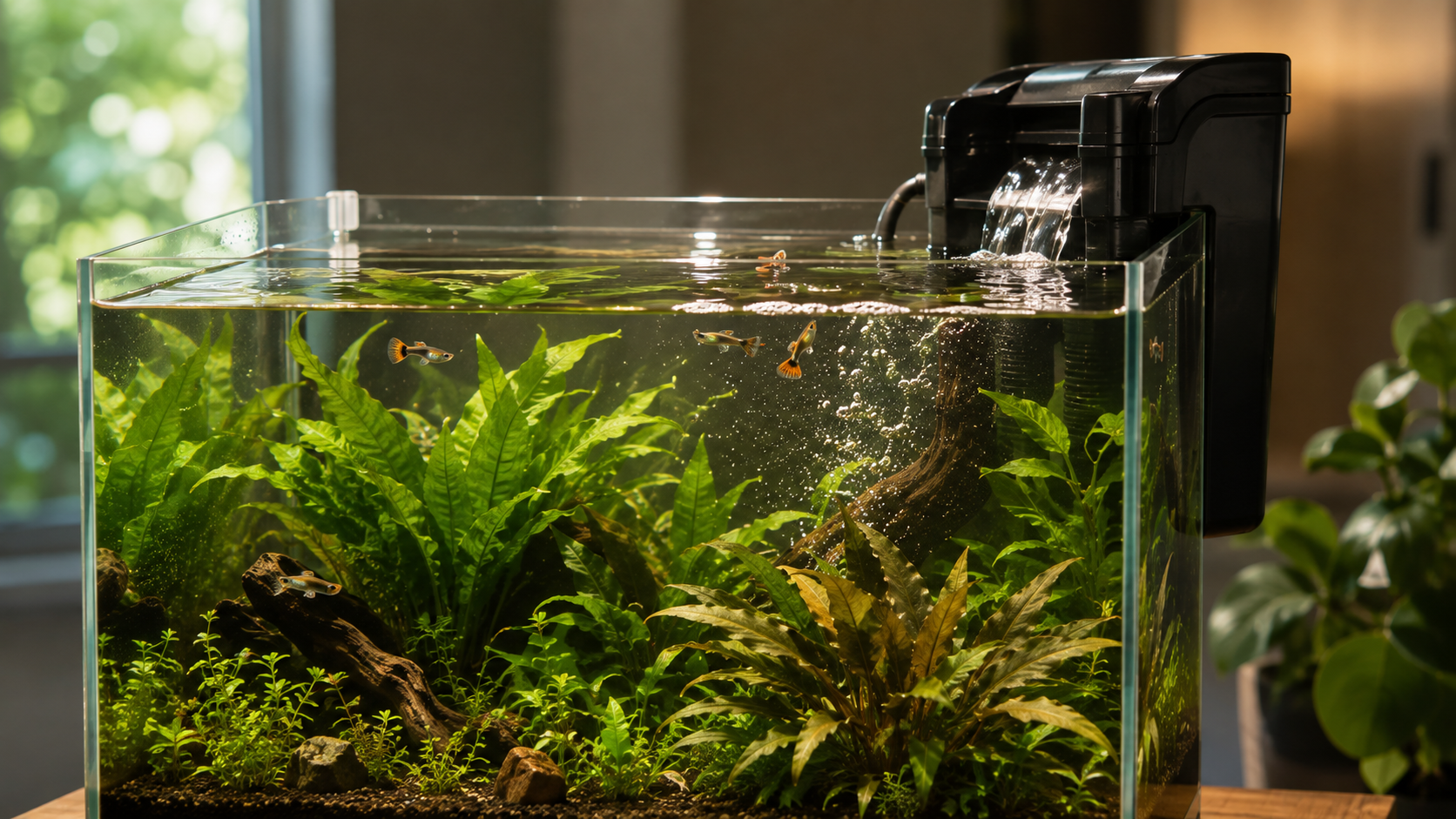
A hang-on filter with floss helps trap the first dust. Our Top Fin Aquarium Filter EF-S guide walks through one common hang-on unit.
For a wider filter shortlist, see our top filter aquarium Reddit recommendations. Pair any filter with a gravel vacuum, because leftover food sinks between grains.
CaribSea’s FAQ says to replace substrate in an old tank at 5 to 10% per week. It says the biological filter can wobble for 4 to 6 weeks after a big swap.
FAQ
How much gravel do I need for a 10-gallon tank?
CaribSea’s FAQ starts at 1 to 2 pounds per gallon, which is 10 to 20 lb for a 10 gallon tank. Seachem says one 7 kg (15.4 lb) Flourite bag covers about a 2 inch bed in a 40 L (10 gallon) tank. Buy the higher end if you want a back slope.
Is colored gravel safe for fish?
Natural, uncoated stone is the safer label to buy. CaribSea’s Super Naturals Aquascapes notes say no paints, dyes, or coatings, and Seachem says Flourite is not chemically coated. We skip neon bags that hide grain size and coating details.
Can I grow live plants in regular gravel?
Yes, if you match the plant to the bed. Plants that sit on wood do not need a rich gravel, while root feeders in inert gravel need root tabs. For a heavy planted tank, use a plant soil such as Eco-Planted Black, Fluval Stratum, or Amazonia Ver.2.
What grain size works for bottom-sifting fish?
Stay at or under 2 mm if the fish sift sand. CaribSea lists Peace River at 1.0 to 2.0 mm and names it the favorite Super Naturals pick for corys. Skip Zen Garden and Jelly Beans for small mouths, because those bags list 9.5 to 13.0 mm and 13.0 to 26.0 mm.
Should I put plant soil under gravel?
Only in a new tank, and only if the maker allows a mix. CaribSea’s FAQ allows a top layer on Eco-Planted in new setups and warns that you lose some early biological filtration. It also caps a mix at 50%, so do not cap an old bed with new sand.
Sand or gravel for a community tank?
Use 2–5 mm gravel if you want easy vacuuming and rooted stems, and use a sand-size bag if you keep sifters. The USGS 2 mm line is the split, with Peace River on that line and Gemstone Creek above it.