Quick answer: Use barley straw to slow new green-water algae, not to kill a current bloom. For farm ponds, Rutgers NJAES lists 225 pounds per surface acre. For small lined ponds, follow the maker’s listed gallon rate.
Rutgers NJAES lists 225 pounds of barley straw per surface acre of pond. This page is a 2026 desk brief on published rates and four current products.
Waterpuppy.net may earn a commission if you buy through affiliate links added after this article.
Desk selection rule: We covered only currently sold barley formats with a live maker page. That page had to list a treat volume or a replace interval. We left out wheat straw, rye straw, copper algaecides, and any brand with no official size or treat figure.
How barley straw works in a pond
Barley straw slows new algae, and it does not wipe out a bloom that is already there.
Rutgers NJAES calls that action an algistat, not an algicide, and says the exact chemical path is still unknown. Decay products are one guess, and microbes that feed on the straw are another.
Penn State Extension says the straw needs sunlight and oxygen to work. The active effect is weaker if the straw sits in still, low-oxygen water. Keep the straw near the surface, which is the shared rule in both fact sheets.
Rutgers NJAES also says wheat straw and rye straw have not been shown to work for this use. Buy named barley, not a mixed farm bale of unknown crop.
Results vary by algae type, and Rutgers NJAES says planktic algae, the soup-green kind, is the better match. Filamentous mats and blue-green growth have mixed reports on that same fact sheet.
One Rutgers NJAES trial used the recommended rate in a ¼-acre farm pond, and filamentous algae still grew. A second Rutgers farm trial reduced filamentous algae but did not wipe it out.
Top 7 Barley straw for pond
The picks below are the 7 barley straws for pond on sale right now, listed with what each suits best and an honest drawback. Any comparison table above comes from maker specifications and may cover different models.
1. Summit Clear-Water Barley Straw Pond Treatment
Best for: First backyard water-garden season
This is Summit’s widely listed Clear-Water straw treatment, the bale format most backyard keepers meet first. Maker pages describe small straw packs that sit in the water and decay over months. Owners report it is a set-and-wait product, not a same-week clarifier.
Pros: Familiar straw-bale format; Low backyard starting price Cons: Slow seasonal payoff
2. Summit...responsible solutions Summit 125 Clear-Water Barley Straw
Best for: Patio ponds and tiny features
Summit 125 is the smaller Clear-Water SKU. Published labels pair two mini-bales with compact water gardens, not farm ponds. Owners like the price but note the bales look undersized beside a midsize liner.
Pros: Smaller labeled mini-bales; Near-ten-dollar price Cons: Too small for big ponds
3. The Pond Guy Straw Barley Bale
Best for: Small backyard koi keepers
The Pond Guy sells this as a one-pound straw bale in mesh. The maker page aims it at water gardens, fountains, and small koi setups. Owners like the contained bag but still wait weeks for decay, as with any raw straw.
Pros: Contained one-pound mesh bale; Sized for small koi ponds Cons: Costs more than mini-bales
4. Microbe-Lift Concentrated Barley Straw Extract Conditioner for Ponds
Best for: Ponds with bottom drains
This is a concentrated liquid extract, not a decaying bale. Microbe-Lift’s page says it goes to work on contact and leaves no straw residue, which the brand flags for ponds with bottom drains. Owners like the pour-and-go routine, and they note the jug costs more than a season of mini-bales.
Pros: No leftover straw debris; Easy liquid extract dosing Cons: Higher price than raw straw
5. EasyPro EBP40 Barley Straw Pellets
Best for: Large ponds and farm lakes
EBP40 is EasyPro’s 40-pound pellet bag. Maker directions treat it as a broadcast product for large ponds, with smaller scoops for water features. Owners with acre-scale water like the bulk, while the bag is overkill for a patio tub.
Pros: Forty-pound bulk pellet bag; Suits large-pond broadcast use Cons: Overkill for small features
6. MAQIHAN Barley Straw for Ponds
Best for: Budget DIY first trials
MAQIHAN sits at the bottom of this price list. It is generic barley straw, not a pond-shop brand with a long label history. Owners treat it as a cheap way to try straw, and brand support is thinner than the names above.
Pros: Lowest price on this list; Simple raw-straw starter Cons: Lesser-known generic brand
7. CrystalClear Barley Extract Pond Treatment
Best for: Measured biweekly extract dosing
CrystalClear’s Barley Extract is a bottled liquid, not a bale. Maker labels set a repeat pour instead of waiting for straw to rot. Owners who already run CrystalClear treatments like staying in one line, though the bottle sits in a higher price tier than straw.
Pros: Mess-free liquid extract; Fits a repeat dosing schedule Cons: Premium bottle-price tier
Comparison: Barley straw for pond at a Glance
Want to browse every option? See the full range of barley straw for pond on Amazon →
How much barley straw to use
Match the dose to pond type: farm ponds use pounds per acre, and lined garden ponds use the maker’s gallon rate.
For open farm or yard ponds, Rutgers NJAES lists these rates:
- Usual rate: 225 pounds per surface acre, or 4 to 5 bales
- Low published rate: 110 pounds per acre
- Do not exceed 450 pounds per acre
Rutgers NJAES ties the 450-pound cap to oxygen loss as straw decays. A heavy load can stress fish, so stay under that cap.
Penn State Extension uses a different bale count and lists 2 to 3 bales per surface acre. That page also lists 10 to 25 grams of straw per square meter. The two fact sheets do not use the same bale weight, so follow the pound or gram figure.
Penn State Extension says water depth does not change the dose, and surface area does. Muddy ponds, or ponds with a heavy algae history, may need two or three times the common dose for a first pass.
That page also warns that a large overdose can kill fish by stripping oxygen. For small lined ponds, Rutgers NJAES lists 1 pound of straw per 2,000 gallons.
Maker packs often use their own gallon charts, so use the label on the pack you bought. Aquascape’s pellet page gives this pond-volume math:
- Length in feet × width in feet × average depth in feet × 7.48 = U.S. gallons
Our research team analyzed four live maker pages for this brief. Listed replace intervals ran from 6 to 8 weeks on Aquascape pellets to 6 months on Summit bales. That spread is why we sort products by format.
When to put straw in the pond
Put straw in before green-water season, because both fact sheets treat timing as a decay clock.
Penn State Extension, on a page updated September 8, 2025, lists these lag times:
- Water under 50°F: about 6 to 8 weeks before the straw is active
- Water above 70°F: about 1 to 2 weeks
- Once active, the straw lasts about 6 months
Rutgers NJAES lists a similar life span of 4 to 6 months. That fact sheet says to place straw in spring, before algae take off.
It lists start dates from April to as early as February, and local weather sets the date. If you place straw in April, Rutgers NJAES says a mid-July swap can cover the rest of the season.
Summit’s Clear-Water barley straw page says to start early in the season. The maker says each bale works for up to 6 months.
Aquascape’s pellet page says to add new pellets every 6 to 8 weeks and to overlap the bags by 2 weeks. The maker says that overlap keeps enzyme output from dropping to zero.
Aquascape’s extract page uses a different clock. For spring start-up or a new pond, that label says to treat twice weekly for 2 weeks, then once weekly.
Do not wait for a thick green soup and then expect a fast clear. Rutgers NJAES says barley straw will not act as fast as copper sulfate.
Four current barley formats we compared
This section matches format to pond size, and it is not a ranked list.
Our research team compared published specs on four live maker pages. We used treat volume, package size, and replace interval.
| Product | Form | Package listed | Treat volume listed | Replace or duration listed |
|---|---|---|---|---|
| Summit Clear-Water Barley Straw Pond Treatment | Mini bale | 2-pack (#125 or #130) or jumbo (#135) | 500, 1,000, or 3,000 to 5,000 gallons | Up to 6 months |
| Aquascape Concentrated Barley Straw Pellets (SKU 96029) | Pellets | 5 lb / 2.3 kg | 1,000 gallons per container | Every 6 to 8 weeks |
| MICROBE-LIFT Barley Straw Pellets + | Pellets with peat | 4.4 lb or 10.5 lb | 500 gal / 12 months (4.4 lb); 1,000 gal / 14 months (10.5 lb) | Duration is size-based |
| Aquascape Barley Straw Extract Professional Grade (SKU 98906) | Liquid extract | 1 gal / 3.78 L | 96,000 gallons per bottle; 6,000 gallons per scoop | Twice weekly for 2 weeks, then weekly |
Summit Clear-Water Barley Straw Pond Treatment is the bale format, and the maker’s page lists three sizes.
Item #125 treats up to 500 gallons per bale, and item #130 treats up to 1,000 gallons per bale. Item #135 treats 3,000 to 5,000 gallons.
Summit says the bales work for up to 6 months. The maker also says they are harmless to fish, plants, and animals.
Aquascape Concentrated Barley Straw Pellets, SKU 96029, skip the loose straw mess. The 5-pound, 2.3-kilogram pack treats 1,000 gallons, or 3,780 liters, and packaged weight is 5.5 pounds.
MICROBE-LIFT Barley Straw Pellets + add peat and humic acid to barley. The 4.4-pound bag treats 500 gallons for 12 months, or 800 gallons for 8 months. The 10.5-pound bag treats 1,000 gallons for 14 months, or 2,500 gallons for 6 months.
Aquascape Barley Straw Extract Professional Grade, SKU 98906, is a 1-gallon liquid. One bottle treats up to 96,000 gallons, one scoop treats 6,000 gallons, and packaged weight is 9.75 pounds.
The maker’s page says the bottle is 25% more concentrated than the consumer equivalent. Add it where flow is strongest, aerate for at least 24 hours, and keep water at or above 32°F.
Use this Desk Format Map when you pick a pack:
- Bale: one drop-in unit, long listed life, small garden ponds
- Pellet: cleaner than loose straw, mid-length replace cycle
- Extract: measured scoops, weekly upkeep, large water volume
Farm ponds over a fraction of an acre still fit the Rutgers NJAES acre rate better than these garden packs. A 1,000-gallon pellet bag will not cover a 1-acre pond.
How to place straw so it can work
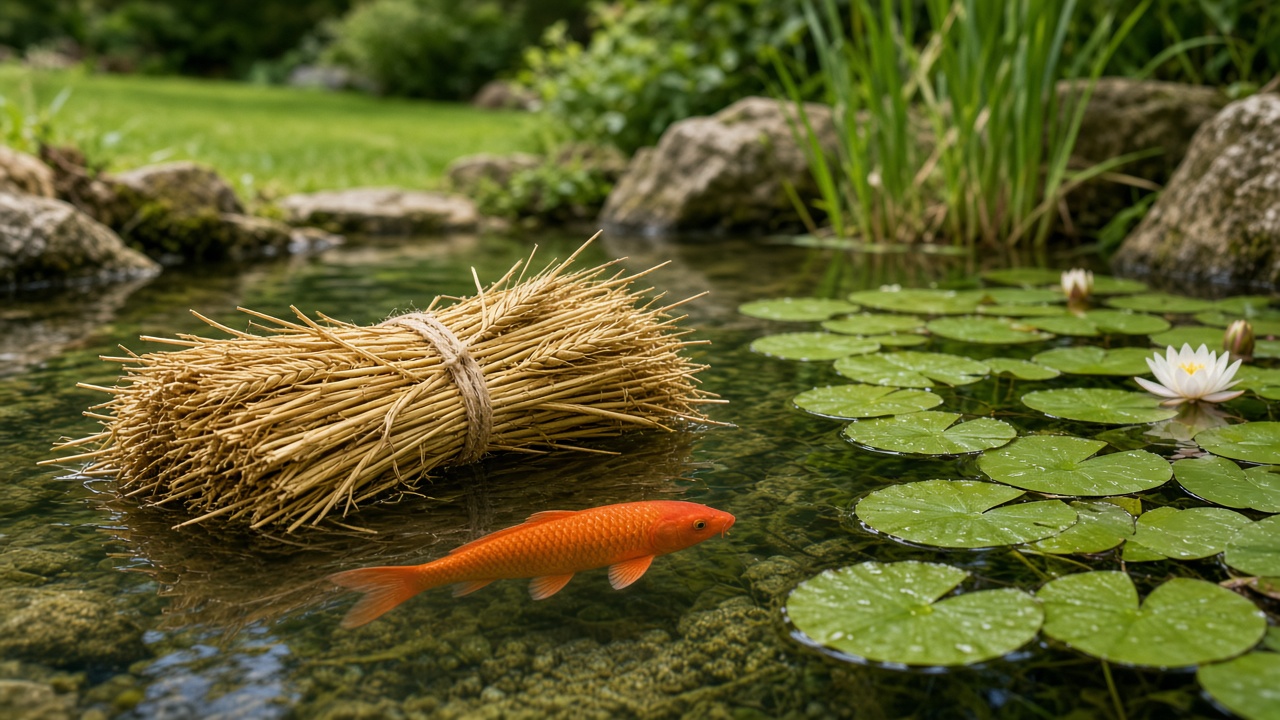
Loose, wet, sunlit straw is the placement goal, because tight bales and sunk bags fight that goal.
Rutgers NJAES says to use only dry straw and to skip fresh green material. Break full farm bales apart and fluff the straw so water can move through it.
For farm bales, Rutgers NJAES lists these steps:
- Bag the loose straw in onion sacks, bird netting, Christmas-tree netting, or jute
- Tie the sack to a float
- Keep it within a few feet of the surface
- Anchor it so it does not drift
Penn State Extension says the same surface rule. Anchor the bag to the bottom, and add a float so the straw stays high. Place more than one bag if the pond is large.
Put a bag near a spring or stream inlet if you have one.
Summit’s bale page is built for pre-bagged mini bales that you drop in as sold. The maker lists this swap:
- Start early in the season
- Add a new bale at month 5
- Remove the first bale at month 6
Aquascape’s pellet page says to park the mesh bag in the strongest circulation. MICROBE-LIFT says you can broadcast pellets or pack them in a porous sock. Hang that sock in the pond, a skimmer, or a filter chamber.
Aquascape’s extract page says to pour into the strongest flow, then aerate for at least 24 hours. When the listed life is up, pull the spent straw and compost it or bin it.
What barley straw will not do
Barley straw is a slow clarity tool, not a weed killer and not a licensed pesticide.
Rutgers NJAES says barley straw does not control higher plants such as duckweed, watermilfoil, and pondweed. In some ponds those plants can grow more after algae fade, because the plants then face less competition.
Rutgers NJAES also says barley is not a pesticide under the U.S. Environmental Protection Agency or New Jersey rules. You can use it on a private pond without a pesticide license in that framing.
You cannot sell it with an algae-control claim, and shared lakes may have extra limits. Do not use it as a same-week rescue. Rutgers NJAES says it will not match the speed of copper sulfate.
Do not pile on extra bales to speed the job. Rutgers NJAES caps the rate at 450 pounds per acre. Penn State Extension warns that an overdose in a warm spell can drop oxygen and kill fish.
Do not swap in wheat or rye. Rutgers NJAES says those straws have not been shown to work for this job.
Straw will not cancel a heavy fertilizer load from runoff, septic leaks, or goose droppings.
FAQ
Does barley straw kill the algae I already have?
No, Rutgers NJAES says it prevents new growth and does not kill existing algae. That is why the fact sheet uses the word algistat, and a green pond will not clear overnight.
How long before the water looks clearer?
Penn State Extension lists 6 to 8 weeks in water under 50°F. It lists 1 to 2 weeks in water above 70°F. Rutgers NJAES says the straw then lasts 4 to 6 months, so start before the bloom peaks.
Is barley straw a pesticide?
Rutgers NJAES says the U.S. Environmental Protection Agency does not treat barley as a pesticide. New Jersey uses the same view on that fact sheet.
That is why makers talk about clarity, not algae kill. Your state may still limit use on public water.
Will barley straw hurt fish or pond plants?
Rutgers NJAES says barley straw is not known to harm people, higher plants, or animals at normal rates. Summit’s bale page says the product is harmless to fish, plants, and animals.
The risk is overdose, because too much decaying straw can steal oxygen.
What if my pond is already a green soup?
The straw will not kill the bloom you see, and Rutgers NJAES says the action is slower than copper sulfate. You can still start a correct dose so new cells have a harder time.
You may also need to net mats, cut nutrients, or add aeration.
How often should I replace the straw or pellets?
Rutgers NJAES lists 4 to 6 months for loose straw, and Penn State Extension lists about 6 months. Summit lists up to 6 months per bale, while Aquascape pellets list a new bag every 6 to 8 weeks.