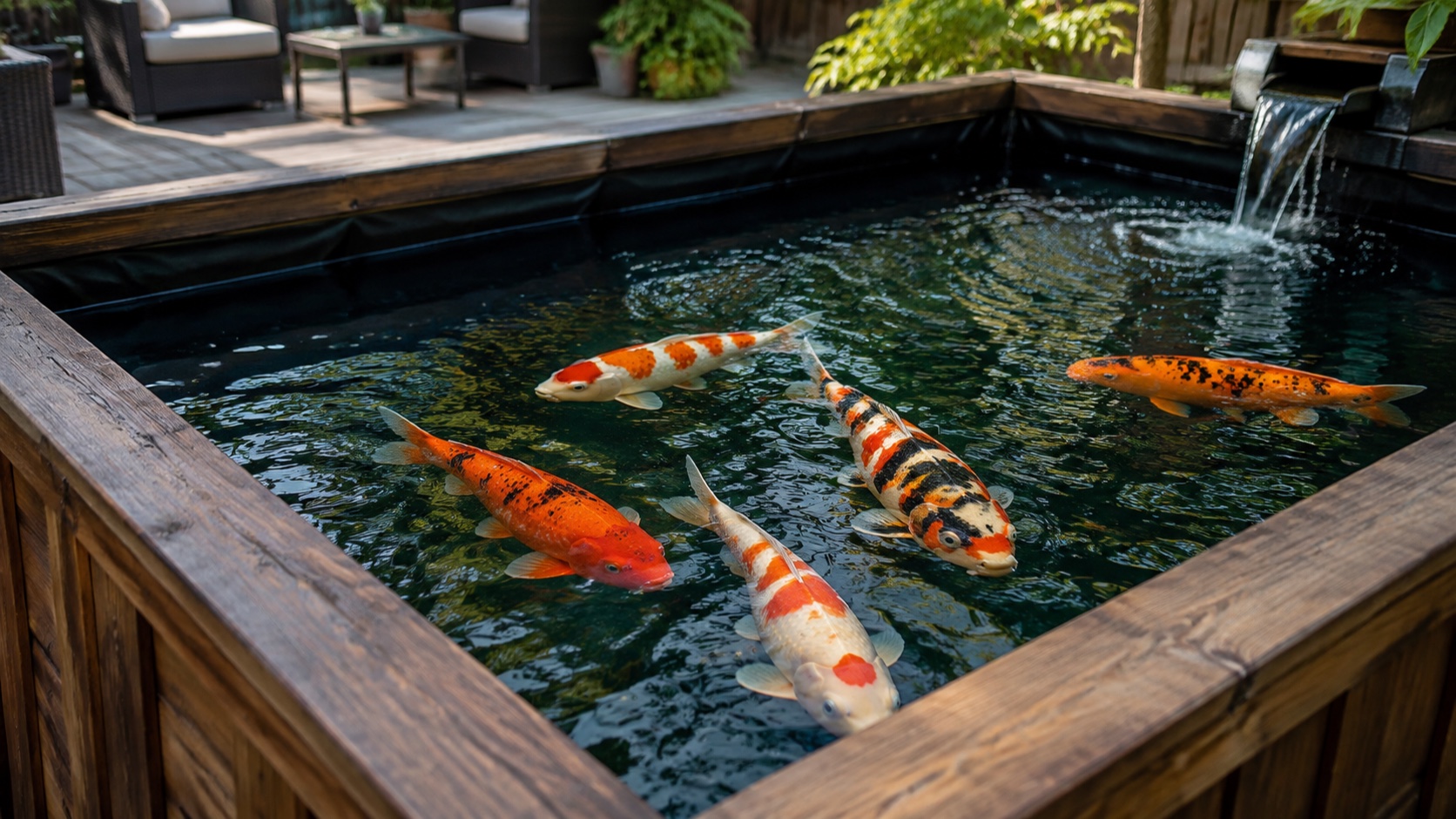
Quick answer: Build a lined, raised box and size it to a pond filter’s fish-stocked rating. Skip stock tanks, pool kits, and indoor canisters.
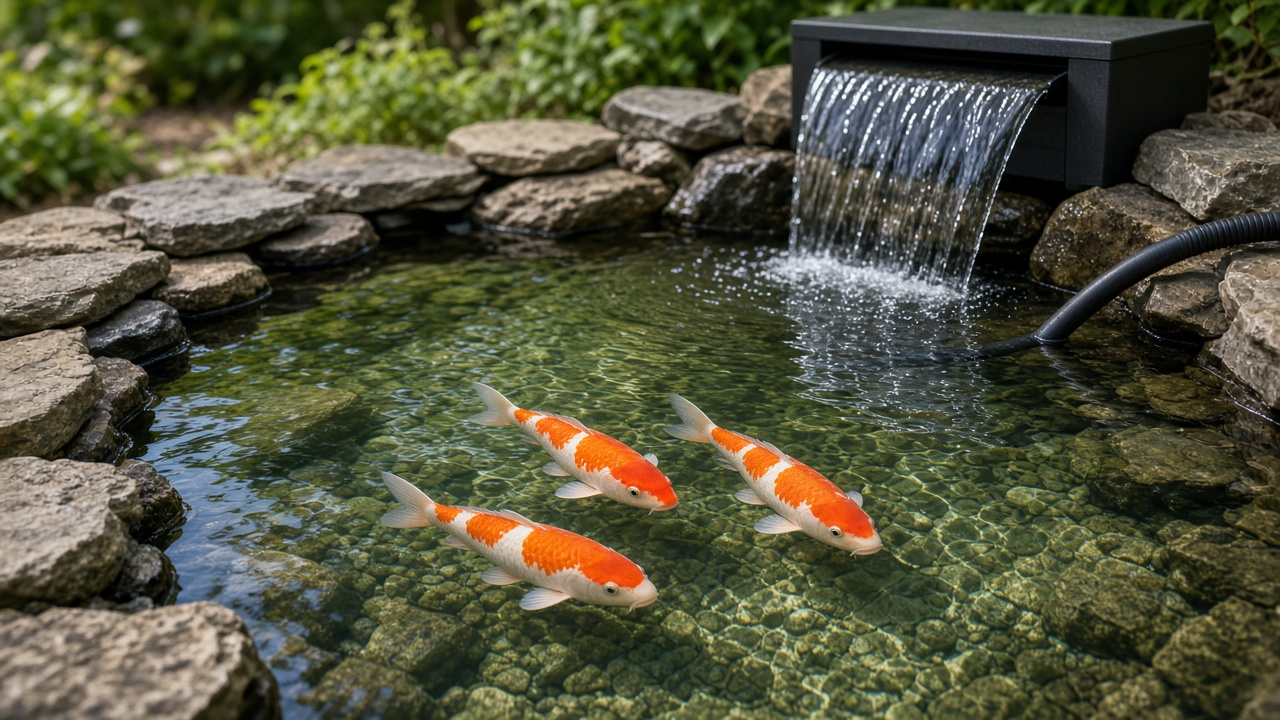
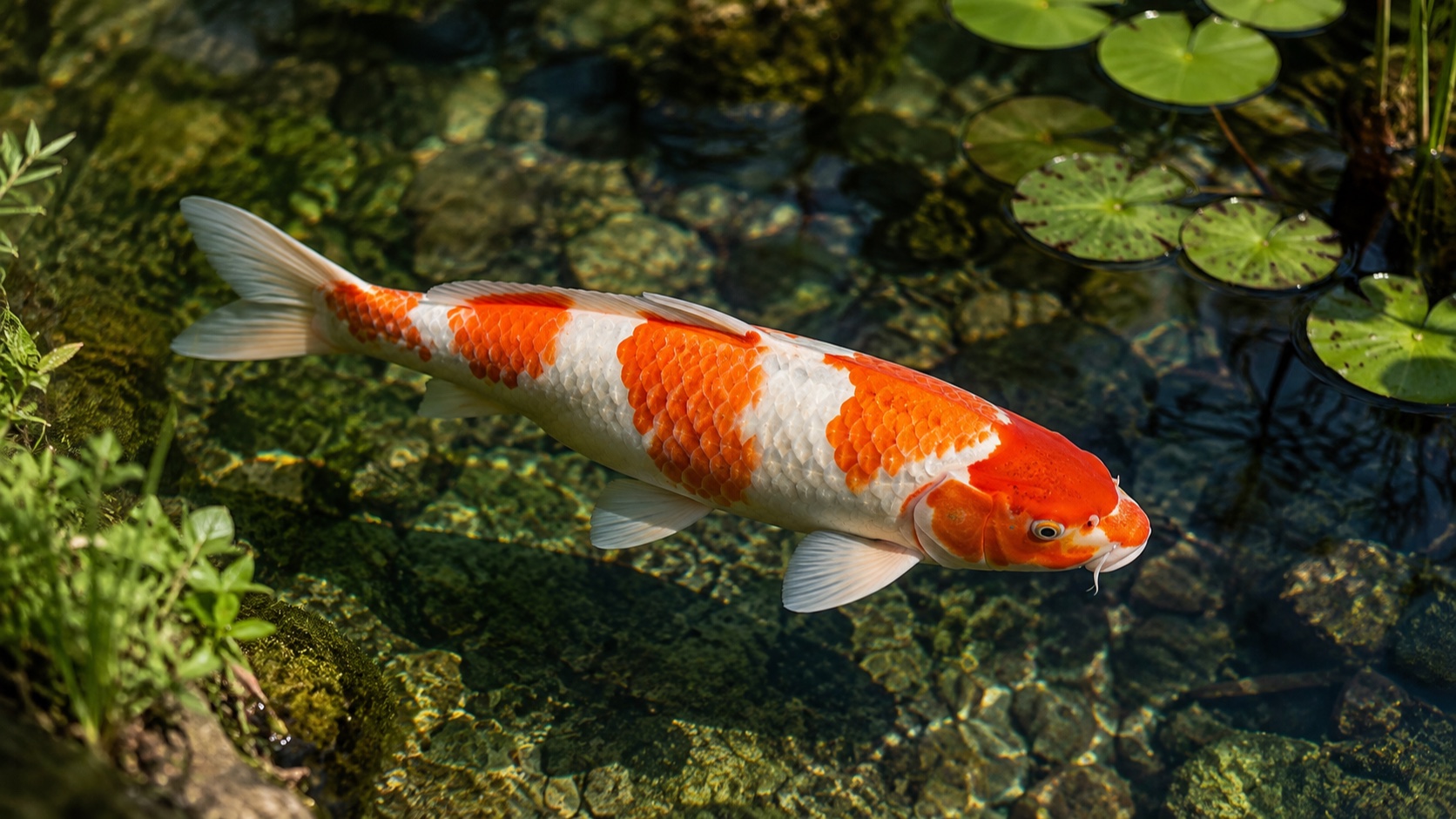
A raised liner box can hold koi if its gallons meet the filter maker’s fish-stocked rating.
This page is a 2026 build, size, and filter guide from WaterPuppy’s research desk.
Comparing published specs, EasyPro halves the EC2600 rating from 2,600 to 1,300 gallons with fish. That cut is the WaterPuppy Fish-Load Split, so use the fish number, not the no-fish number.
What this guide includes
The takeaway: a build or product enters this guide only if a maker page lists a fish-stocked or koi volume.
That is the WaterPuppy Fish-Rating Rule, and our research team applied it to current pond-filter pages.
We included these six currently sold units:
- EasyPro EC2600 Eco-Clear
- EasyPro EC3900U Eco-Clear
- OASE BioSmart 18000
- Aquascape UltraKlean 2000
- Aquascape UltraKlean 3500
- Aqua Ultraviolet Ultima II 4000
We left out these groups on purpose:
- Stock tanks with no maker fish-volume rating
- Swimming-pool kits sold as koi ponds
- Indoor hang-on and canister filters
- In-ground dig plans and concrete shells
- Ranked “top pond” lists
An above-ground koi pond is a sealed box you build up, not a hole you dig down. The filter loop stays the same, but the raised walls carry the full water load.
Size the pond from the fish rating
The takeaway: size the raised pond to the fish number on the filter page, not the no-fish number.
EasyPro’s page for the EC2600 Eco-Clear states 2,600 gallons, or 1,300 gallons with fish. EasyPro’s page for the EC3900U Eco-Clear states 3,900 gallons, or 1,950 gallons with fish.
Both cuts are exactly half, and that 50 percent drop is the WaterPuppy Fish-Load Split.
OASE’s BioSmart 18000 page lists three volumes:
- 18.0 cubic meters for a garden pond
- 9.0 cubic meters with fish stock
- 4.5 cubic meters with koi
4.5 cubic meters is about 1,189 US gallons, the smallest koi rating in this set.
Aquascape’s UltraKlean page lists 2,000 gallons on the 2000 and 3,500 gallons on the 3500. Aqua Ultraviolet’s Ultima II 4000 page lists 2,000 to 4,000 gallons and no separate no-fish figure.
Use this matching list as a rule, not a rank:
- If the filled box is near 1,200 gallons, the OASE BioSmart 18000 koi rating is the closest match in this set.
- If the filled box is near 1,300 gallons with fish, EasyPro’s EC2600 page is the floor.
- If the filled box is near 1,950 gallons with fish, EasyPro’s EC3900U page is the next step.
- If the filled box is 2,000 to 3,500 gallons, the two Aquascape UltraKlean ratings sit in that band.
- If the filled box is 2,000 to 4,000 gallons, Aqua Ultraviolet’s Ultima II 4000 range covers it.
Do not pick a filter from the no-fish gallon line, because koi are a fish load. The fish-stocked line is the number that answers the above-ground koi pond query.
Measure the inside length, width, and water height, then convert the box to gallons. Match that gallon count to the fish-stocked number before you buy the filter.
Build the raised box
The takeaway: an above-ground koi pond is a rigid frame, a liner, and a filter loop you plumb before you fill.
The walls must hold the water weight, and the liner must not leak.
Use this build order:
- Pick a level pad that will not settle under the water weight.
- Build a rigid frame from timber, block, or steel.
- Smooth the inside and pad every screw head and sharp edge.
- Lay underlayment on the floor and walls.
- Set one pond liner with extra slack at the corners.
- Plumb the filter loop before you add water.
- Fill slowly and fold the liner as the water rises.
- Recheck the true gallons against the filter’s fish rating.
Keep the top of the wall above the water line, and leave a freeboard strip so a rain day does not spill koi.
Hide the filter beside the box, not inside it. EasyPro’s Eco-Clear pages say the housing can be buried up to the cleaning ring.
OASE’s BioSmart 18000 page says the housing can be buried to one-third of its height. Do not set an indoor tank filter on this raised box.
A Top Fin EF-S is a hang-on unit for glass tanks, and that scale is wrong for a koi pond. A still-water betta setup is the wrong model too, because koi need a pond-rated loop.
Compare six current pond filters
The takeaway: pressure filters, flow-through boxes, and bio-mechanical canisters all work if the maker lists a fish or koi volume.
Our research team built this table from maker pages, and every cell is a listed attribute. A blank cell means that page did not print the figure.
| Model | Filter style | Fish or koi volume (maker) | Peak listed flow | UV on this SKU |
|---|---|---|---|---|
| EasyPro EC2600 Eco-Clear | Pressurized foam and bio media | 1,300 gal with fish | — | None |
| EasyPro EC3900U Eco-Clear | Pressurized foam and bio media | 1,950 gal with fish | — | 24 W |
| OASE BioSmart 18000 | Gravity flow-through | 4.5 m³ koi | 5,500 L/h | None on this SKU |
| Aquascape UltraKlean 2000 | Pressurized with UV | 2,000 gal average pond | 2,700 GPH | 14 W |
| Aquascape UltraKlean 3500 | Pressurized with UV | 3,500 gal average pond | 5,200 GPH | 28 W |
| Aqua Ultraviolet Ultima II 4000 | Bio-mechanical canister | 2,000–4,000 gal | 4,500 GPH | None |
Read the table left to right, and do not treat the first row as a winner.
EasyPro’s EC3900U page states a 24 watt UV lamp. Aquascape’s UltraKlean page states 14 watts on the 2000 and 28 watts on the 3500.
OASE’s BioSmart 18000 page lists a maximum flow of 5,500 liters per hour. That page also lists four filter foams and a 3-year guarantee.
Aqua Ultraviolet’s Ultima II 4000 page lists a minimum flow of 2,000 GPH and a maximum of 4,500 GPH. The 1-1/2 inch unit is 20-1/2 inches in diameter and 38 inches tall.
Aquascape’s UltraKlean 3500 listing is 13 inches by 13 inches by 21.5 inches. The UltraKlean 2000 listing is 13 inches by 13 inches by 17 inches.
Both UltraKlean pages list a 20-foot power cord. A pressure filter can sit beside a raised wall and push water back up.
A flow-through box like the BioSmart needs a downhill return. A tall unit like the Ultima II 4000 needs floor space next to the box.
Pick the filter style that fits the pad, then match the fish-stocked gallons on the maker page.
Pumps, flow, and filters that do not belong
The takeaway: pair the pond filter with a pump inside the maker’s listed flow band, not with an indoor canister.
Aqua Ultraviolet’s Ultima II 4000 page lists 2,000 GPH as the floor and 4,500 GPH as the ceiling. The pond range on that same page starts at 2,000 gallons.
Those two floors meet at one turnover per hour, and that pairing is a listed match, not a bench result.
OASE’s BioSmart 18000 page lists 5,500 liters per hour next to a 4.5 cubic meter koi rating. 4.5 cubic meters is 4,500 liters, so the listed flow is a little over one pond volume per hour on that koi line.
Aquascape’s UltraKlean 3500 page lists a 5,200 GPH maximum on a 3,500 gallon average pond. That ceiling is more than one pond volume per hour.
Do not use an indoor canister filter as the main koi filter, because those units are sized for tank gallons. A hang-on Top Fin EF-S is even smaller, and it cannot serve a raised koi box.
Use this plumbing list:
- Put the pump in a pump vault or on a shelf inside the pond.
- Run a short, large-diameter hose to the filter inlet.
- Return water at the far wall so the box circulates.
- Add a valve if the pump can exceed the filter’s listed maximum.
- Keep the filter flood-safe beside the frame, not under the water line.
If you want a waterfall, a pressure filter can feed it. A gravity BioSmart cannot lift water, so plan the pad height first.
Quarantine numbers from University of Florida IFAS
The takeaway: University of Florida IFAS published a 30-day, 75°F quarantine rule for new koi.
University of Florida IFAS’s Koi Herpesvirus Disease page states that fish should be quarantined for a minimum of 30 days. For KHV, it says new koi should be held at 75°F (24°C) for at least 30 days.
That page also states KHV disease often results in 80% to 100% mortality. Those losses occur when water is between 60°F and 77°F (16°C and 25°C).
University of Florida IFAS cites the first recognized case in the United Kingdom in 1996. The same page states there is no treatment for KHV. It says viral particles in environmental water may remain infectious for up to three days.
If you empty a system, that page lists a chlorine protocol of 200 ppm (200 mg/L) for one hour. For household bleach at 5.25% sodium hypochlorite, it states 35 milliliters per gallon of water to reach 200 mg/L.
Use that bleach math only on gear with no fish in the water, then rinse well. The same page says leftover disinfectant can kill fish.
Keep new koi in a separate tub or tank, and use separate nets and buckets. Do not add them to the raised pond on day one.
A betta filter article will not cover this virus, because koi and bettas are different jobs.
FAQ
Can I keep koi in an above-ground pond?
Yes, if the filled box meets a filter maker’s fish-stocked or koi rating. EasyPro’s EC2600 page sets that floor at 1,300 gallons with fish. OASE’s BioSmart 18000 page sets a koi line at 4.5 cubic meters, about 1,189 gallons.
How many gallons does an above-ground koi pond need?
Use the fish number on the filter you will buy. EasyPro halves both Eco-Clear ratings when fish are listed. OASE cuts the BioSmart 18000 from 18.0 cubic meters to 4.5 cubic meters for koi.
Can I use a stock tank as a koi pond?
Not under the WaterPuppy Fish-Rating Rule. We left stock tanks out because they lack a maker fish-volume rating that matches these pond filters. A tub can hold water, but that is not the same as a rated koi loop.
Do I need a UV lamp on the filter?
Only if green water is the problem you want to treat. EasyPro’s EC3900U page lists 24 watts, and Aquascape’s UltraKlean 3500 page lists 28 watts. UV does not raise the fish-gallon rating.
Can I run an indoor canister on a raised koi pond?
No. Indoor canister filters are built for tank gallons, so pair the pond with a pond-rated unit from the table. Keep the indoor canister on a glass tank.
How long should new koi stay separate?
University of Florida IFAS says a minimum of 30 days. For KHV, it says hold new koi at 75°F (24°C) for at least 30 days. Use a separate system and separate tools.
How tall should the walls be?
Tall enough that the filled volume meets the filter’s fish-stocked gallons. Recheck after you fill, and if the true gallons sit under the fish line, remove fish or step up the filter.