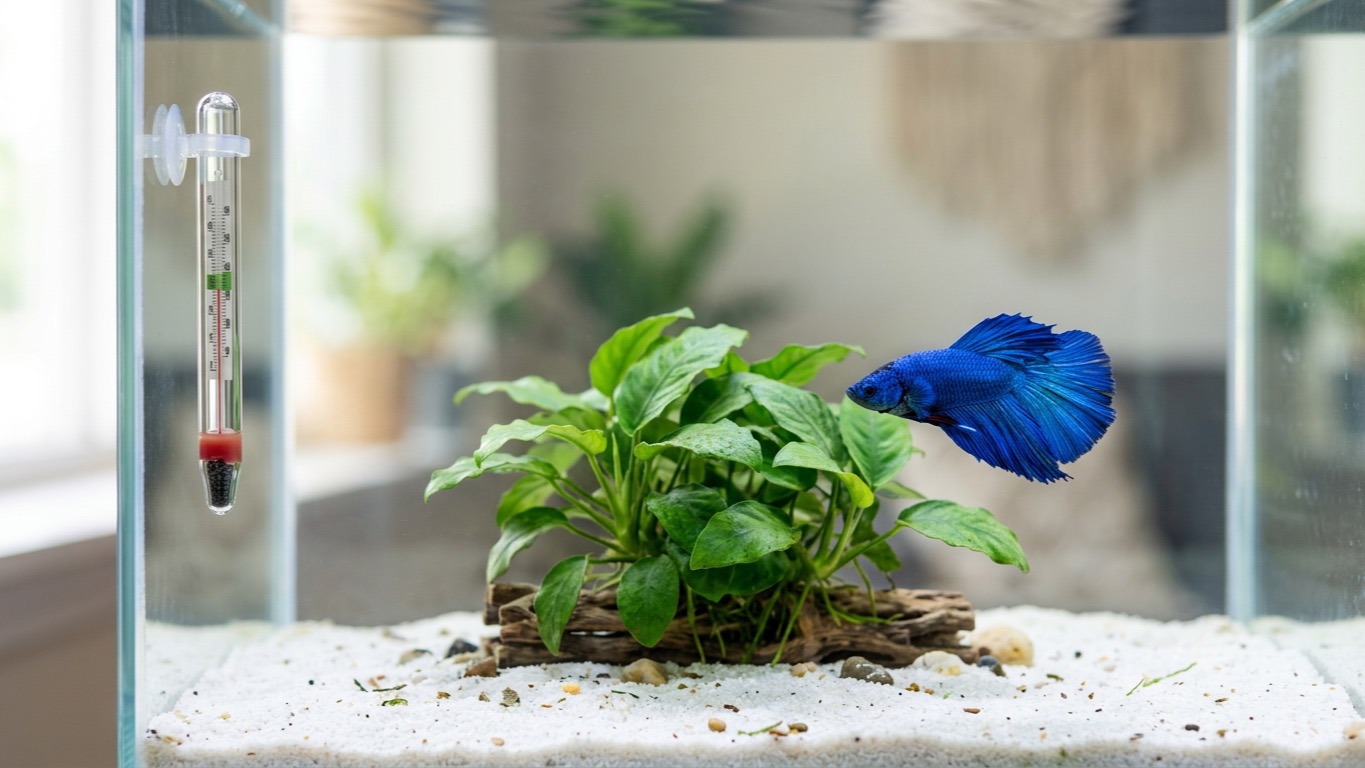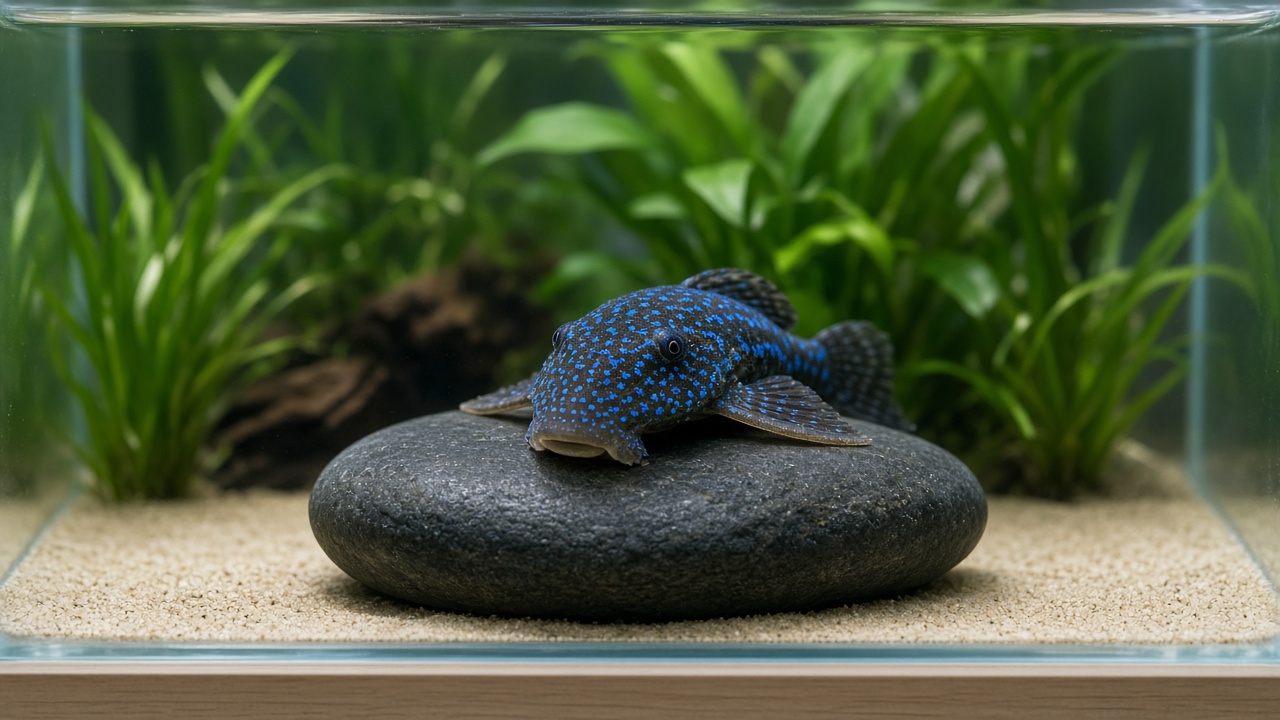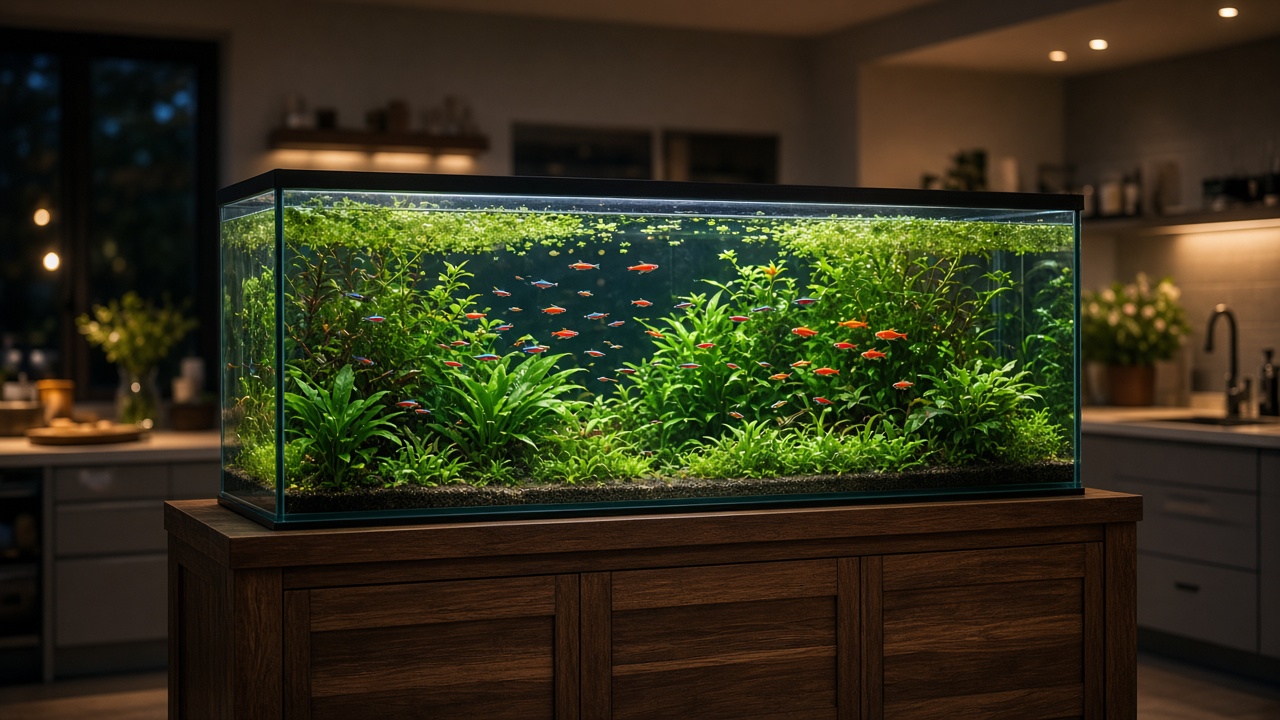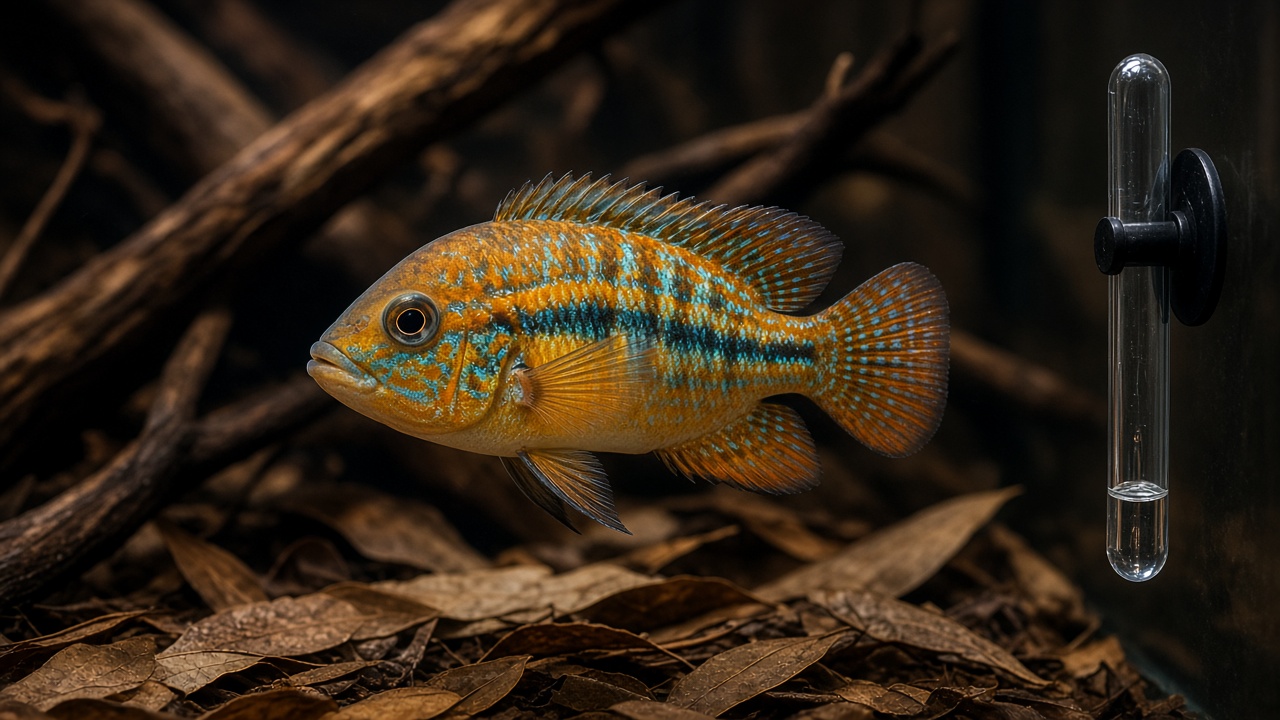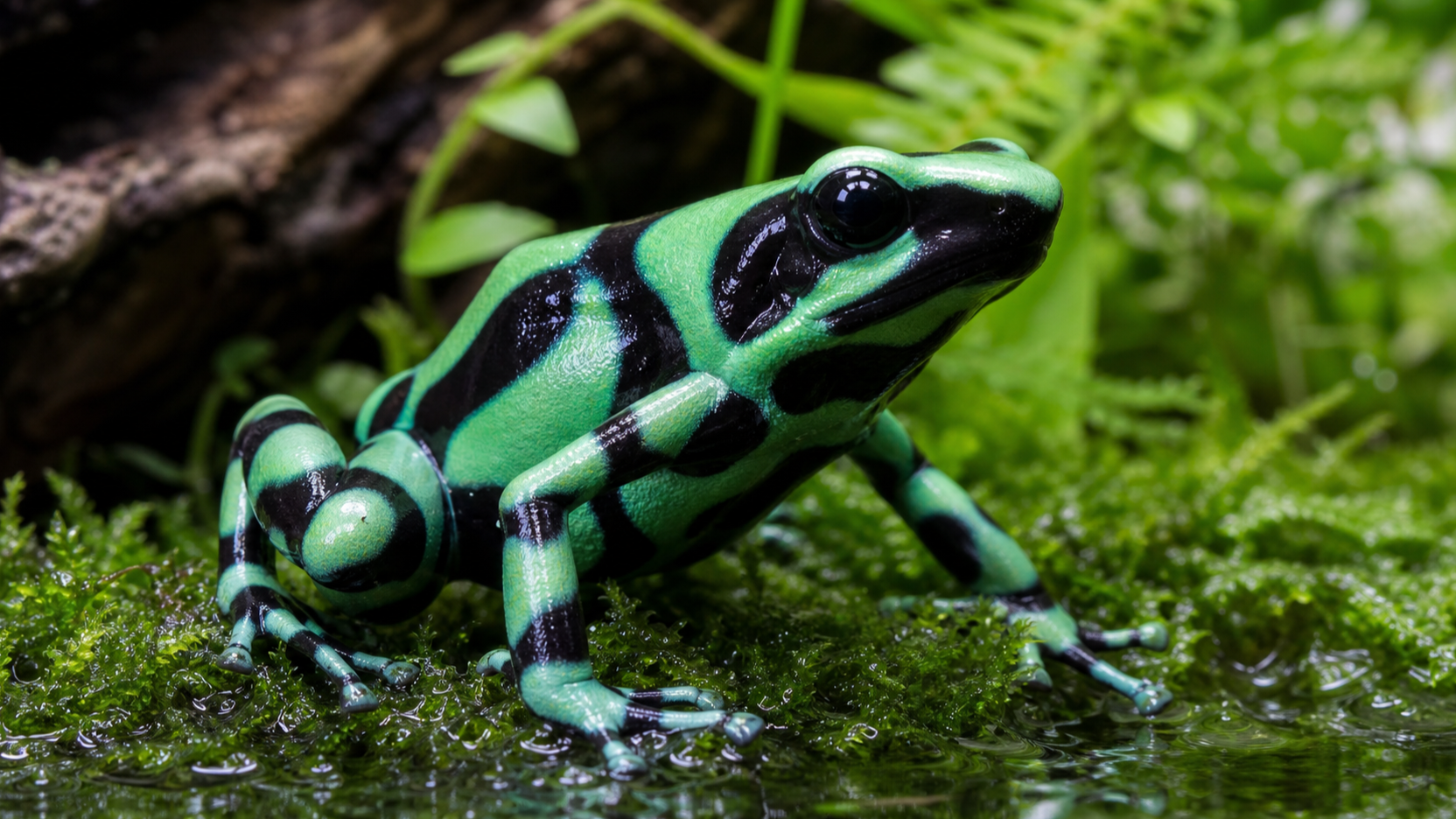
The best paludarium pets are animals that genuinely need land and standing water: Oriental fire-bellied toads, Vietnamese mossy frogs, vampire crabs, cherry shrimp, nerite snails and least killifish. Poison dart frogs dominate the search results but want almost no open water. Most of these species must be kept alone, not mixed.
What a paludarium actually is — and where you buy the animals
A paludarium is one enclosure holding two environments: a shallow body of standing water and a humid, ventilated land mass, usually planted. It is not an aquarium with a rock in it. The water section behaves like a much smaller aquarium than the tank's nominal gallonage suggests — a 20-gallon tank that is half land holds roughly a 10-gallon water body, which fouls, heats and chills far faster than a full tank.
A practical note on shopping. Live animals are not sold by the general online retailers most people default to. Dart frogs, mossy frogs and vampire crabs come from specialist breeders who ship overnight; fire-bellied toads, newts and small fish come from independent aquatic stores, reptile expos and hobbyist breeder networks. Only the hardware — tanks, filters, misting systems, heaters, test kits — comes from ordinary retail. If a listing promises you a live dart frog alongside a bag of gravel, that is a reseller, not a breeder.
This article is general care information compiled from published care sheets, species databases and regulatory sources. Confirm requirements for your specific animal with the breeder you buy from and with an exotics-experienced veterinarian.
---
Amphibians
Amphibians can carry Salmonella. The Minnesota Department of Health advises that they not be kept in households with children under five, pregnant women, older adults or immunocompromised people, and that hands be washed after any contact with the animal or its enclosure. None of the animals below is a handling pet.
Oriental Fire-Bellied Toad — Bombina orientalis
Difficulty: Beginner · Adult size: 3.5–8 cm per Animal Diversity Web, though hobby sheets more commonly report 38–50 mm snout-to-vent (1.5–2 in) · Temperature: 72–78°F day, occasional drops to 60°F tolerated, do not exceed 82°F (AmphibianCare) · Water: dechlorinated, sloping to about 3 in deep · Minimum enclosure: a 15-gallon 24 × 12 × 12 in for five adults (AmphibianCare)
Why it suits a paludarium: This is the genuine beginner animal of the category. ADW describes it living in and around ponds, ditches and puddles — a shoreline animal by default. It is diurnal, needs no heat lamp or UVB, and AmphibianCare puts the land area at roughly one half to two thirds of the floor area, which is close to the classic 50/50 build people picture. It is also the only species here comfortable at ordinary US room temperature.
Honest drawback: They foul shallow water fast; a small water section may need changing daily. Their skin toxin is, per ADW, harmless on intact human skin but harmful in eyes, mouth or broken skin, and a badly threatened toad can foam toxin over its whole body. ADW records a captive maximum near 30 years, so the $10 impulse purchase is a serious commitment — though the same source gives an average of only 2.3 years, which tells you how often that goes wrong.
Cohabitation: Same species only, strictly. Their skin secretions contaminate shared water and decor, which is why the FrogForum care article calls housing them with fire-bellied newts "a dangerous and common mistake." That prohibition rests on the toxin and on mutual predation — not on temperature, and no thermostat setting makes the pairing safe.
Vietnamese Mossy Frog — Theloderma corticale
Difficulty: Intermediate · Adult size: males around 61 mm snout-vent, females 8–9 cm · Temperature: Reptiles Magazine calls the 60s and low 70s°F ideal, says down to about 50°F is fine, and states plainly that above 80°F is unsafe; Exotics Keeper is cooler at 15–21°C · Water/humidity: 2–4 in of standing water; Reptiles Magazine gives a humidity floor of 60%, Exotics Keeper argues for above 80% at all times · Minimum enclosure: 18 × 18 × 18 in for a pair (FrogPets); at Reptiles Magazine's roughly 10 gallons per frog, a 24 × 18 × 18 (~34 gal) suits three
Why it suits a paludarium: This is the species the format was made for. Mossy frogs float with just the nostrils breaking the surface, then haul out onto wet cork and rock. Roughly half water, half emergent land is right, and the camouflage only reads properly against a mossy, tannin-stained background. Reptiles Magazine uses reverse-osmosis water reconstituted with a mineral additive plus an Indian almond leaf for tannins — straight RO is not appropriate for an animal absorbing water through its skin.
Honest drawback: Keeping it cool enough. A lit, planted tank in a typical US home drifts warm, and this frog needs to stay well under 80°F year-round, which often means air conditioning or a cool basement. It is nocturnal and cryptic — it will sit motionless in one spot all day. Filtration is optional, not required: Reptiles Magazine reports keeping hundreds in unfiltered standing water and associates over-clean water with eye problems, changing roughly two thirds of the volume every two to three weeks instead.
Cohabitation: Groups of two to four of their own species work well. Reptiles Magazine mentions white cloud mountain minnows but concedes in the same breath that a fish may become an occasional snack — an 8–9 cm frog will eat a 4 cm minnow, and unfiltered tannin water two to four inches deep is not adequate fish housing either. Treat this as a species-only tank.
Chinese Fire-Bellied Newt — Cynops orientalis
Difficulty: Intermediate · Adult size: 6–10.3 cm total length (Caudata.org); males stay under 8 cm · Temperature: 14–20°C (58–68°F), with Caudata.org stating temperatures above 23°C (74°F) should be avoided; [](https://www..com/exotic/fire-bellied-newt-care-sheet) gives a hard ceiling of 78°F · Water: cool, dechlorinated, low-flow, fully cycled; Research suggests depth at least 1.5× the body length of the largest newt · Minimum enclosure: 15 gallons for one, 20 for two
Why it suits a paludarium: A small, slow, cold-water newt from shallow vegetated ponds and abandoned rice paddies. It is essentially aquatic but, as Salamanderland puts it, an emerged area — even a small one — is mandatory. A stack of smooth rocks or a cork raft breaking the surface is enough. No heater, no UVB, no basking site.
Honest drawback: Heat and handling. In most US homes without air conditioning an unheated tank sits in the high 70s°F for months, above every published ceiling. Skin secretions contain tetrodotoxin; a Toxicon survey of Asian newts (PMID 28528177) reported a mean of 36.25 µg/g in this species, the highest among those sampled. Research suggests never letting secretions reach eyes, mouth or open wounds. also cites 15–25 years of life with good care.
Cohabitation: Species-only, and no fish. Caudata.org's article on newts and fish gives three concrete reasons: most pet-store fish want 74–82°F while caudates want a 72°F maximum; newts eat small fish while fish nip gills, limbs and slime coat; and fish import parasites that hide invisibly in gill rakers. Conspecifics can share a tank but bite hard at feeding time — Salamanderland warns they can bite off each other's limbs — so feed with tongs and spread food out. Never house with fire-bellied toads.
Legality (checked July 2026): All Cynops are listed as injurious wildlife under the Lacey Act. The 2016 interim rule was finalized alongside a new interim rule effective 27 January 2025, and the listing now covers 36 genera of salamanders and newts — including Ambystoma, which captures axolotls and tiger salamanders. Importation into the US is prohibited, as is shipment between the continental US and DC, Hawaii, Puerto Rico or US possessions. Shipment between the 49 continental states is allowed under federal law, though state law may apply, and possession and captive breeding are not prohibited. Because imports stopped in 2016, cheap fire-bellied newts are still widely advertised in the US — insist on proof of domestic captive breeding, and verify current FWS guidance before you buy.
Green and Black Poison Dart Frog — Dendrobates auratus
Difficulty: Intermediate · Adult size: roughly 1.25–1.6 in (ADW gives about 4 cm; Josh's Frogs gives females ~1.5 in, males ~1.25 in) · Temperature: Josh's Frogs states 65–85°F is tolerated but the low-to-mid 70s preferred, with sustained temperatures over 85°F dangerous · Humidity: 70–100% (Josh's Frogs); dartfrog.pet gives 80–95%. Brief dips toward 50% are survivable only with water access · Minimum enclosure: an 18 × 18 × 18 in or 20-gallon high for one to three frogs, horizontally oriented
Why it suits a paludarium: It is the most forgiving commonly kept dart frog and the usual first choice, diurnal and genuinely active on the forest floor. The permanently high humidity a paludarium generates is exactly what it wants — but the water is not. Josh's Frogs notes auratus climb less than other darts and prefer a horizontal tank.
Honest drawback: The standing water that defines a paludarium is the single biggest hazard to this frog. Dendrobatids swim badly and can drown in a few centimetres; experienced keepers generally advise against real water features, citing drownings (including frogs drowning each other while wrestling) and easier pathogen spread. Plan on 90–95% planted land with leaf litter, and any water as a shallow, gently sloped margin the smallest frog can walk out of. There is also no shelf-stable food: you culture flightless fruit flies weekly for the animal's whole life, and cultures crash.
Cohabitation: None. Never mix auratus with another dart species or another auratus morph — size and aggression differences let one frog dominate while the losers quietly waste away, and mixed morphs produce hybrids that pollute hobby bloodlines. Devin Edmonds' analysis of mixed-species enclosures covers the rest: incompatible needs, predation, and pathogen transfer between animals from different sources. Springtails and isopods only.
Legality: Dendrobates are CITES Appendix II, so buy captive-bred — which also means non-toxic, since Understory Enterprises states no captive dendrobatid possesses alkaloids, these being acquired in the wild from ants, millipedes and mites. Introduced to Oahu in 1932 (USGS), the species is now naturalized there; the Hawaii Department of Agriculture & Biosecurity reports populations on Oahu and Maui and states that poison dart frogs are illegal to possess or transport to or within Hawaii, with penalties up to a class C felony, a $200,000 fine and three years' imprisonment.
Dyeing Poison Dart Frog — Dendrobates tinctorius (includes "Azureus")
Difficulty: Intermediate · Adult size: FrogDaddy gives 1.5–2.5 in; ADW gives 3–4.5 cm for the species — the sources disagree by roughly 2 cm at the top end · Temperature: 68–80°F day with a slight night drop (FrogDaddy). Do not exceed 80°F · Humidity: 80–90%, misted once or twice daily rather than constantly · Minimum enclosure: 18 × 18 × 18 in for a pair, floor space over height
Why it suits a paludarium: The showiest and most-kept dart frog, bold and diurnal rather than hiding, and comfortable in permanent high humidity. ADW notes wild animals stay near small streams among moss-covered rocks and will climb several metres, so a mossy stream-margin build with low climbing structure reads as natural — as long as the water stays a shallow, exitable margin. These are heavy-bodied, ground-dwelling, poor swimmers.
Honest drawback: Female-female aggression. Josh's Frogs reports that as a group reaches sexual maturity around 10–12 months the dynamic changes and all but one female may need removing — which means a second finished vivarium on standby. ADW reports about 10 years in captivity and up to 12, versus 4–6 in the wild: a decade of daily misting checks and weekly fly cultures.
Cohabitation: A proven male/female pair and nothing else. Never mix species or morphs. No fish, reptiles or other frogs. Fighting here is slow and quiet — the loser stops feeding and declines over weeks, which is why keepers miss it.
Mimic Poison Frog — Ranitomeya imitator
Difficulty: Advanced · Adult size: 17–21 mm · Temperature: Major League Exotics gives 70–74°F as ideal with a night drop, tolerated lows of 65–68°F which often trigger breeding, and 78°F as a hard ceiling · Humidity: 90–100% is the operating band; sustained drops below about 75% cause health problems. Twice-daily misting minimum, with screen tops 85–90% covered · Minimum enclosure: a vertical 12 × 12 × 18 in for a bonded pair; a 1.2 trio only in a larger tank
Why it suits a paludarium: It is the one frog here that actually uses the vertical zone — the mossy background, cork tubes and bromeliads most builders install and then watch go unused. In the wild it breeds in the few millilitres held in bromeliad axils, not in pools; pooled water at the tank bottom is a hazard to a frog this small, not an amenity. Brown, Morales and Summers (American Naturalist 175:436–446, 2010) documented social and genetic monogamy in this species, the first confirmed case in any amphibian, driven by cooperative biparental care.
Honest drawback: Almost no margin for error. Under an inch long, they escape through gaps you did not know existed and can only eat Drosophila melanogaster — the larger D. hydei is too big at any age, so the whole feeding operation depends on one culture type not crashing. A 78°F ceiling and a 75% humidity floor means a bad week is a dead frog. Dart specialists rate it intermediate among thumbnails; for a general paludarium keeper it is advanced.
Cohabitation: One adult male per enclosure, no exceptions — two males means chronic stress and fighting. A single male with one or two females can work in a larger planted tank. Nothing else, ever, and tadpoles are cannibalistic and must be reared separately.
---
Invertebrates
Vampire Crab — Geosesarma dennerle and related species
Difficulty: Intermediate · Adult size: carapace roughly 1.5–2.5 cm (the G. dennerle holotype male measured 14.4 × 14.0 mm), about 2 in across the legs; lifespan around 2–2.5 years · Temperature: Indoor Ecosystem gives water 71–78°F and air 71–82°F; a build guide for this species warns that water above 28°C (82°F) has disastrous consequences · Humidity/water: 75% or higher; water deep enough to fully submerge the crab for moulting — sources give 2–4 in (Petco), 5–6 cm and 10–15 cm respectively, and disagree on pH (7.5–8.0 versus 6.5–7.5) · Minimum enclosure: 10 gallons for a small group, with a tight lid
Why it suits a paludarium: This is the flagship. An 80% land / 20% water split with burrowable soil, high humidity and a shallow moulting pool is precisely what a paludarium is. They have direct development — females carry 20–80 eggs and release fully formed 1–2 mm juveniles with no planktonic stage — so they genuinely breed at home. Colourful, small, day-active, and they use vertical space.
Honest drawback: Humidity is what kills them; Petco notes owners commonly fail on the land section, and holding 75%+ takes a sealed enclosure with controlled venting, not an open aquarium. The lifespan is short, so the colony is always rebuilding. And a freshly moulted crab disappears for about a week — you can go days without seeing an animal you paid a premium for. Petco's 2.5-gallon minimum for a single crab is a figure to reject, not a floor to aim at: at an 80/20 ratio that is half a gallon of water, which cannot hold stable parameters.
Cohabitation: Species-only, and do not mix different Geosesarma — conflicts between them are fatal, and much of what stores sell as one species is a mixed bag of look-alikes. They prey on small snails and take shrimp opportunistically. A cherry shrimp colony can outbreed the predation, but that is a tolerated loss you are choosing, not compatibility. Springtails and isopods are genuinely useful.
Cherry Shrimp — Neocaridina davidi
Difficulty: Beginner · Adult size: females up to about 1.5 in, males 1–1.25 in (Aquarium Co-Op); short-lived, often little more than a year · Temperature: 60–82°F tolerated, 72–76°F optimal · Water: fully aquatic; pH 6.5–8.5, GH at least 6°/110 ppm, KH at least 2°/40 ppm, ammonia and nitrite zero · Minimum enclosure: 2 gallons is technically workable, 10+ for a breeding colony
Why it suits a paludarium: The low-risk way to put visible animal life in the water section. They graze biofilm off hardscape and leaves, breed without a larval stage to manage, tolerate a wide parameter band, and cost little enough that a beginner's early mistakes are not catastrophic. Note the implication of that 10-gallon figure: in an 80/20 land-heavy build, a self-sustaining colony means a roughly 50-gallon tank overall. Shrink the water instead and you get an unstable puddle.
Honest drawback: They hide, they are prey, and they are chemically fragile — a single dose of copper-containing fish medication or an untested plant fertiliser can wipe out the colony at once, and soft water causes repeated failed moults. In a vampire crab tank running toward 82°F, the water sits at the very top of their tolerated band, which shortens their already short lives.
Cohabitation: Peaceful, so the risk runs the other way — almost all fish eat baby shrimp. Fine with nerite and ramshorn snails. Never release them or dump tank water outdoors: the USFWS ecological risk screening rates the species HIGH RISK, though with a stated certainty of LOW, and USGS records it established on Oahu since the 1990s with collections in central Florida.
Nerite Snail — Neritina / Vittina natalensis (zebra), Clithon corona and C. diadema (horned)
Difficulty: Beginner · Adult size: roughly 0.5–1 in shell diameter (Aquatic Arts); published lifespan figures vary too widely to state · Temperature: 65–85°F · Water: pH 6.5–8.5, kH 12–18, gH 12–18 — a hard-water animal; soft acidic water erodes the shell. Extremely copper-sensitive · Minimum enclosure: volume is not the limit, an established cycled water section with real algae growth is. A lid is non-negotiable
Why it suits a paludarium: The best algae grazer for the waterline film a paludarium always develops. Critically, they cannot reproduce in fresh water — the larvae need brackish conditions — so you get sustained grazing with no population explosion.
Honest drawback: The eggs. Females deposit hard white sesame-seed capsules over glass, wood and leaves; in fresh water they never hatch but they do not come off without scraping, which in a mossy display build is a permanent nuisance. And they climb out. Aquatic Arts, which sells them, claims they take on tough hair algae other snails refuse; other keepers report they ignore it — treat nerites as steady maintenance grazers, not an outbreak cure.
Cohabitation: One of the few genuinely safe additions — fine with small peaceful fish, dwarf shrimp and other snails, but not with loaches or cichlids, and not with vampire or fiddler crabs, which eat them. Note the trade is wild-collected: because the larvae require brackish water, nobody rears nerites commercially.
Fiddler Crab — Minuca and Leptuca spp. (formerly all Uca)
Difficulty: Advanced — despite being cheap and widely sold · Adult size: about 2 in across including legs; 2–3 years in correct conditions · Temperature: 75–82°F ([](https://www..com/blog/fish/tips-for-keeping-fiddler-crabs-in-your-brackish-tank/)) to 75–88°F (Shrimp and Snail Breeder), with the air above the land mattering as much as the water · Water: BRACKISH — specific gravity 1.005–1.015 made with marine salt mix, pH roughly 7.2–8.2 · Minimum enclosure: 10 gallons is quoted, but the binding constraint is a 4–8 in sand bed and a sloped shoreline, which a tall 10-gallon cannot give you
Why it suits a paludarium: Behaviourally they are excellent — they burrow, forage the sand, and males wave the enlarged claw in visible display. A sand slope running into shallow brackish water is an accurate salt-marsh mudflat.
Honest drawback: They are the most commonly killed animal in this category, and the cause is usually the shop. They are routinely sold and kept in fresh water; Research suggests they survive it for up to about three weeks, which is exactly why the mistake persists — the crab does not die immediately, it dies at the next moult, and adults moult every two to three months. Note that Minuca minax, the red-jointed fiddler, is a low-salinity outlier found well up tidal streams, but it still cannot live indefinitely in fresh water. Skip the submersible heater: in a few inches of water over a deep sand bed it will not stay covered, so heat the air with an under-tank or ambient source on an external thermostat.
Cohabitation: Alone. They eat shrimp and snails outright, males fight over burrows, and the salinity they require is flatly incompatible with every other species on this list. Sourcing is the other honest problem: essentially all trade animals are wild-caught, because the larvae are planktonic and, per fiddlercrab.info, spend "a few weeks to a few months" swimming before becoming true crabs — a rearing job for a lab, not a home.
---
Fish
Shallow water breaks common gear: hang-on-back filters need depth to prime, so plan on an air-driven sponge filter, a low-profile internal filter, or a canister with the intake sunk into the deepest point.
White Cloud Mountain Minnow — Tanichthys albonubes
Difficulty: Beginner · Adult size: 30–40 mm (Seriously Fish) · Temperature: 14–22°C (57–72°F); Aquarium Co-Op gives a working 65–77°F and states no heater is required · Water: pH 6.0–8.5, hardness 90–357 ppm, fully cycled · Minimum enclosure: Seriously Fish gives 60 × 30 cm (24 × 12 in) as the minimum base for the water body alone — so in a half-land build you need roughly a 48 in / 55-gallon-class footprint, or a 24 × 24 in square one
Why it suits a paludarium: The only genuinely beginner-proof fish here. Wide pH and hardness tolerance, no heater, breeds unaided, and survives the temperature swings a small water volume suffers. Drawback: its cool-water requirement collides with almost every other paludarium — Seriously Fish states that permanent exposure to warmer conditions is likely to shorten its lifespan, so a tropically heated build is simply the wrong home. The same source warns that inbreeding among farm-bred stock means many fish sold today are genetically weak.
Cohabitation: Peaceful with small cool-water fish and adult shrimp, but it is a micropredator on small crustaceans and will eat shrimplets, so a dwarf shrimp colony will not recruit alongside it. Explicitly unsuitable with goldfish. Not with amphibians — the cool-temperature overlap tempts people, but newts eat small fish. Keep 10 or more.
Clown Killifish — Epiplatys annulatus
Difficulty: Intermediate · Adult size: 30–35 mm (Seriously Fish) · Temperature: 20–26°C (68–79°F); cooler conditions may extend its short life · Water: pH 4.0–7.0, hardness 18–143 ppm — soft and acidic, with botanicals and leaf litter · Minimum enclosure: 45 × 30 cm (18 × 12 in) base for the water body; keep 8–10 specimens
Why it suits a paludarium: Its natural habitat is a paludarium in miniature — lowland swamps and slow streams among marginal vegetation, warm, soft, acidic. It lives permanently at the surface, so it stays visible in a tank that is mostly land, and it wants surface area and floating cover rather than depth.
Honest drawback: Seriously Fish says it should never be added to a biologically immature aquarium, so a paludarium stocked the week it is finished will likely kill them. It accepts appropriately sized dried food, but daily small live or frozen fare — brine shrimp nauplii, Daphnia, Moina, grindal worm — is strongly recommended, and its mouth is small enough that flake needs crushing. It is a committed jumper. Cohabitation: peaceful but too small to be a community fish; anything with a mouth eats it. It preys on baby shrimp. No frogs, newts, turtles or crabs. Ask your retailer whether stock is tank-bred.
Least Killifish — Heterandria formosa
Difficulty: Intermediate · Adult size: males 0.8 in, females 1.4 in (Seriously Fish) — despite the name it is a livebearer, not a killifish · Temperature: 68–78°F · Water: pH 7.0–8.0, hardness 5–20°H, i.e. neutral to mildly alkaline and tolerant from soft through hard · Minimum enclosure: Seriously Fish keeps a pair in 12 × 8 × 8 in, but that 12.5-litre volume is dangerously unstable in a paludarium catching runoff and detritus; TFH notes a 15-gallon with a thicket of Java moss can happily house a couple dozen
Why it suits a paludarium: The closest thing to a purpose-built paludarium fish. Its habitat is shallow, still, heavily vegetated marsh margin — the exact condition a paludarium creates and most aquarium fish resent. It tolerates low flow, and its superfoetation breeding means continuous fry production rather than a stocking event.
Honest drawback: So small that in a large planted build you may go days without seeing one, and TFH notes it is not commonly found in retail stores, so you are buying from hobbyist breeders. It is completely defenceless — one impulse addition of anything larger ends the colony. Cohabitation: only other tiny, slow, peaceful species and shrimp. Collecting your own is a legal question, not a free-for-all: Florida treats native freshwater fish as not takeable except as its rules permit, and North Carolina requires a licence for scientific collection. Check your state agency, and never release fish into local water.
Atlantic Mudskipper — Periophthalmus barbarus
Difficulty: Advanced · Adult size: around 15 cm; FishBase records a maximum of about 14.7 cm standard length · Temperature: 25–30°C (77–86°F) for the water and the enclosed air — this is an air-breathing fish that spends most of its time out of the water, so a water heater alone is not enough · Water: brackish, specific gravity around 1.005 with marine salt, pH 7.0–8.5, hardness 10–25°H · Minimum enclosure: Seriously Fish specifies 120 × 30 × 30 cm (48 × 12 in, ~110 litres) as just about acceptable for a single fish, plus a bare minimum of 24 × 12 in of territory per fish — so a paludarium, where land subtracts from usable space, should start larger than 48 in
Why it suits a paludarium: The only fish that genuinely uses both halves rather than tolerating one. It walks and skips across mud, climbs roots and rocks, and hunts terrestrial arthropods on the land, which should be a broad, gently sloped sand beach making up roughly half to two thirds of the footprint. Seriously Fish rates it hardier than its reputation and describes it as entertaining, curious and intelligent.
Honest drawback: Almost nothing else can live with it, and brackish water rules out the lush planted aquascape most people picture. It is a determined escape artist. Dried food is discouraged because it swells in the stomach and causes bloating. And it cannot be propagated: in the wild males dig deep turreted burrows in estuarine mud where spawning and brood care occur, and Seriously Fish states the species has never been successfully bred in captivity — so every animal in the trade should be assumed wild-caught from West Africa. FishBase lists it as IUCN Least Concern, but if you object on principle to a wild-caught fish nobody can breed, choose something else.
Cohabitation: Assume none. Highly territorial with conspecifics; a single male is the safe default, though Seriously Fish allows a group of five or more in a large tank. It eats small fish and crustaceans, and the salinity independently excludes every amphibian, freshwater fish, shrimp and most live plants.
---
Comparison table
| Species | Difficulty | Adult size | Land / water need | Tank mates |
|---|---|---|---|---|
| Oriental fire-bellied toad | Beginner | 1.5–2 in typical | ~½–⅔ land, water to 3 in | Own species only (skin toxin) |
| Vietnamese mossy frog | Intermediate | Females 8–9 cm | ~50/50, 2–4 in water | Own species, 2–4; no fish |
| Chinese fire-bellied newt | Intermediate | 6–10.3 cm | Mostly water, small mandatory haul-out | Own species only; never fish |
| Green & black dart frog | Intermediate | 1.25–1.6 in | 90–95% land, shallow margin only | None |
| Dyeing dart frog | Intermediate | 1.5–2.5 in | ~90%+ land | Proven pair only |
| Mimic poison frog | Advanced | 17–21 mm | 95%+ land and vertical | One male, 1–2 females |
| Vampire crab | Intermediate | ~2 in leg span | 80% land / 20% water | Own species only |
| Cherry shrimp | Beginner | Up to 1.5 in | Aquatic section only | Snails; safest species-only |
| Nerite snail | Beginner | 0.5–1 in | Aquatic, but climbs out | Peaceful fish, shrimp, snails |
| Fiddler crab | Advanced | ~2 in | Sand beach + shallow brackish | None — brackish, eats tank mates |
| White cloud minnow | Beginner | 30–40 mm | Water-dominant, cool | Small cool-water fish, adult shrimp |
| Clown killifish | Intermediate | 30–35 mm | Broad shallow water, floating cover | Best alone in the water section |
| Least killifish | Intermediate | 0.8–1.4 in | Shallow planted margin, 60–70% land OK | Tiny peaceful species only |
| Atlantic mudskipper | Advanced | ~15 cm | ~½–⅔ land, shallow brackish | None |
---
Setting the tank up properly
Choose the animal first, then build. The land-to-water ratio is set by the species, not by the style — published builds range from 70% land / 30% water to a strict 80/20 for vampire crabs. Do not split the difference between two species' requirements; one of them will be wrong. Dividers are siliconed in with 100% aquarium-safe sealant containing no mildewcide, and cured for the period the manufacturer's label specifies before you fill — often up to a week, not overnight.
Build the drainage layer. This is the most consequential invisible component. Expanded clay pebbles or a rigid drainage panel, built at least two inches above the final waterline, with a fiberglass window screen or untreated landscaping fabric barrier and at least three inches of substrate above it. Without that capillary break, water wicks upward, oxygen is forced out of the soil, anaerobic bacteria proliferate and the substrate produces hydrogen sulfide — the rotten-egg smell. The Bio Dude's advice for an enclosure that has already stagnated is blunt: scrap it and start over.
Ventilate as hard as you humidify. Cross-ventilation means a low intake vent below the doors and a screened top so warm air exits. Terrarium Quest cautions that one full side of screen is often too much air exchange for a rainforest build, and recommends aluminium or nylon screen over vent openings so air moves but animals cannot. The warning signs of too little airflow are readable without a gauge: condensation that never clears after the lights have been on for hours, a musty smell on opening, mould that persists despite a clean-up crew, and substrate permanently waterlogged where it should be merely damp. A healthy enclosure smells like leaf litter. If you use a fan, put it outside the tank on a timer.
Heat and light the two zones separately. A light over the land does not reliably heat the water, and a water heater does not warm the air. Purpose-built shallow-water paludarium heaters come in tiers of roughly 25 W to 7 gallons, 50 W to 15 gallons and 100 W to 30 gallons; low-profile submersible filters come in 10- and 20-gallon ratings. Set the temperature from your species' care sheet, never from the middle of the heater's dial — the top of a typical 68–93°F programmable range is lethal to most animals on this list. For lighting, NEHERP recommends choosing by enclosure height rather than gallons, using a 5000–6700K fixture, and running 12 hours on and 12 off, dropping to 10 on and 14 off in hot summer months. UVB is only needed if your species needs it — dart frogs do not. Note also that tall enclosures run 5–7°F warmer at the top than the bottom, so put the thermometer probe at animal level.
Cycle the water before you buy the animal. In a fishless cycle, dose ammonia to 2–3 mg/L and never above 5, and keep nitrite-nitrogen under 5 mg/L, which otherwise poisons the very bacteria you are growing. DrTim's Aquatics defines completion behaviourally: a full dose of ammonia disappears overnight to nitrate with no sign of nitrite, and an unassisted cycle takes 30 to 45 days. Two weeks is a floor, not a finish line — test, do not count days. Afterwards, large water volumes want partial changes every two to three weeks and small ones as often as once or twice weekly.
Quarantine, and assume infection. Published amphibian disease guidance is to manage all amphibians as if they are infected, because healthy-looking animals can be carriers. Chytrid fungi spread through water, equipment, soil, gravel and plants and persist in the environment for weeks. Use dedicated tools per enclosure, disinfect wastewater, never clean tanks outside, and never release an animal or its water. Reassuringly, neither chytrid nor ranavirus can infect people.
---
The equipment this actually takes
Live animals come from breeders and aquatic stores, not general retailers — but the hardware does not. Below is the kit the care requirements above imply, with what each part is genuinely for. Buy the enclosure and the measuring tools first; you cannot assess anything else until you can read the temperature and humidity you actually have.
| Component | Listed price |
|---|---|
| Digital thermometer / hygrometer (2-pack) | $6.92 |
| Front-opening glass terrarium, 18 × 18 × 24 in | $176.99 |
| Automatic misting system | $30.99 |
| Ultrasonic fogger | $47.99 |
| Sponge filter (3-pack) | $6.68 |
| Water conditioner / dechlorinator | $8.48 |
| Indian almond (catappa) leaves | $5.99 |
| Low-wattage heat mat | $9.89 |
| Escape-proof mesh net / screen lid | $12.17 |
Digital thermometer / hygrometer (2-pack)
The single most useful thing on this list, and the cheapest. Every species above has a temperature ceiling it will die above, and humidity you cannot judge by eye. Two units let you read the land section and the water section separately — they differ more than people expect.
Front-opening glass terrarium, 18 × 18 × 24 in
Front-opening matters for animals that bolt upward when a lid lifts, and a sealed lower section is what lets you hold standing water at all. This size suits a pair of mossy frogs or a dart frog group; fiddler crabs and mudskippers need a longer footprint instead of height.
Automatic misting system
Hand-misting twice a day works right up until you travel. For dart frogs and mossy frogs, a missed day of humidity is not a missed chore — it is a dead animal.
Ultrasonic fogger
Produces the visible ground fog that suits mossy frogs and mimic frogs. Worth knowing before you buy: a fogger raises humidity but does not water plants, so it supplements misting rather than replacing it.
Sponge filter (3-pack)
Shallow paludarium water fouls fast and most aquarium filters need more depth than you have. A sponge filter runs in a few inches, will not suck in shrimp or fry, and gives beneficial bacteria somewhere to live.
Water conditioner / dechlorinator
Non-negotiable for amphibians, which absorb water through their skin. Chlorine and chloramine in tap water are lethal to them, not merely irritating.
Indian almond (catappa) leaves
Releases tannins that stain the water the colour mossy frogs and clown killifish come from. Also breaks down slowly into biofilm, which is what shrimp actually graze on.
Low-wattage heat mat
For the cool-side species this is the wrong purchase — read the temperature line before you buy one. Where it does belong, mount it on the side or back, never under the water section, where it will heat the water uncontrollably.
Escape-proof mesh net / screen lid
Vampire crabs, fiddler crabs and mudskippers are all accomplished escape artists, and a crab that gets out dies behind furniture. This is the component people add after losing an animal.
Prices are the listed Amazon prices at the time of writing and move around; the cards above show current pricing. We have not published star ratings here because we cannot verify how they are calculated.
Common mistakes that kill paludarium animals
- Building a deep water feature for a frog that cannot swim. Dart frogs drown in centimetres. Any water needs a gently sloped, textured exit the smallest animal can climb, and no overhangs to get trapped under. This applies to vampire crabs too — they tire quickly and drown without an easy way out.
- Keeping a brackish animal in fresh water. Fiddler crabs need marine salt at specific gravity 1.005–1.015, measured with a refractometer. They survive fresh water for about three weeks and then fail at the next moult. If the shop's tank is fresh and the staff say that is fine, walk out.
- Heat. Mossy frogs, fire-bellied newts and every dart frog die from sustained warmth faster than from almost anything else, and a lit planted tank drifts upward all by itself in a US summer. Budget for cooling, not just heating.
- Stocking a tank that is not cycled. An uncycled shallow water section is slow ammonia poisoning, and a paludarium's small volume has almost no buffer.
- Skipping the drainage layer. It is buried, invisible, and the failure it prevents is not repairable.
- No lid. Nerites, shrimp, mudskippers, killifish, vampire crabs and every amphibian here escape. An escaped animal desiccates behind the furniture.
- Mixing species because the tank looks empty. Almost every pairing on this page is a predation, toxin or parameter conflict.
- Buying the animal after building the tank. Ratios, depth and footprint cannot be retrofitted without a teardown.
- Impulse-buying wild-caught stock. Wild-caught fire-bellied toads, mossy frogs and fiddler crabs arrive dehydrated, parasitised and stressed, and are the animals most likely to die in the first months.
---
FAQ
What is the easiest paludarium pet for a first build? The Oriental fire-bellied toad. It is day-active, needs no heat lamp or UVB, is comfortable at ordinary room temperature, eats normal feeder insects, and genuinely uses both land and water. For the water section alone, cherry shrimp and nerite snails are the two unambiguously beginner-safe choices.
Can I keep poison dart frogs in a real paludarium? Not in the usual sense. All three dart frogs here are terrestrial or semi-arboreal rainforest-floor animals that swim badly, and the standing-water section is the most likely thing in the build to kill them. Build a densely planted terrarium at 90%+ land, with water no deeper than a shallow, exitable margin. If you want an amphibian that actually wants water, choose the mossy frog.
Can I mix two species in one paludarium? Almost never. A paludarium has one atmosphere, one photoperiod and roughly one temperature, so species with different needs cannot both be right. Beyond that, fire-bellied toads poison shared water, newts and dart frogs eat or are eaten, and fiddler crabs need salinity nothing else here tolerates. The only reliable "tank mates" are springtails and isopods as a clean-up crew.
Where do I buy these animals? Specialist breeders and dedicated aquatic or reptile stores — not general online retailers, which do not ship live animals. Dart frogs, mossy frogs and vampire crabs come from breeders who ship overnight; ask directly whether stock is captive-bred and, for dart frogs, which named morph or locality, and never cross morphs. Reptile expos and hobbyist livebearer or dart frog forums are where least killifish and captive-bred fire-bellied toads actually turn up.
Are any of these animals restricted in the US? Yes. As of the rules effective 27 January 2025, 36 genera of salamanders and newts — including Cynops and Ambystoma — are listed as injurious wildlife, which bars importation and shipment to Hawaii, Puerto Rico and US territories, though possession, captive breeding and movement between the 49 continental states remain federally permitted. Poison dart frogs are illegal to possess or transport in Hawaii, with penalties up to a class C felony. Several states regulate native fish collection and Pomacea apple snails. Check current federal guidance and your own state's rules before ordering; this summary was checked in July 2026.
How big does a paludarium need to be? It depends entirely on the animal, and the honest answer is bigger than most people plan for. A pair of vampire crabs works in 10 gallons; three mossy frogs need roughly 34; a self-sustaining cherry shrimp colony in an 80/20 build implies a tank around 50 gallons; a single mudskipper needs a 48-inch footprint before you subtract the land. Size the water section against the species' published minimum, then add the land on top — do not carve the land out of a tank that was only just big enough to begin with.
---
Article Update Log
- July 2026 — New article published. Species selection, care parameters, legal status and cohabitation guidance compiled from published care sheets, species databases, and federal and state wildlife sources; all figures attributed to the source that states them, with disagreements between sources flagged rather than averaged.
Last reviewed: July 2026.