Quick answer: Buy a floating pellet sized to the turtle’s mouth. Use a 43% protein hatchling formula under 2 inches of shell. Switch to a 25% protein adult formula at 6 inches, and use sinking pellets only for bottom feeders.
Aquatic turtle pellets on these US maker pages list 25.0% to 43.0% crude protein.
This page is a label comparison of five currently sold aquatic-turtle pellets. We did not run feeding trials, did not open bags, and did not include treats, tortoise diets, or fish-only pellets.
How we chose the pellets on this page
We kept a bag only if the maker page prints a protein guarantee and a float or sink claim.
That selection rule is the only gate we used, and our research team analyzed published specs side by side.
A bag made the page when all three items were true:
- The maker still lists the product for sale.
- The maker page prints a crude-protein guarantee.
- The maker page says the pellet floats or sinks.
A bag did not make the page when any of these was true:
- The page is a treat, mix-in, or freeze-dried blend.
- The diet is for tortoises or land turtles only.
- The diet is a fish pellet with no turtle feeding directions.
- The maker page does not print a protein number.
AAFCO’s Understanding Pet Food page states that AAFCO does not regulate, test, approve, or certify pet food. The same page says the US Food and Drug Administration and the states enforce the rules.
A protein number on a turtle-food bag is a maker guarantee, not an AAFCO nutrient profile.
Top 7 Turtle pellets
The picks below are the 7 turtle pellets on sale right now, listed with what each suits best and an honest drawback. Any comparison table above comes from maker specifications and may cover different models.
1. Tetra ReptoMin Floating Food Sticks 1.26 Pounds
Best for: Multi-turtle tanks buying bulk sticks
Tetra’s US retail labels list ReptoMin as floating sticks for aquatic turtles, newts, and frogs, with a 42.5% crude-protein guarantee. This 1.26-pound listing is the bulk stick bag on the page. Owners report turtles take the sticks readily, and they also report leftovers can cloud water if the sticks sit.
Pros: Bulk 1.26-pound stick bag; High published protein guarantee Cons: Leftover sticks cloud water
2. Zoo Med Natural Aquatic Turtle Food
Best for: Keepers matching protein to shell length
Zoo Med’s Natural Aquatic Turtle Food pages split Hatchling, Growth, and Maintenance bags, with printed protein from 43.0% down to 25.0%. The same pages say the pellets float so surface feeders can find them. Owners report the pellets stay up long enough to net leftovers, and some say the bites stay firm until they soak.
Pros: Life-stage protein split published; Floating pellets for surface feeders Cons: Buyer must match the formula
3. Fluker's Buffet Blend Aquatic Formula
Best for: Picky turtles that refuse plain pellets
Fluker Farms’ Buffet Blend page lists a floating mix of vitamin-fortified pellets, freeze-dried river shrimp, and freeze-dried mealworms. The printed protein floor is 38%, and leftovers are said to break up and sink. Owners report picky turtles chase the shrimp and worm pieces first.
Pros: Shrimp-and-worm mix-in jar; Low entry-price floating blend Cons: Leftovers sink and foul
4. Mazuri | Nutritionally Complete Aquatic Turtle Food | Freshwater
Best for: One-bag keepers across life stages
Mazuri’s Aquatic Turtle Diet page calls the bag nutritionally complete and lists one 40.00% protein formula from baby turtles through adults. The published form is a 4 mm floating round pellet with fish meal first. Owners report the single bag simplifies shopping, and some say the 4 mm bite is large for the smallest mouths.
Pros: Printed 4 mm floating pellet; One complete life-cycle formula Cons: One protein for every stage
5. Ultra Fresh
Best for: Shrimp-scented floating-stick keepers
Ultra Fresh turtle nutri-stick pages sell a floating stick and lead with shrimp. The $9.09 Amazon price is a small-jar tier, not a bulk sack. Owners who use the sticks report turtles take the shrimp-forward scent, and they also note the jar runs out fast.
Pros: Floating shrimp-forward stick form; Small-jar mid-tier price Cons: Small jar, not a staple sack
6. Fluker's Aquatic Turtle Diet
Best for: Households stocking a larger staple bag
Fluker Farms’ Aquatic Turtle Diet page lists floating pellets at 34% crude protein and 10% crude fat, with corn first on the ingredient list. The brand sells 8 oz, 15 oz, and 3.5 lb sizes, and the $26.56 Amazon price sits in the larger-bag tier. Owners treat it as a weekly staple pellet, and the maker says unused pellets break up and sink later in the day.
Pros: Larger-bag staple pellet price; Printed mid-30s protein floor Cons: Corn leads the ingredient list
7. Zilla Aquatic Turtle Food
Best for: New keepers starting a small jar
Zilla’s Aquatic Turtle Fortified Food page describes extruded pellets as a complete diet and tells keepers to pull leftovers after a 10-minute window. The $9.12 Amazon price matches the small-jar listing. Owners report the jar is an easy first buy; some also report leftover pellets or dye can tint the water.
Pros: Small-jar extruded pellet starter; Printed complete-diet feeding window Cons: Tiny jar, leftover water tint
Comparison: Turtle pellets at a Glance
Want to browse every option? See the full range of turtle pellets on Amazon →
The Shell-Length Protein Rule
Protein should drop as the shell grows from under 2 inches to 6 inches.
That is our working rule after comparing the five labels. Zoo Med’s Hatchling Formula page lists 43.0% crude protein, and the Maintenance page lists 25.0%, an 18-point gap.
Zoo Med’s Hatchling Formula page sets the small-shell line at 2 inches (5 cm). Zoo Med’s Maintenance Formula page sets the adult line at a 6-inch (15 cm) shell, or full adult size. Zoo Med’s Hatchling page also names a Growth formula for the size class between those two.
Mazuri’s Aquatic Turtle Diet page takes a different path and lists one 40.00% protein diet from baby turtles through adults. Fluker Farms’ Aquatic Turtle Diet page lists 34% protein for juvenile and adult turtles.
Use this split when you pick a bag:
- Shell up to 2 inches (5 cm): use a hatchling pellet near 43% protein.
- Shell between 2 inches and 6 inches: use a mid-protein pellet in the mid-30s to 40%.
- Shell at 6 inches (15 cm) or full adult size: use a maintenance pellet near 25% protein.
- One-bag keepers who want a single formula: Mazuri’s page lists 40.00% protein for the full life cycle.
Fat follows the same step-down on Zoo Med’s labels. Mazuri lists crude fat at 10.00%, Fluker Farms lists 10%, and Zoo Med’s Hatchling Formula lists 10.0%. The Maintenance page drops fat to 5.0%.
First ingredients also split by formula:
- Mazuri Aquatic Turtle Diet: fish meal first.
- Zoo Med Hatchling Formula: fish meal first.
- Zoo Med Maintenance Formula: wheat mill run first.
- Zoo Med Sinking Mud & Musk Turtle Food: soybean meal first.
- Fluker Farms Aquatic Turtle Diet: corn first.
Our research team counted those five lead ingredients from the maker pages, and two bags lead with fish meal.
Pellet size, calcium, and feeding windows
Size the bite to the mouth, then pull leftovers on the maker’s clock.
Mazuri’s page is the only one of these five that prints a pellet diameter. Mazuri lists an extruded round particle at 5/32 inch (4 mm). Zoo Med’s Hatchling page does not print a millimeter size and ties the bag to shells up to 2 inches (5 cm) instead.
Calcium and phosphorus sit on four of the five labels, and Fluker Farms’ page does not print those two minerals.
Compare the floors the makers do print:
- Mazuri Aquatic Turtle Diet: calcium 1.85% to 2.35%; phosphorus 1.00%.
- Zoo Med Hatchling Formula: calcium 2.5% to 2.9%; phosphorus 1.0%.
- Zoo Med Maintenance Formula: calcium 1.3% to 1.7%; phosphorus 1.0%.
- Zoo Med Sinking Mud & Musk Turtle Food: calcium 0.9% to 1.3%; phosphorus 1.0%.
Mazuri’s calcium floor sits above its phosphorus floor, and Zoo Med’s Hatchling Formula does the same. Zoo Med’s Sinking Mud & Musk page lists a calcium minimum of 0.9% and a phosphorus minimum of 1.0%. Those two floor values do not show calcium above phosphorus.
Other printed micronutrients differ by bag. Mazuri’s page lists vitamin E at 250 IU/kg, and Zoo Med’s Hatchling Formula page lists ascorbic acid at 55 mg/lb (121 mg/kg).
Zoo Med’s Maintenance Formula page lists ascorbic acid at 40.8 mg/lb (90 mg/kg), and the sinking page lists 49.9 mg/lb (110 mg/kg).
Follow the maker’s feeding clock, not a generic daily scoop:
- Zoo Med Hatchling Formula: feed for five minutes, then net out leftovers.
- Zoo Med Maintenance Formula: start with one tablespoon; feed for five minutes; net out leftovers.
- Zoo Med Sinking Mud & Musk Turtle Food: feed once or twice daily for about five minutes; discard leftovers after one hour.
- Mazuri Aquatic Turtle Diet: feed one time per day, three to five times per week.
- Mazuri also says turtles often eat floating diet for 15 to 20 minutes, then bask.
- Fluker Farms Aquatic Turtle Diet: feed one time per day, three to five times per week, for 15 to 20 minutes.
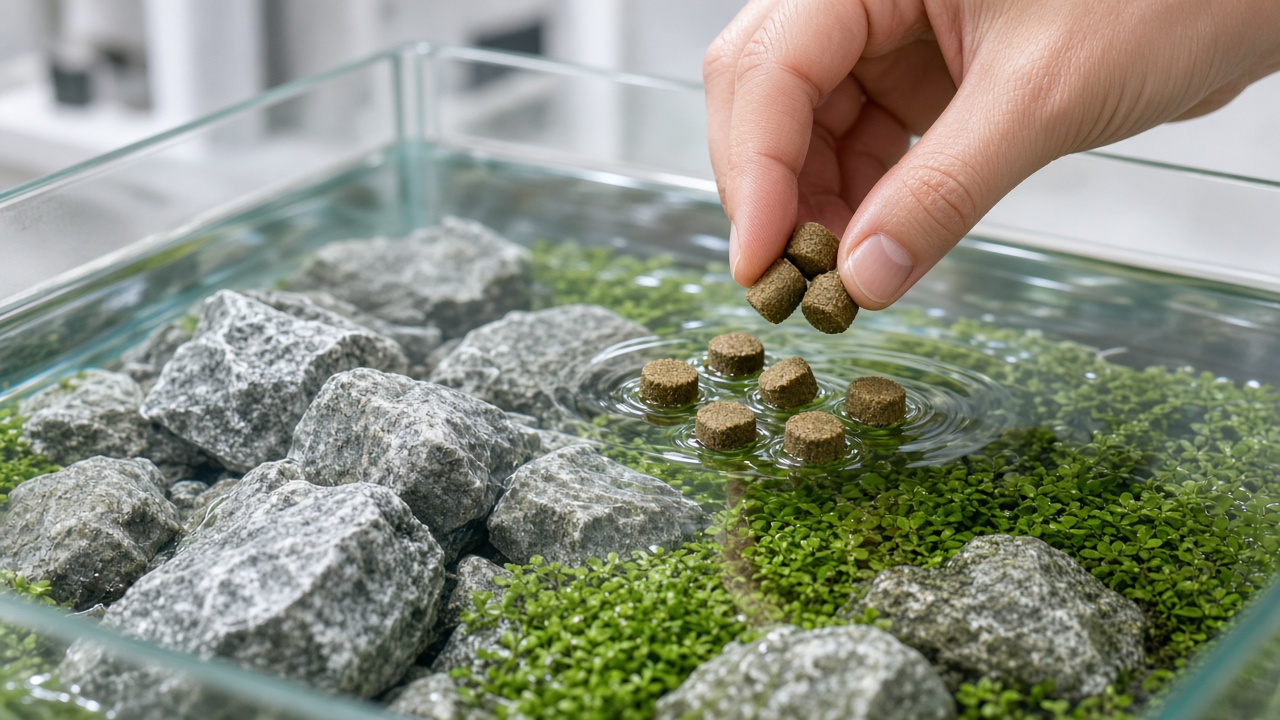
Mazuri’s page says to scatter the diet on the water, where it will float, and Fluker Farms’ page uses the same scatter-and-float direction. Zoo Med’s floating formulas say to place pellets in the water and watch the five-minute window.
Mazuri’s page adds a storage rule: store the bag at 75°F (24°C) or colder, and near 50% relative humidity. Use the diet within 1 year of the bag date.
Retail sizes on the maker pages run from small jars to bulk sacks. Mazuri lists 12 oz (240 g) and 25 lb (11.33 kg), and Fluker Farms lists 8 oz, 15 oz, and 3.5 lb.
Floating pellets versus sinking pellets
Use floating pellets for surface feeders and sinking pellets for mud and musk turtles.
Four of the five bags on this page float. Mazuri’s page calls the diet a floating round pellet, and Fluker Farms’ page calls its pellets floating. Zoo Med’s Hatchling and Maintenance pages say the pellets float so surface feeders can find them.
Zoo Med’s Sinking Mud & Musk Turtle Food page is the sinker. That page is for aquatic turtles with a shell of 2 inches (5 cm) or larger. It lists 35.0% crude protein and 5.0% crude fat.
Pick float or sink by how the turtle feeds:
- Red-eared sliders, painted turtles, and other surface feeders: start with a floating pellet.
- Mud turtles and musk turtles that hunt the bottom: start with a sinking pellet.
- Mixed tanks: float a staple and add a sinking pellet only if a bottom feeder misses the surface food.
- Leftovers: net floating pellets on the five-minute Zoo Med clock, or after the one-hour sinker window.
A floating pellet that sits all day still becomes waste. Mazuri’s page says unused diet may sink later and get eaten on a second pass. Do not dump extra pellets to force that second pass.
Spec comparison of five current pellets
These five bags differ most on protein, calcium, and whether they float.
The table uses attributes from the maker pages named in each row, and it is not a ranked list.
| Product | Crude protein (min) | Crude fat (min) | Float or sink | Shell or life stage on the maker page | Calcium (min–max) |
|---|---|---|---|---|---|
| Mazuri Aquatic Turtle Diet | 40.00% | 10.00% | Float | Baby through adult; 4 mm round pellet | 1.85%–2.35% |
| Zoo Med Aquatic Turtle Food, Hatchling Formula | 43.0% | 10.0% | Float | Shells up to 2 in (5 cm) | 2.5%–2.9% |
| Zoo Med Aquatic Turtle Food, Maintenance Formula | 25.0% | 5.0% | Float | Adult, or shell 6 in (15 cm) | 1.3%–1.7% |
| Zoo Med Sinking Mud & Musk Turtle Food | 35.0% | 5.0% | Sink | Shell 2 in (5 cm) or larger | 0.9%–1.3% |
| Fluker Farms Aquatic Turtle Diet | 34% | 10% | Float | Juvenile and adult | Not listed |
Mazuri’s page also lists moisture at 12.00% and ash at 12.00%. Zoo Med’s Hatchling Formula page lists moisture at 11.0% and ash at 13.0%.
Where pellets fit in the tank
Leftover pellets foul water, so the tank setup matters as much as the bag.
Pellets are only one input, and uneaten food raises waste that hits the filter and the water-change schedule. If you are still building the enclosure, start with our turtle tank setup guide before you scale up feeding.
Stocking and tank size change how much leftover food you can absorb. A tight tank leaves less room for a missed scoop. Our turtle tank picks page walks through size and hardware choices that keep waste in check.
Pellet size is the same problem in a fish tank, because a pellet that is too large sits uneaten. We use that bite-size rule in our best food for betta fish guide as well.
Keep the feeding loop short:
- Match protein to shell length with the rule above.
- Match float or sink to the turtle’s feeding height.
- Use the maker’s time window, then net leftovers.
- Watch the water after each change in bag or portion.
Mazuri’s page says the actual amount eaten varies with temperature and time of year, so start low. Raise the portion only if the turtle clears the food inside the printed window.
This page compares labels and is not a diagnosis. If a turtle stops eating or the shell looks uneven, get hands-on help from a clinician who sees reptiles.
FAQ
How much protein should turtle pellets have?
Zoo Med’s Hatchling Formula page lists 43.0% crude protein for shells up to 2 inches (5 cm). Zoo Med’s Maintenance Formula page lists 25.0% for adults at 6 inches (15 cm). Mazuri’s page lists 40.00% protein for the full life cycle, so pick the number that matches the shell.
Should turtle pellets float or sink?
Most slider-type turtles take food at the surface, so a floating pellet is the default. Zoo Med’s Sinking Mud & Musk page is built for bottom feeders with a shell of 2 inches (5 cm) or larger. If a bottom feeder ignores floating pellets, switch that animal to the sinking bag.
What size pellet should I buy?
Mazuri’s page lists a 4 mm (5/32 inch) round pellet. Zoo Med does not print a millimeter size on the hatchling or maintenance pages. Use Zoo Med’s shell-length lines instead: hatchling food up to 2 inches (5 cm), and maintenance food at 6 inches (15 cm).
How often should I feed pellets?
Zoo Med’s floating pages use a five-minute feeding window. Zoo Med’s sinking page says once or twice daily, with leftovers pulled after one hour. Mazuri’s page and Fluker Farms’ page both say one feeding per day, three to five times per week.
Can I feed only pellets?
Mazuri’s page calls the diet nutritionally complete and says no vitamin or mineral supplements are required. Zoo Med’s pages say each formula meets the dietary requirements for its life stage. AAFCO’s Understanding Pet Food page still warns that feeding the wrong product can harm an animal.
When do I switch from hatchling pellets to adult pellets?
Zoo Med’s Hatchling Formula page stops at a 2-inch (5 cm) shell. Zoo Med’s Maintenance Formula page starts at a 6-inch (15 cm) shell or full adult size. Mazuri’s page does not ask you to switch bags, because it lists one 40.00% diet for every stage.
Do leftover pellets hurt water quality?
Yes, leftover pellets hurt water quality. Zoo Med’s floating pages tell you to net leftovers after five minutes, and the sinking page says to discard leftovers after one hour. Extra pellets decay and load the filter.