Quick answer: Place the tank and stand first, then install the filter, heater, and décor before you add water. Treat tap water, start the filter, and wait until tests read 0 ppm ammonia and 0 ppm nitrite before a full fish load.
A new freshwater tank is ready to stock only after ammonia and nitrite both read 0 ppm. This page is a freshwater setup order, and Our research team analyzed published maker specs from API, Seachem, Aqueon, the MSD Veterinary Manual, and the EPA.
Selection rule: we cover first-time freshwater kits from 10 to 29 gallons. Each kit in scope uses a hang-on or internal filter, a heater, and a liquid test kit. We leave out saltwater, ponds, breeding racks, and any plan that skips a test kit.
Start with the dry-first setup order
Hardware goes in dry, water is treated next, and fish wait for a finished cycle.
Most failed first tanks skip a step rather than a gadget. The numbered order below is the rule we used when comparing published specs from API, Seachem, and Aqueon.
- Set the stand, then set the empty glass tank on it.
- Rinse décor and substrate with tap water and use no soap.
- Place the substrate, rocks, and plants before any water goes in.
- Install the filter and heater, but do not plug them in yet.
- Fill with tap water that you treat as you pour.
- Start the filter and heater, then check the stand for leaks.
- Cycle until tests read 0 ppm ammonia and 0 ppm nitrite.
- Add a small first group of fish, then test the water again.
That sequence is the whole job of a first setup. Décor style and brand names come after the water is stable.
Choose the tank and stand before you buy fish
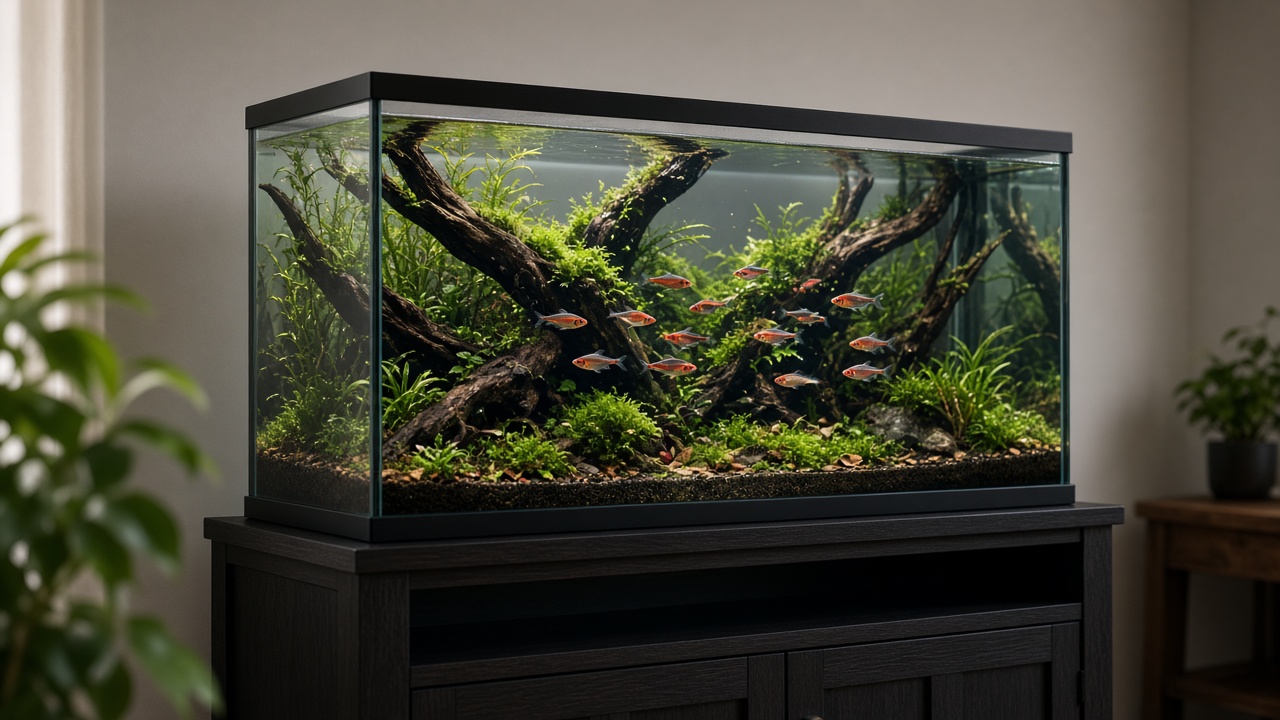
Pick a stable 10- to 20-gallon freshwater box before you pick any fish.
A larger water volume forgives small mistakes that a bowl will not. Aqueon’s SmartClean LED kit page lists 10-gallon and 20-gallon sizes for a first boxed setup.
The same Aqueon page lists a preset heater held at 78 degrees. It also lists a 50-watt heater in the 10-gallon kit contents.
Those figures are kit specs, not a stocking chart, and they tell you the box is built for tropical community water.
Buy the stand that matches the filled tank, not the empty box. Water is heavy, and a weak table will bow under the load.
The MSD Veterinary Manual’s volume notes use 1 gallon equal to 231 cubic inches, or 3.785 liters. Use that conversion if your tank is sold only in inches.
Measure length, width, and water depth, then convert before you dose conditioner, because guessing the gallons will throw off every later dose.
Skip bowls and unheated desktop cubes for this guide, because they fall outside the 10- to 29-gallon rule above.
Do not start this build with a turtle, because a turtle tank setup uses a dry basking dock and a different water-to-land split.
Install hardware while the tank is still dry
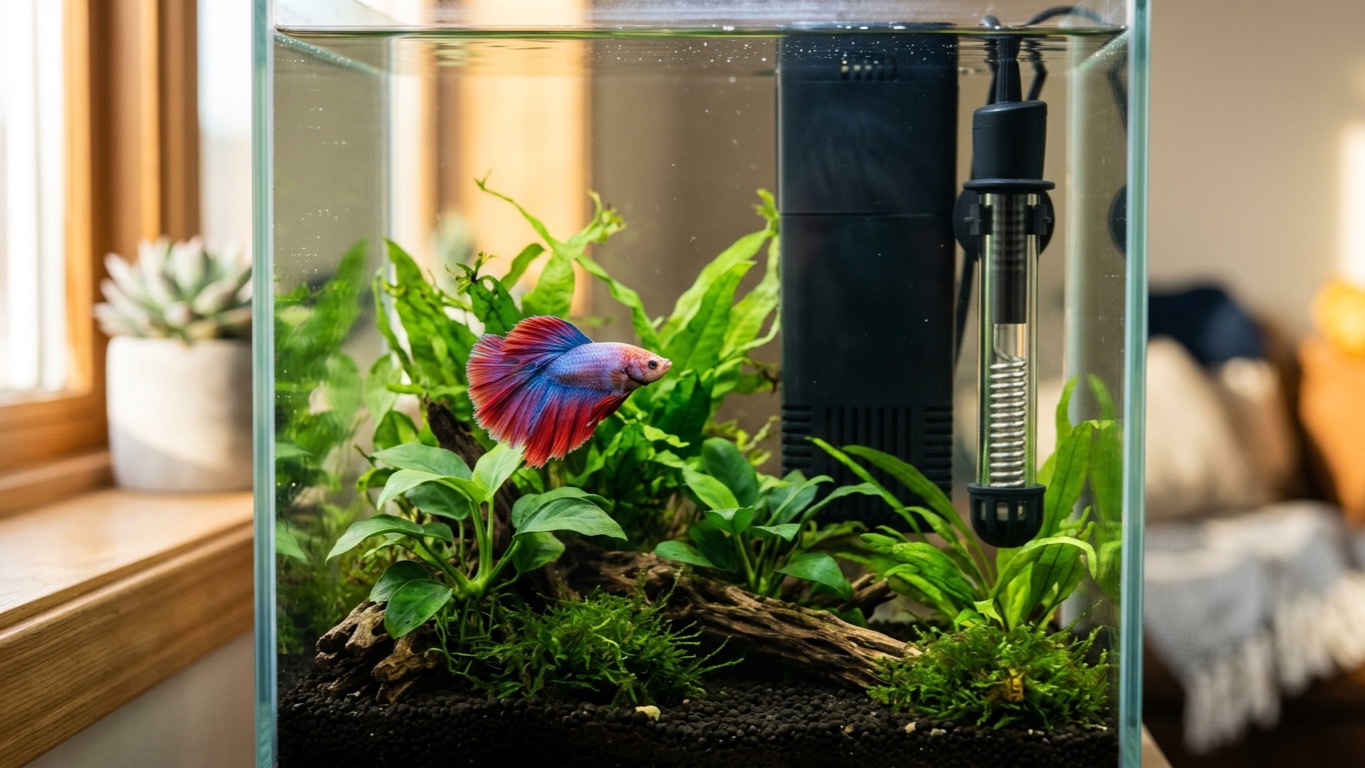
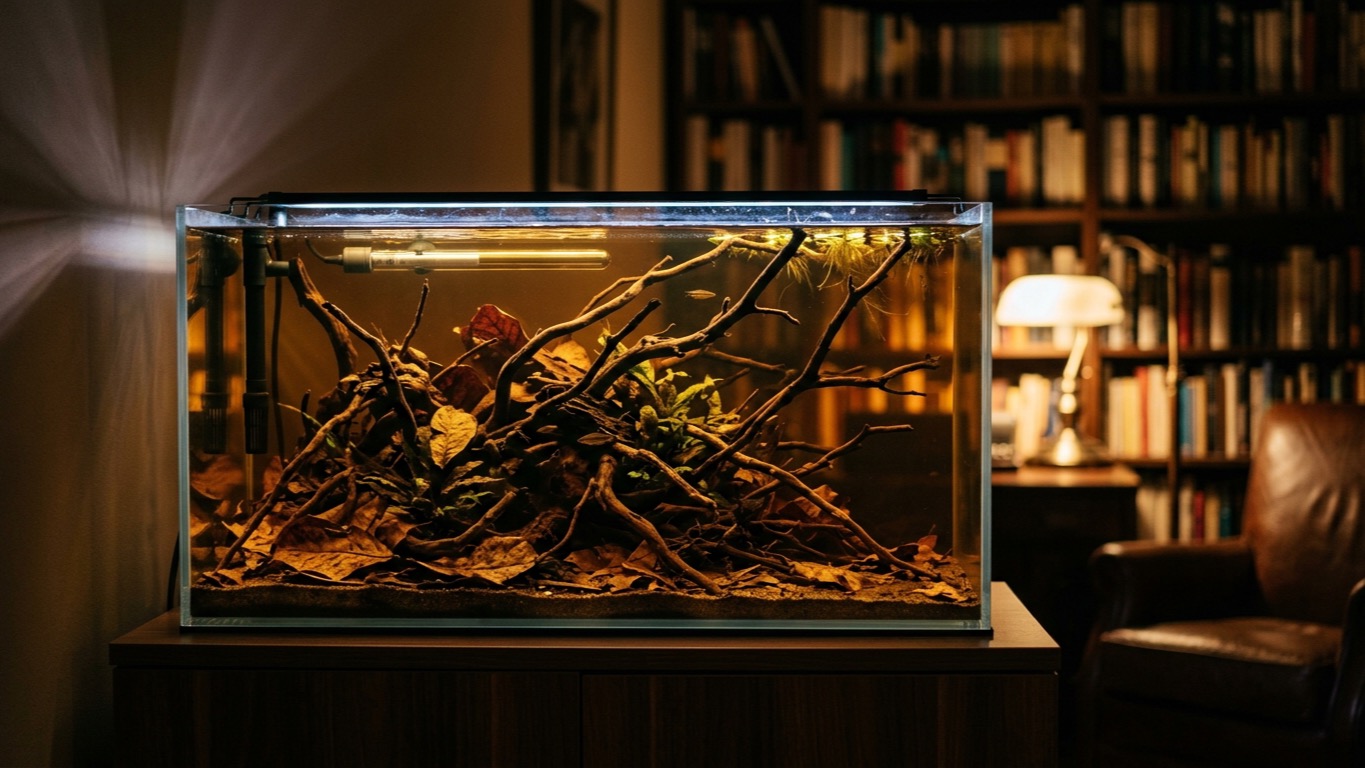
Seat the filter, heater, and décor before the tank holds any water.
A dry tank lets you level the stand and seat the filter lip without a spill. It also lets you hide cords along the back wall.
Place the heater near a filter outflow so warm water mixes through the box. Aqueon’s kit page states the preset heater holds 78 degrees for most tropical fish.
Do not plug the heater in until the tube is fully submerged, because a dry heater can crack the glass tube.
Rinse new gravel until the water runs clearer than it started. Soap residue is not a published dose, and you cannot test it later.
Leave a gap at the back for the filter body and the heater, because you will need that space when you service media.
Keep one spare filter cartridge on the shelf, and do not open the pack until the first change.
Treat tap water, then fill
Dechlorinate every gallon before that water sits in the tank.
US tap water is treated so people can drink it. The EPA’s National Primary Drinking Water Regulations list an MRDL of 4.0 mg/L for chlorine and for chloramines, measured as Cl2.
That cap is a human drinking-water limit, not a fish-safe leftover. Chlorine and chloramines are added to control microbes in pipes.
Seachem’s Prime page states a standard dose of 1 capful, or 5 mL, for each 200 L, which is 50 US gallons of new water. For a 10-gallon fill, that published ratio is 1 mL.
The same Seachem page says each cap thread is about 1 mL. Dose the new water first when you can measure it.
If chloramine is high, Seachem’s page allows a double dose. In a nitrite emergency, it allows up to 5 times the normal dose.
Prime’s page also says the binder can hold ammonia, nitrite, and nitrate as non-toxic for up to 48 hours. Re-dose every 24 to 48 hours if those readings stay high.
API’s cycling page tells you to add API STRESS COAT to dechlorinate before you start, so use one conditioner and do not stack mystery doses.
Fill slowly onto a plate so gravel does not crater. Then plug in the filter and heater and watch the stand for drips.
Cycle the filter before you stock
The tank is not set up until the nitrogen cycle finishes on a test kit.
API’s cycling page says the nitrogen cycle can take between 2 and 6 weeks. The MSD Veterinary Manual says a tropical biofilter can take up to 8 weeks to become established.
Those two windows are why we do not treat day 7 as done. For the longer timeline, see how long to cycle a fish tank.
API’s page says a finished cycle reads 0 ppm ammonia, 0 ppm nitrite, and 5 ppm to 20 ppm nitrate. Write those three numbers in a notebook each time you test the water.
The MSD Veterinary Manual describes fishless cycling as adding ammonia to reach at least 1 to 5 mg/L. Keep fish out of the tank for that method, which is the cleaner first-setup path.
API’s page instead walks through a fish-in cycle and says to test every 3 to 4 days. It says ammonia often rises to 0.5 ppm to 1 ppm after the first fish go in.
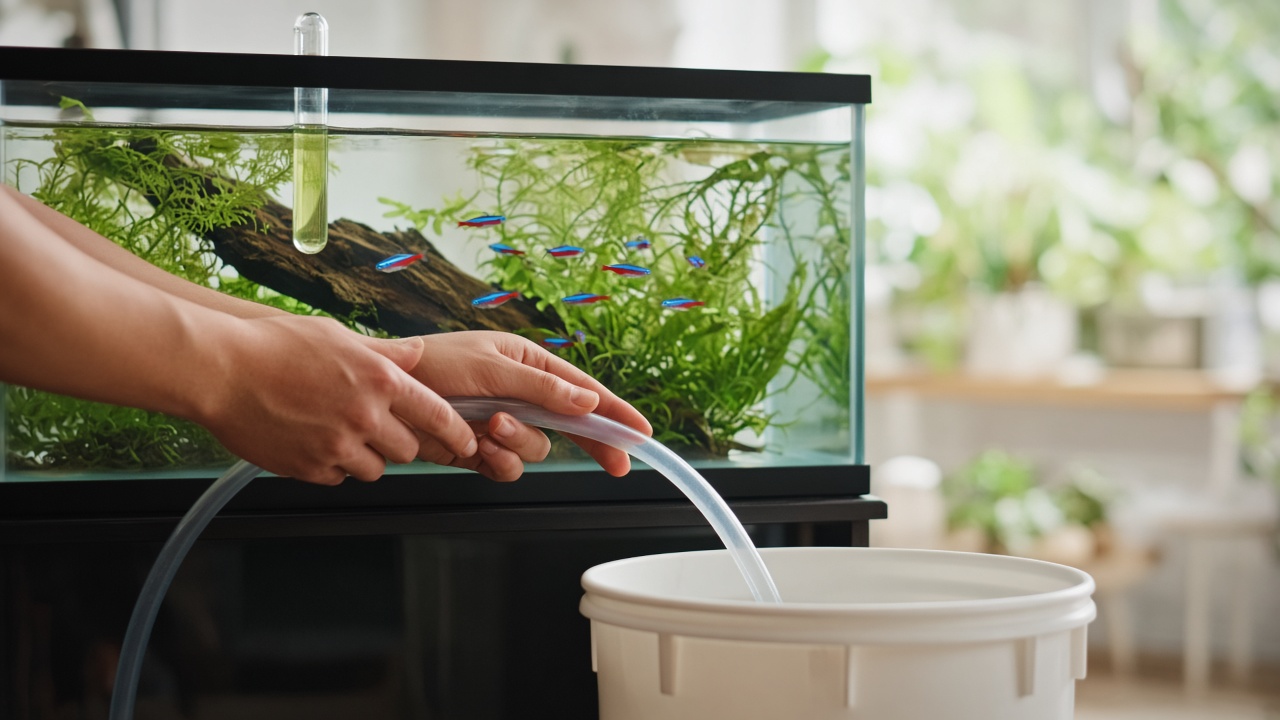
If you follow API’s fish-in notes, it recommends a 30 percent partial water change when ammonia or nitrite is elevated. Add conditioner to the new water each time you replace it.
The same API page says an initial pre-fish reading is often 0 to 0.25 ppm ammonia, 0 ppm nitrite, and 0 ppm nitrate. That is a baseline, not a green light to stock the tank.
API’s freshwater care page says the Freshwater Master Test Kit performs over 800 tests. Use that kit on the 3- to 4-day gap API lists during startup.
The MSD Veterinary Manual calls high ammonia or nitrite in the first 6 weeks new tank syndrome. That phrase is a timing warning, not a brand claim.
Cloudiness can show up while bacteria bloom in a new box. API’s page says to test and do a 30 percent water change if ammonia or nitrite is high.
Do not rinse biological filter media in untreated tap water from the sink. The EPA’s 4.0 mg/L MRDL is a disinfectant cap meant to control microbes on that sponge.
Add the first fish in a small group
A finished cycle still needs a light first load, not a full shop bag.
API’s cycling page says to add small amounts of fish at a time. It also says each new group restarts a smaller cycle.
Match the first fish to 78-degree tropical water if you used an Aqueon preset heater. Net the fish into the tank and leave store water out.
Feed only what the fish eat in a short sitting. Uneaten food becomes ammonia the new filter is not yet sized to handle.
API’s page says to add API QUICK START with each new group of fish, during water changes, and on a weekly basis. That is the maker’s seeding note, not a skip-the-cycle pass.
If ammonia returns above 0 ppm, stop adding fish and do the 30 percent change API lists. Dose conditioner at Seachem’s 5 mL per 50-gallon rate, scaled to the water you add.
Week-one checks that keep the cycle intact
The first week after stocking is a test week, not a décor week.
Test ammonia, nitrite, nitrate, and pH on a set schedule. API’s cycling page uses a 3- to 4-day test gap during startup.
Keep a short log of the four readings after each check. A log is how you see a rise before the water looks wrong.
Do not replace all filter media at once; swap only the clogged pad and leave the wet biological surface in the tank.
If you must rinse a sponge, swirl it in a bucket of old tank water. Never use the sink, because tap disinfectant will strip the bacteria.
Hold major décor changes until readings stay at 0 ppm ammonia and 0 ppm nitrite. Stirring the whole gravel bed dumps waste back into the water.
If you need a clinic water sample, the MSD Veterinary Manual asks for at least 500 mL of tank water. Pack it with no air bubble and keep it on ice. That figure is clinic sample volume, not a water-change size.
FAQ
Can I add fish the same day I fill the tank?
No, filling and plugging in the filter is only the hardware stage. API’s cycling page says the nitrogen cycle still takes 2 to 6 weeks to establish. Add fish only after tests show 0 ppm ammonia and 0 ppm nitrite.
How long does a beginner tank take to cycle?
API lists 2 to 6 weeks, and the MSD Veterinary Manual says a tropical biofilter can take up to 8 weeks. Plan on the longer end if tests still show ammonia or nitrite.
Do I need a liquid test kit?
Yes, this guide requires a liquid kit for the cycle readings. API’s cycling page says a Master Test Kit is the tool for watching ammonia, nitrite, and nitrate. API’s freshwater care page says that kit performs over 800 tests.
How much dechlorinator do I add?
Seachem’s Prime page says 5 mL treats 50 US gallons of new water. That published ratio is 1 mL for 10 gallons, or 2 mL for 20 gallons. Dose the new water and do not guess from bottle color.
What size tank should a beginner start with?
Stay inside our 10- to 29-gallon freshwater rule, and note that Aqueon’s SmartClean LED kit page starts at 10 gallons and also lists 20 gallons. Those sizes hold enough water to slow a small dosing error.
Can I use this same order for turtles?
No, turtles need a haul-out area and a different filter load, so use our turtle tank setup page for that build.
When should I change the filter cartridge?
Change a clogged pad when flow drops, and do not dump every media insert on the same day. For cartridge types and swap timing, use our filter cartridge guide and leave the biological sponge wet.