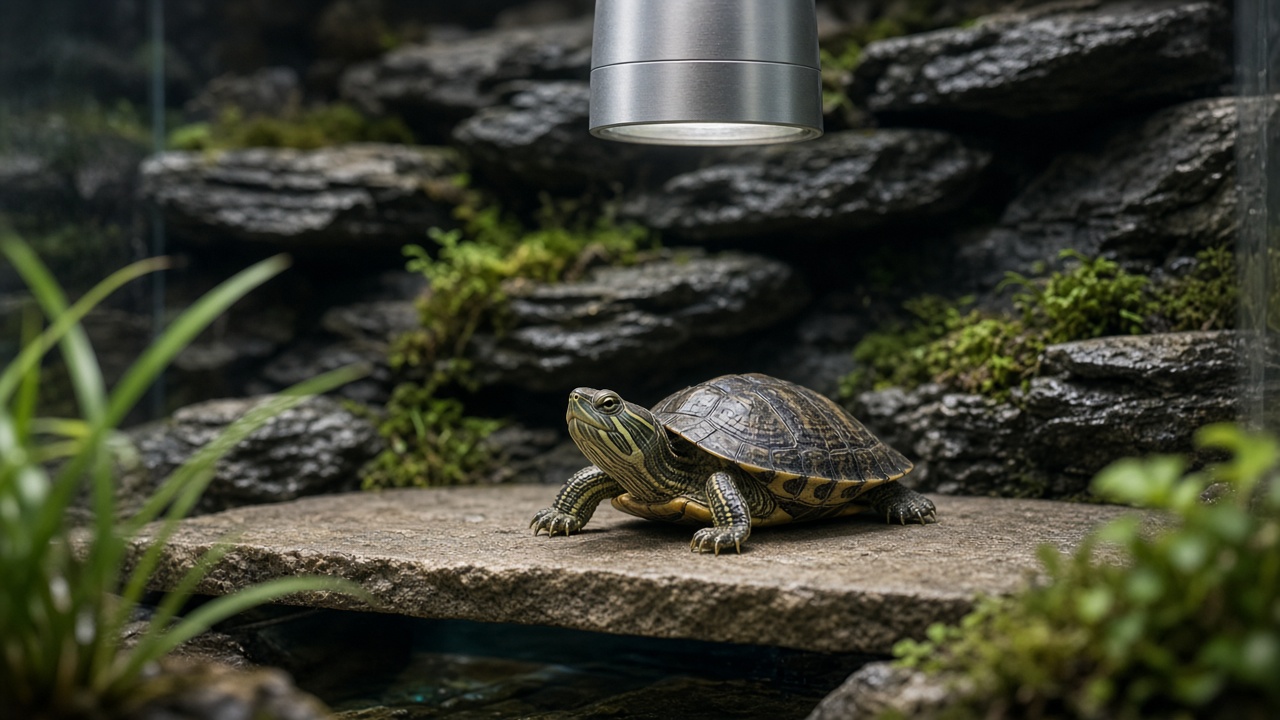
Quick answer: Keep one captive-bred Chinese pond turtle in a long indoor tank with a dry bask shelf, UVB light, and pellets matched to shell length. Do not start this species in a bowl. Plan for years of water work.
Mauremys reevesii, the Chinese pond turtle, is IUCN Endangered and reaches a 300 mm carapace. This page is a desk indoor-care brief;
Selection rule: We cover one indoor, captive-bred turtle and only gear whose maker page lists a number. We leave out outdoor ponds as a first home, multi-turtle colonies, and wild-caught stock.
What a Chinese pond turtle is
This animal is an East Asian freshwater turtle with a three-keeled top shell, not a red-eared slider.
The IUCN/SSC Tortoise and Freshwater Turtle Specialist Group account names it Mauremys reevesii. That page also uses Reeves’ turtle and Chinese three-keeled pond turtle. It places the species in the family Geoemydidae.
The same account lists carapace length to 300 mm. Carapace means the top shell, measured in a straight line. That published maximum is about 11.8 inches.
The IUCN/SSC page lists the 2011 Red List status as Endangered and CITES Appendix III for China.
Buy captive-bred stock from a seller who can name the hatch year. Skip any animal sold as wild-caught China stock. The IUCN/SSC account states that collection and habitat loss drove the decline.
The same account maps still or slow fresh water across central and eastern China, the Korean peninsula, Taiwan, and southern Japan. A Chinese pond turtle is shy and messy, and it needs land, light, and heavy filtration rather than a bare bowl.
Indoor tank size and water
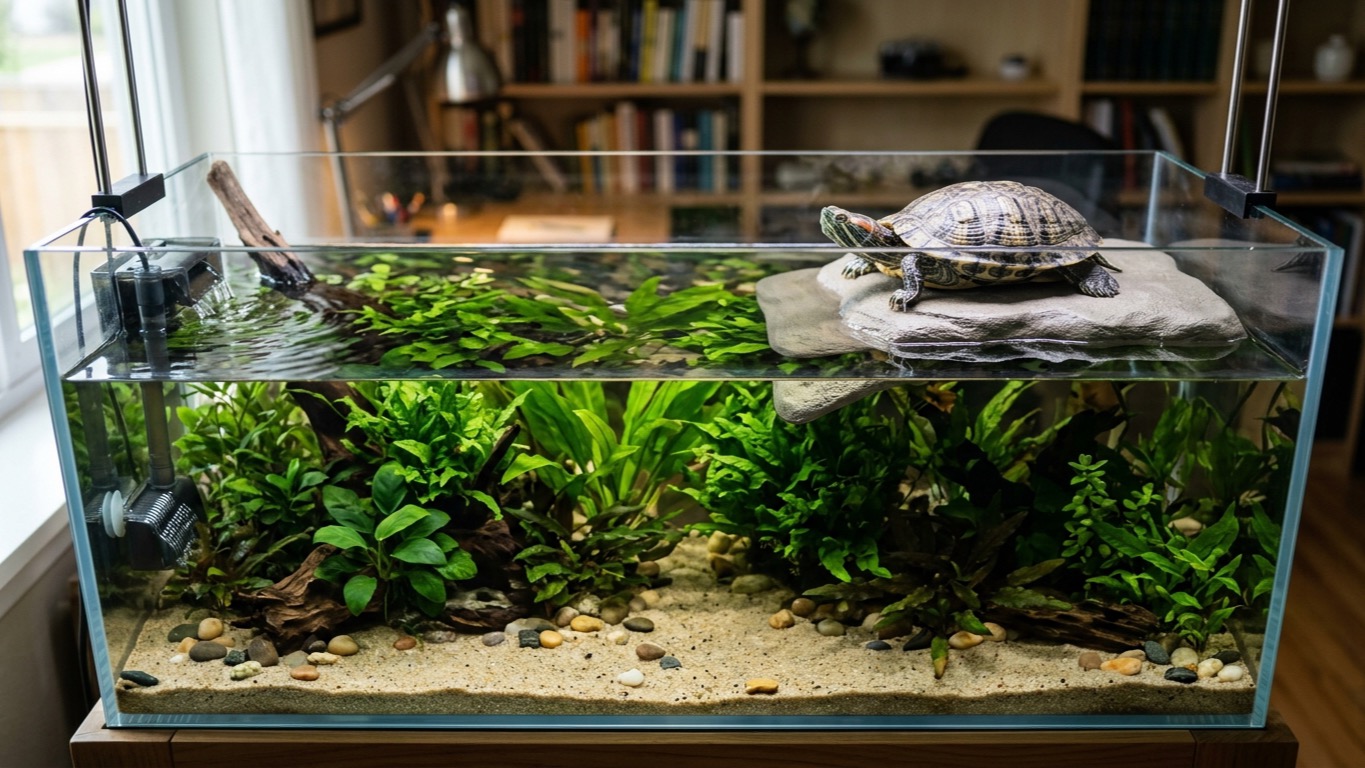
Use a long indoor tank, not a tall column, and size it for the adult.
Zoo Med Laboratories’ aquatic-turtle page lists a 20 gallon minimum for hatchlings and juveniles. The same page lists a 40 gallon minimum per pair of adults. Those figures are Zoo Med’s published floor for aquatic turtles, not a trial on Mauremys reevesii.
After comparing those specs, we use 40 gallons of actual water as the indoor floor for one adult. A hatchling can start in a 20 gallon long tank. Move it before the shell crowds the swim lane.
Pick a tank with a large footprint, because swimming length matters more than height. Our turtle tank setup guide covers dry land, water depth, and lid hardware.
If you are still choosing a box, use our turtle tank picks page for long, open-top models.
Zoo Med’s aquatic-turtle page sets water at 78–80°F. Use a fully submersible heater rated for the filled gallons. Place a second thermometer at the far end of the tank.
Zoo Med’s same page says not to use sand or gravel, because those beds can be swallowed. Use a bare bottom or rocks too large to eat.
Fill water deep enough for swimming, and add a rest shelf near the surface. Give hatchlings a ramp they can walk, because they tire on a long vertical climb. Cover the tank, since these turtles climb and a screen lid also holds lamps.
Basking, heat, and UVB
The turtle must climb out, dry off, and sit under heat and UVB every day.
Zoo Med’s aquatic-turtle page sets daytime air at 75–80°F. It sets the basking spot at 85–90°F. Measure the dock surface, not the side glass.
Zoo Med’s page says UVB lighting should run 8–10 hours per day. The same page names ReptiSun 5.0 UVB lamps for that job. UVB is the short-wave light that helps turtles use calcium.
Pellets with vitamin D3 do not replace that lamp. Keep lamps over dry land, not over open water. Zoo Med’s page warns that a PowerSun lamp must stay away from water.
Use a dock that stays dry as the water line moves. Zoo Med’s Turtle Dock page lists a self-leveling float dock with a submerged ramp.
Compare the listed dock sizes before you buy:
- Mini (TD-5): 3.5 by 8 inches
- Small (TD-10): 5 by 11.25 inches
- Medium (TD-20): 7 by 15.5 inches
- Large (TD-30): 9 by 18 inches
- X-Large (TD-40): 12 by 24 inches
An adult near the IUCN/SSC 300 mm carapace mark will not fit a Mini dock. Pair a Large or X-Large dock with a 40 gallon-class tank so the whole shell sits dry.
Zoo Med’s Turtle Dock page lists a 6 month warranty, which is a maker term rather than a wear trial by our desk. Put the heat lamp over the dock’s far end, and leave a cooler wet zone so the turtle can leave the heat.
Diet by shell length
Match the pellet formula to shell length, and do not feed an adult mix to a 2 inch hatchling.
Zoo Med Laboratories publishes three Aquatic Turtle Food formulas with different protein floors. Our research team compared those guaranteed analyses and uses this Shell-Length Feed Rule.
- Hatchling Formula: 43.0% crude protein minimum, for shells up to 2 inches (5 cm) on Zoo Med’s page
- Growth Formula: 35.0% crude protein minimum, for shells 2 to 6 inches (5 to 15 cm)
- Maintenance Formula: 25.0% crude protein minimum, starting at a 6 inch (15 cm) shell
That is an 18 point drop in listed protein from Hatchling to Maintenance. The IUCN/SSC 300 mm carapace mark sits well above Zoo Med’s 15 cm adult-food start, so a large adult still uses Maintenance.
Zoo Med’s Hatchling page lists 10.0% crude fat minimum, while the Growth and Maintenance pages both list 5.0% crude fat minimum. Zoo Med’s Maintenance page lists calcium at 1.3% to 1.7% and phosphorus at 1.0% minimum.
Zoo Med’s Hatchling page lists calcium at 2.5% to 2.9%, the higher calcium band in this set.
Feed in the water, then remove leftovers. Zoo Med’s three food pages all set a 5 minute feed window, so net out uneaten pellets after that time.
Zoo Med’s Growth page starts a feeding at one teaspoon. The Maintenance page starts at one tablespoon. Raise or cut the pile so the bowl is empty at 5 minutes.
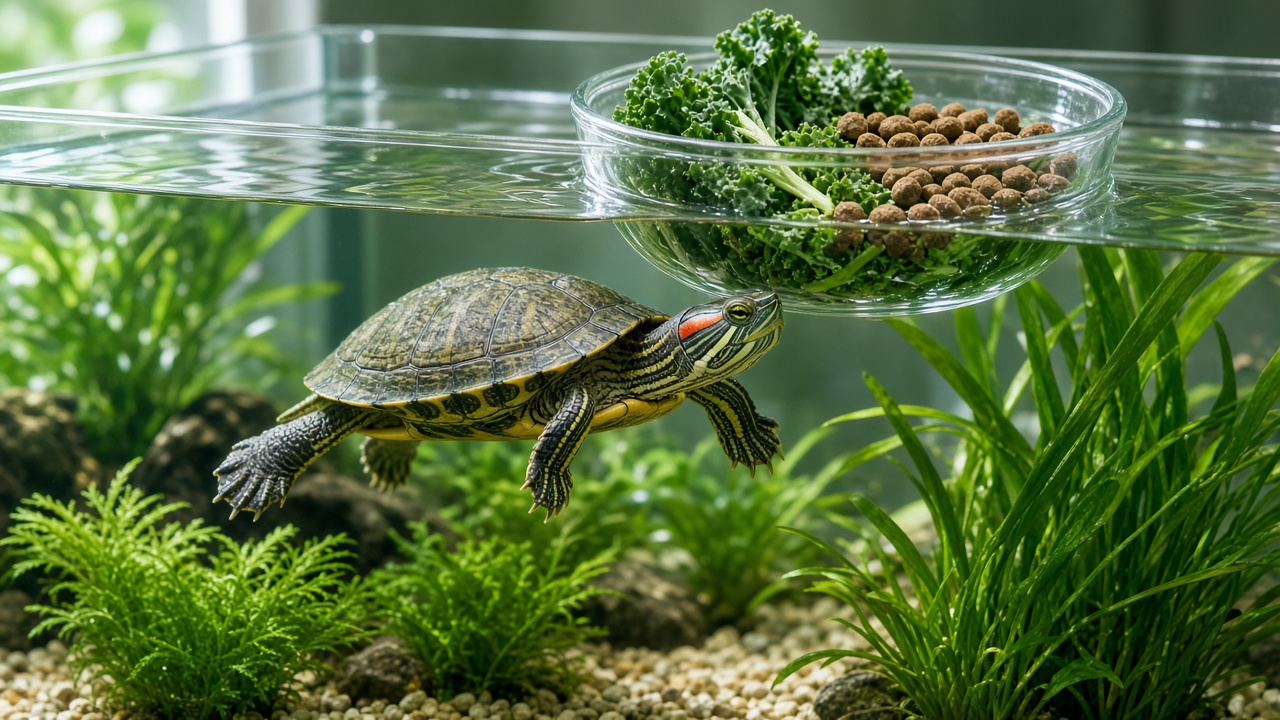
Offer dark leafy greens on off-pellet days for adults, and keep pellets as the measured base. Zoo Med’s aquatic-turtle page also names a Turtle Bone cuttlebone for free-choice calcium. Do not use feeder goldfish as a staple, because they are not on Zoo Med’s listed diet set.
Gear we compared
This table holds currently sold Zoo Med items whose pages list a number, and it is not a ranked list.
| Product | Type | Listed size or use | Listed nutrient or measure |
|---|---|---|---|
| Zoo Med Aquatic Turtle Food Hatchling Formula | Floating pellet | Shells up to 2 in (5 cm) | 43.0% protein min; 10.0% fat min |
| Zoo Med Aquatic Turtle Food Growth Formula | Floating pellet | Shells 2–6 in (5–15 cm) | 35.0% protein min; 5.0% fat min |
| Zoo Med Aquatic Turtle Food Maintenance Formula | Floating pellet | Shells from 6 in (15 cm) | 25.0% protein min; 5.0% fat min |
| Zoo Med Turtle Dock Medium (TD-20) | Floating bask dock | 7 by 15.5 inches | Self-leveling ramp dock |
| Zoo Med Turtle Dock Large (TD-30) | Floating bask dock | 9 by 18 inches | Self-leveling ramp dock |
| Zoo Med Turtle Dock X-Large (TD-40) | Floating bask dock | 12 by 24 inches | Self-leveling ramp dock |
The X-Large dock at 12 by 24 inches is the listed pad for a turtle near the IUCN/SSC 300 mm mark. A Medium dock at 7 by 15.5 inches fits a juvenile better than an adult female.
Buy the smallest food bag until you know the 5 minute portion, because stale fat fouls water fast.
Lifespan, status, and buying
Plan for a long indoor life, and treat a wild-caught sale tag as a hard no.
The IUCN/SSC HTML account does not list a captive lifespan number. Zoo Med’s aquatic-turtle page lists a 6–35+ year span for the genera it names there: Graptemys, Trachemys, and Pseudemys. Chinese pond turtles are a different genus.
Use that Zoo Med range only as a maker’s broad aquatic-turtle window, not as a Mauremys record. Budget time and tank space for well over a decade.
The IUCN/SSC account assessed the species as Endangered in 2011. It lists CITES Appendix III for China. Ask the seller for captive-bred proof, and do not import animals yourself.
Skip breeding, because this brief does not cover nesting, egg heat, or sexing hatchlings. Males often stay smaller and may darken with age, while females can approach the IUCN/SSC 300 mm mark. Sex does not change the 40 gallon pair floor on Zoo Med’s page.
Weekly water work
Dirty water is the usual failure, not a “hard” species.
Turtles eat in the water and pass a lot of waste. A canister or overflow filter helps, but it does not replace water changes.
Do this on a fixed day:
- Skim leftover pellets after every 5 minute feed.
- Wipe the film on the waterline.
- Test temperature at both ends of the tank.
- Change a large share of the water if it smells or clouds.
- Rinse filter sponges in old tank water, not hot tap water.
If you later move an adult to a secured outdoor tub, use our pond maintenance schedule for algae, debris, and seasonal checks.
Keep a lid or fence on any outdoor tub, because raccoons and dogs will take a basking turtle. Do not mix this species with fish you cannot replace, because the turtle will hunt them.
FAQ
Is a Chinese pond turtle the same as a Reeves’ turtle?
Yes. The IUCN/SSC account treats Chinese pond turtle, Reeves’ turtle, and Chinese three-keeled pond turtle as names for Mauremys reevesii. That page lists no subspecies split, so a listing that uses the old name Chinemys reevesii is still this species.
How large a tank does one adult need?
Zoo Med’s aquatic-turtle page lists 40 gallons per pair of adults and 20 gallons for hatchlings and juveniles. After comparing those published floors, we use 40 gallons of water as the indoor adult floor for one Chinese pond turtle. Upgrade before the shell reaches Zoo Med’s 6 inch (15 cm) adult-food mark if the swim lane is already short.
Can I keep two Chinese pond turtles together?
This brief’s selection rule leaves out multi-turtle colonies. Zoo Med’s 40 gallon figure is “per pair,” which is a volume floor, not a social approval. Two adults share waste and one bask spot, so if you still house two, double the land and the filter load and watch for bites.
What do I feed a hatchling versus an adult?
Use Zoo Med’s Hatchling Formula at 43.0% protein for shells up to 2 inches (5 cm). Switch to Growth Formula at 35.0% protein from 2 to 6 inches (5 to 15 cm). Use Maintenance Formula at 25.0% protein once the shell is 6 inches (15 cm), and feed for 5 minutes before you net the rest.
Do pellets replace a UVB lamp?
No. Zoo Med’s aquatic-turtle page says UVB is essential for calcium use, should run 8–10 hours per day, and names ReptiSun 5.0 lamps. Pellet labels list vitamin D3, but that page still calls for a UVB lamp over the dry dock.
Can I start this turtle in an outdoor pond?
Not as the first home in this brief. Hatchlings get lost, chilled, and taken by predators, so raise the turtle indoors under the Zoo Med 20 gallon and 40 gallon floors. An adult in a secure outdoor tub is a later choice, and the pond schedule page covers that water work.
Why does the Endangered listing change a pet buy?
The IUCN/SSC account lists Endangered status from the 2011 assessment and CITES Appendix III for China. It names collection as a driver of decline. Ask for a hatch date and a breeder name before you pay, because a wild-caught adult adds demand.