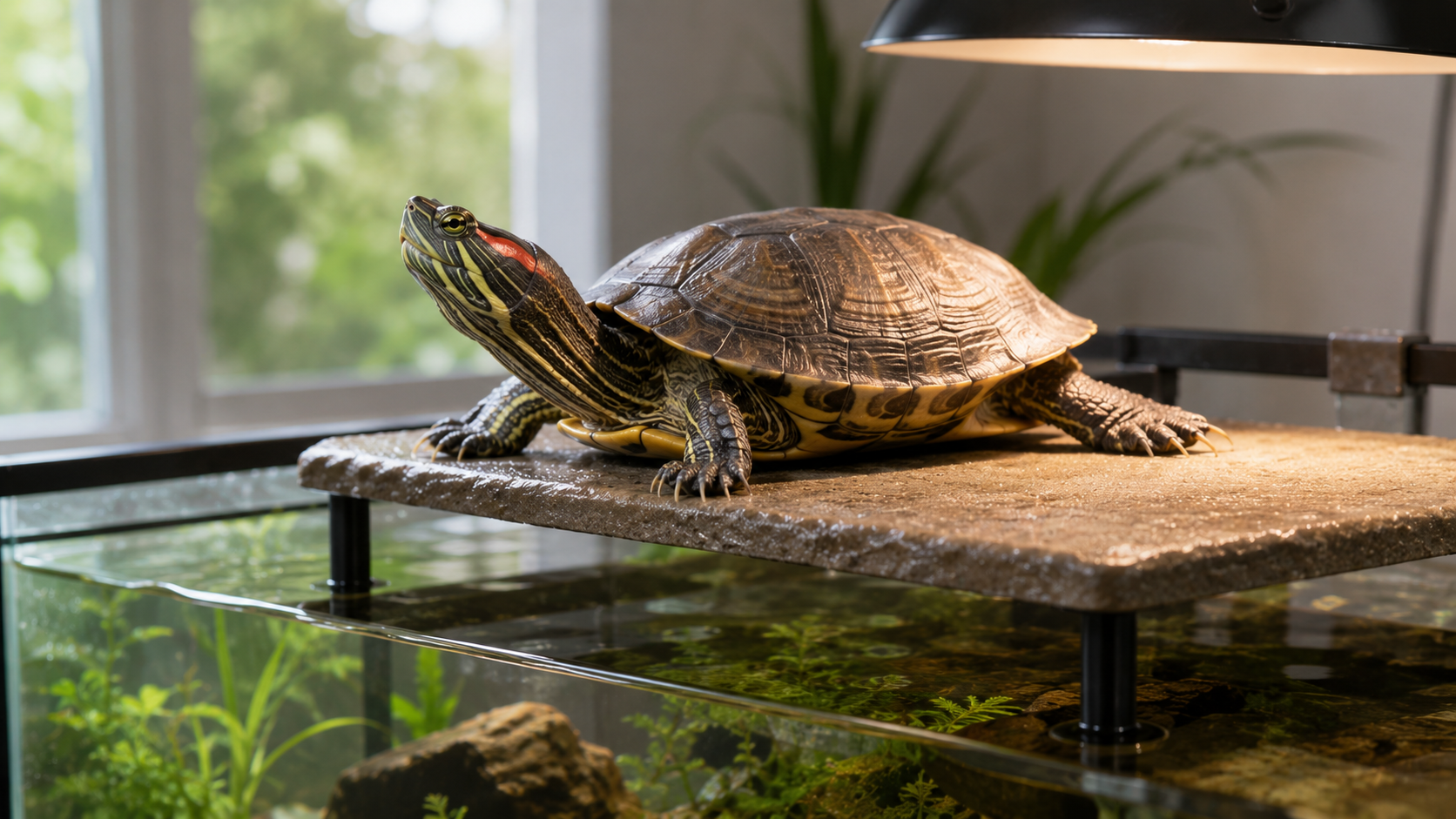
A turtle tank is not a fish tank with a rock. It needs three things at once: enough water to swim in, a dock the animal can haul out on until it is completely dry, and a UVB lamp that actually reaches the shell. A 10-gallon starter kit is a hatchling box. It’s not a home.
This page is husbandry research for a setup, not a product ranking and not a veterinary diagnosis. We’re hobbyist researchers. We’re not vets and we don’t run a water lab. Shell rot, respiratory infection, and metabolic bone disease (MBD) belong with an exotic-animal veterinarian. Every number below is on a named sheet. If a sheet doesn’t publish a figure, it isn’t here.
Who this page is for
The worked example is the animal people actually buy: the red-eared slider, Trachemys scripta elegans. Other aquatic sliders, cooters, and painted turtles follow the same water + dry bask + UVB shape. Check a species sheet for adult size and legal status before you copy the gallon math.
Hatchling red-eared sliders with a carapace under 4 inches are restricted for sale in the United States. That’s a public-health rule about Salmonella, not a shopping tip. 21 CFR § 1240.62 says viable turtle eggs and live turtles with a carapace length of less than 4 inches shall not be sold, held for sale, or offered for commercial or public distribution, with narrow exceptions for science, education, exhibition, non-business transfers, and export. The CDC notes the FDA ban has been in place since 1975 because small turtles are a known source of illness in children.
Red-eared sliders are native to the south-central United States and northeastern Mexico. USGS NAS records nonindigenous, often reproducing populations well outside that range, introduced mainly by pet releases. The species is also on the IUCN ISSG “100 of the World’s Worst Invasive Alien Species” list. Many U.S. places restrict RES as invasive. Check local law. This page doesn’t invent a state list. Never release a pet turtle.
Size: water volume, not the sticker on the kit
The published common minimum is 10 U.S. gallons of water per inch of shell, per turtle. ReptiFiles, Aurora Animal Hospital’s aquatic-turtle caresheet, the ARAV companion-reptile trifold, and VCA’s aquatic-turtle housing page all use that rule. Land is extra. The dock, the air gap, and the décor don’t count as swim volume.
ReptiFiles’ worked examples: a 4-inch turtle needs 40 gallons of water; a 12-inch turtle needs 120 gallons of water. Aurora uses the same 4-inch / 40-gallon-of-water example and says the tank itself has to be larger than the water column — they write a 50-gallon tank as the vessel that actually holds those 40 gallons. Water depth on the ReptiFiles tank-size page should be at least the turtle’s shell length, preferably deeper. ARAV writes depth at least twice the carapace, so the animal can right itself if it flips. VCA publishes 1.5–2× shell length for depth and 4–6× shell length for the swimming run, plus a dry zone of 15–25% of surface area.
Adult size is a range, not one number. Aurora: most aquatic species, including RES, usually 8–12 inches of shell. ReptiFiles’ 2020 PDF: generally 10–12 inches. The ReptiFiles tank-size page: most top out between 8–11 inches. ARAV vital stats: females 10–12 inches, males 7–9 inches. USGS NAS lists carapace length 125–289 mm (about 5–11.4 inches). Females run larger.
Keepers argue about the adult box. ReptiFiles tells you to buy adult-sized from day one and names 100 U.S. gallons as the minimum acceptable tank, then prefers a more common 120–125 gallon over stepping down to a 90. The PDF translates the 10–12 inch adult into 100–120 gallons of water. ARAV’s housing bullet lists a 10–20 gallon tank for hatchlings and a 60–125 gallon tank for adults — and, on the same sheet, a 30-gallon aquarium as the hatchling minimum. Pender Veterinary Centre writes a 50-gallon minimum for one adult slider and says a hatchling in a 20-gallon will outgrow it in about two years. We’re not picking a Waterpuppy “best gallon.” The published floor is 10 gallons of water per inch. The published adult-box range runs from ARAV’s 60–125 gallon tank to ReptiFiles’ 100-plus, buy-once advice. A 75-gallon box sits inside ARAV’s 60–125 adult range. It’s still smaller than ReptiFiles’ 100-gallon buy-once minimum.
| Stage | What the sheets actually say | Water-volume math (10 gal / inch) | Why people start too small |
|---|---|---|---|
| Hatchling (under 4 in shell) | Commercial sale is restricted (21 CFR § 1240.62; FDA / CDC). ARAV lists 10–20 gal tanks for hatchlings and a 30-gal minimum on the same trifold. Pender: 20 gal, outgrown in ~2 years. | Still 10 gal of water per inch of shell (ReptiFiles, Aurora, ARAV, VCA). A 3-inch shell is 30 gal of water, not a 10-gal kit. | The kit is cheap. The turtle isn’t done growing. |
| Growing / ~4 in | ReptiFiles and Aurora both use 4 in → 40 gal of water. Aurora: 50-gal tank to hold that water. | 40 gal of water, plus a dry dock that doesn’t steal the swim column. | Stores sell “turtle kits” sized for the animal on the shelf, not the adult. |
| Adult | Aurora 8–12 in; ReptiFiles PDF 10–12 in; ReptiFiles tank page 8–11 in; ARAV ♀ 10–12 in, ♂ 7–9 in. | 70–120 gal of water at 10 gal/inch, depending on sex and length. ReptiFiles: buy ~100 U.S. gal now; 120–125 is the common step-up. ARAV adult tank: 60–125 gal. | People upgrade through 10 → 20 → 40 → 75 and quit, or the turtle is given up. Aurora says that last part out loud. |
A 10-gallon kit fails the 10-gal-per-inch rule as soon as the shell is longer than an inch — which a slider already is. Buy the adult box, or a stock tank / indoor pond that holds the same water, once.
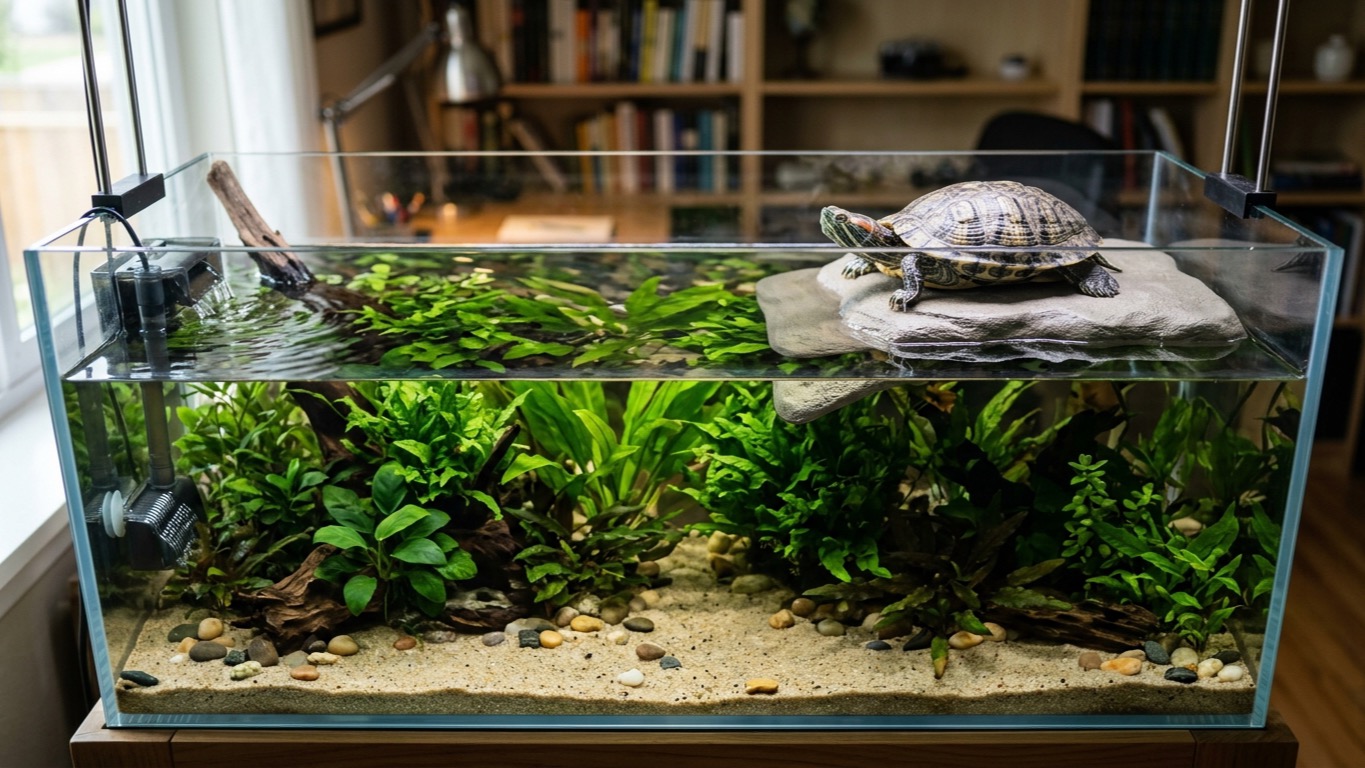
Dry land: a dock they can haul out on completely
The water half isn’t the whole habitat. Aurora: most of the habitat is water deep enough to swim in, and there must be land big enough that the turtle can get completely out and dry off. Heat and UVB point at that dock, not at the glass lid. VCA: the dry landing place should be large enough to climb completely out, easy to reach, and at the same end as the basking lamp. ReptiFiles: at bare minimum the whole body leaves the water; they also want walking room, not a postage-stamp island. ARAV tells you to avoid the little plastic “island bowl.”
If the plastron stays wet, the dock is too small or too steep. That’s a setup fault, not a personality.
Basking and water temperatures aren’t one number. Published sheets disagree. We’re reporting the range, not averaging it into a house figure.
| Zone | Published range | Source |
|---|---|---|
| Basking (air / “area”) | 85–90°F | Aurora; ARAV (one section); Pender |
| Basking (area, second ARAV line) | 90–95°F | ARAV basking-site paragraph |
| Basking surface | 95–104°F | ReptiFiles 2020 PDF |
| Basking (VCA) | 75–88°F | VCA |
| Water | 75–80°F, and at least 10°F cooler than the bask | Aurora |
| Water | 74–76°F | ReptiFiles 2020 PDF |
| Water | 75–86°F (higher end hatchlings, lower end adults) | ARAV |
| Water | 75–82°F | VCA |
| Water (Pender, sliders) | 82–85°F recommended for sliders; 72–82°F for “most” semi-aquatic species | Pender Veterinary Centre |
Put a thermometer on the dock and one in the water. Aurora and ReptiFiles both say that. An infrared gun for the dock surface is what those sheets name. A submersible heater can hold winter water, with a plastic guard so the turtle can’t burn on the tube (ReptiFiles, Pender). Heat from above the dry dock, not from a rock the turtle sits on. Pender: heat rocks tend to become too hot and should be avoided because of burns. VCA: heat sources go outside and above the tank so the animal cannot contact them.
Lights on by day, dark at night. Aurora: 10–12 hours, then total darkness. ReptiFiles PDF: 12 hours. ARAV: 12–14 hours of UVA/UVB in spring and summer, 10–12 in fall and winter.
UVB and heat
Aquatic turtles must have UVB. Aurora’s wording is blunt: a lack of UVB leads to metabolic bone disease, severe deformation, and death. VCA: UVB in the 290–320 nm range is what the animal uses to make vitamin D3 and absorb calcium; without it they pull calcium from bone. That’s MBD. We’re not diagnosing it. Soft shell, pyramiding, and fractures are vet work.
UVB does not go through glass or plastic. Aurora: a cage near a window doesn’t work. VCA: the light must reach the turtle unfiltered — no glass or plastic between lamp and animal. Pender: glass filters most UV. The lamp sits over the dry dock, in open air, at the distance the bulb’s maker publishes.
Compact fluorescent vs T5: Aurora says T5 UVB bulbs provide better zones of UVB than compact fluorescents. ReptiFiles’ caresheet specifies a linear T5 HO (their examples are an Arcadia T5 HO 6% or a Zoo Med T5 HO ReptiSun 5.0 in a reflective fixture) rather than a coil in a dome. Those are type examples, not a shopping list.
Replacement: Aurora — after about 6 months most bulbs stop emitting adequate UVB even though they still shine; change the bulb every 6 months. VCA — replace every 6 months or as the manufacturer directs. Pender — generally every 6 months for strip/tube lights and 12 months for coil lights; visible light isn’t proof of UV. If a box gives a different schedule, follow the box. We didn’t measure output.
VCA also publishes 12–18 inches from turtle to lamp as their distance band. ReptiFiles’ PDF places a 34-inch T5 HO about 13–14 inches above the bask in a 48-inch enclosure and wants a UVI around 3.0–4.0 at the dock if you own a Solarmeter. Those are their figures, not a test we ran.
Filtration and cycling
Turtles are messy. They eat in the water and they defecate in the water. Aurora: waste (ammonia, nitrates) builds fast in a small tank and that toxic water is how you get skin, eye, shell, and respiratory infections. Failure to give a large enough cage is listed on that sheet as a cause of toxin buildup, injuries from crowding, and stunted growth.
Filter rating is a published rule of thumb, not a Waterpuppy lab test. Aurora: use a filter rated for at least 2× the actual gallon size; filters labeled specifically for turtles (they name ReptoFilter as the type) are often not strong enough; sometimes you need more than one. ReptiFiles: a canister rated for at least 2–3× the water volume — their example is 120 gallons of water → at least 240 gallons of “filter power,” and they name a large canister (Fluval FX6) as the type that can do that job. Hang-on-back filters exist. Canisters are what those two sheets reach for on an adult slider. That’s a type note, not a ranked buy list. This page isn’t a “best filter for turtle tank” roundup.
A filter isn’t a cycle. The nitrogen cycle on a new aquarium is 4–8 weeks. It isn’t two weeks. Read how long to cycle a fish tank before the turtle goes in. You’re waiting for ammonia and nitrite to stay at zero after a challenge, with nitrate rising — the same biology as a fish tank, with a heavier bioload waiting at the end. Do the cycle fishless. Don’t use the turtle as the ammonia source.
Test with a liquid kit that actually reads ammonia. The freshwater aquarium test kit page is the tool write-up; this page is the habitat. We don’t run a water lab. The kit is how you see what the filter hasn’t yet handled.
Water changes still happen after the cycle. Aurora: at least 25% weekly; if the water still tests poor or looks dirty, 50–75%. Check parameters at least twice a month on that sheet. ReptiFiles: 30% every 1–2 weeks, because filtration alone is not enough. VCA: at least weekly, and many keepers change 50% weekly. Treat new water for chlorine and chloramine before it goes in (Aurora; ReptiFiles shopping list). Several sheets (Aurora, VCA, ARAV, Pender) suggest feeding in a separate tub so the main tank isn’t a soup of leftover pellets.
Substrate and décor
Bare bottom is honest and easy to siphon. If you want rock, use stone the turtle cannot swallow.
Aurora: don’t use small gravel — turtles may eat it and get impacted. ReptiFiles: avoid gravel or pebbles; if you want rock, use medium to large river rock. ARAV: no gravel or any substrate smaller than the turtle’s head. VCA: stones must be smooth and too big to eat; avoid sand or gravel. Pender: substrate is optional for semi-aquatic turtles; larger stones if you use any; sand has caused impaction when the animal hunts on it.
Décor is enrichment, not clutter. ReptiFiles lists wood, rock, hides, and plants. Plastic plants are a VCA warning if the turtle tries to eat them. Nothing sharp on the haul-out. ARAV wants 6 inches of air between the water line and the rim — sliders climb.
Water parameters
These targets are Aurora Animal Hospital’s published ranges for aquatic turtles. Other sheets didn’t give us a competing ppm table, so we aren’t inventing one.
| Parameter | Aurora target | Notes from that sheet |
|---|---|---|
| pH | 7–8 | Test at least twice a month. |
| Ammonia | <0.25 ppm | Buildup is tied to skin, eye, shell, and respiratory infections. |
| Nitrate | <30 ppm | Water changes are how you keep it there. |
| Nitrite | — | Not published on that sheet. Cut. Use the cycling article’s “zero before the animal goes in” rule. |
| Water change | ≥25% weekly | 50–75% if tests stay poor or the water looks dirty. |
| Chlorine / chloramine | Off | Treat tap water before it enters the tank. |
A cycled tank for fish is usually described as 0 ammonia and 0 nitrite. Aurora’s turtle sheet still writes ammonia <0.25 ppm as the “safe” line they print. Aim at zero. If you can read ammonia, you aren’t guessing.
What not to do
- A fish tank with a rock. Swim volume without a fully dry dock is half a habitat. A dock without swim volume is the other half. You need both.
- No UVB, or UVB through a window. Aurora and VCA: UVB does not pass glass or plastic. MBD is the published outcome of skipping this. See a vet if the shell is soft or misshapen. We won’t walk you through a home diagnosis.
- A heat rock. Pender: too hot, burn risk. VCA: heat from above, out of contact. Overhead bask + a guarded water heater is what the sheets describe.
- A 10-gallon forever. The 10 gal/inch rule makes a 10-gallon kit a one-inch box. Adults are 7–12 inches on the sheets above. Aurora says aquatic turtle pets are often given up because care and size were larger than the purchase suggested.
- Releasing the turtle outdoors. Aurora: many species are invasive and will compete with native animals; never release into local ponds. USGS NAS: pet releases are the main introduction pathway for RES outside the native range. CDC: don’t release unwanted pets — most die, and some threaten wildlife. Rehome through a rescue, a vet, or a keeper who is allowed to have the species. Never dump a slider in a park pond.
Tank mates
Default: none.
ReptiFiles’ caresheet is direct: sliders do well housed alone, and indoor tanks don’t give them room to get away from each other. USGS NAS describes pond sliders as aquatic omnivorous generalists that eat aquatic invertebrates, fish, frog eggs and tadpoles, and a wide range of plants. Fish in the turtle tank get eaten, or they nip skin and tail, or they die in the water-quality swings a slider produces. This isn’t a community list. Don’t stock “dither fish” to decorate a slider.
FAQ
Is a 10-gallon tank enough for a baby red-eared slider?
No. The published water rule is 10 gallons of water per inch of shell (ReptiFiles, Aurora, ARAV, VCA). A hatchling already has inches of shell, not a fraction of one. ARAV’s own enclosure paragraph sets a 30-gallon aquarium as the hatchling minimum. ReptiFiles tells you to skip the upgrade ladder and buy the adult box (~100 U.S. gallons, or a 120–125 if that’s what the shop actually stocks).
How long should I cycle the tank before the turtle goes in?
4–8 weeks, same biology as a fish tank. Not two weeks. Details are on how long to cycle a fish tank. Confirm with a liquid kit that reads ammonia, nitrite, and nitrate — see the freshwater aquarium test kit guide.
Does a sunny window replace a UVB bulb?
No. Aurora: UVB does not penetrate glass or plastic. VCA and Pender say the same in different words. The lamp goes over the dry dock, unfiltered.
What filter do I need?
A filter rated well above the water volume, because turtles are messy. Aurora prints 2× the tank’s gallons. ReptiFiles prints 2–3× and specifies a canister on an adult setup. That’s a published rule of thumb, not a test we ran. Name-brand canisters and HOBs are types. This page isn’t a “best filter for turtle tank” roundup.
Can I keep fish with a red-eared slider?
Default no. Sliders eat fish. Fish nibble turtles. The bioload is already high. House the turtle alone unless a species-specific sheet you trust says otherwise — and even then, assume lunch.
What if I cannot keep the turtle?
Don’t release it. CDC, USGS NAS, and Aurora all land on that. Find a rescue, an exotic vet, or a keeper in a place where the animal is legal.
How often do I change water?
Aurora: at least 25% weekly, more if tests are poor. ReptiFiles: 30% every 1–2 weeks. VCA: at least weekly. Test; don’t guess. Chlorine and chloramine still have to come out of the new water.
We are not vets, and we are not a water lab
Waterpuppy is an aquarium desk. This article is sourced husbandry for a tank shape: water volume, a dry bask, UVB, filtration, and a real cycle. It isn’t a medical workup.
Respiratory signs (bubbles from the nose, gaping, lopsided swimming), shell lesions, swollen eyes, and soft or deformed shell are reasons to see a reptile veterinarian — ARAV’s “find a vet” list exists for that. MBD, SCUD / shell rot, and Salmonella in the household are clinical problems. We won’t pretend a parameter table replaces either.
Wash your hands after you touch the turtle or the tank water. CDC: reptiles carry Salmonella even when they look clean; children under 5, adults over 65, and people with weakened immune systems are the households they tell to pick a different pet.