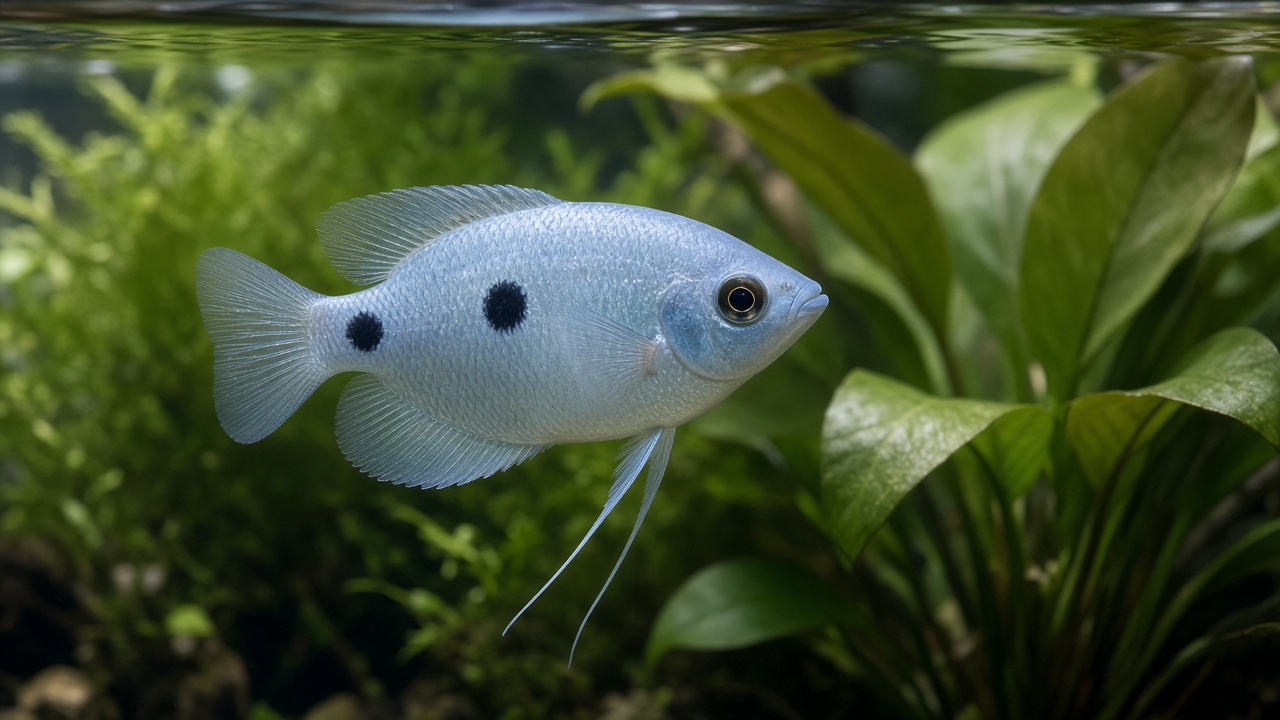
Quick answer: Keep a blue gourami in a tank at least 100 cm long. Adults reach 15 cm. Feed small tropical pellets or flakes, and skip short 20-gallon boxes.
A blue gourami reaches 15 cm SL and needs a tank at least 100 cm long.
This page is a desk brief on published specs, and
Our selection rule is the Waterpuppy 100 cm cut. A tank enters the pass set only if Aqueon lists a front length of 100 cm, or 39.4 inches, or more.
A food enters only if the maker lists protein for small-mouthed tropical fish. We left out nano kits, betta cups, live-food culture, and drug-dose recipes.
What a blue gourami is
A blue gourami is Trichopodus trichopterus, the three-spot gourami sold in shops as a blue, gold, or opaline fish.
FishBase places the species in the Mekong basin in Laos, Yunnan, Thailand, Cambodia, and Viet Nam, plus wider Southeast Asia. The same page lists a tropical band from 26°N to 10°N and from 99°E to 108°E.
FishBase lists a maximum length of 15.0 cm SL and a common length of 10.0 cm SL. The USGS aquatic species page repeats that 15 cm SL size and lists the trade name blue gourami.
FishBase describes a very small, very oblique mouth. The dorsal fin has 6 to 8 spines and 7 to 10 soft rays. The anal fin has 9 to 12 spines and 30 to 38 soft rays.
FishBase notes a black spot in the middle of the side and another at the tail-fin base. This is an air-breathing fish, and FishBase calls it an obligate air-breathing species that lives in marshes, swamps, and canals.
It uses shallow, sluggish, or standing water with a lot of plants. It is not a tiny nano fish, even when a shop sells a small juvenile.
FishBase reports the IUCN Red List status as Least Concern, assessed on 21 January 2019, Version 2025-2. That label is a wild-status tag, not a reason to buy a short tank.
USGS says Florida introductions failed in two counties, and the same page says the species is established in Puerto Rico. USGS lists Florida voucher lots UF 97053, UF 97054, and UF 97055, and its occurrence table was last updated on 9/6/2026.
FishBase also lists a fishing vulnerability score of 19 of 100, which it calls low. The same page lists a trophic level of 2.7 based on food items.
Tank size and the 100 cm rule
The published length rule is 100 cm, and gallon slogans that ignore length fail that rule.
FishBase’s aquarium note is a hard length of 100 cm, which is about 39.4 inches of swimming floor. A short, tall tank can hold many gallons and still fail, so measure the long side first.
Use this length check before you buy:
- Tank front length must be at least 100 cm, about 39.4 inches.
- Treat a shop juvenile as a future 15.0 cm SL adult.
- Do not use volume alone to pass a short box.
Our research team compared six Aqueon rectangles that are sold now, and only two meet the 100 cm cut on listed length.
Aqueon’s dimensions chart lists the 20 High at 24¼ by 12½ by 16¾ inches and a filled weight of 225 lb. The same chart lists the 20 Long at 30¼ by 12½ by 12¾ inches, also at a filled weight of 225 lb.
The Aqueon 29 is 30¼ by 12½ by 18¾ inches, with a filled weight of 330 lb. The Aqueon 40 Breeder is 36 3/16 by 18¼ by 16 15/16 inches, with a filled weight of 458 lb.
The Aqueon 55 is 48¼ by 12¾ by 21 inches, with a filled weight of 625 lb. The Aqueon 60 Breeder is 48½ by 18½ by 16 inches, with a filled weight of 543 lb.
Those inch lengths convert this way:
- Aqueon 20 High: about 62 cm. Fail.
- Aqueon 20 Long: about 77 cm. Fail.
- Aqueon 29: about 77 cm. Fail.
- Aqueon 40 Breeder: about 92 cm. Fail.
- Aqueon 55: about 123 cm. Pass.
- Aqueon 60 Breeder: about 123 cm. Pass.
The 40 Breeder holds more water than many 30-gallon boxes, and it still misses FishBase’s 100 cm length note. The 55 and the 60 Breeder both clear 48 inches, and those are the two pass tanks in this set.
| Product | Listed volume | Length (in) | Width (in) | Height (in) | Filled weight listed |
|---|---|---|---|---|---|
| Aqueon 20 High aquarium | 20 gal | 24.25 | 12.5 | 16.75 | 225 lb |
| Aqueon 20 Long aquarium | 20 gal | 30.25 | 12.5 | 12.75 | 225 lb |
| Aqueon 29 aquarium | 29 gal | 30.25 | 12.5 | 18.75 | 330 lb |
| Aqueon 40 Breeder aquarium | 40 gal | 36.19 | 18.25 | 16.94 | 458 lb |
| Aqueon 55 aquarium | 55 gal | 48.25 | 12.75 | 21 | 625 lb |
| Aqueon 60 Breeder aquarium | 60 gal | 48.5 | 18.5 | 16 | 543 lb |
Aqueon’s chart notes that filled weights can change with substrate and décor. Plan the stand for the listed filled weight, then add margin.
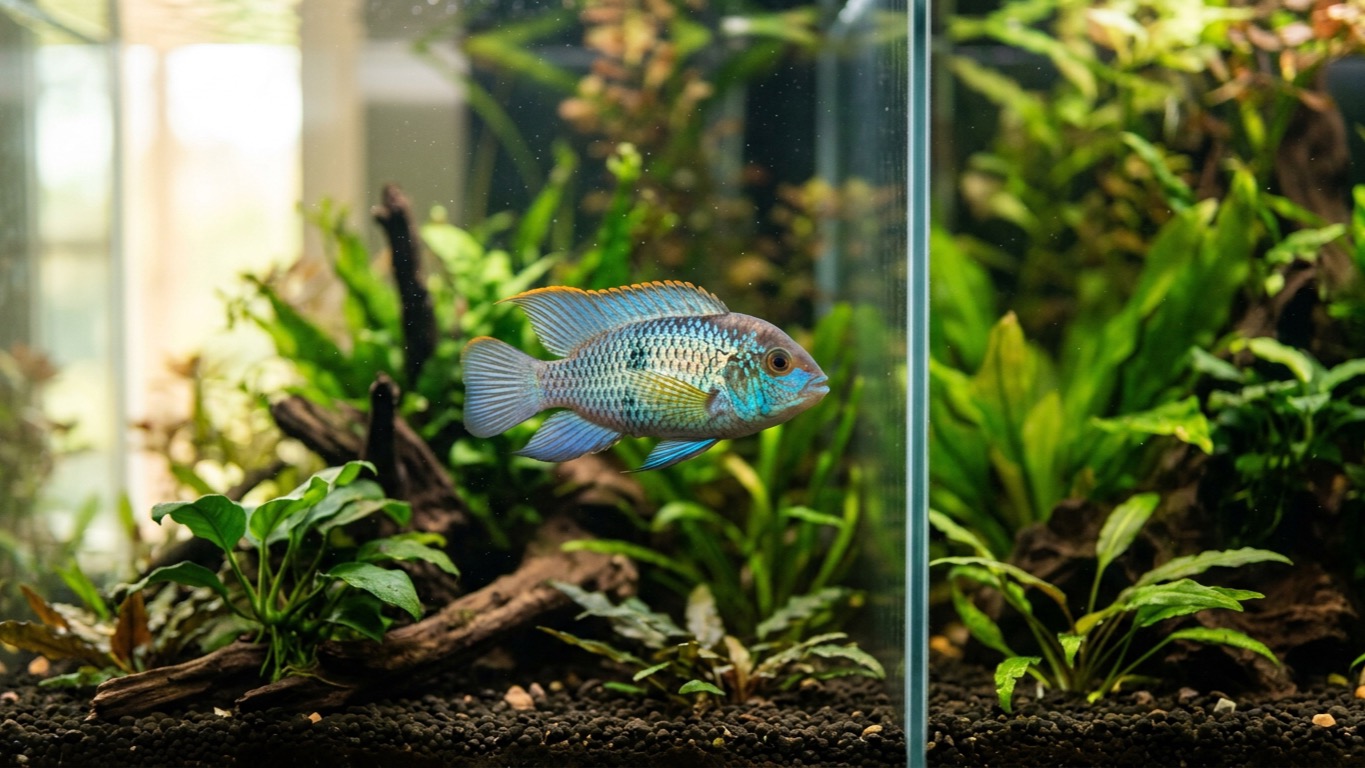
A 30.25-inch Aqueon 29 can house some other mid-sized fish. Our electric blue acara tank size notes use a different length cut.
That 29 still fails the 100 cm gourami rule. Do not treat the two species as the same tank.
Do this when you set the tank:
- Use the Aqueon 55 or the Aqueon 60 Breeder for an adult.
- Plant stems in clumps so two fish can lose sight of each other.
- Leave an open lane along the front glass.
- Leave a still surface patch, because FishBase says males build a bubble nest there.
- Skip the Aqueon 20 High, 20 Long, 29, and 40 Breeder for this species.
Water, heat, and weekly tests
Match the FishBase bands, then measure the water, and do not guess from the color of the gravel.
FishBase lists a pH range of 6.0 to 8.0 and a hardness range of 5 to 19 dH. The same page lists 22°C to 28°C, so stay inside that published heat band if your room swings.
Hold heat and chemistry this way:
- Keep display water between 22°C and 28°C.
- Keep pH inside 6.0 to 8.0.
- Recheck temperature after a large water change.
- Give still surface access, because this is an air-breathing fish.
API’s page for the Freshwater Master Test Kit says to test weekly. The kit checks ammonia, pH, high-range pH, nitrite, and nitrate. It ships with four test tubes, a holding tray, and a laminated color card.
API defines pH 7.0 as neutral.
Weekly checks we would log:
- Ammonia
- Nitrite
- Nitrate
- pH, and the high-range pH test if the first reading sits high
This is a research-desk water brief, not a diagnosis of a sick fish.
Tank mates
FishBase does not publish a community stocking list, so this page does not invent one.
Males build a bubble nest at the surface, and FishBase says the male usually gathers the eggs and places them in the nest. That published nest work is a territorial event.
Two males in a tank that only just meets 100 cm are a poor match for that note.
Tank-mate rules we used:
- Skip a second male if the tank only just clears 100 cm.
- Skip any fish small enough to be treated as insect prey.
- Skip slow long-finned fish that share the same midwater lane.
- Do not add a second large gourami unless the 100 cm length still holds after décor.
FishBase says the mouth is very small. That cuts the risk of swallowing large tank mates, but it does not make two males peaceful.
A planted Aqueon 55 or 60 Breeder can hold one pair if you break sightlines, and a short Aqueon 29 cannot.
Feeding
Feed a small tropical staple that lists protein, because FishBase describes an animal-biased wild diet.
FishBase says the species feeds on zooplankton, crustaceans, and insect larvae, so this is not an algae-only menu. Hikari’s page for Tropical Micro Pellets calls the food a daily diet for small-mouthed tropical fish, and that matches FishBase’s very small mouth note.
Hikari’s guaranteed analysis on that page lists:
- Crude protein min. 43%
- Crude fat min. 7%
- Crude fiber max. 7%
- Moisture max. 10%
- Ash max. 17%
- Phosphorus min. 1.1%
Hikari lists 0.77 oz (22 g) and 1.58 oz (45 g) packs on that page. It also lists a 2.82 oz (80 g) pack. Hikari says to feed two to three times daily the amount the fish will finish in a few minutes.
Omega Sea’s page for Super Color Flakes lists a different staple:
- Min. crude protein 42%
- Min. crude fat 12%
- Max. crude fiber 2%
- Max. moisture 8.5%
- Max. ash 8%
Omega Sea lists pack sizes of 0.42 oz, 1 oz, 2.2 oz, 5.3 oz, and 5 lb. Use the flake if you want a surface feed, and use the Hikari pellet if you want a small granule.
Feed this way:
- Offer Hikari Tropical Micro Pellets or Omega One Super Color Flakes.
- Feed two to three times a day, per Hikari’s page.
- Use only what the fish finish in a few minutes.
- Remove leftover flakes so nitrate does not climb between weekly API tests.
Our research team compared those two maker labels.
Sexing and bubble nests
Males build the nest, and that published job is the sexing clue this page keeps.
FishBase says the species builds a bubble nest, usually at the surface. The male usually gathers the eggs, places them in the nest, and guards them.
Look for these nest clues:
- A foam patch under a still leaf or the glass corner.
- One fish chasing others away from that patch.
- Eggs stuck in the foam, if a spawn happens.
This page is not a hatchery plan.
If you do not want a nest, keep one fish in the Aqueon 55 or 60 Breeder. If you want a pair, give plants and a still corner.
Do not chase a second male to “make a school.” FishBase does not list a group-of-five rule for this species.
FAQ
How big do blue gouramis get?
FishBase lists a maximum of 15.0 cm SL and a common length of 10.0 cm SL. USGS repeats the 15 cm SL figure on its species profile.
Plan the tank for the 15.0 cm adult, not the shop juvenile.
What tank size does a blue gourami need?
FishBase’s aquarium note is a minimum length of 100 cm, so measure the tank’s long side first. In the Aqueon set we compared, only the 55 and the 60 Breeder clear that length.
Can a blue gourami live in a 20-gallon tank?
No. Aqueon lists the 20 High at 24.25 inches and the 20 Long at 30.25 inches, and both sit far below 100 cm.
A 20-gallon kit fails the Waterpuppy 100 cm cut.
What do blue gouramis eat?
FishBase says they feed on zooplankton, crustaceans, and insect larvae. Hikari Tropical Micro Pellets list a minimum of 43% crude protein, and Omega One Super Color Flakes list a minimum of 42% crude protein.
Use one of those staples, not an algae wafer as the only food.
Can two males live together?
Not in a tank that only just meets 100 cm. FishBase says the male builds a bubble nest and gathers the eggs, and that nest work is a chase event.
Use one male, or give much more than 100 cm of length.
Do blue gouramis need a heater?
They need water inside FishBase’s 22°C to 28°C band. If your room falls below 22°C, you need a heater to hold that band.
This page does not pick a heater model, because no heater page sat in our source set.
Are blue gouramis established in Florida?
USGS says the Florida introductions failed in two counties. The same page says the species is established in Puerto Rico.
USGS lists three Florida voucher lots: UF 97053, UF 97054, and UF 97055.