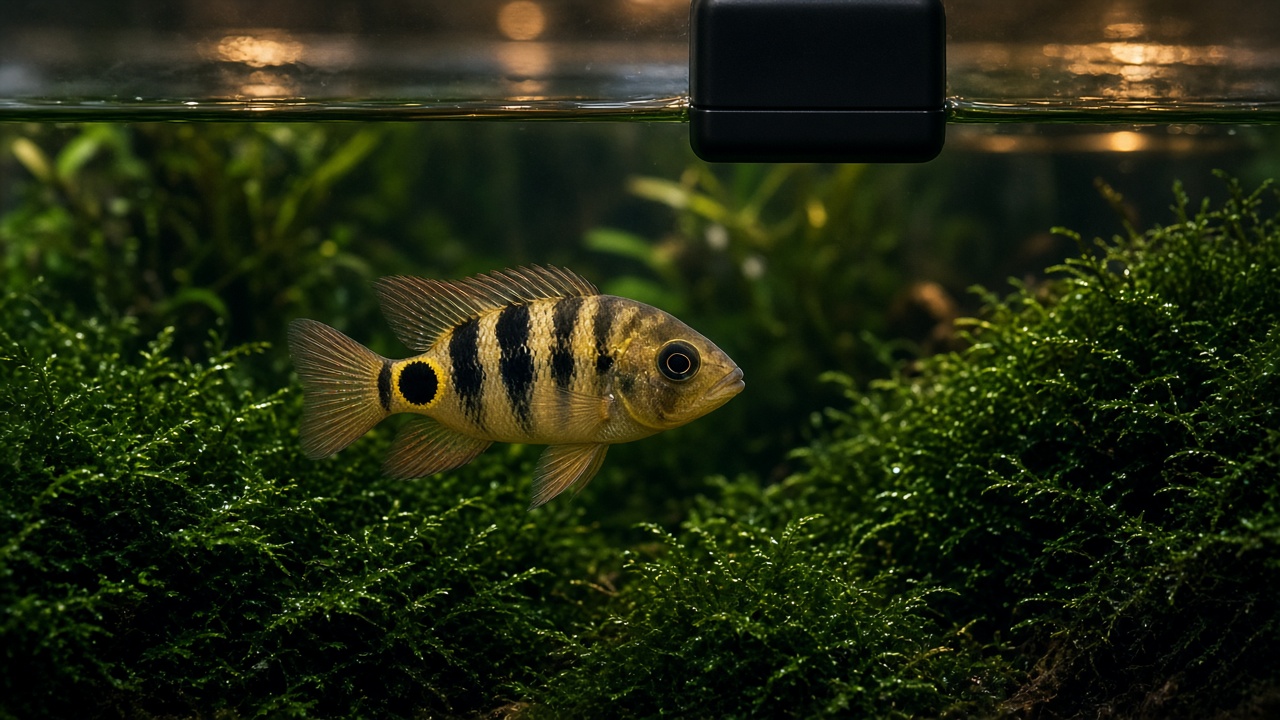
Quick answer: Keep a blue ram in a heated 60 cm tank at 27–30 °C. Hold pH at 5.0–6.0. Feed pellets at or under 2 mm.
FishBase lists blue ram cichlids at 4.2 cm standard length, 27–30 °C, and a 60 cm minimum tank. This page is a Waterpuppy Desk label comparison dated 6 September 2026. It did not keep rams in-house, did not sample Orinoco water, and did not run feeding trials.
What this page includes, and the Small-Mouth Rule
The takeaway: a product or scenario is in only if FishBase or a maker page prints a number that fits a 4.2 cm fish.
The Waterpuppy Desk Small-Mouth Rule is the filter. A food enters if its maker page names a small-fish format and prints protein as a percent. A conditioner enters if the maker prints a milliliter dose.
A tank-mate scenario enters only if the other fish can share 27–30 °C water and cannot eat a 4.2 cm adult.
These items stay out:
- Large cichlid pellets listed above 2 mm
- African rift-lake hard-water mixes
- Medicines and disease protocols
- Breeding recipes and fry-rearing steps
- Price tiers and ranked “top” lists
The 6 September 2026 Waterpuppy Desk Spec Sheet compared four food labels plus Seachem Prime. Published minimum crude protein on those four foods ran from 39% to 43%. That four-point spread is a label fact, not a feeding trial.
Water, heat, and tank length
The takeaway: size the tank by FishBase length first, then match the printed heat and pH bands.
FishBase’s species page for Mikrogeophagus ramirezi was read on 6 September 2026. It prints these figures:
- Maximum length: 4.2 cm standard length
- Temperature: 27–30 °C (81–86 °F)
- pH range: 5.0–6.0
- Hardness (dH): 5–12
- Aquarium keeping: in pairs
- Minimum aquarium size: 60 cm
- Range: Orinoco River basin, Venezuela and Colombia
A 60 cm long side is the rule, not a gallon slogan. A short, tall tank can fail that length even when the volume looks fine. Measure the glass, then buy.
Hold heat inside 27–30 °C, which FishBase prints as tropical climate data. A 24 °C community tank sits below the printed floor.
Use a heater you can read, and check it on the same day each week.
Hold pH at 5.0–6.0 if you can do it without swings. FishBase prints that acidic band, so do not chase pH daily.
Hold hardness in the printed dH 5–12 window, because very hard tap water sits outside that band.
FishBase also records the IUCN Red List status as Least Concern, assessed on 29 October 2020. The same page cites Red List version 2025-2. Status is not a care setting.
Diet and four foods on the shelf
The takeaway: pick a printed small-mouth format, then feed the maker’s timed portion, not a handful.
Blue rams have small mouths, so the Small-Mouth Rule keeps large cichlid pellets off this page. The four maker pages below were live on 6 September 2026, and each prints protein as a percent.
On that date, the Waterpuppy Desk Spec Sheet lined up these label numbers:
| Product | Maker-listed format | Crude protein (min) | Crude fat (min) | Listed size or pack |
|---|---|---|---|---|
| Fluval Bug Bites Cichlid Granules (S-M) | Slow-sinking granules | 40.0% | 12.5% | 1.4–2.0 mm; 45 g (1.6 oz) |
| Hikari Tropical Micro Pellets | Micro-coated granules for small-mouthed fish | 43% | 7% | Packs of 0.77 oz, 1.58 oz, and 2.82 oz |
| Omega One Super Color Pellets Small Floating | Small floating pellets | 42% | 10% | Packs of 3.5 oz and 6.5 oz |
| New Life Spectrum Thera+A Small Pellet | Sinking small pellet | 39% | 9% | 0.5–0.75 mm; 60 g jar |
Fluval’s granule page, read on 6 September 2026, lists black soldier fly larvae first at up to 40%. It prints a 1.4–2.0 mm slow-sinking granule. That size fits the Small-Mouth Rule.
The same Fluval page says to feed what fish finish in two minutes, two or three times daily. It also prints 12.5% minimum crude fat, 2,500 IU/kg vitamin A, and 75 IU/kg vitamin E.
Hikari’s Micro Pellets page, read the same day, names the food a daily diet for small-mouthed tropical fish. The guaranteed analysis prints these minima and maxima:
- Crude protein: 43% min
- Crude fat: 7% min
- Moisture: 10% max
- Ash: 17% max
- Phosphorus: 1.1% min
Hikari says to feed two to three times daily the amount fish finish in a few minutes.
Omega Sea’s Super Color Pellets Small Floating page was read the same day. It prints these guaranteed analysis lines:
- Crude protein: 42% min
- Crude fat: 10% min
- Crude fiber: 2% max
- Moisture: 8.5% max
- Ash: 8% max
The listed packs are 3.5 oz and 6.5 oz. The page names salmon and whole herring on the ingredient line.
New Life Spectrum’s Thera+A page, read the same day, prints a sinking small pellet at 0.5–0.75 mm. That is the smallest published pellet on the Spec Sheet.
The same page prints 39% minimum crude protein and 9% minimum crude fat. Vitamin lines include 10,000 IU/kg vitamin A and 600 IU/kg ascorbic acid.
The small-pellet jar is listed at 60 g. The page also lists a jumbo pellet at 7.5–8 mm, which stays out under the Small-Mouth Rule.
Use one staple food at a time, and follow the printed minutes, not a second scoop.
Daily feeding, from the two maker pages that print a clock:
- Offer only what fish finish in two minutes (Fluval) or a few minutes (Hikari).
- Repeat two or three times that day.
- Skip extra food if uneaten crumbs remain.
Hikari’s 43% protein is the high label on the Spec Sheet. New Life Spectrum’s 39% is the low label. The foods sit four points apart.
Tank mates that fit a 4.2 cm fish
The takeaway: share the 27–30 °C band, and skip anything that can swallow a 4.2 cm adult.
A blue ram is a short, warm-water dwarf cichlid, and FishBase says to keep them in pairs. A pair is the default stocking unit on this page.
Extra rams need more than 60 cm of length and broken sight lines. This page does not invent a head-count chart for six rams.
Good tank-mate tests, in order:
- The other species is sold for the same 27–30 °C band.
- The other species will not eat a 4.2 cm fish.
- The other species does not need hard, alkaline rift-lake water.
- The other species leaves the bottom free enough for the pair to hold a small spot.
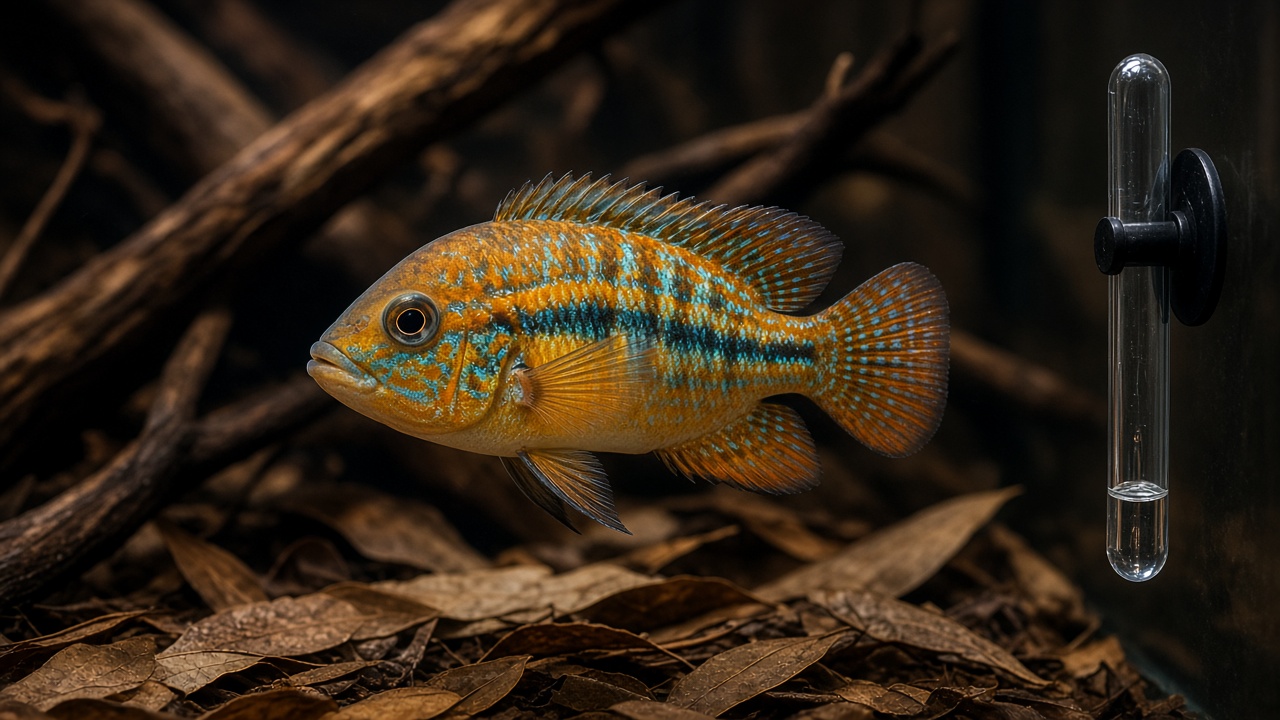
Skip large cichlids. An electric blue acara is a South American cichlid too, but it is a different size problem. The electric blue acara tank-size guide covers that larger fish’s length math.
Skip fin-nippers and fast food hogs. A ram that misses meals will not match the two-minute Fluval window. Skip unheated goldfish tanks, which sit far below 27 °C.
This page does not name a tetra list. Maker pages in the Spec Sheet do not print tetra counts. If you add mid-water fish, keep the ram pair’s 60 cm floor and the 27–30 °C band.
Weekly water work
The takeaway: dose new water from Seachem’s printed ratio, then test on a fixed day.
Seachem’s Prime page was read on 6 September 2026. It prints a standard dose of 1 capful (5 mL) for each 200 L (50 US gallons) of new water. Each cap thread is about 1 mL.
Seachem says the product is better in new water first, so if you pour it into the tank, dose the full tank volume.
Seachem also prints these numeric limits:
- A double dose is listed as safe for high chloramine.
- An emergency nitrite dose may go up to 5 times the normal dose.
- If temperature is above 30 °C (86 °F) and chlorine or ammonia is low, use a half dose.
- Prime may be dosed every 24–48 hours.
- The ammonia bind is listed for up to 48 hours.
FishBase’s heat band tops out at 30 °C. That is the same 86 °F line where Seachem cuts the Prime dose in half when chlorine and ammonia are low. Read both numbers before you heat a tank hard.
Prime bottle sizes on that page run from 50 mL to 4 L. A change far below 50 gallons needs the 1 mL cap-thread mark, not a full cap.
A simple weekly loop:
- Test on the same weekday.
- Change a slice of water you can measure.
- Dose Prime at 5 mL per 50 US gallons of new water.
- Recheck heat against the 27–30 °C band.
This page does not invent a nitrate ceiling or a percent water-change chart. Measure the water you remove, then dose only that volume.
Mistakes the labels already flag
The takeaway: most ram losses start when a keeper ignores a printed number.
These mismatches show up when shop cards sit next to FishBase:
- A 40 cm nano tank fails the 60 cm FishBase length.
- A 24 °C community heater sits below the 27 °C FishBase floor.
- A 7.5–8 mm New Life Spectrum jumbo pellet sits above the 0.75 mm small pellet and the 2.0 mm Fluval granule.
- A full cap of Prime in a small bucket overshoots the 5 mL-per-50-gallon line.
- A hard, alkaline African cichlid mix sits outside pH 5.0–6.0 and dH 5–12.
Fluval’s page also says to finish an open container within 6 months for best value. That is a freshness rule, not a disease claim. Hikari notes that natural ingredients can shift pellet color by lot, and that shift is not spoilage on that page.
Do not copy a gallon slogan if the tank is short. Length is the printed FishBase number, and volume is your follow-up check.
FAQ
How big do blue ram cichlids get?
FishBase lists a maximum of 4.2 cm standard length for Mikrogeophagus ramirezi on the page read 6 September 2026. Shop bags that say “2 to 3 inches” are longer than 4.2 cm. Use the FishBase number when you size food and tank mates.
What tank size does a pair need?
FishBase says to keep them in pairs and lists a 60 cm minimum aquarium. Measure the long side of the tank. Extra fish need more length and cover.
What temperature and pH do they need?
FishBase prints 27–30 °C and pH 5.0–6.0. In Fahrenheit that heat band is 81–86 °F, and hardness is listed as dH 5–12, so hold those bands steady.
What should I feed a blue ram?
Use a small-mouth food from the Spec Sheet. Fluval Bug Bites Cichlid Granules (S-M) print 1.4–2.0 mm granules, while New Life Spectrum Thera+A Small Pellet prints 0.5–0.75 mm. Hikari Tropical Micro Pellets and Omega One Super Color Pellets Small Floating are the other two small-format labels. Feed what fish finish in two minutes, two or three times daily, as Fluval prints.
Can I keep one blue ram alone?
FishBase’s aquarium note is “in pairs,” so a single fish is outside that printed setup. This page follows that pair rule and does not invent a lone-ram exception.
Can blue rams live with larger South American cichlids?
Not as a default, because a 4.2 cm ram is easy prey for a much larger cichlid. The electric blue acara tank-size guide is the length plan for that bigger fish. Share a tank only if both species keep the 27–30 °C band and the ram can still hold a bottom spot.
How often should I add conditioner?
Seachem’s Prime page allows a dose every 24–48 hours at 5 mL per 50 US gallons of new water. The bind is listed for up to 48 hours. If the tank is above 86 °F and chlorine or ammonia is low, Seachem prints a half dose.