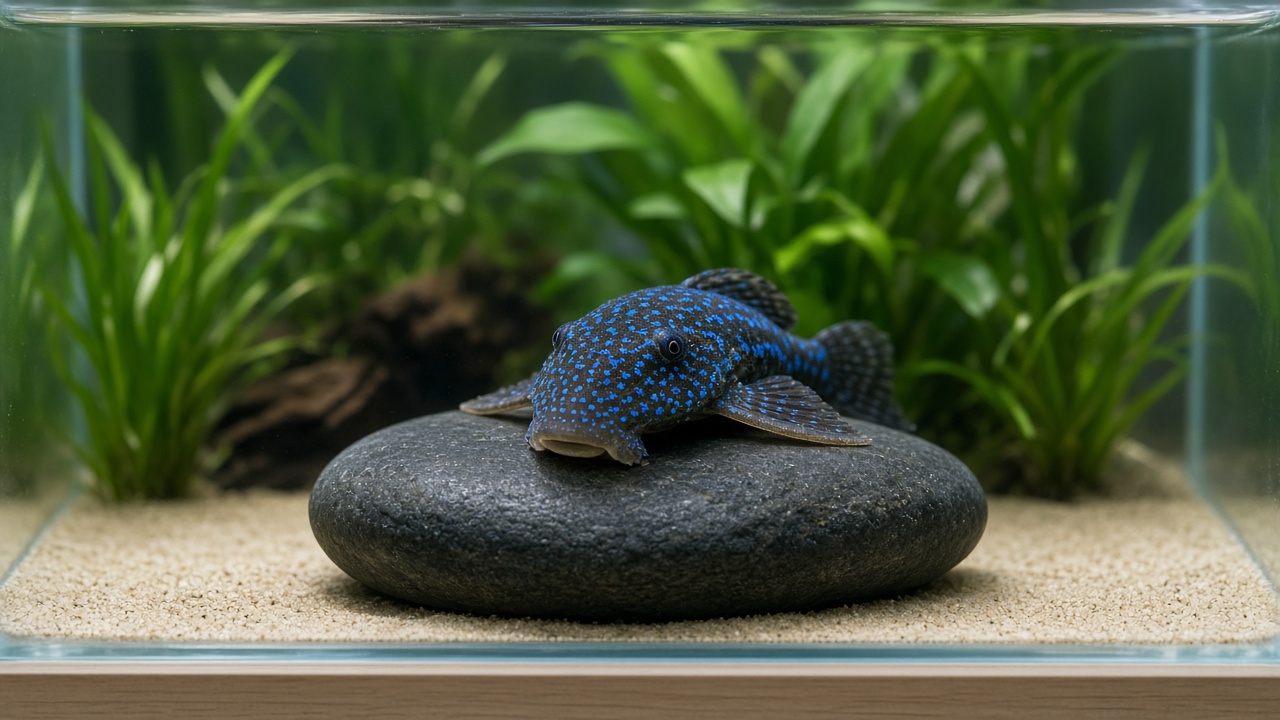
Quick answer: Keep one L128 blue phantom pleco in a long tank of 40 gallons or more. Give it current, a cave, and sinking food with both plants and protein. It is not a small algae janitor.
An adult blue phantom pleco (L128) grows to 7 inches SL and needs a 40-gallon, 48-inch tank. This page is a WaterPuppy research brief on published L128 sheets and maker labels. We did not run aquarium trials, import wild fish, or write a breeding protocol.
Selection rule: we cover one adult L128 in a tank that meets both published floors we compared. That means a 48-inch footprint from Seriously Fish and 40 gallons from Aquatic Arts. We leave out common plecos, nano tanks, breeding recipes, and any product whose maker page we did not read.
What the L128 is, and what we left out
This fish is an undescribed Orinoco suckermouth sold as L128, not a common pleco.
Shops list it as Hemiancistrus species L128, the blue phantom pleco. Seriously Fish says even that genus name is still tentative, and it places the fish in the northern Rio Orinoco drainage in Venezuela.
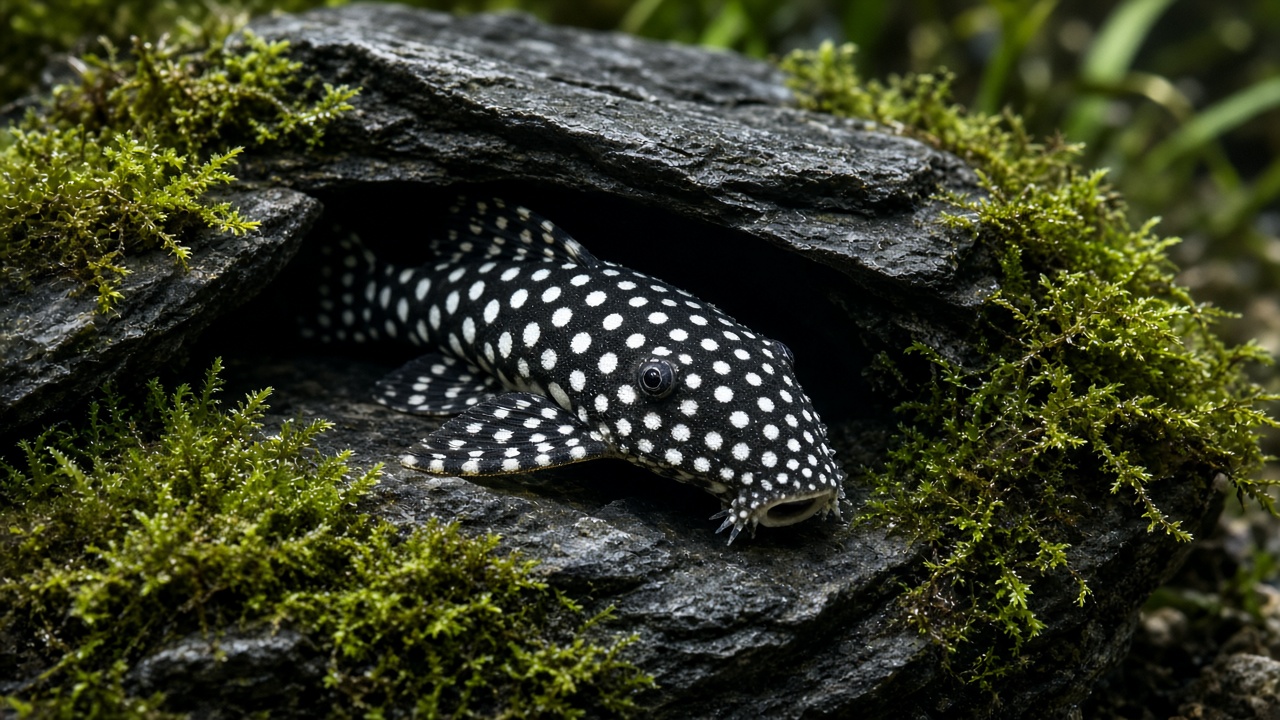
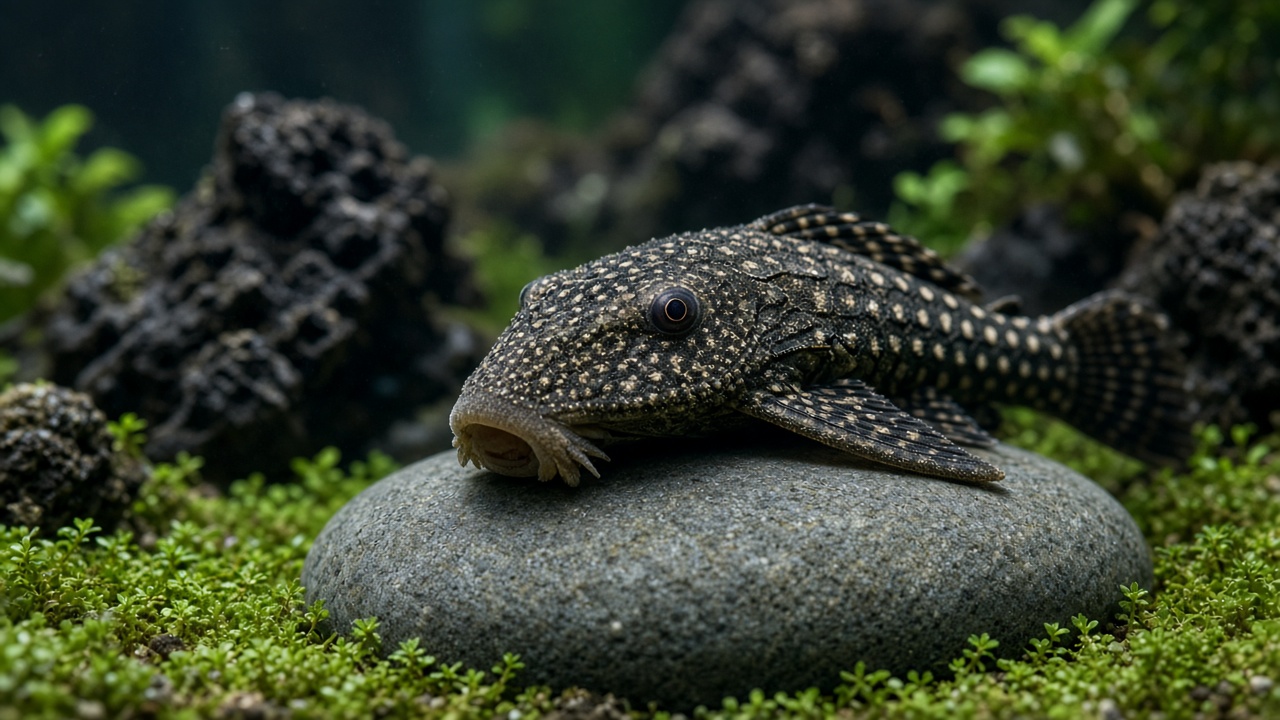
It is a spotted, blue-gray bottom fish, not the green phantom (L200). It is also not a Hypostomus “common” pleco that outgrows a living-room tank.
Our research team analyzed two public care sheets, not tank logs. We call that comparison the WaterPuppy L128 Spec Spread and use it for size, tank, and temperature ranges below.
If you want a smaller, more algae-focused suckermouth, read our bristlenose pleco care notes. That species stays shorter and fits a different tank plan.
Adult size and the tank footprint that matches it
Published adult length is 7 inches SL, and published tanks start at a 48-inch base or 40 gallons.
Seriously Fish lists standard length as 180 mm, or 7 inches SL. Standard length is body length without the tail fin.
Aquatic Arts lists average adult size as 6.0 to 7.0 inches (15.2 to 17.8 cm). Those two sheets agree on a mid-size adult, not a giant.
Aquatic Arts lists purchase sizes in two bands:
- Juvenile: 1.5 to 2.0 inches (3.8 to 5.1 cm)
- Sub-adult: 3.0 to 5.0 inches (10 to 13 cm)
Do not size the tank to the fish in the bag; size it to the 7-inch adult.
Seriously Fish sets the aquarium base at 120 × 30 cm, or 48 × 12 inches. That box is about 108 liters, or about 29 US gallons, if the tank is only 12 inches tall.
Aquatic Arts sets a different floor: 40 gallons or more for a full-grown adult. The WaterPuppy L128 Spec Spread keeps both floors, so the tank must be at least 48 inches long and at least 40 gallons.
A short 40-gallon cube fails the length rule, and a skinny 29-gallon “long” fails the volume rule. A 48-inch tank that holds 40 gallons or more meets both published numbers.
Seriously Fish describes a stream-type tank with gravel or sand, rounded stones, and current. It also says the fish is at home in a planted tank.
Give each fish its own cave or rock gap, because two L128s need two homes, not one shared tube.
Water, current, and filter math
Match warm, oxygen-rich water and a filter rated for 50 gallons or more.
The two sheets we compared do not list the same temperature band. That gap is the most useful part of the Spec Spread.
| Source | Temperature | pH | Other listed value |
|---|---|---|---|
| Seriously Fish | 72–77°F (22–25°C) | 6.0–7.0 | Hardness 2–12 dGH |
| Aquatic Arts | 77–86°F (25–30°C) | 6.0–7.0 | KH 0–30 dKH |
The overlap is 77°F, which is the only number both sheets share. Our research team analyzed those ranges and treats 77°F as the overlap, not a lab result.
Aquatic Arts also calls pH “somewhat flexible” if you avoid sudden swings, and Seriously Fish wants well-oxygenated water and some current.
Live plants can struggle in high flow, so plan rock and wood first, then add plants that tolerate moving water.
For tap water, Seachem’s page for Prime lists this dose:
- 1 capful (5 mL) per 200 L (50 US gallons) of new water
- Each cap thread is about 1 mL
- Dose every 24 to 48 hours, or use a half dose if water is above 30°C (86°F)
For filtration, Fluval’s page for the 407 Canister Filter lists:
- Aquarium capacity: 50–100 US gallons (150–500 L)
- Pump output at 120 V / 60 Hz: 383 US GPH (1450 LPH)
- Filter circulation at 120 V / 60 Hz: 245 US GPH (930 LPH)
- Wattage at 120 V / 60 Hz: 23 W
A 50-gallon or larger L128 tank sits inside that 50–100 gallon band. Point the output along the length so the fish feels current on the bottom.
What to feed, and what to skip
Treat L128 as an omnivore that needs sinking wafers plus protein, not algae alone.
Seriously Fish says wild fish graze aufwuchs and small crustaceans. In the tank it accepts sinking dry food, blanched spinach or spirulina, and frozen foods such as bloodworm or daphnia.
Aquatic Arts also calls the diet omnivorous and asks for meaty food plus vegetable matter.
Hikari’s page for Tropical Algae Wafers lists these guaranteed values:
- Crude protein min. 33.0%; crude fat min. 4.0%
- Crude fiber max. 3.0%; moisture max. 10.0%
- Vitamin A min. 8,700 IU/kg; ascorbic acid min. 190 mg/kg
Hikari sets a two-hour leftover rule for Tropical Algae Wafers. Feed late in the day and remove what remains after that window.
Repashy’s page for Super Green lists a different form and a higher protein floor:
- Crude protein min. 35%; crude fat min. 8%
- Crude fiber max. 8%; moisture max. 8%; ash max. 12%
Repashy’s mix rule is 1 part powder to 2–3 parts boiling water. The gel sets at room temperature, then keeps up to two weeks in the fridge or up to six months in the freezer.
A simple week looks like this:
- Offer one Hikari wafer after lights-out, sized so it is gone in two hours.
- Offer a small cube of Repashy Super Green two or three nights a week.
- Add a protein item (bloodworm or daphnia, as Seriously Fish lists) once or twice a week.
- Add blanched spinach on a night you skip the gel.
- Siphon uneaten food before the next lights-on.
Skip the plan that says this fish will live on glass algae. Aquatic Arts still wants frozen meaty foods with the wafer, and a bristlenose can lean harder on algae than this L128 can.
Gear we compared from maker pages
We compared four in-stock products on listed attributes, not price or rank.
The table is an attribute sheet, not a ranked list. We picked items that match the 48-and-40 rule: a sinking wafer, a gel mix, a 50–100 gallon canister, and a tap-water conditioner.
| Product | Form | Listed nutrient or output | Listed size or dose | Maker-stated use |
|---|---|---|---|---|
| Hikari Tropical Algae Wafers | Sinking disc | Protein min. 33.0%; fat min. 4.0% | Finish food in 2 hours | Plecostomus and other algae eaters |
| Repashy Super Green | Gel powder | Protein min. 35%; fat min. 8% | Mix 1 part powder to 2–3 parts water | Freshwater algae-grazing fish |
| Fluval 407 Canister Filter | External canister | Pump 383 US GPH; circulation 245 US GPH | 50–100 US gal; 23 W | Freshwater and saltwater tanks |
| Seachem Prime | Liquid conditioner | 5 mL treats 50 US gallons | Dose new water, not the whole room | Fresh and saltwater tap water |
We did not compare price or rank these four. A shorter canister or a flake food did not make the sheet, because they fail the length or sinking-food rule.
Tank mates that share the same water
Midwater community fish fit, and extra bottom-dwellers usually do not.
Seriously Fish calls L128 a decent community fish. It lists flowing-water characins such as Anostomus, Hemiodus, Semaprochilodus, and Metynnis, plus current-loving cichlids such as Retroculus.
Aquatic Arts says it can live with community fish and some semi-aggressive cichlids. That same page calls it generally solitary and somewhat territorial with other nocturnal bottom-dwellers.
Use this mate rule:
- Yes: midwater tetras or peaceful characins that like warm, moving water
- Yes: one current-tolerant cichlid if the tank is 48 inches or longer
- No: a second L128 unless each fish has its own cave and extra floor
- No: another large pleco that wants the same rock
- No: slow, long-finned fish that hate strong flow
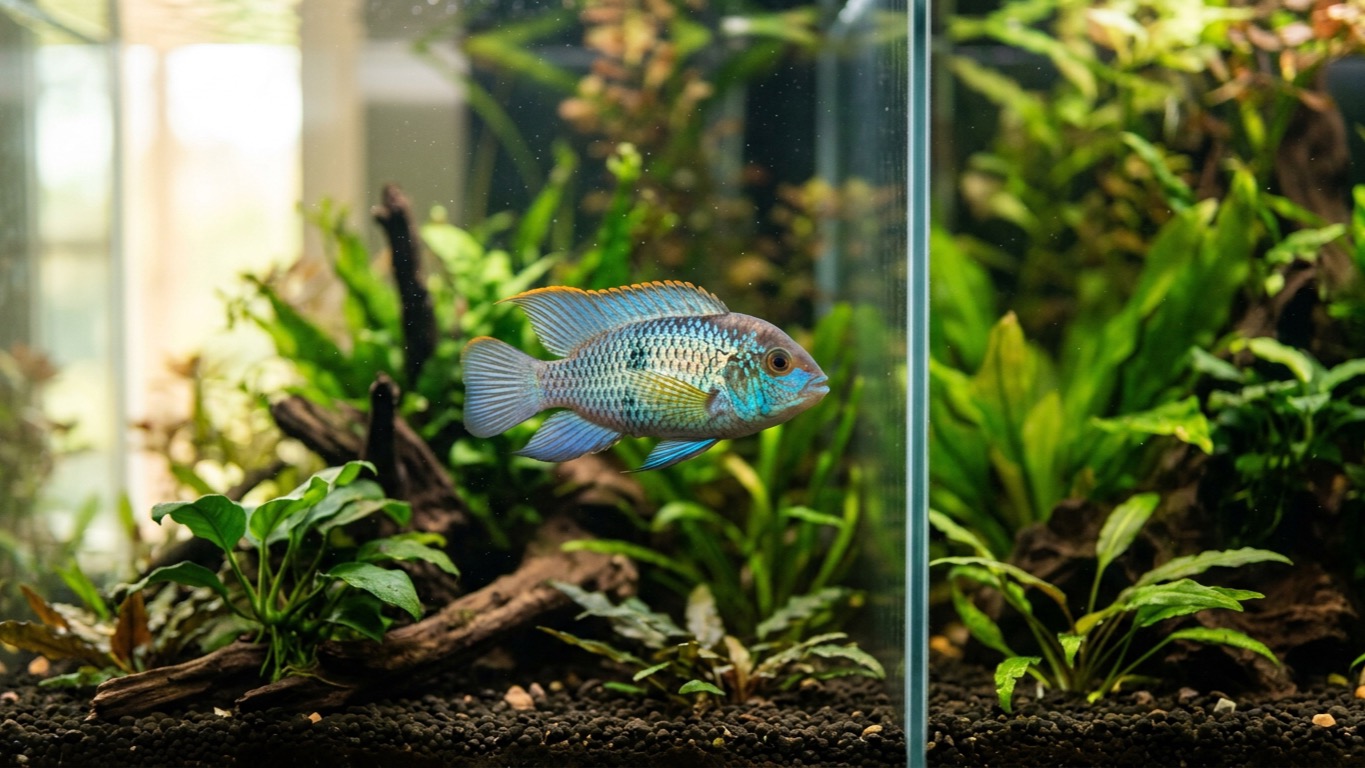
If you want a midwater cichlid that also needs a long tank, read our electric blue acara tank size guide. Match temperature overlap before you mix them, because our L128 sheets only share 77°F.
Seriously Fish says more than one L128 will bicker over refuges. Give each fish a cave it can fill, and do not stack two adults in a 40-gallon box.
Buying and first weeks
Aquatic Arts lists juveniles at 1.5 to 2.0 inches, so skip fish with sunken eyes.
Seriously Fish says new imports can be fragile and tells buyers to check for a rounded belly and eyes that are not sunken. It lists those as classic signs of a starved loricariid.
Buy-day checks:
- Belly looks rounded, not pinched
- Eyes sit level with the head, not sunk
- The L-number on the bag is L128, not a generic “blue pleco”
- You already have a 48-inch, 40-gallon-or-larger tank cycled and warmed
Aquatic Arts notes the fish may hide at first, then come out in the day once settled. Keep lights dim for the first week, and feed after dusk so the new fish finds wafers without a crowd.
Do not add a second bottom-dweller in that first month; let the L128 claim one cave first.
FAQ
How big does a blue phantom pleco get?
Seriously Fish lists 180 mm, or 7 inches SL, and Aquatic Arts lists 6.0 to 7.0 inches for an average adult. Plan hardscape and tank length for that 7-inch body, not for the 1.5- to 2.0-inch juvenile Aquatic Arts sells.
What tank size does an L128 need?
Use both published floors: Seriously Fish wants a 48 × 12 inch base, and Aquatic Arts wants 40 gallons or more for an adult. A tank that is 48 inches long and 40 gallons or larger meets both sheets.
What temperature should I keep?
The two sheets disagree, since Seriously Fish lists 72–77°F while Aquatic Arts lists 77–86°F. The only shared number is 77°F, so hold the heater near that overlap unless you have a reason to follow one sheet only.
Will a blue phantom pleco eat all my algae?
No. Seriously Fish lists an omnivore diet with sinking food, greens, and frozen prey, and Aquatic Arts also wants meaty foods with wafers. Hikari’s wafer is a staple, not a promise that glass algae will feed the fish.
Can I keep two blue phantom plecos together?
Only if each fish has its own cave and a long floor. Seriously Fish expects territorial bickering when more than one is kept. Aquatic Arts calls the fish solitary and somewhat territorial with other night-shift bottom fish.
What should I feed besides wafers?
Rotate Hikari Tropical Algae Wafers with Repashy Super Green gel. Add the frozen items Seriously Fish names, bloodworm or daphnia, and add blanched spinach on some nights. Follow Hikari’s two-hour leftover rule so waste does not sit.
Is Seachem Prime a food or a medicine?
Neither. Seachem’s page lists it as a tap-water conditioner, and the listed dose is 5 mL per 50 US gallons of new water. Use it when you add water, because it does not replace wafers, gel, or a cycled filter.