Quick answer: Siphon the slimy sheets first. Then run a maker-labeled 48-hour cyanobacteria stain treatment and the water change that bottle lists. Cut leftover food and still corners so the film does not return.
Blue-green aquarium slime is cyanobacteria; siphon the sheets, then follow a maker-labeled 48-hour stain treatment.
This page is a spec-comparison guide from our research desk.
What this guide covers, and what it skips
A product enters this page only if its maker names cyanobacteria, blue-green slime, or phosphate.
That is our selection rule, and we skip green-water algaecides, pond-only bottles, and any mix that needs a prescription.
We skip algae-eating livestock as the main fix, since no maker page below lists a fish or shrimp.
Our research team analyzed published specs and public-water pages. We kept a figure only when that named page prints it.
If the smear is hard green dots, hair strands, or cloudy green water, use our guide to other aquarium algae types instead.
How to tell cyanobacteria from true green algae
The slimy blue-green sheet in a home tank is a bacteria film, not a true alga.
The EPA’s page on harmful algae states that cyanobacteria are also known as blue-green algae. The same page says they are microscopic organisms that use sunlight to make food.
That page also says cyanobacteria and green algae blooms are often confused. Both can make dense growths, odor problems, and low oxygen.
Here is the split the EPA prints: unlike cyanobacteria, green algae are not generally known to produce toxins.
Some cyanobacteria can produce cyanotoxins, and the EPA lists Microcystis as the most common bloom-forming genus.
The same EPA page states there are more than 200 forms of microcystins. Home tanks are not swimming beaches, and
Match the look before you shop:
- Slimy sheets that peel off sand, glass, or décor point to cyanobacteria.
- A swampy or earthy smell on the mat still means you treat it as cyanobacteria.
- Hard green dots that need a scraper are true spot algae.
- Long green strings you can twist off are hair algae.
- Green water you cannot wipe away is a water-column bloom.
If a sheet lifts in one pull, you are not looking at spot algae.
What causes the slime in a home tank
Cyanobacteria win when leftover waste sits in still, lit water.
The EPA’s cyanobacteria page says blooms can form under the right light, nutrients, temperature, and salinity. It also says many species can fix nitrogen from the air.
That nitrogen-fixing note matters in a tank, because a low nitrate reading does not prove the film will starve.
The EPA also states that cyanotoxins stay inside cells until the cells die and break, though some species can release toxin without rupture.
So do not shred a thick mat and walk away. Lift it into a siphon so the cells leave the tank.
Common home-tank drivers our research team mapped to those EPA factors include leftover food and packed sand mulm. A filter outlet that never reaches one back corner creates the same still pocket.
A clogged pad, extra light after plants are done, or a new tank with unstable waste can open the same door.
Do not assume high nitrate is the only cause, because the EPA notes that some cyanobacteria can pull nitrogen from the air.
Phosphate is the nutrient you can actually bind with media. Seachem’s PhosGuard page exists for that job, not for stain removal.
Remove the sheets before you dose anything
A bottle does not replace a siphon, because dead slime still sits there and rots.
Work this list in order:
- Keep the filter running if the maker allows it, and unplug a heater only if you must lift décor.
- Siphon sheets into a bucket, and do not blast them into bits with a powerhead.
- Vacuum the sand under the mat, because that pocket holds the next start.
- Rinse mechanical pads in a bucket of tank water, not tap water.
- Add an air stone before any stain treatment that warns about oxygen.
- Dose only one labeled stain product, and do not stack bottles.
Comparing published specs, three stain products on this page all list a 48-hour window. They do not agree on the water change after that window.
Raise oxygen before you dose. Boyd’s Chemiclean page says aquarium oxygen levels must be increased with heavy aeration or a large air stone.
UltraLife’s Blue-Green Slime Stain Remover page says oxygen demand rises during treatment. It tells you to add airstones before and during the dose.
Fritz’s Slime Out page says to maintain aeration and water flow. It also says to remove chemical filtration before you dose.
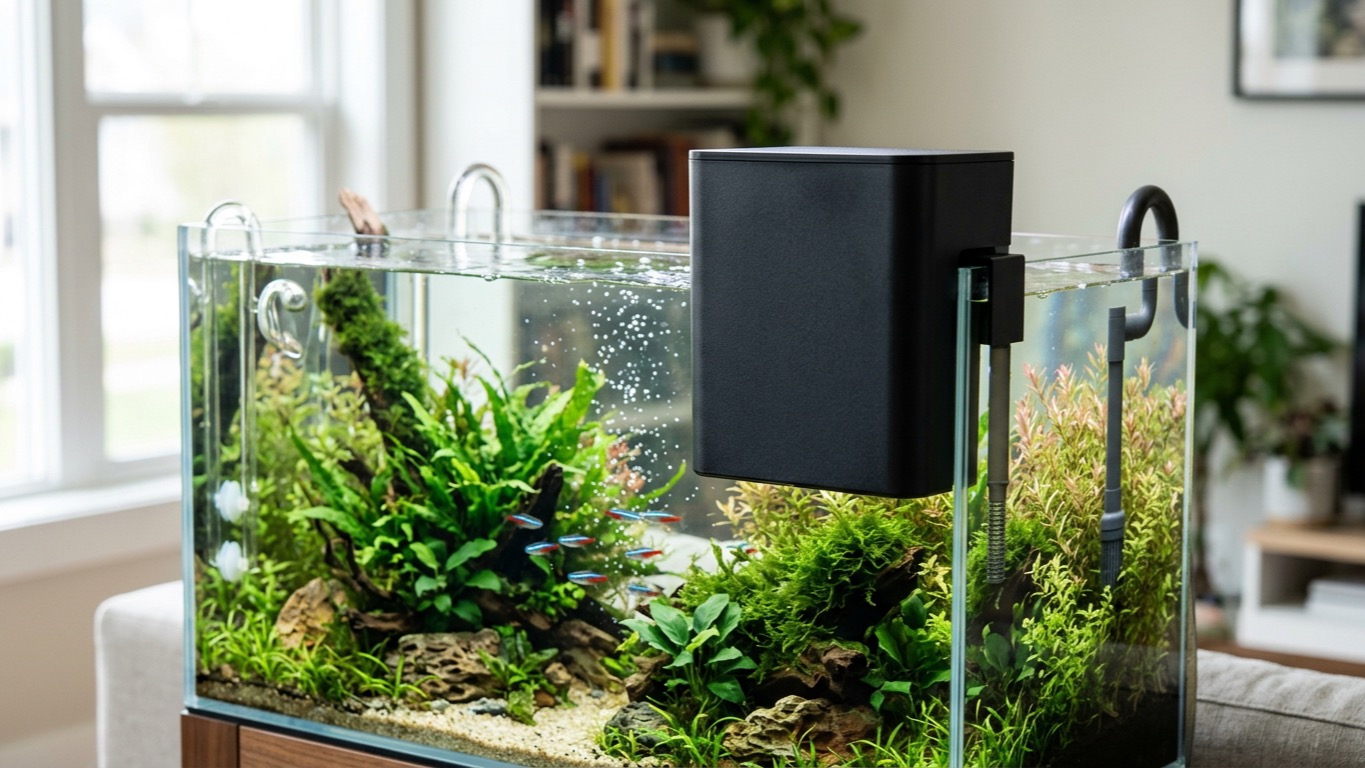
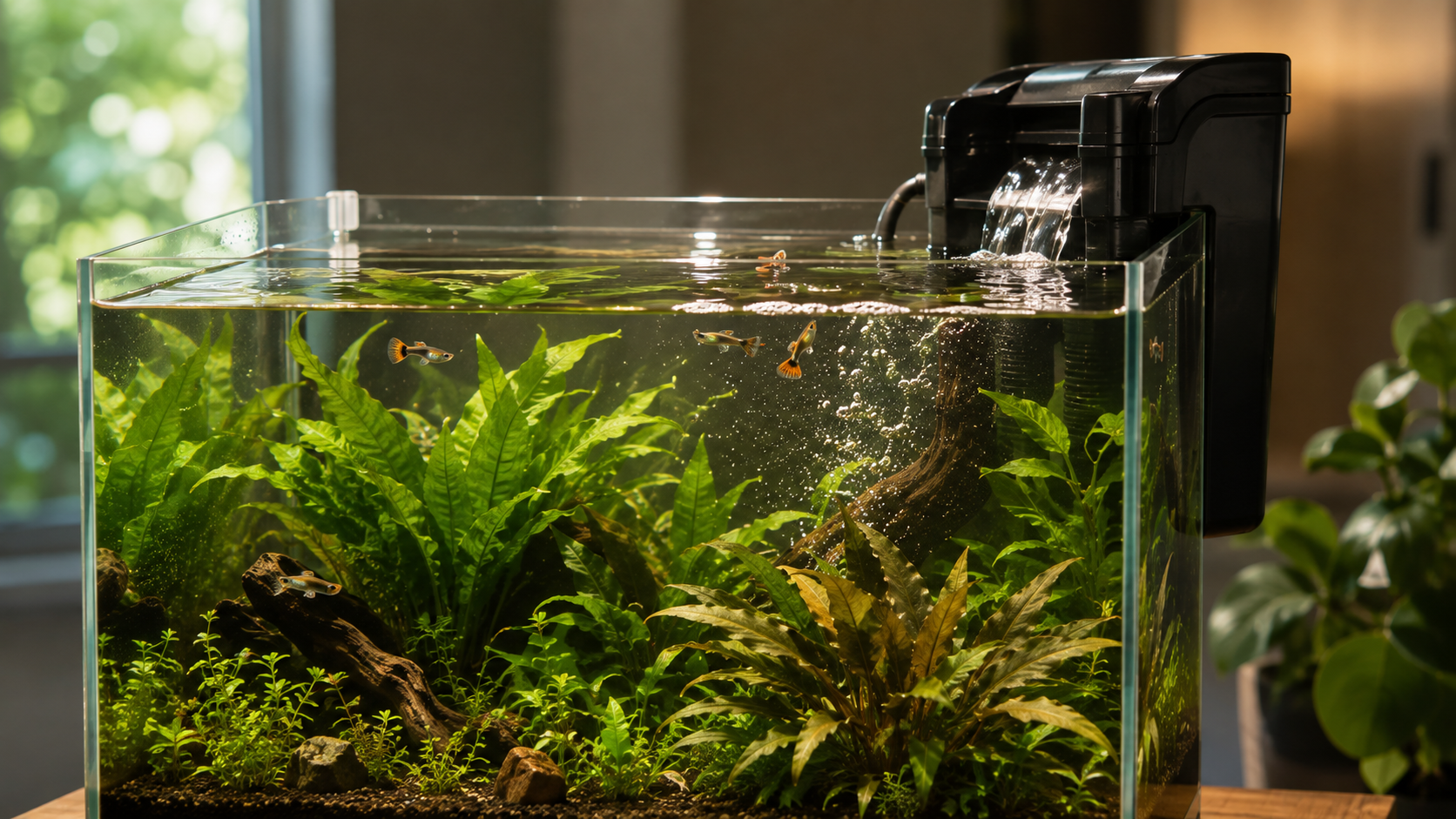
If your hang-on unit uses a carbon cartridge, pull that cartridge for the treatment window. Our Top Fin EF-S filter guide covers that small hang-on style, which can leave a still back corner if the outlet never turns.
Keep pumps moving, because still water is how the next sheet finds a home.
Stain removers and phosphate media, compared
These four products made the table because each maker page names cyanobacteria stains or phosphate.
| Product | Maker-stated job | Dose on the maker page | Follow-up step | Water type |
|---|---|---|---|---|
| Boyd Chemiclean 2 g (CC02) | Cleans stains from red, black, blue-green, and bubble cyanobacteria | 1 scoop per 10 gallons; micro spoon is 0.15 cc | 20% water change after 48 hours | Fresh and salt |
| UltraLife Blue-Green Slime Stain Remover | Removes blue-green slime stains in a freshwater aquarium | 2 level spoons per 15 gallons; spoon is 0.625 CC | Optional repeat at 48 hours; wait 1 week before more | Freshwater |
| Fritz Slime Out (10 pack) | Aids removal of stains from cyanobacteria outbreaks | 1 packet per 25 gallons (95 L) | 25% water change after 48 hours | Fresh and salt |
| Seachem PhosGuard | Removes phosphate and silicate; not a stain remover | 85 mL per 400 L (100 US gallons) freshwater | Test after 4 days; target about 0.02 mg/L | Fresh and marine |
Boyd’s Chemiclean page states the 2 g pack treats up to 300 gallons. The 6 g pack treats up to 900 gallons, and the 2 fl oz liquid treats up to 720 gallons.
The same page says treatment may take up to 48 hours, and after that window you perform a 20% water change.
Boyd also says to turn off UV sterilizers and ozonizers. Remove Chemi-pure or carbon during treatment, then put fresh media back after the change.
UltraLife’s page prints three sizes: 15 gallon, 150 gallon, and 1000 gallon. It says there is no need to change the water or the filtration system.
UltraLife also says the formula contains no algaecides or erythromycin succinate. It warns the dose may affect pH and oxygen levels.
Fritz’s Slime Out page states results within 48 hours. The 10 pack treats up to 250 gallons (946 L), and the 20 pack treats up to 500 gallons (1,893 L).
Fritz also states the powder contains no algaecides, phosphates, or erythromycin succinate. It says the dose will not negatively affect nitrifying bacteria.
Seachem’s PhosGuard page states each gram binds 0.87 mg of phosphate. Use 85 mL (1/3 cup) for every 400 L (100 US gallons) of freshwater.
For saltwater, that same Seachem page uses 85 mL for every 200 L (50 US gallons). Leave the media 4 days, then test.
Seachem prints a follow-up target around 0.02 mg/L. If the reading has not dropped that far, replace the media.
Seachem also says that once phosphate stays under 0.2 ppm, you can leave that portion in place. PhosGuard is not sold as a cyanobacteria stain remover.
Pick one stain product if sheets remain after the siphon. Use PhosGuard only when you are cutting phosphate, not as a stand-in for the siphon.
Dose on real water volume, not the gallons printed on the tank box.
Stop the film from coming back
A clean sand bed on day two means little if the same corner stays stale.
Work this list after the labeled water change:
- Point a small pump at the old dead spot.
- Feed only what fish finish in a short window.
- Keep a weekly siphon of the sand that held the mat.
- Replace packed mechanical pads before they choke flow.
- Shorten décor-only light if plants are not using the full day.
- Test phosphate if the same patch returns.
Seachem’s page is the phosphate tool on this list, not a weekly stain dose.
Do not add algae-eating fish as the plan for this film. Those species help with other growth, and they are not a cyanobacteria siphon.
If a new green smear is hair, spots, or cloudy water, switch guides. The stain bottles above are labeled for cyanobacteria sheets, not for every green mark.
A hang-on filter that only skims the front glass will leave a back wall for the next mat. Turn the outlet, or add a small powerhead, until every corner moves.
Wash your hands after you siphon, and do not pour the bucket into a sink used for food.
The EPA’s 2019 recreational page is written for lakes and beaches, not for a 20-gallon box. It still shows why this organism is not “just algae.”
That EPA page lists a swimming-advisory magnitude of 8 micrograms per liter for microcystins. The same page lists 15 micrograms per liter for cylindrospermopsin.
Those numbers are one-day swimming advisories. They are not aquarium test-kit targets, and
The EPA also defines a recreational excursion as a 10-day stretch above that magnitude. Use those lake numbers only as context, because your job in a glass tank is to lift the sheets, follow one label, and cut waste.
FAQ
Is the blue-green film in my tank true algae?
No. The EPA’s cyanobacteria page calls these organisms blue-green algae and describes them as photosynthetic bacteria. True green algae are a different group, and the EPA says green algae are not generally known to produce toxins.
Will a stain treatment work if I skip the siphon?
Not as a first step. Boyd, UltraLife, and Fritz all describe stain removal, not a substitute for lifting biomass. Siphon the sheets first so dead film does not rot in place, then run one labeled 48-hour plan.
Do I have to do a water change after 48 hours?
It depends on the bottle. Boyd’s Chemiclean page requires a 20% change after 48 hours, and Fritz’s Slime Out page requires a 25% change after 48 hours. UltraLife’s page says no water change is needed, with an optional repeat at 48 hours.
Can algae-eating fish clear cyanobacteria?
Do not count on them. None of the maker pages in this comparison list a fish or shrimp as the removal method. Use a siphon and a labeled stain product, and save grazers for other algae types.
Why does the slime return on the same sand?
The sand still holds waste, and that corner is still slow. The EPA lists nutrients and light among bloom conditions. Vacuum that patch, move water through it, and cut leftover food.
Is lake-toxin guidance the same as a tank test?
No. The EPA’s 2019 recreational page sets swimming-advisory magnitudes at 8 micrograms per liter for microcystins and 15 micrograms per liter for cylindrospermopsin. Those values protect people in recreational water, and they are not a home-aquarium test target.
Can I use phosphate remover instead of a stain product?
Only for the nutrient side. Seachem’s PhosGuard page binds 0.87 mg of phosphate per gram and tells you to test after 4 days. It does not claim to lift blue-green sheets, so siphon first and then decide if phosphate media is the follow-up.