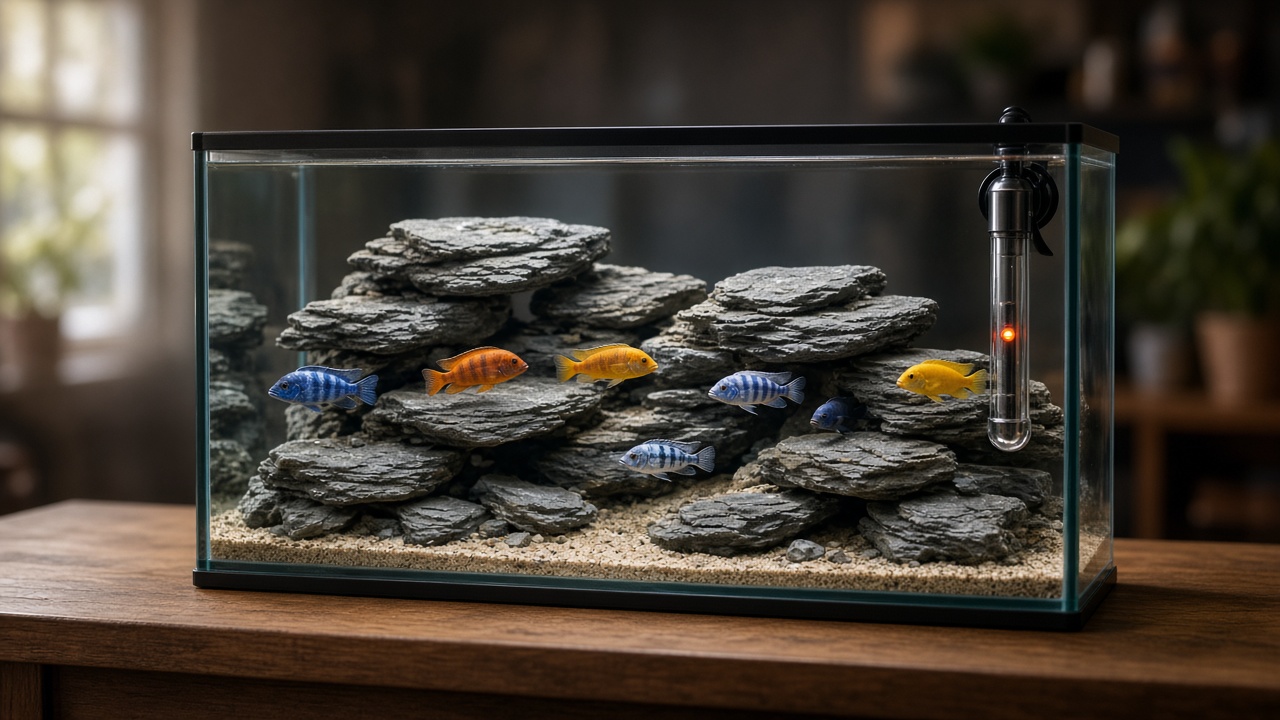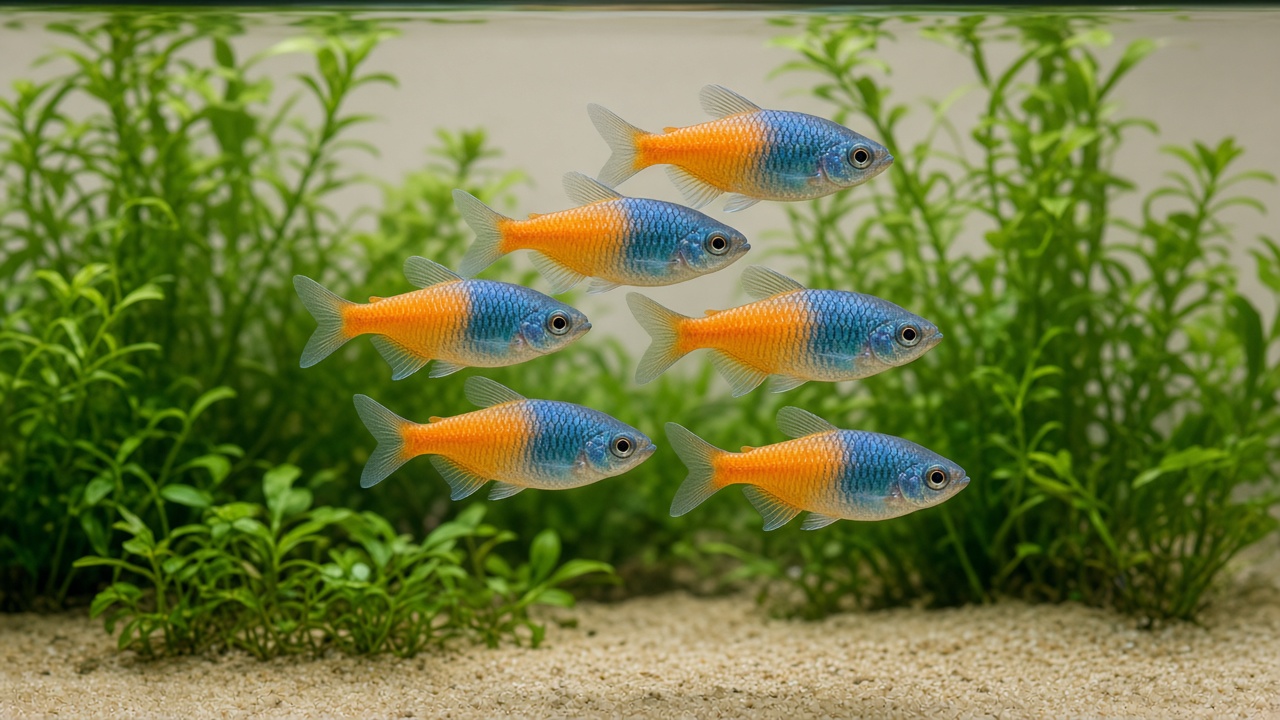
Quick answer: Keep a school of at least six Boesemani rainbows in a long, 48-inch tank. Buy pale juveniles and wait more than 12 months for the blue-and-orange split. Match hard, alkaline water, not a soft tetra tank.
A Boesemani rainbow school of six needs a tank at least 48 inches long.
This page is a research-desk comparison of FishBase, Seriously Fish, and four current product labels. We did not keep a display school, run water tests, or hatch eggs for this article.
Our selection rule is narrow: we cover a farmed school of six or more in a long, hard-water tank.
We include only daily flakes with a published protein figure, plus one conditioner and one test kit. Those two support products made the list because their maker pages print a dose or a parameter list.
We leave out nano tanks, wild-collection steps, and breeding-for-sale. We also skip heaters, filters, and foods with no protein number.
What the species records actually say
FishBase and Seriously Fish disagree on a few numbers, and that gap is the point of this page.
FishBase names the fish Melanotaenia boesemani, described by Allen and Cross in 1980. It lives only in the Ajamaru Lakes region on Indonesia’s Vogelkop Peninsula, and it also lists Aitinjo Lake 20 km to the southeast.
FishBase lists these adult sizes:
- Males: 9.0 cm standard length
- Females: 7.0 cm standard length
Seriously Fish lists 110 mm standard length, which is 11.0 cm. That figure is longer than the FishBase male record.
Our research team analyzed both pages and uses the FishBase pair for sexed size. We use the Seriously Fish length when we talk about tank base.
FishBase records the IUCN Red List status as Endangered, criteria B1ab(iii,v). The assessment date on that FishBase record is 4 December 2019.
Farmed fish in shops are not a wild stock. That date still belongs here because the trade once hit the lakes hard.
Seriously Fish notes that almost all shop fish come from farms in the Far East and Eastern Europe. It also states that wild collection once reached an estimated one million fish a year.
Tank size: length first
A Boesemani rainbow is an open-water cruiser, so tank length matters more than height.
FishBase lists a minimum aquarium size of 80 cm and groups of 5 or more. Seriously Fish lists a tank base of 120 × 30 cm, about 48 × 12 inches.
It also lists a volume of about 108 liters, or about 29 US gallons, for a 120 × 30 × 30 cm box.
Those two floors are not the same, because 80 cm is 31.5 inches and 120 cm is 48 inches.
We use the longer Seriously Fish base as the keep rule for a school of six. The FishBase 80 cm line is the shortest published figure we found, not the size we would buy.
Seriously Fish’s 29-gallon volume is the math for that bare box. A furnished school of six adults needs more water than 29 gallons, so keep the 48-inch length and then add width and height.
A first fish tank setup should finish cycling before any rainbows go in. A long, open midwater lane is the layout that matches this species.
Plant the back and ends, and leave the front length clear. Use a tight lid, because rainbows jump when startled.
Water chemistry from the two species pages
Both species pages want warm, hard, alkaline water, not a cardinal-tetra profile.
FishBase lists:
- pH: 7.0 to 8.0
- Hardness: 9 to 19 dH
- Temperature: 27 to 30°C
Seriously Fish lists:
- pH: 7.0 to 8.0
- Hardness: 10 to 20 dGH
- Temperature: 27 to 30°C, printed as 81 to 86°F
Seriously Fish also describes the wild lakes as pH 8.0 to 9.0. It says nearby tributaries can run pH 6.0 to 6.5.
The tank band both pages print is 7.0 to 8.0. Do not chase lake pH 9.0 in a glass box.
Many shop cards print a cooler range, and we do not follow those cards. We follow the 81 to 86°F band both records share.
The API Freshwater Master Test Kit page lists tests for ammonia, pH, high-range pH, nitrite, and nitrate. It includes four test tubes and a color card.
Use that kit to stay inside the published pH band. Ammonia and nitrite should read zero after the cycle.
Seachem’s page for Prime states a standard dose of 1 capful, 5 mL, for each 200 L of new water. That volume is 50 US gallons, and each cap thread is about 1 mL.
Dose the new water, and do not guess from the full tank unless you pour the conditioner straight in.
Seachem also states these extra rules:
- A double dose is allowed for high chloramine
- Up to 5 times the normal dose may be used to bind nitrite in an emergency
- Use a half dose if temperature is above 30°C, or 86°F, and chlorine or ammonia is low
- The product can be dosed every 24 to 48 hours
Weekly work follows the same how to clean a fish tank pattern used for other community tanks. Siphon waste, replace a slice of water, and dose conditioner to the new water at 5 mL per 50 gallons.
Do not strip every surface, because the bacteria that finish the cycle live in the filter and on hard surfaces.
Color: the 12-month wait
Shop Boesemani rainbows are usually drab, and that is normal.
Seriously Fish says adult fish are rarely offered, so the juveniles in dealer tanks look plain. Full color can take more than 12 months, even on a good diet.
Males turn into the split fish people search for. The front half goes blue or purple, and the rear goes yellow to orange.
Seriously Fish says mature males are larger and brighter than females. Males also grow a deeper body, while females stay slimmer and paler.
A dealer tank of two-inch fish will not show that split yet. Color tracks age, diet, group size, and stable hard water.
A single male in a 20-gallon cube will stay washed out. That is a husbandry miss, not a “bad strain.”
Omega One’s page for Super Color Flakes lists a minimum of 42% crude protein and 12% crude fat. Tetra’s page for TetraMin Flakes lists 46% crude protein and 11% crude fat.
Both are daily ornamental flakes, not a miracle dye. Feed a small amount two or three times a day, and remove leftover flakes after a few minutes.
Extra food does not speed the 12-month clock, and it does raise nitrite risk.
Schooling and who can share the tank
This species looks and acts right only in a group.
FishBase says keep them in groups of 5 or more. Seriously Fish says they do far better in a shoal of at least 6 to 8, preferably more.
Males show better color when other Boesemani rainbows are present.
We use six as the floor because it meets both pages. Eight is better if the 48-inch tank still has open water after plants.
A good starting mix is more females than males, because that spreads male display. Two males and one female in a short tank is the pattern that causes chasing.
Seriously Fish calls them very peaceful, but it also warns they can bother smaller or slow fish with speed and size.
It lists these tankmate types:
- Other similarly sized rainbowfish
- Characins
- Danios
- Barbs
- Catfish such as Corydoras
- Many Rift Lake cichlids, because the water is hard and alkaline
Skip tiny, timid tetras that want soft, acidic water. Skip long-finned slow fish that get nipped in the midwater lane.
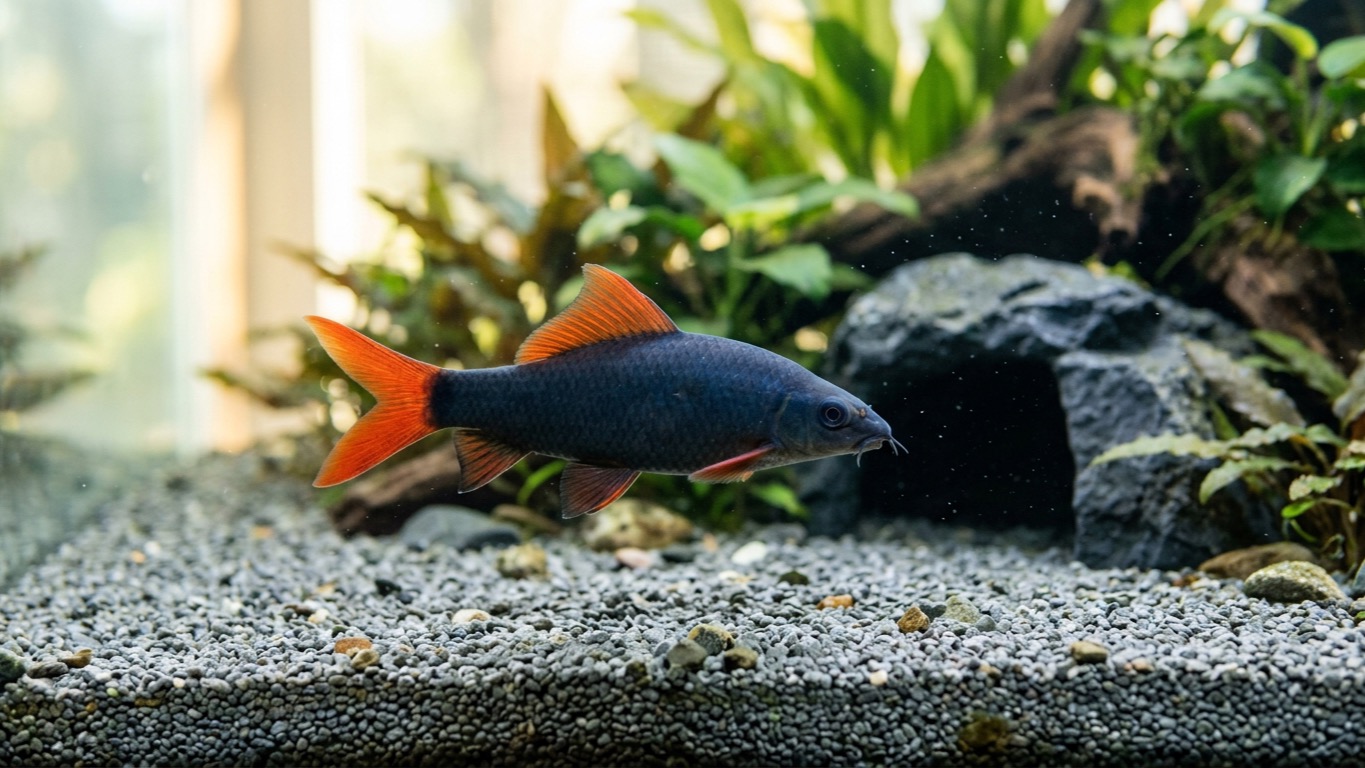
A rainbow shark is a different fish. It is a bottom-dwelling cyprinid, not a rainbowfish, and it also needs a long tank plus a plan for territorial stress.
Do not treat the two as one “rainbow” stocking rule.
Daily foods and the two support products we compared
Adult Boesemani rainbows eat flakes, pellets, and frozen foods, and we compared labels, not tanks.
Seriously Fish calls the species unfussy and says most dried, frozen, and live foods are accepted. It also says regular live or frozen feedings help color.
Our product rule stays the same here, so we list two current flakes with a published protein figure.
We add Seachem Prime and the API Freshwater Master Test Kit because water work is part of feeding success. We skip cichlid sticks, betta-only pellets, and any food with no protein number on the maker page.
| Product | Type | Maker-listed nutrient or dose | Other listed spec |
|---|---|---|---|
| Omega One Super Color Flakes | Flake food | Crude protein min. 42%; crude fat min. 12% | Crude fiber max. 2%; moisture max. 8.5%; ash max. 8% |
| TetraMin Flakes | Flake food | Crude protein 46%; crude fat 11% | Crude fibre 2%; moisture 7%; vitamin D3 1848 IU/kg |
| Seachem Prime | Water conditioner | 5 mL per 50 US gallons of new water | Cap thread about 1 mL; emergency dose up to 5× |
| API Freshwater Master Test Kit | Liquid test kit | Tests ammonia, pH, high-range pH, nitrite, nitrate | Four test tubes and a laminated color card |
A simple week looks like this:
- Feed a pinch of TetraMin Flakes or Omega One Super Color Flakes two or three times a day.
- Add one frozen feeding, such as brine shrimp or daphnia, a few days a week.
- Test pH and nitrogen with the API kit once a week.
- Change a portion of water and dose Seachem Prime at 5 mL per 50 gallons of new water.
These four labels are aquarium products. We compared the numbers on those pages only.
Seriously Fish says this species is an egg scatterer, and the fry are the hard part. It lists a breeding tank of at least 30 inches and pH about 7.5.
It also lists 26.5 to 29°C, printed as 80 to 84°F. Eggs hatch in 7 to 12 days, depending on temperature.
Fry need infusoria-type food first, then baby brine shrimp after about a week. This article does not walk through a breeding room.
FAQ
How big do Boesemani rainbows get?
FishBase lists 9.0 cm standard length for males and 7.0 cm for females. Seriously Fish lists 110 mm standard length.
Plan for a fish about 3.5 to 4.3 inches long in the body, plus fins. That size is why a 10-gallon tank fails.
How many Boesemani rainbows should I keep?
FishBase says groups of 5 or more. Seriously Fish says at least 6 to 8, preferably more.
Our keep rule is six in a 48-inch tank. Add fish only if the midwater lane stays open.
Why is my Boesemani rainbow still gray?
Seriously Fish says juveniles are the fish shops sell, and full color can take more than 12 months.
Check group size, tank length, and the 81 to 86°F band before you blame the bag of food. One pale fish in a short tank is doing what the pages predict.
What temperature do Boesemani rainbows need?
FishBase and Seriously Fish both list 27 to 30°C. Seriously Fish prints that as 81 to 86°F.
Hold the heater in that band, because a swing of several degrees in one day is worse than sitting at 82°F all week.
Can Boesemani rainbows live with small tetras?
Only if the tetras are large enough and want the same hard, alkaline water. Seriously Fish warns that fast, mid-sized rainbows can disturb small or slow fish.
Soft-water neon tetras are a poor match. Similar-sized rainbowfish, danios, barbs, and Corydoras fit the published list better.
Are Boesemani rainbows endangered?
FishBase records the IUCN Red List status as Endangered, assessed 4 December 2019. That applies to wild lakes, not to farmed shop fish.
Buy farmed stock, and do not treat a home tank as a rescue of the Ajamaru population.
How long do the eggs take to hatch?
Seriously Fish says 7 to 12 days, depending on temperature. Fry stay near the surface and need tiny foods first.
Sinking adult flakes are the wrong first food.